
Tenby is a quiet seaside town in Wales, land of bards. It was here that, as a child, the artist Gwen John (1876-1939) combed the beaches looking for seashells to paint.
Gwen’s mother died when Gwen was only eight. The absence of a parent always has consequences on a child. Unfortunately, sometimes those consequences only seem to grow.
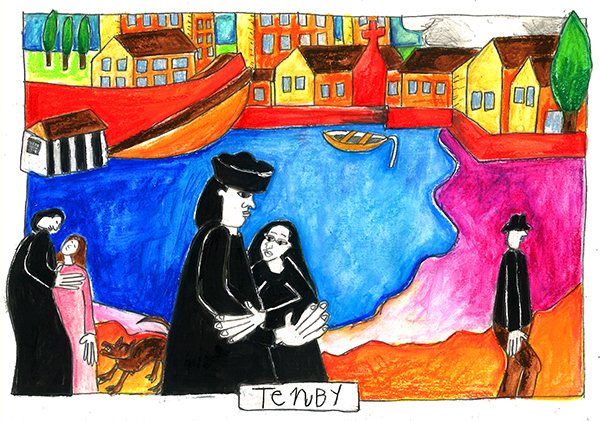
Both Gwen and her younger brother, Augustus, wanted to become artists. So when Gwen was 19, the siblings travelled together to London to attend the Slade School of Art, the only art school that admitted women. Once there, Gwen, already shy by nature, became better known as her brother’s sister than as an artist in her own right.
Augustus was a good draftsman, charming, and a major womanizer. Within a few years, he became a well-known society painter. Gwen and one of her brother’s friends, Ambrose McEvoy, began an intimate relationship. Gwen was head over heels whereas Ambrose was just a heel. With no warning, he dumped Gwen and then married an older unattractive woman. Gwen was crushed.
In 1903 Gwen and a friend decided to walk to Rome. They sailed from Liverpool to Bordeaux where they began walking. They walked carrying their art equipment, slept in fields, and tried exchanging sketches for food. However, once they had arrived in Toulouse, the thrill of On the Road was way gone and they headed towards Paris. It was 1904 and Gwen had begun modeling to maintain herself. Her brother Augustus suggested that she seek employment as a model for Rodin, the most well-known artist at the time. Rodin preferred British and American models. He quite liked Gwen’s physical presence and decided to use her as a model for his monument to Whistler (with whom Gwen had studied for a short time). But the statue was never finished.

Despite the 35 year age difference, Gwen and Rodin became lovers. Rodin was a serial seducer with years of experience. Gwen was inexperienced and needy. She began writing him obsessively sending him up to three letters a day for the next ten years. Gwen was in love but Rodin was not. Eventually he tried keeping her at a distance.
Gwen had now been dumped by the only two men she had ever loved. Like Dora Maar after Picasso, Gwen sought solace in Catholicism. So Rodin was replaced by God and Gwen’s only desire was to become “God’s little artist.”
Gwen practiced extreme frugality. Frugality, a form of restraint, is necessary when you don’t have much money to survive on. But frugality is often considered a form of spiritual discipline. Catholics believe in forms of self-denial such as fasting, penances, and giving your money to the church instead of using it for some personal pleasure. Deprivation is, for many, a religious experience.
The external world had been too aggressive for her. It was best, she thought, to focus even more on her interior self. So for the rest of her life she lived in Meudon alone with her cats (Camille Claudel style). Gwen John died of starvation on a street in Dieppe in 1939.
There is much mythology about Gwen’s reclusiveness. Although she never completely retired from life, solitude was the essence of her being. She even saw solitude as a form of self-preservation. In 1912 Gwen began a notebook entitled “Rules to keep the world away”.
“I don’t pretend to know anybody well. People are like shadows to me and I am like a shadow” she wrote.
The desire for solitude radically affected her art. She preferred painting women all alone. Some of her models commented that Gwen often pulled their hair back maybe to look a bit more like Gwen herself.

Gwen John, Self-Portrait (1902) Source

Gwen John, The Student (c. 1903) SOURCE

Gwen John, The Artist in her Room (c. 1907) SOURCE
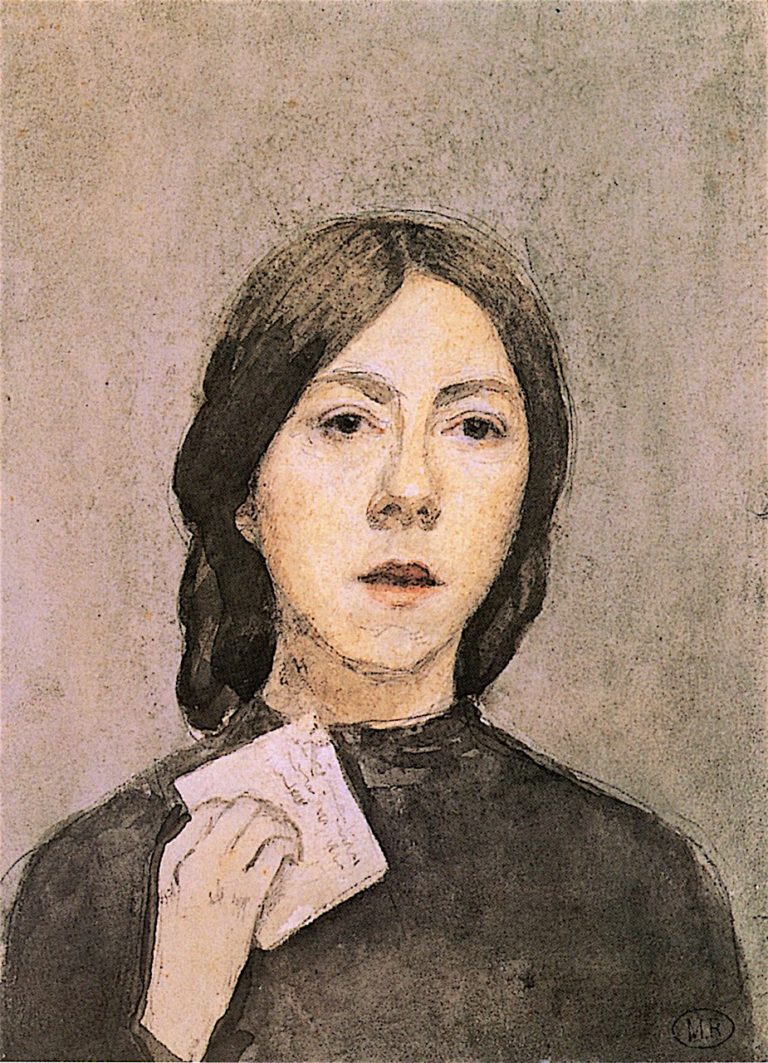
Gwen John, Self-Portrait with Letter (1907) SOURCE
There are currently more than one thoushand letters by Gwen to Rodin in the archives of the Rodin Museum in Paris.
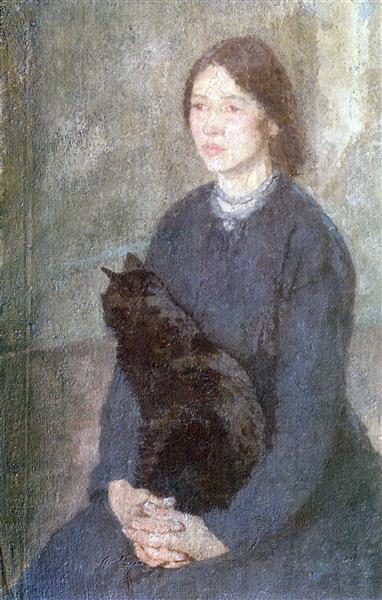
Gwen John, Young Woman Holding a Black Cat (c. 1920) SOURCE
Gwen was a cat lover .

Related:
Camille Claudel and Touch +
Gwen John + THE PORTRAITURE OF GWEN JOHN + Gwen John: student and master + A Muse For Rodin, The Welsh Painter Gwen John + Did Auguste Rodin Steal From Camille Claudel? +
Gwen John | Motifs
Bibliography:
Taubman, Mary. Gwen John. James Price Publishing. London. 1985. (available of archive HERE)
Chitty, Susan, Lady. Gwen John, 1876-1939. F. Watts. NYC. 1987. (available on archive HERE)


 The Narrative Within
Pingback: smile power | The Narrative Within