Life is about interrelating and how we interrelate determines the quality of our daily life.
Sometimes the presence of a force outside of us provokes not only a psychological response but a physiological one as well.
Imagine living like a plant fighting for nourishment and sunlight every day.
Plants are stuck in place. So, to survive, they must adapt. Like trees, for example. When and where a tree shoot grows will determine the basic form it will grow into.
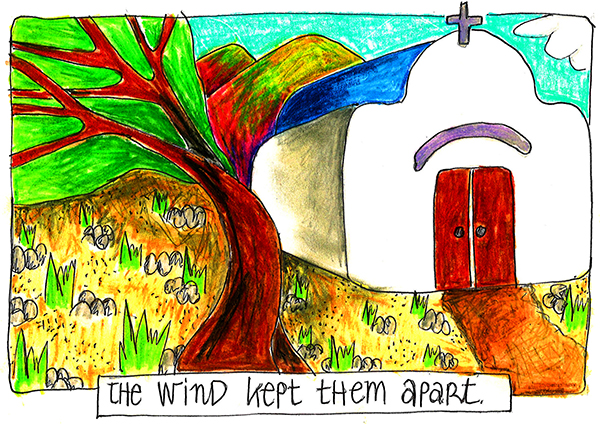
The interplay between physiological and external forces can easily be seen in trees sculpted by the wind. As the tree grows, it is continually moved by the wind.

Whatever you do continually becomes you. A tree that’s bent regularly by, for example, the sirocco wind blowing northwest from the Sahara, will grow bent towards the north.
In 1977, when the Woman’s Movement was full of energy, art critic Linda Nochlin published an essay “Why Have There Been No Great Women Artists?” The answer is simple. There have been no “great” women artists because we live in a patriarchal society.
Linda refers to John Stuart Mill who wrote that we tend to accept whatever is as natural. And since women have always lived in a world dominated by white male subjectivity, we see this as natural. But, continues Mill, male domination is just one more social injustice to eradicate if a true and just social order is to be created.
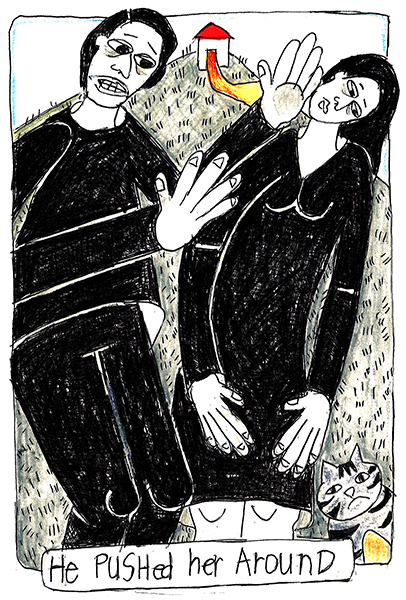
Men have failed society. There have been no “great” female artists because women have been excluded from the possibility of becoming great. Not only were women kept out of the academies, they were and continue to be restricted socially and economically as well.
Women have also been accused by men of being “incapable of greatness”. But what is “greatness”? What’s great for you is not necessarily great for me.
Aesthetic canons have been created by the boys who focus on their own capabilities to determine what the standards for others are.
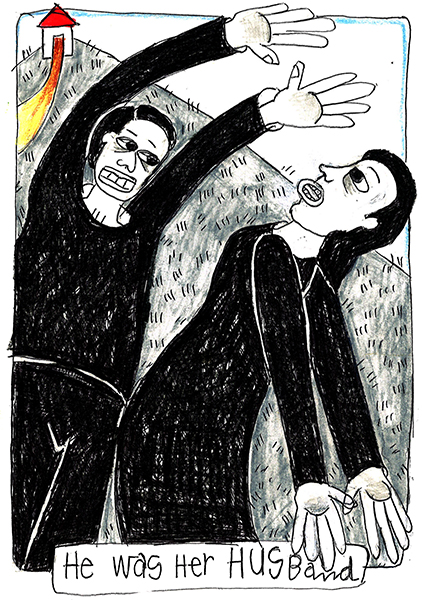
Women are “potentially” great, but our potential is restricted by our condition of possibility. A condition of possibility, says Immanuel Kant, is a necessary framework for the possible appearance of a given list of entities. Easy example: if I am tall, I have more of a chance of playing on a basketball team than does someone who is short. And another example: if my dad has a bunch of money, I have a better chance of getting a good education than does someone without funds. And the better the education, the better chance of getting a good job.
The 19th Amendment gave American women the right to vote in 1920. However, that was for white women. Many minorities were unable to vote until President Lyndon Johnson signed the Voting Rights Act into law in 1965.

A patriarchal society deprives women of their potential. A patriarchal society deprives itself of its own potential, too. Because men’s and women’s roles were meant to be complementary not competitive. To deprive a woman of her potential is to create a society that limps because it has created one leg longer than the other.
When Michele Obama spoke recently at the Democratic convention, she said that most people “will never benefit from the affirmative action of generational wealth.” In other words, the condition of possiblity favors the wealthy.
So ladies, it’s time to harness the wind.

-30-
(“Women and Condition of Possibility” ⓒ 2024)
Related:
Bent into shape: The rules of tree form + 9 Treescapes Dramatically Shaped by Wind + Krummholz, crooked wood +
John Stuart Mill (1806-1873) + The Subjection of Women by John Stuart Mill + Condition of Possibility + When Did Women Get the Right to Vote? A Look Back at U.S. History +
Read Linda Nochlin’s “Why Have There Been No Great Women Artists?” HERE + The great women artists that history forgot + Why Have There Been No Great Women Artists? wikipedia +
The UN’s FAQs: Types of violence against women and girls (VAW)+


 The Narrative Within
wow!! 55Kàmala Kool