
Just because a man needs you doesn’t mean that he loves you.
Ariadne was the daughter of the Cretan king, Minos. Like most men of wealth and power, Minos was greedy. When sent a beautiful white bull from the sea meant to be sacrificed for Poseidon, Minos decided to keep the bull for himself. Poseidon was not pleased, and, like most gods, he was vindicative. To punish Minos, Poseidon had Pasiphae, Minos’ wife, fall in love and mate with the bull. This strange affair produced an offspring that was half man and half bull later known as the Minotaur. The Minotaur’s real name was Asterius and he was a cannibal.

As punishment for killing his son, Minos had forced the people of Athens to send him sacrificial victims for the Minotaur. Theseus had been sent to Crete as one of the potential sacrifices. But everything changed when, before being sent into the labyrinth, Theseus met and wooed the young and naïve Ariadne. Illiterate in love, she immediately fell for Theseus and decided to help him escape the Minotaur even if it meant putting her own life in danger. Ariadne gave Theseus a ball of yarn that, once tied to the entrance, was released little by little as Theseus walked. Like Hansel and Gretal who’d left pebbles to mark their way, it provided a means for Theseus to find his way out of the labyrinth once the minotaur was slain.
After they were safely out of the labyrinth, Theseus and Ariadne escaped towards Naxos. But once there Theseus dumped Ariadne and sailed for Athens without her.
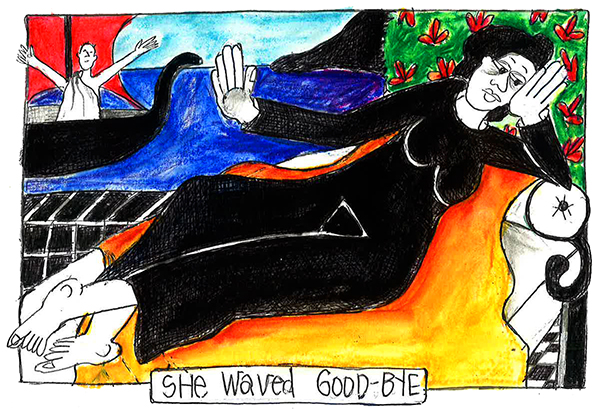
Ovid’s Metamorphoses
Ovid was born 80 miles east of Rome in 43 BC. His father had sent him to Rome to learn rhetoric so Ovid could become a lawyer. Too bad for his dad that Ovid wanted, instead, to become a poet. Maybe it had something to do with his hormones. By the time he was thirty, Ovid had already been married three times. He had sex on the brain and primarily wrote erotic poems in elegiac meter. His “Ars Amatoria” (The Art of Love) gave instructions on love and seduction making him a very popular poet. But after all the Cleopatra scandals, Emperor Augustus wanted to push moral and social reform. Ovid’s erotic poetry was not compatible with the emperor’s new moralism. Augustus took offense at Ovid’s lecherous writings and ordered that his books be burned and that Ovid be exiled (note that this is Augustus of the Ara Pacis who was supposed to be such a fair guy). Ovid was sent to a small town in what’s now modern-day Romania.
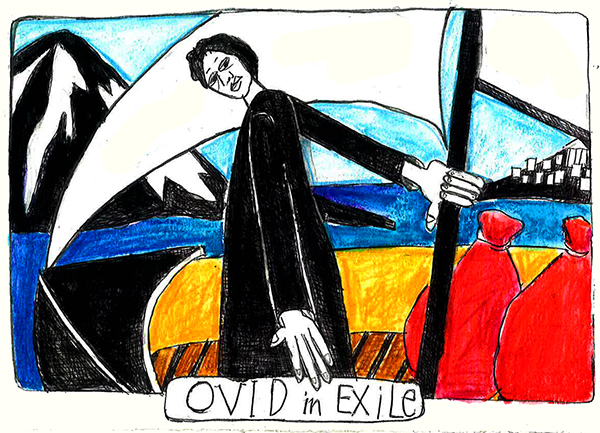
Despite all his pleas, Ovid was never allowed to return to Rome and, instead, forced to died far away from home.
While banished on the shores of the Black Sea, Ovid completed his finest work, Metamorphosis, an epic poem that chronicles the world from creation to the death of Julius Cesear.
The theme of Metamorphoses is revealed in the title. Metamorphoses is a book about transformation. It’s a book that explores the concept of change. If you don’t like something, just change it. This includes yourself. But be careful because your transformation will affect others.
Some transformations that happened in Metamorphoses:
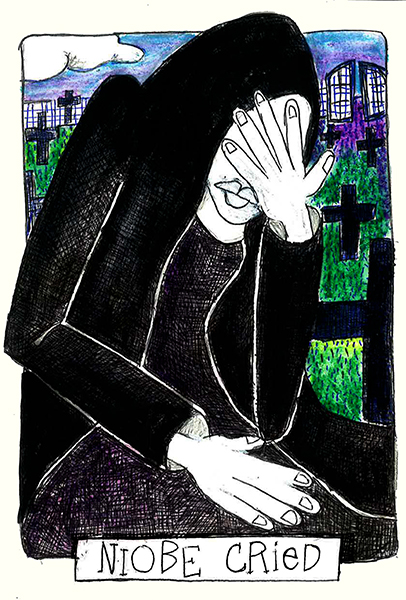
Niobe was insecure. This made her brag a lot and minimize others. At the celebration in honor of Leto, Niobe bragged that, unlike Leto who only had two kids, she had 14. Apollo and Artemis, Leto’s two kids, did not take kindly to their mom being dissed in public. To defend her honor, Artemis murdered Niobe’s daughters and Apollo murdered Niobe’s sons. Overwhelmed by the death of her children, Niobe fled to Mt. Sipylus where she was turned into stone (as described by Pausanias).
Because Niobe is remembered for the tragic loss of her children and for having been transformed into stone, representations of her are often used as tombstones for children’s grave such as these at Rome’s Verano Monumental Cemetery.
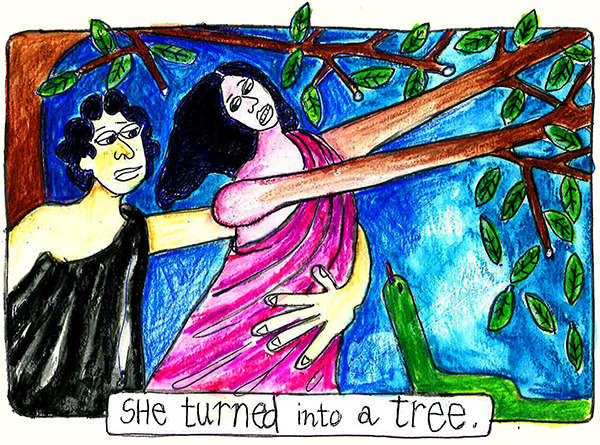
Daphne was a very beautiful nymph. Unfortunately, Apollo, with the help of Cupid’s arrow, had the hots for her. Daphne ran and called out to her dad, the river god Peneus, for help. Her dad turned Daphne into a laurel tree but that didn’t stop Apollo’s passion. He stroked her limbs and picked her leaves and declared that he would wear them in his hair. And from then on laurel crowns would be worn on the heads of the royal and the victorious. (Even now, in Italy, graduating university students wear wreaths of laurel on their heads).
“Daphne” in Greek means “laurel”.
The most impressive interpretation of Daphne’s escape is that by Bernini at Villa Borghese.
Galatea was a statue created by Pygmalion. Pygmalion, sculptor and king, was such a misogynist that he’d promised himself a life of celibacy. To keep from thinking about sex, he’d stay awake at night sculpting stone. Since no perfect woman existed, he decided to create one for himself. Pygmalion worked day and night on the statue and fell in love with it once it was finished. He named it Galatea meaning “she who is milk white” then hungrily kissed her mouth and caressed her breasts. Of course, having been made from stone, Galatea was cold and could not return his effusions.
Aphrodite’s feast was approaching. Pygmalion went to her temple and begged the goddess to turn his statue into a real woman. Impressed by his begging and the beauty of the statue, Aphrodite consented. When Pygmalion returned home, Galatea ran to kiss him on the mouth. A short time later, the ex-statue and her creator were married.
George Bernard Shaw liked this story so much that he reimagined it and wrote Pygmalion (which was later reimagined for the film My Fair Lady which was later reimagined for Pretty Woman).
Transformations can be physical but psychological as well.
“The difference between a flower girl and a lady is not the way she behaves but the way she is treated.” Eliza Doolittle

Ovid had been physically exiled but women were mentally exiled every day then as they are now. Women also know much about physical transformation thanks to menstruation, pregnancy, and menopause. But they also know about how, not living in a society compatible with your own biology, you must constantly adapt and change.
Since men have always been the ones to set the standards, today many women writers are rewriting history to make it their own. Many are rewriting Greek mythology from a female point of view. One such mythographer is Marina Warner. Intrigued by Ovid, Marina has reimagined him from a female point of view. In her short story “Adriane After Naxos”, Marina describes Adriane’s life after Theseus.
She’s living on an island just for women. There’s a convent there populated by women who wanted to get away from the male dominated world. It’s a celibate community that observes a rule of silence. The island is lush with an abundance of food. Trying to keep a paradise in order is not easy. “So much fruitfulness: like a wave, its greatest expansion is also its breaking point., when the fruit will lose the shape that gives it its identity, its integrity.”
The eldest member of the community is Hypatia, a philosopher and astronomer who once lived in Alexandria. Having had more experience with life, the women count on her for advice.
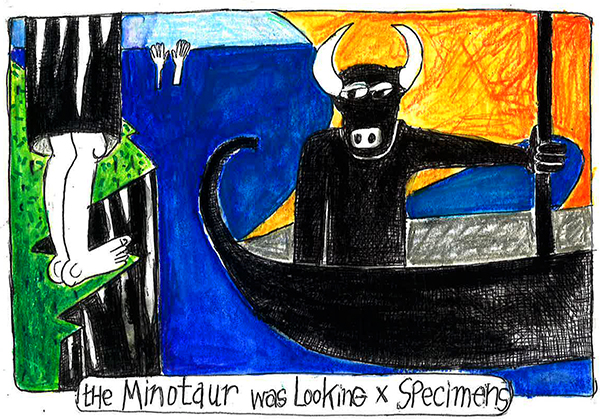
One morning Ariadne was scanning the sea when she saw a boat sailing towards the island bringing with it news that would shock her. The Minotaur had not been killed after all by Theseus, just neutered. Now a botanist and vegan, the Minotaur cruised the islands looking for plant specimens. That’s how he arrived on the island where Ariadne was living, an island inhabited only by women. These women had worked hard to have a place of their own where they weren’t intimidated or imposed upon by men. Thus they were not pleased about having a mutated male bull on their island of refuge. However, Hypatia said, “we have no quarrel with men who have no quarrel with us.”
The decision as to whether or not the Minotaur could stay would all depend upon how he answered this question:
“Who is superior, the man or the woman?”
Hypatia knew that a man, simply because he is a man, would answer “a man”. But, to get what he wanted from a woman, a man might lie and say, “a woman”.
Instead, the Minotaur responded like this: In botany there’s a phenomenon known as enantiomorphosis. It is a phenomenon widespread in nature. On a vine the tendrils twist one way as they leave the stem, they twist another way to fasten themselves; in the center, where they meet, the spirals stop, and the join shows no kink. The horns of a deer mirror similarity one to another as do pairs of tusks, pairs of wings, and even our own pairs of hands.

Women already knew that women and men are mirrored opposites, the same but different. Like looking in a mirror, we know ourselves only via reflection.
The women voted and decided that the Minotaur’s had been a fair reply. Therefore, he was allowed to stay on the island to collect plant samples.

-30-
Related:
Ariadne’s Thread on archive HERE +
The mermaids in the basement: stories by Marina Warner on archive HERE +
Why a poet’s scandalously suggestive poetry earned the wrath of a Roman emperor +
Metamorphoses Wikipedia + Metamorphoses videos on YouTube +
How Greek Mythology Is Being Rewritten Through A Feminist Lens + 10 Brilliant Retellings of Classical Myths by Female Writers +
Ariadne to Theseus in The Epistles of Ovid +
Ovid’s Presence in Contemporary Women’s Writing +
Ovid’s Presence in Contemporary Women’s Writing: Strange Monsters, by Fiona Cox +
The Myth of Pygmalion and Galatea +
Marina Warner’s work is discussed in Ovid’s Presence in Contemporary Women’s Writing by Fiona Cox, published by Oxford University Press 2018 +
Picasso and the Minotaur: Why Was He So Obsessed?


 The Narrative Within