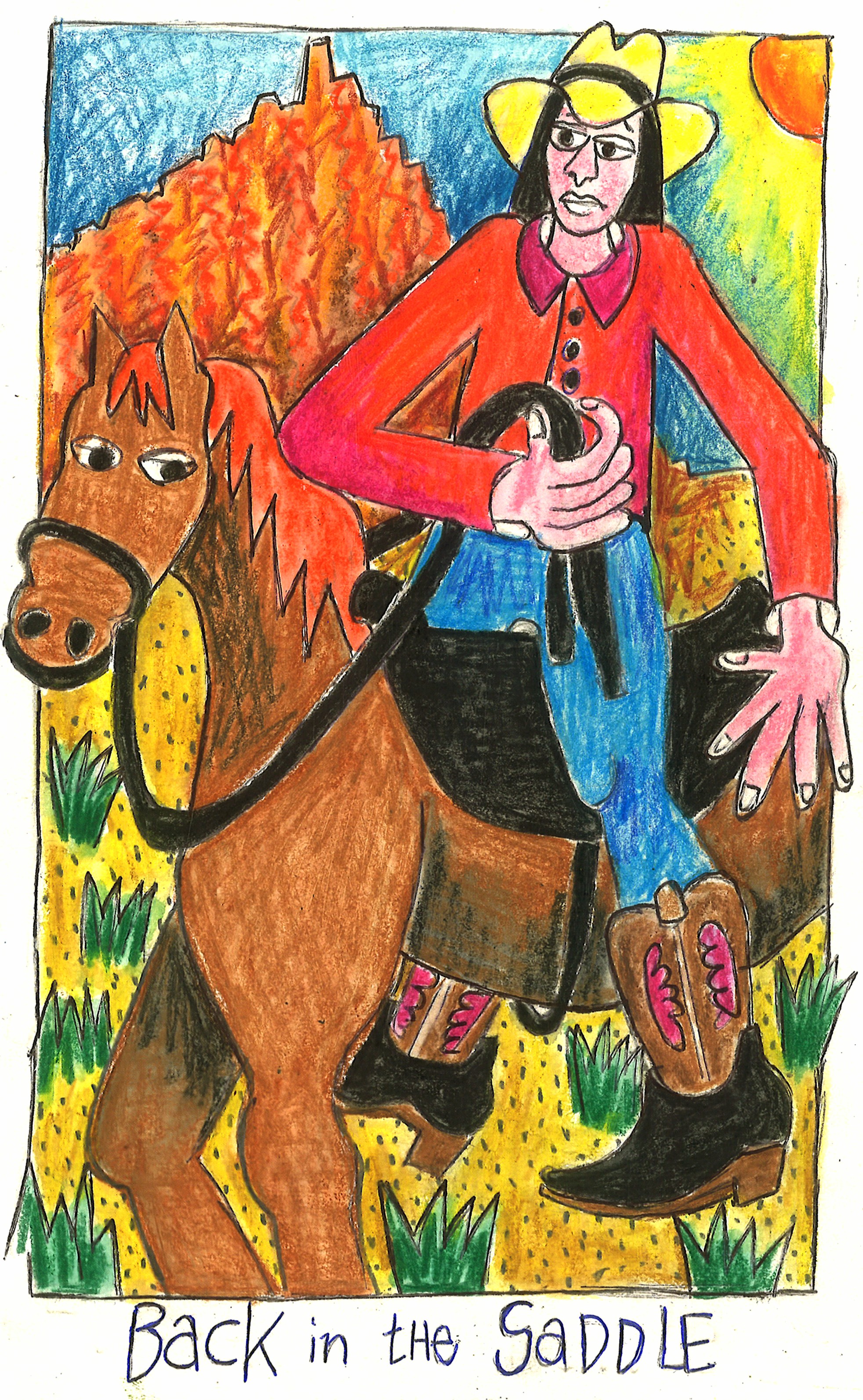
When you fall off your horse, don’t linger on the ground. Pick yourself up and get back in the saddle again. Women have been doing it for centuries.
Italy is full of equestrian statues such as that of Marcus Aurelius in Piazza del Campidoglio in Rome. Because sitting up high on a horse makes you look more powerful than what you really are. Although equestrian statues always have a man sitting on the horse, women sit on horses, too.
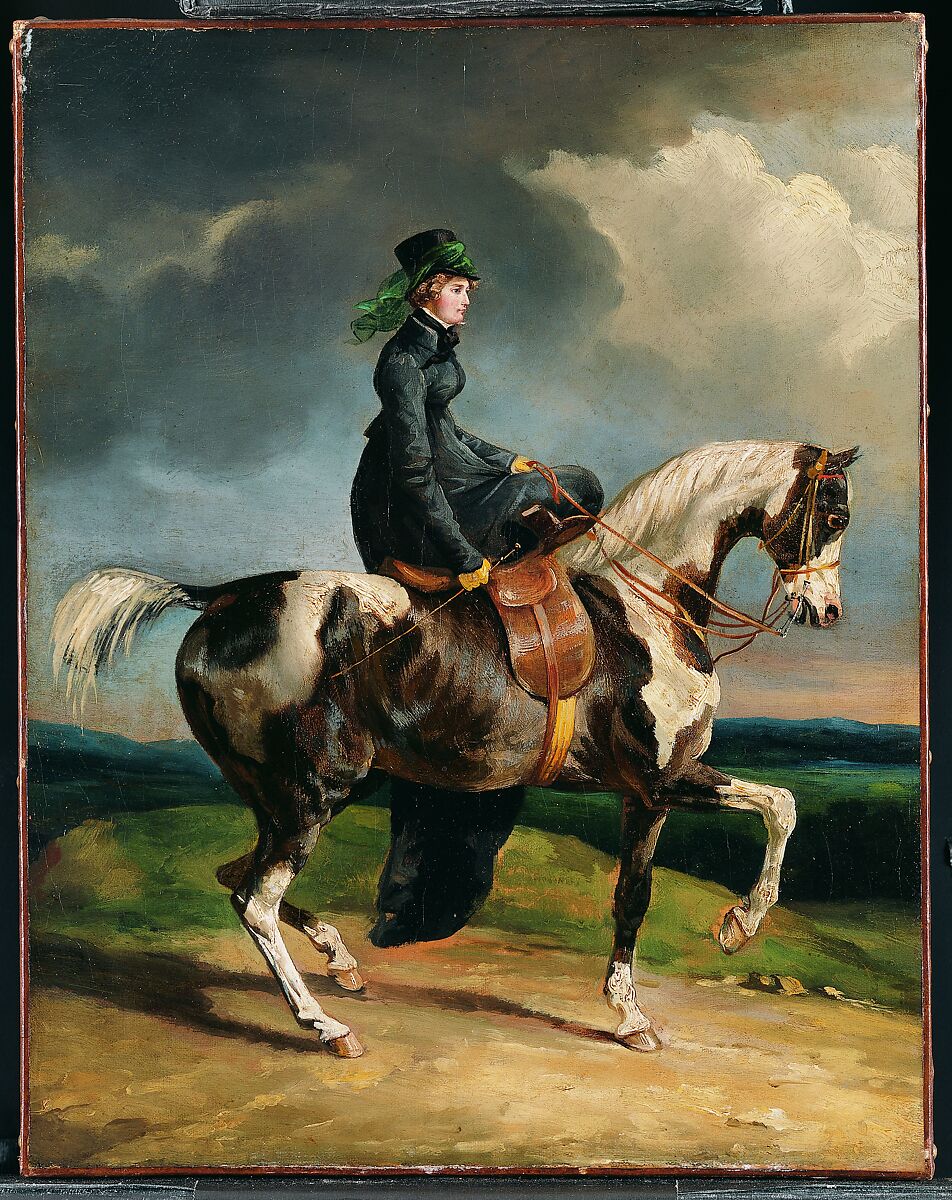
“The Horsewoman” (c 1820) by Theodore Gericault
Theodore Géricault ((1797-1824) was a French painter and lithographer. A pioneer of the Romantic movement, his most famous painting is The Raft of the Medusa (1819) regarding cannibalism and the survivors of the Medusa. However, he really liked to paint horses.
In 1816, he went to Italy and discovered Michelangelo. A couple of years later, he had a son with his maternal aunt creating a big scandal. A few years later he would die of tuberculosis. He was only 32.

“Une Amazon au Bonus de Bolognesi” by Alfred Deux
Women were once obligated to ride sidesaddle. That is, to sit aside rather than astride because it wasn’t considered ladylike to straddle a horse. So sidesaddles were invented. The woman may have appeared more ladylike. But sitting on the side made it more difficult to stay on and control the horse.

“John and Sophia Musters Out Riding at Colwick Hall” (1777 ) by George Stubbs
George Stubbs (1724-1806), an important English painter best known for his paintings of horses, was self taught. Much of what he learned came from copying paintings in important art collections.
In 1754, Stubbs went to Italy to verify his notion that nature is superior to art even to that by the Greeks and the Romans.

“The Horsewoman” by Karl Bryullov
Karl Bryullov (1799-1852) was a Russian painter during the Romantic period. He’d studied at the Accademy but was not enthusiastic about classical art. He went to Rome where he painted many portraits. Although best known for “The Last Day of Pompeii”, he’s also known for portraits of women.
Bryullov studied at the Academy but was bored with classical art. He went to Rome where he painted portraits. In 1832, he completed the above painting representing the daughters of composer Giovanni Pacini, Giovannina on horseback and Amazilla on the balcony.
Bryullov spent the last years of his life in Italy and is buried at the Cimitero Acattolico in Rome.
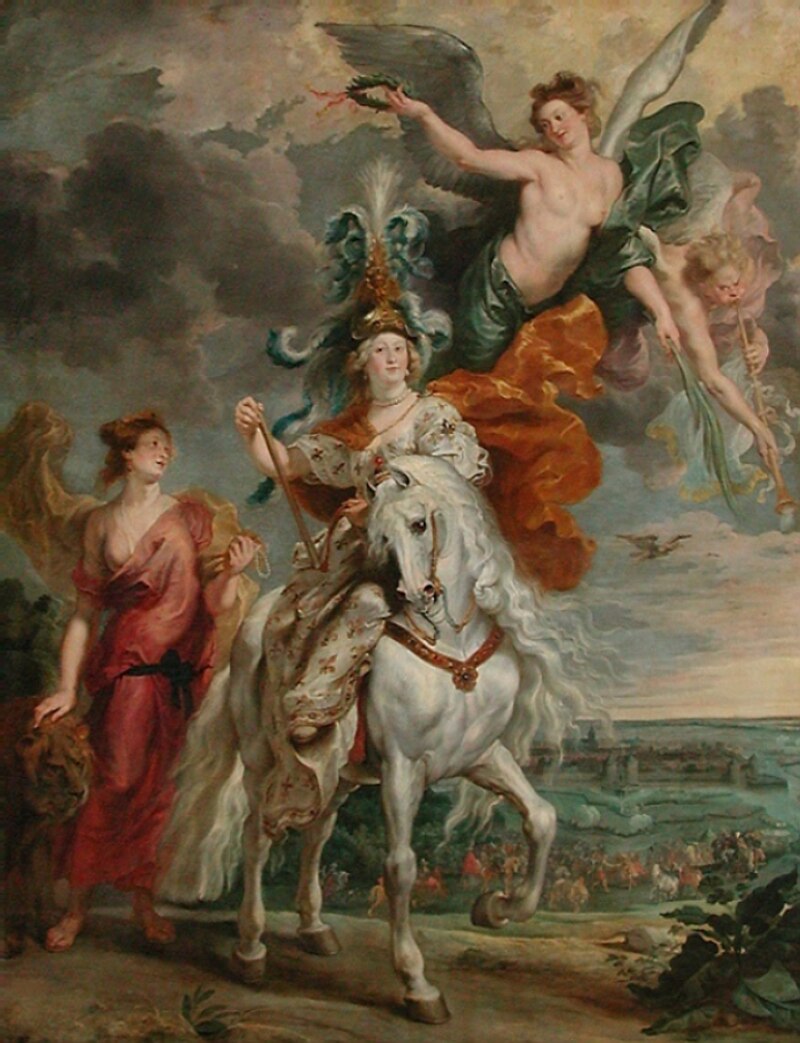
“Maria de Medici” by Rubens
The Marie de’ Medici Cycle is a series of 24 paintings by Rubens. The intent of the paintings was to depict the trials and triumphs of Marie’s life. The paintings are now at the Louvre.
When King Henry IV, Marie’s husband, died, their son Louis was only eight years old so Marie took command of the throne. But at age 15, Louis wanted to assume his role as king. Mom was so uncollaborative that she was exiled to Blois. Eventually mother and son reconciled. Marie returned to Paris to redecorate the Luxembourg Palace. She commissioned Rubens to do a series of paintings based on her life . But in 1631 Marie was once again banned from France and spent the rest of her life exiled in Belgium.
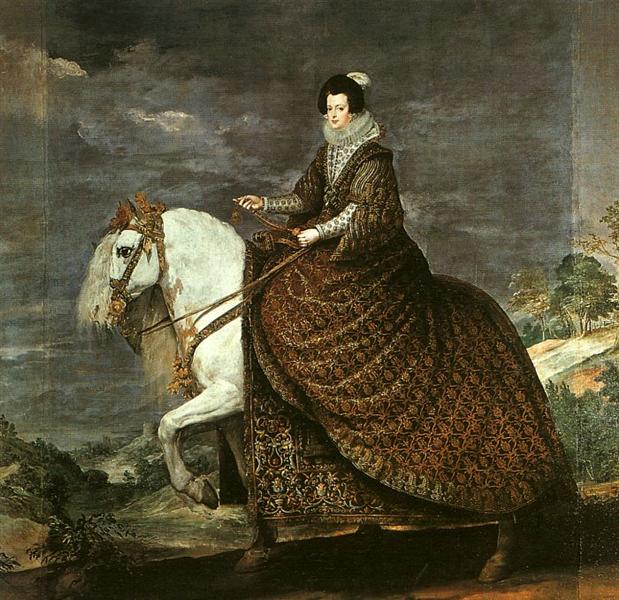
Queen Isabel of Bourbon Equestrian by Diego Velazquez
Around 1635, Velazquez made a portrait of Elizabeth of France riding a horse.
Elizabeth of France (1602-1644) was the wife of Felipe IV and the daughter of King Henry IV of France and to Marie de Medici. It’s said that Marie was not fond of her daughter and let it show.
Although Elizabeth was very beautiful and affable, her husband had mistresses. So she got a lover, too, only he was murdered

“Lady Godiva” by John Collier (1897)
Lady Godiva was a 13th cen Anglo Saxon Nobel woman and wife of Leofric the Earl. The couple were known to be generous. However when Leofric wouldn’t lower rents for his tenants, Lady Godiva had a fit. So Leofric said he would lower the rent only if she would ride a horse in town naked. So she did.
John Collier (1850-1934) was an English painter and writer focused on Pre-Raphaelites. He married twice and both times to daughters of Thomas H Huxley. First he married Mady but she died in 1887. Two years later he married Mady’s sister Ethel. But they had to go to Norway to do so because at the time it was illegal to marry your sister in law .
Related: Ladies in Painting: Women’s equestrian portraits (17th–18th centuries) + The Lady Vanishes + Paintings of women on horseback +
Exhibition “Karl Bryullov and Italy” + The Russian Centre of Science and Culture in Rome (IL CENTRO RUSSO DI SCIENZA E CULTURA a Roma è aperto dal 2011. La sede del Centro si trova nel Palazzo storico Santacroce (XVI secolo) nella immediate vicinanza di Piazza Campo dei Fiori)+ Karl Brjullov: memorie di pietra dal Cimitero Acattolico di Roma + La Galleria Tretyakov presenterà una mostra dedicata a Karl Bryullov +


 The Narrative Within