
Birds are magnificent architects and construct fascinating nests for their families. Bowerbirds, for example, build simple structures but decorate them with colored objects hoping to attract a companion. Barn swallows make nests from mud that are built onto man made structures such as barn rafters. Then there are the weaver birds such as the Baya capable of collecting long grasses and intricately weaving them into sophisticated structures worthy of AD Magazine. But the nests that I can most relate to because of their simplicity and practicality are those of the malleefowls.

The malleefowl is a stocky ground dwelling bird that’s the size of a chicken. Shy and solitary, the male, as with most birds, has the responsibility of constructing the nest.
Using his claws, the malleefowl tries to gather as much organic material as possible (such as leaves) to build a huge mound on top of a compost pile. It’s like a giant incubator because the decomposition of the organic material provides the heat necessary for the eggs to hatch. So all the momma bird has to do is lay her eggs then go. Because it’s the leaf litter that incubates the egg and not the mom.
While the malleefowl male is busy trying to keep the temperature of the mound stable, the female is busy laying eggs. An egg is laid about every five days or so and, during a normal season, she can lay up to 32 eggs.
But once the eggs are hatched, the chicks are left on their own. There will be no momma bird to bring them worms to eat. In fact, they will have no contact with adult birds and, as they grow older, will tend to ignore other birds unless it’s to mate or to fight over territory.
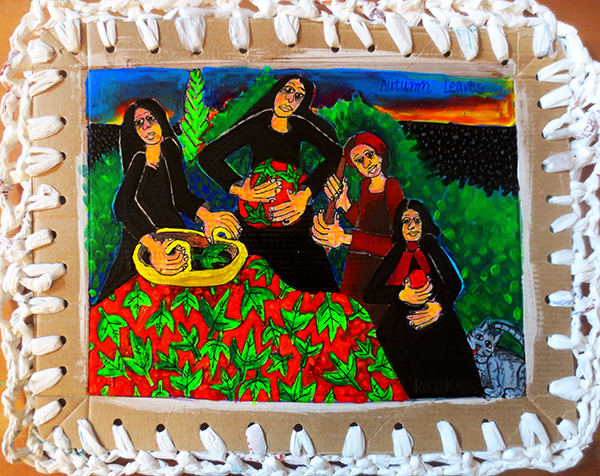
The malleefowl’s mound of leaves reminds me of John Everett Millais’s painting “Autumn Leaves” (1856). Four young girls are standing in front of a big pile of leaves meant to be used for a bonfire. Only the leaves produce little more than smoke.
Millais loved the smell of burning leaves. It reminded him of his childhood and how the smell of burning leaves represented the end of the season.
Millais painted this in his garden in Scotland after returning from his honeymoon with his new bride, Effie Gray. Effie had previously been married to art critic, John Ruskin, but the marriage had been annulled as it had never been consummated. Apparently, Ruskin had been repulsed by his wife’s pubic hairs. After all the Greek statues he’d seen and studied, he was not ready for the real thing.
The painting shows four young girls in front of a pile of leaves. The two girls on the right are his wife’s sisters, Alice and Sophie Gray. They are dressed in nice clothes whereas the other two girls are shown in working class clothing. It’s twilight and the day is ending. In many ways, the painting is about the transience of youth and beauty.
The protagonist here is Sophie Gray in the middle. Fifteen years younger than her sister, Effie, Sophie was very beautiful and became Millais’ favorite model during his Pre-Raphaelite period. But maybe too much emphasis was placed on her beauty as it caused her to have a distorted image of herself. She began to suffer from anorexia nervosa and her health rapidly declined. By 1868, Sophie was sent to an asylum. Although she later married and had a child, Sophie’s health continued to decline. Dramatically emaciated, her body broke down. She died of “atrophy of the nervous system” in 1882 at the age of 38.
Beauty is as ephemeral as burning leaves.
-30-
Related:
Video malleefowl building nest + 10 Birds That Build Beautiful Nests (Really Amazing) + ABOUT MALLEEFOWL +
The Beautiful and Ingenious World of Bird Nests + Bowerbird + Which Birds Make Mud Nests? + TEXTILE IN THE TREES: WEAVER BIRD NESTS + Baya weaver +


 The Narrative Within