Lewis Carroll, the author of Alice in Wonderland, suffered from terrible headaches. They were painful and made him feel weird about himself.

In 1955, the British psychiatrist, John Todd, began studying symptoms related to migraines and epilepsy. Noticing that certain kinds of migraines provoked a sense of depersonalization and an altered perception of the self, he tried to understand why. The symptoms made him think of Alice after falling into the rabbit hole. So he decided to name this condition the Alice in Wonderland Syndrome (AIWS).
The British mathematician, Charles Lutwidge Dodgson, aka Lewis Carroll, often wrote in his diaries about his migraines and the aural phenomena that preceded them.
In 1862, Carroll and a clergyman friend took the three young Liddell sisters on a boat ride down the Thames. To keep them entertained, Carroll invented the story of Alice and her adventures in the rabbit hole. Alice Liddell, age 10 at the time, liked the story so much that she insisted Carroll write it for her.
Alice was the daughter of the dean of the college where Carroll taught. At the time, Carroll had developed a passion for photography and began taking photos of Alice and her sisters.
Carroll did not limit his interests to the Liddell sisters. He had many young “playmates” that he’d send letters to full of puns, puzzles, and requests for locks of hair. Carroll also asked them to sit on his lap semi-naked and pose for a photo. A very strong Peter Pan Jim Barrie vibe for me.
Initially Victorians were ok with photos of children in costume and/or partially undressed. But as the Victorians began to become interested in psychoanalytical theory, attitudes changed.
Giorgio de Chirico (1888-1978) was born in Athens. His father was an Italian railroad engineer busy putting up rails in Greece whereas his mother was a baroness of Genoese-Greek origins.

When de Chirico was 17, his father died and his mother decided that it was time to return to Italy. In Italy de Chirico began studying at the Academy of Fine Arts in Florence. But in 1911, de Chirico and his brother, Alberto Savinio, moved to Paris but had to return to Italy to enroll in the army as WWI broke out.
In 1817, the French writer Stendhal was visiting the church of Santa Croce in Florence. Fascinated, he couldn’t stop himself from wandering around it to admire its beauty. But after a while, he began to feel ill. He writes: “My heart was pounding, and I felt dizzy. All those works of extraordinary workmanship, so compressed into a limited space, were really too much for an aesthetic lover like me.
I had reached that level of emotion where the celestial sensations given by the arts and passionate feelings come together. Coming out of Santa Croce, I had a [strong] heartbeat; it was as if my life had dried up, I walked fearing I would fall.” A hundred years later, de Chirico would also experience an overwhelming sensation inside Santa Croce.
Almost 100 years later, de Chirico would have a similar sensation. In 1909, the artist was sitting in Piazza Santa Croce looking at the church. He’d recently recovered from an illness and was feeling weird. De Chirico writes that he was in “a nearly morbid state of sensitivity” causing him to feel as if he was seeing his surroundings for the first time. But he sees this epiphany moment as an enigma. Is the world in disguise? Is everyday life something so alien that one can never feel at home?
Metaphysics in philosophy exams the structure of reality. But how can one ever know what is real and what is not?
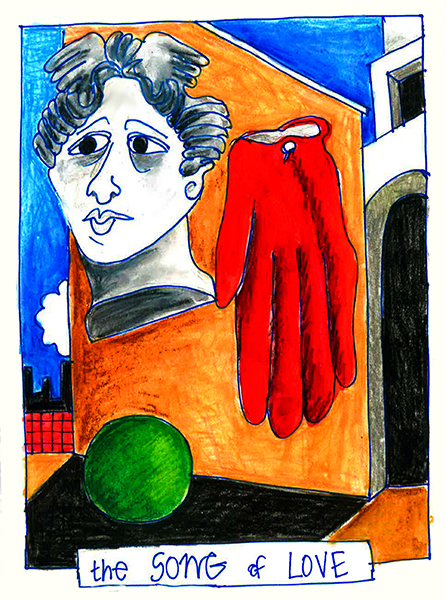
The Song of Love (1914) pursues the enigmas de Chirico was consumed by. There are certain recurring elements in these paintings such as the architectural setting, the Greek statues, and the trains puffing smoke. The latter is most likely a reference to his dad who helped with the construction of the Greek railroads.
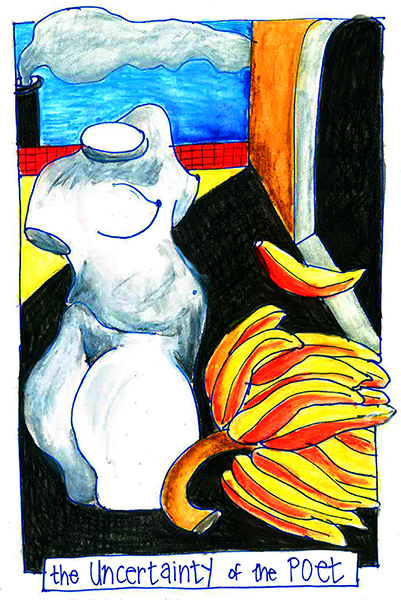
The Uncertainty of the Poet (1913) shows the torso of Aphrodite next to a bunch of bananas that remind me of Josephine Baker’s dance costume.

In The Soothsayer’s Recompense, once again we have an empty city square, a train puffing smoke, and a Greek statue. This statue represents Ariadne, the daughter of Minos who helped Theseus escape from the Minotaur’s labyrinth. But once a free man, Theseus dumped Ariadne on the island of Naxos. He may be considered by some to be a divine hero but he most certainly was not a gentleman.
De Chirico spent the last 30 years of his life living at Piazza di Spagna in Rome with his wife Isabella Pakszwer Far. They had a magnificent home and a magnificent terrace that looked towards Villa Medici.
De Chirico, “Pictor Optimus”, although initially buried at the Verano Monumental Cemetery in Rome, was later reburied in the church of San Francesco a Ripa whereas his brother Alberto Savinio remained at Verano.
-30-
Related: Brakes, Daphne du Maurier and Jim Barrie +
Giorgio de Chirico, The Soothsayer’s Recompense + Who Was Giorgio de Chirico? + The Neurology of Art – The Example of Giorgio de Chirico + Enigmas in Philip Guston’s de Chirico City + Video: Migraine aura + Famous Artists with Migraine Throughout History + Rabbit Hole Syndrome: Inadvertent, accelerating, and entrenched commitment to conspiracy beliefs + The Neurological Disorders in Alice in Wonderland + Alice in Wonderland inspiration + De Chirico: le fasi pittoriche e l’influenza dell’aura emicranica +


 The Narrative Within