
The Climber
After her mother’s death, Dorothy was separated from her siblings and sent to live with a second cousin. She was only seven years old. At 16, she was sent off to her grandparents where, for the first time in nine years, she reestablished contact with her siblings.
Dorothy Wordsworth was the sister of William Wordsworth, the poet. In 1797 the two moved to Somerset. Samuel Taylor Coleridge was their neighbor and the three became a trio. A year later, Wordsworth and Coleridge, with input from Dorothy, were publishing poetry as well as hiking together. Wordsworth’s “Tintern Abbey” was inspired by these walks.
In 1802, Wordsworth married but that didn’t keep him from hiking with Dorothy. Or with Coleridge. In Coleridge’s words, together they were ‘Three people, but one soul’. Maybe he shouldn’t have said that as Dorothy had a crush on him. For a while, Coleridge was part of the Wordsworth household. But all that opium had exasperated the negative aspect of his personality. He was picky about everything including his food. And it was Dorothy who was doing all the cooking and cleaning.
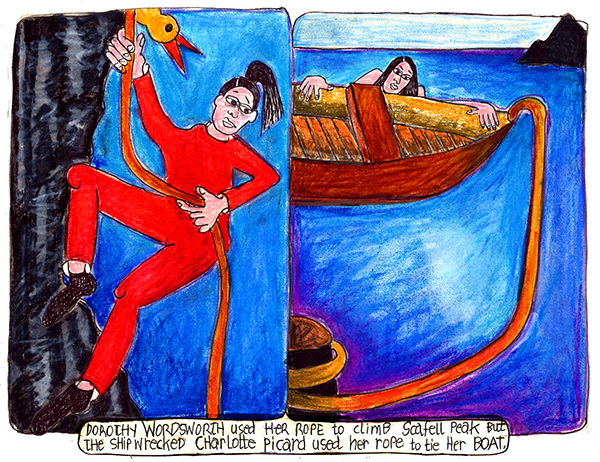
Dorothy enjoyed climbing. In 1818, she climbed Scafell, England’s highest peak. It was a daring thing for a woman to do at the time. She was even more daring by writing about it. Because climbing a peak was a form of rebellion. And women who wanted to be emancipated were frowned upon.
Dorothy’s advice for lady climbers: make sure to look closely at what’s around you when climbing. If you start to fall, you may need something to hold on to.
The Drifter
In 1816, the Medusa wrecked off the coast of Senegal. After the wreck, about 147 survivors were set adrift on a hastily constructed raft. There were elements of scandal in this survival and the people wanted to know more. A few years later, 23-year-old Theodore Géricault painted The Raft of the Medusa representing the wreck and its survivors.
One survivor was Charlotte Picard, an 18-year-old woman travelling with her family. Of her nine family members on board, only four survived. After adrift on the raft for ever so long, she woke up next to her mom on the ground being stared at by dark skinned bearded men sitting on camels. The ladies immediately fainted. When they came to, one of the men explained that they were really Irishmen disguised as Arabs.
Charlotte and her group were forced to live in Senegal for the next two years. But, once back in France, Charlotte published her memoirs describing what it was to survive a shipwreck.
Jane read Charlotte’s book. It inspired her to write, in a life coach style, a book about drifting. Some drift with a purpose, some do not. Some drift intentionally, others are simply lost. But if you must drift, this is Jane’s advice: It’s ok to drift but only if you have a rope long enough to keep you tied to something stable.
No matter how big of a boat, you still need an anchor.
-30-
(“Jane’s Rope” to be continued ⓒ 2024)
30-
Related:
Did Wordsworth really betray Coleridge?: The strange events of 27th December 1806 +
Coleridge and Wordsworth debate poetry with Dorothy video clip +
The Romantic Poets documentary +
…
Utsuro Bune + Water: The Drifting Boat (Ukifune), circa 1851 – 1852 +
Women and Shipwrecks: Surviving ‘The Medusa’ +


 The Narrative Within