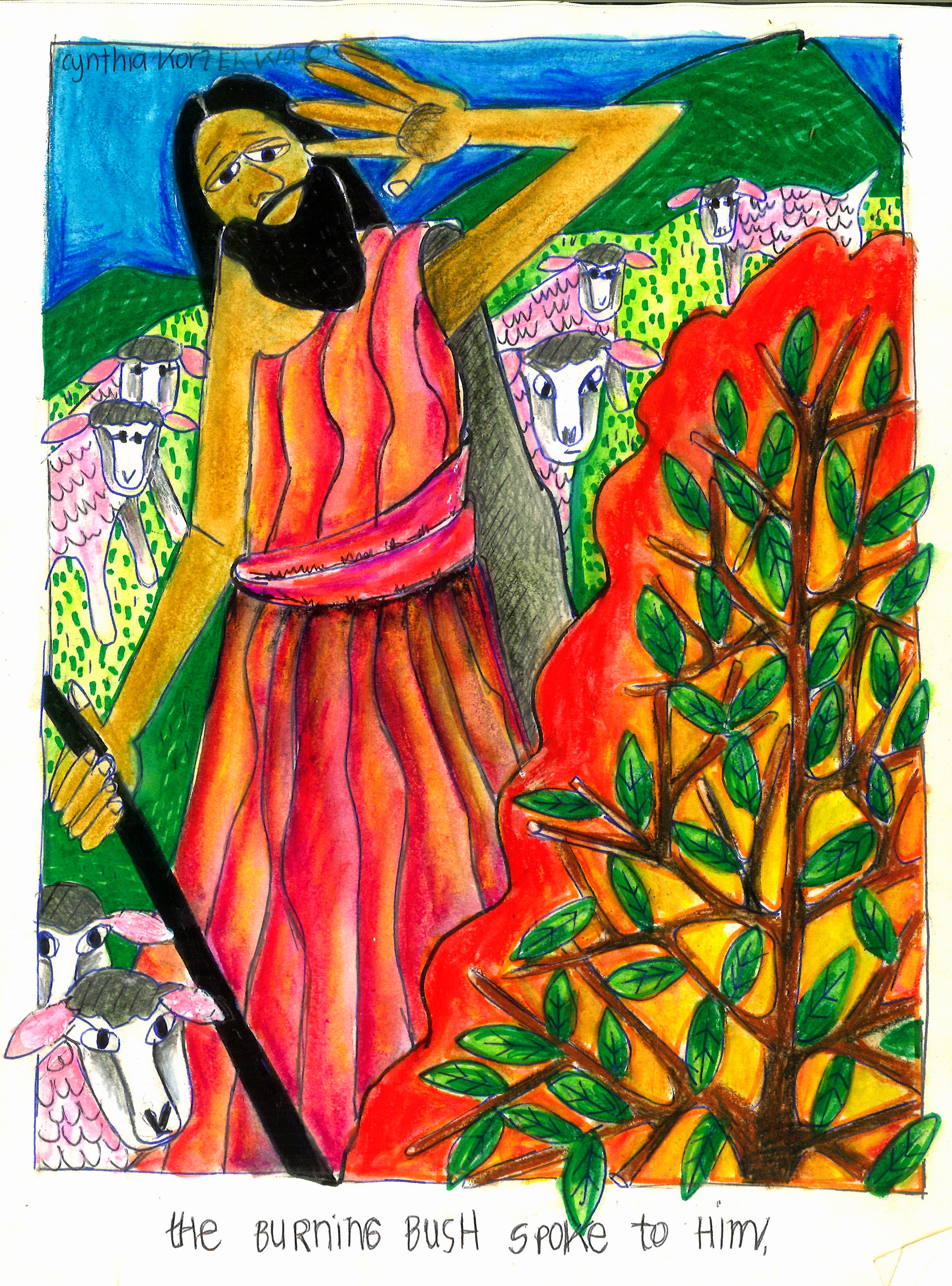
Moses was out tending the sheep when he saw a bush that was on fire but wasn’t burning. Curious, Moses walked towards the bush. Then he heard someone call out his name. Who are you?, asked Moses. And the reply was “I am who I am” (Exodus 3:14).
Baruch Spinoza (1632-2677) was born in Amsterdam. He was of Portuguese and Jewish origin and received a traditional Jewish education. So well versed in Hebrew, he couldn’t help but see the contractions between translations of sacred texts and the original versions. One translation in particular that annoyed him was that of “I am that I am”. Spinoza decided to further investigate and, in doing so, came up with interpretations that so scandalized the Jewish community that Spinoza was permanently excommunicated from it.
Spinoza’s problem with “I am that I am” was a matter of tense. According to Spinoza, so I’ve read, the sentence was in the imperfect and not the present tense. As the imperfect tense implies an action that is ongoing or continual, the meaning of “I am that I am” could be more like “I am becoming what I am becoming.” However, I don’t have a copy of “Ethica” yet and researching on internet now is a problem as it’s overdosed with AI and ambiguous sources .
Spinoza concludes that God is nature and the substance creating the universe. God does not exist outside the universe but is the universe itself. And as we are part of this universe, we are also a part of God.
There’s much to absorb. Too much for me at this time. However, of interest is Einstein on Spinoza: “I believe in Spinoza’s God who reveals himself in the orderly harmony of what exists. Not a God who concerns himself with fates and actions of human beings.”

Appropriations for AI will be jinxed.


 The Narrative Within