Today I Found a Poem

It’s been raining every day now for about 10 days. The weather is becoming a serial psycho-killer. So I’m sitting here at the dining room table with the window curtains pulled back trying to squeeze in as much light as possible. Drawing with artificial light is just not the same as drawing with sunlight. I’m easily distracted and my mind jumps around looking for a place to land like a bee buzzes around looking for the right flower to suck. That’s how I got to Found Poetry.

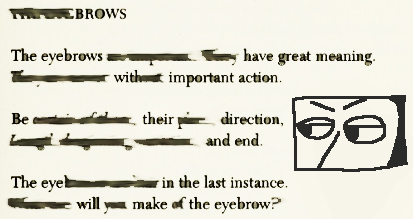
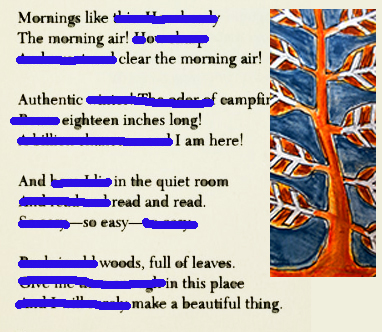
There’s two basic ways of writing “found poetry”. The first is by copying phrases from books and mashing them up together to create a poem. You can further manipulate the existing text by deleting words and/or changing the punctuation. An excellent example of this type of found poetry is Annie Dillard’s “Mornings Like This: Found Poems”. Dillard has carefully recopied chosen sentence fragments from old and often forgotten books to create poems that are sometimes happy, sometimes sad. Below are a couple of excerpts from Dillard’s poems:

“Give me time enough in this place/And I will surely make a beautiful thing.” (from “Mornings Like This”)

“Think over what you have accomplished. Was it all that you wished? Has this story been told before?” (from “Junior High School English”)

(Annie Dillard’s “Mornings Like This” can be found on Archive HERE.)

But I’m a scissors & paste kind of woman and like the idea of de-obsoleting unwanted books (computer manuals, kids’ textbooks, boring unread novels) by cutting them up and, collage style, writing “found poems.” You know, anonymous letter style. But that would mean cluttering up even more my dining room table. So I’ve come up with an alternative—to take snippets of Dillard’s poems online and then evidence the words I want to keep and obliterate the others. Then they would be Found Poems Found within Found Poems.

Some examples:
mornings like this

Fed Mermaid

Brows

-30-

Posted in Books, Drawings & Paintings | Tagged , , , | Leave a comment

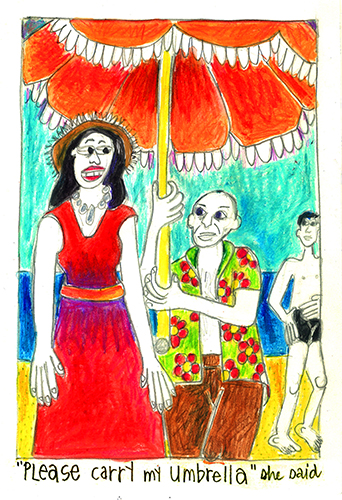
Todo es Nada

Todo es Nada

Françoise Gilot was only 21 years old when she began her 10 year relationship with Picasso, then 61.

Was it Dumas who said that if a woman were to know at 20 what she knows at 40, she would live her life differently? Luckily for her, Françoise didn’t have to wait 10 more years to realize that, if she didn’t leave Picasso, he would devour her. But she did wait those 10 years to write about their relationship in “Life with Picasso” (1964).

Picasso may have been artistically rich but, emotionally, he was poverty stricken. Being in a relationship with him was risky. Wife Olga Khokhlova and lover Dora Maar were left psychology destroyed whereas lover Marie-Thérèse Walter and wife Jacqueline Roque committed suicide. Only Françoise escaped tragedy. Then again, what can you expect from a man who says “For me, there are only two kinds of women—goddesses and doormats.” And, if Picasso found a woman who was a goddess, he did his best to turn her into a doormat.

Picasso’s ego had him criticize other artists non-stop (for example, he called Braque “Madame Picasso”). He highly criticized Pierre Bonnard saying that he wasn’t a modern painter because Bonnard obeyed nature instead of trying to transcend it and that his paintings were a potpourri of indecision. Painting, said Picasso, was a matter of taking power. I, personally, adore Bonnard’s paintings. Maybe the real problem was that Bonnard lived with his wife (and model) from 1893 until her death in 1942. To commit oneself emotionally is a power Picasso didn’t have.

Despite his success as a seducer, Picasso for me is not sexy—how can there be anything sexy about a man who likes to blow a bugle but doesn’t like to dance.

As for Françoise, she is destined to have Picasso’s eternal shadow on her life. Like Marianne Faithful who will always be known for her relationship with Mick Jagger, Françoise will be known primarily for her relationship with Picasso. Of course she protests this saying that she should be considered his equal as “lions mate with lions. They don’t mate with mice.”

To read Françoise’s book free online see: “Life with Picasso

-30-

Posted in Books, Drawings & Paintings | Tagged , , , , | 3 Comments

Letters and Books

Letters and Books

“The Guersney Literary Club and Potato Peel Society” is a book about the bonding powers of letters and books. The story: writer Juliet Ashton is contacted by Dawsey Adams of The Guersney Literary Club and Potato Peel Society asking for information about the author Charles Lamb. This marks the beginning of an exchange of letters between Juliet and other members of the Literary Club.

The club began during the German occupation of Guersney Island. Tragically, one of its members, Elizabeth, was sent to Ravensbruck where she was executed. Juliet would like to write about Elizabeth as well as the experiences of other members of the group during the occupation.

The book is about how people and books can help one survive even the most difficult of situations.

The author, Mary Ann Shaffer, was an American librarian and editor who’d been encouraged by members of her writing group to write a novel even though she was already in her late 60s.

Mary Ann had difficulties in being consistent with her writing. So her group often tried nagging her into action. To explain her inertia, she once wrote them a letter.

Her story, she wrote, was about “a group of unlikely friends who are thrown together because of the exigency of living under the German Occupation during World War II.” But Mary Ann was having problems creating characters she liked. Of the characters she’d created, “there is not one of them I have any desire to spend time with,” she wrote.

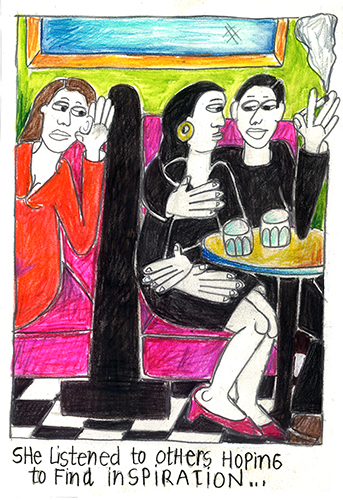
Since the book was based on letters, she tried developing characters by writing imaginary letters from them. But all the letters sounded alike. So she sought illumination from writing gurus who suggested going around eavesdropping on people then writing down what they said in little notebooks. But the people she listened to all sounded alike as well. She also read Annie Lamott who said that every character must have a unique passion. But on the island of Guernsey during the German Occupation, everyone had the same passion—finding food.

In the end, we are all alike.

 “The Guersney Literary Club and Potato Peel Society” was published posthumously, a few months after Mary Ann’s death. It was the only book Mary Ann ever published. Pity she wasn’t around to see that it was a bestseller and transformed into a successful film.

“The Guersney Literary Club and Potato Peel Society” by Mary Ann Shaffer and Annie Barrows is available on Archive HERE.

-30-

Posted in Books, Drawings & Paintings | Tagged , , , , , | Leave a comment

Feeling Groovy

Feeling Groovy

Do you want to feel groovy? Then take the advice of Simon and Garfunkel and “Slow down, you move too fast, you got to make the morning last.” In the age of consumption where we’re all hyped up to consume and be consumed, our biorhythms are easily syncopated. That’s why French philosopher Pierre Sansot wrote an entire book about la lenteur, slowness. He said that a good way to slow down is by walking at such a pace that you synchronize yourself with yourself.

Walking also presents a means of creating intimacy with our own being. The rhythmical movement of a walk can have a hypnotic effect on self-perception facilitating a dialogue between “me & I”.

More than a walk, we’re talking about a stroll. A stroll takes its time and doesn’t rush. It gives us the chance to look at the world around us and see the details. Without those details, our life becomes little more than a big blur.

In “Wanderlust”, Rebecca Solnit says that walking not only provides physical exercise but also “allows us to be in our bodies and in the world without being made busy by them.” She writes about famous walkers such as Henry Thoreau, John Muir, Aristotle, Jean-Jacques Rousseau, and Charles Baudelaire who saw walking as a form of contemplation. And there are those like Saint Jerome who saw walking as a spiritual practice (as do those who walk the Camino de Santiago and other pilgrimage trails).

When walking, you will always be somewhere, somewhere specific. That makes it easier to find yourself.

You can read Rebecca Solnit’s WANDERLUST on Archive (for free).

-30-

Posted in Books, Drawings & Paintings | Tagged , , , , , | Leave a comment

Martha & Ernie

Martha & Ernie

One of the things I enjoy about using Archive.org is that I can have access to a book for free. And, after several pages, if I find that I don’t like the book, I just stop reading it and go on to another book as my list is very long and it’s pointless to spend time on something that doesn’t interest me. Or, as Marie Kondo would say, doesn’t spark joy. One such book was that of Travels with Myself and Another by Martha Gellhorn. I read about Martha several years ago and was intrigued by her personality. However, she was primarily a war correspondent and reading about war makes me uncomfortable. But there were some sparks of joy in what little I read. For example, she referred to Ernest Hemingway (at the time her husband) as U.C.—Unwilling Companion. Although U.C. enjoyed lighting firecrackers in the bedroom, apparently that was the only kind of joy he could spark there. Martha said that her “whole memory of sex with Ernest is the invention of excuses, and failing that, the hope that it would soon be over.” Moral of the story: being a successful writer doesn’t mean you’re good in bed. (And, most of all, drinking too much booze makes you a lousy lover.)

Martha was born in St. Louis, a town she wanted to escape from. And, as for many other travellers, it’s probably that need to leave a place that inspired her to travel.

Three things I learned from Martha: (1) Experience is useless without memory. (2) Endurance is the secret Chinese weapon. (3) No matter how successful a woman is, she will always be in the shadow of a man. Martha resented the fact that, after her involvement with Hemingway, she was often treated as “a footnote in someone else’s life” despite the fact that she was an avant-garde war correspondent way before meeting Ernie.

At the age of 89 and in bad health, Martha committed suicide by swallowing a cyanide capsule.

-30-

Posted in Books, Drawings & Paintings | Tagged , , | 1 Comment