
Pablo Picasso said “Good artists copy, great artists steal.” So he did both.
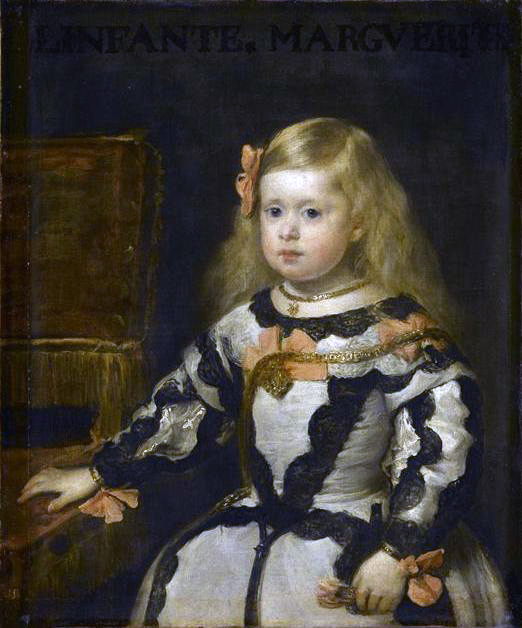

On the left is a painting by Velazquez, “L’infante Marie Marguerite” (1655) and, on the right, Picasso’s version of the Infante Marguerite (1957).

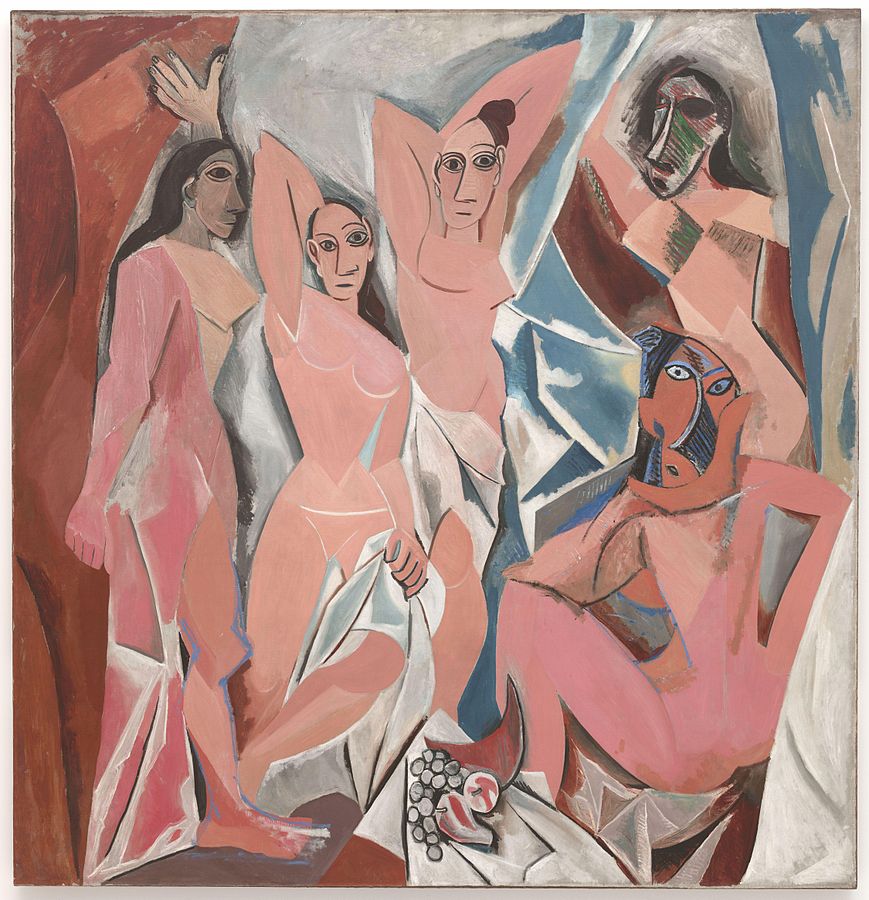
On the left is an African Ngil mask, a mask like many that were being seen in Paris c 1906. On the right is Picasso’s “Les Demoiselles d’Avignon” painted in 1907.

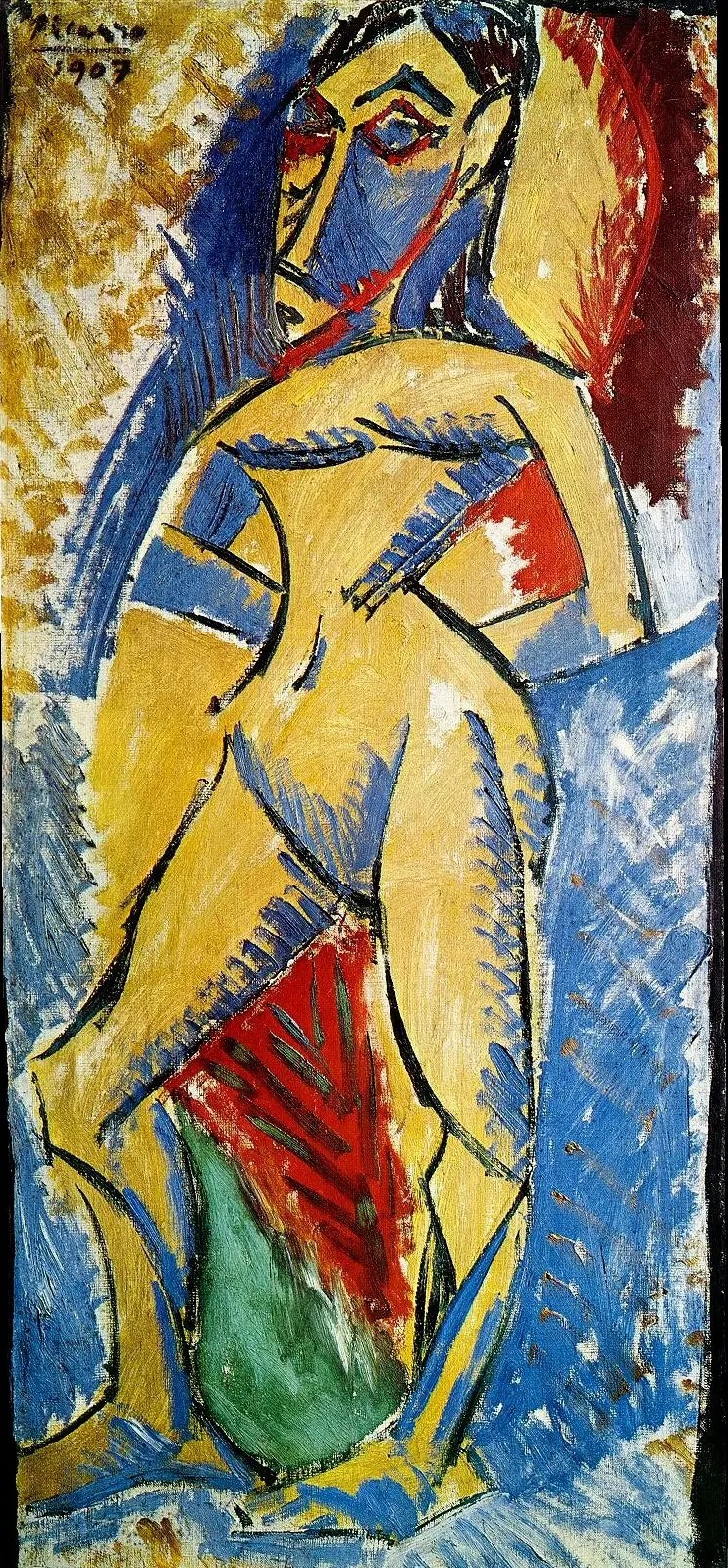
On the left is Degas Little Dancer of Fourteen Years (1880), on the right is Picasso’s Standing Nude (1907).
Ekphrasis is generally considered a literary reaction to a work of art. But not all reactions occur in the same way. Ekphrasis is the encounter between one form of expression and another.
A poet may write an ode to celebrate a work of art such as John Keats’ “Ode on a Grecian Urn” because he is a writer. But to celebrate a painting, a painter will often try to paint it as Picasso did in the examples above.
There are basically two kinds of copyists. There are those like Emma Conant Church who went to Europe with the specific intent to copy Old Masters to be sold. Then there are artists like Cezanne who spent much time at the Louvre copying as a learning experience. Imitation was not the goal. The goal was to copy old paintings with a new attitude and thus create a new awareness.
No one is an island. We were meant to interrelate with others. And this interrelating makes our world bigger and gives us more options. Einstein said he would not have been able to discover all that he had had it not been for the scientists and physicists who came before him as they had laid the foundation for him to build on.

-30-
(Ekphrastic Copyists ©)
Related:
Pain and Painting + Is it Love or just Intuitive Thinking? + Lessons Learned (Louvre) +pThe Gaze of Victorine Meurent +
Why Great Designers Steal—and Are Proud of It + Pablo Picasso on Creativity, “Good artists copy, great artists steal.” + The History of Copying Art: A Learning Tool or a Cheat? + Picasso sources + Who’s the Voyeur Now, Picasso? + Jackson Pollock inspired by Picasso
A History of Copying as Innovation and Resistance in Art since the Ancient World + Vincent van Gogh Copying Other Artists + Copies by Vincent van Gogh + Delacroix’s Influence: The Rise of Modern Art from Cézanne to van Gogh” + WHAT COPYING MEANT TO CÉZANNE + 5 Great Artists Inspired by Delacroix +
8 Paintings that Vincent Van Gogh Copied + Le Déjeuner sur l’herbe (1863) +‘It’s called stealing’: new allegations of plagiarism against Roy Lichtenstein + The Paradox of Henri Fantin-Latour + Turner and Venetian Painting +
Artists who copied artists:
Van Gogh was an animated copier. Some examples: Emile Bernard’s “Breton women in the Meadow”, Jean-Francois Millet’s “The Sower”, Eugene Delacroix’s “The Good Samaritan”, Rembrandt’s “The Raising of Lazarus”, and Gustave Dorè’s “Newgate Exercise Yard”. He even copied a woman— “Man at Sea” by Virginie Demont Breton. The copies made by Van Gogh provide much insight as to what he found intriguing in the work of other artists.
Many artists such as Monet, Degas, Cezanne, and Picasso were inspired by Delacroix and copied him. But Delacroix also did his fair share of appropriation. He made many copies of Rubens and Raphael.
And Manet’s famous “Le Déjeuner sur l’herbe” was inspired by Giorgione’s “The Pastoral Concert” (1510)
Even contemporary artists tend to copy. Much has been made about Roy Lichtenstein’s blatant copying of comic strip artists such as Russ Heath. Some consider Lichtenstein a plagiarist.

Detail from The Death and Ascension of Saint John. On the left, Giotto’s original. On the right, Michelangelo’s copy. Via Sightsize


 The Narrative Within
I learned a new word! I’m ecstatic over ekphrastic! Your examples are terrific!
Thanks Rose🌹 it’s incredible how much artists have copied other artists.
Pingback: Ekphrastic: Lawrence & Jayne | The Narrative Within
Pingback: Ekphrastic Tourists | The Narrative Within