
for Pina
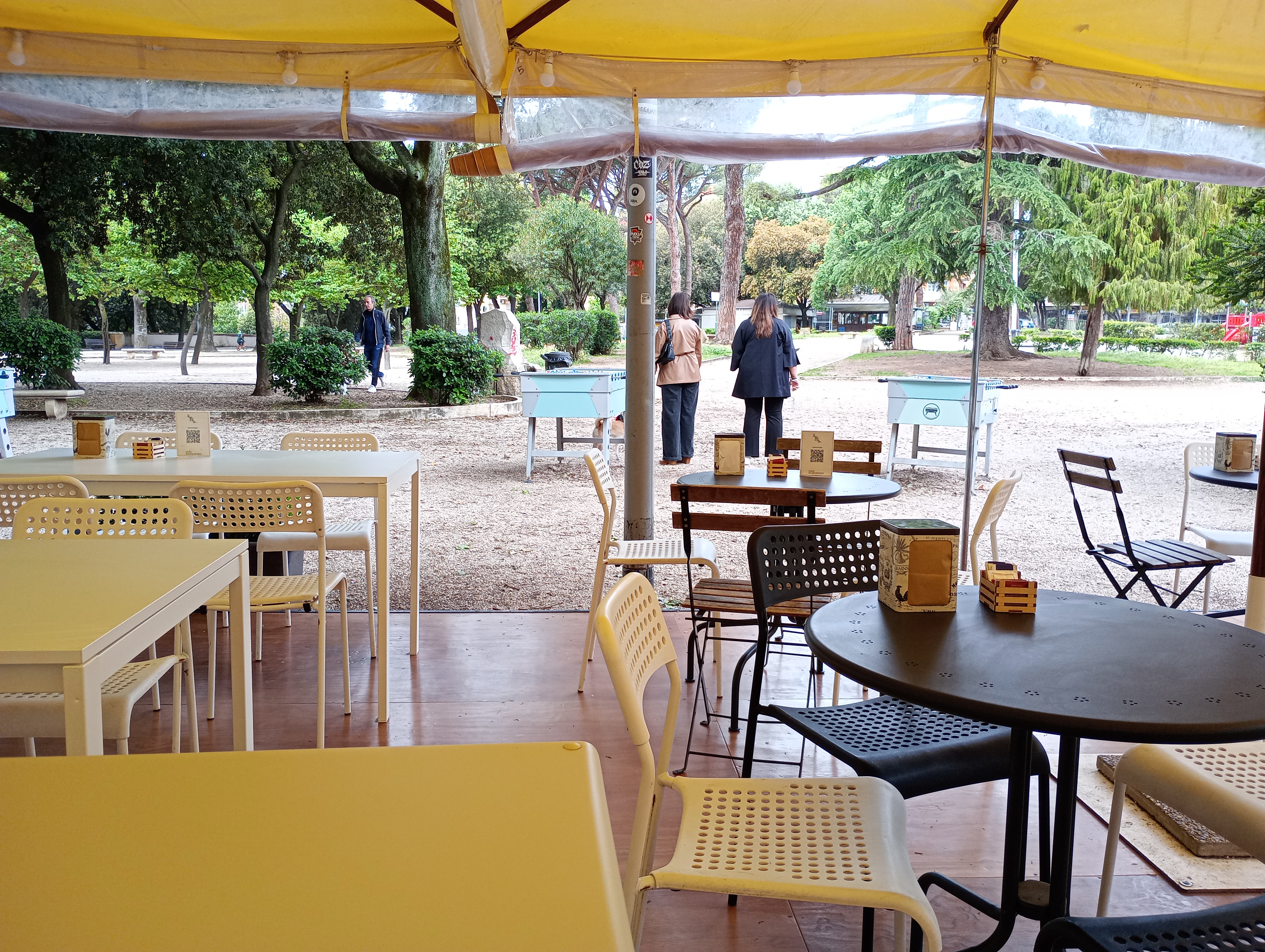
Today I wanted to glow and make my life photogenic. So I bounced to the bar at my neighborhood park for an aperitif.

Since I was alone, I took a book. You know, an old woman drinking Campari late in the morning could give the wrong impression. But if you are reading something other than a smart phone, it gives your presence a totally different vibe.
The book I took was Irine Brin’s Olga a Belgrado. Irene Brin (1914-1969) was a writer, art dealer, and creator of Made in Italy (read more about her HERE). Strangely enough, few Italians seem to know who she is.
Irene was born into a progressive Ligurian family that believed in education. She was thus very well read and spoke four languages. Unfortunately, the National Fascists Party governed the Kingdom of Italy from 1922-1943 so it was the dominating political party when Irene was growing up.
In her early 20s while dancing at the Hotel Excelsior in Rome, she met a young officer, Gasparo del Corso, who shared her interest in Proust, art, and travelling. The couple married in 1937 and, in 1941, Irene joined her husband in Yugoslavia where he was involved as an officer on the Balkan front. Initially the couple was to stay there only six months. But as the war continued, so did their permanency. Irene now could see first-hand the brutal consequences of war and occupation. Instead of focusing on articles for the publication she worked for as planned, Irene was too overwhelmed by the abandoned villages, the arid fields, and so many people degraded by poverty to remain detached. She responded by writing about what she saw first-hand in this world torn up by conflict.
With her elegant, orderly, and direct style, Irene told the stories of people whose lives had been brutally disrupted, with the help of fascists, by the ego and arrogance of the Nazi regime. The result was a collection of vignettes, Olga a Belgrado, published in 1943. The book did not have much success because, as Irene tells us, “it was seized almost everywhere because the title and content seemed too favorable to the Yugoslav partisans”.
Totalitarian governments ban and seize books to restrict collective critical thinking. Because ignorance gives them power. And for this reason, when someone tries to restrict your thoughts, dump them. Because they just want to use you.
Related: Invasion of Yugoslavia + THE MANY LIVES OF IRENE BRIN + Women’s Wardrobes, Men’s Wardrobes by Irene Brin translated into English + Glamour, Art and Architecture Through Pasquale De Antonis’ Eyes + IT’S A ROMAN HOLIDAY FOR ARTISTS: THE AMERICAN ARTISTS OF L’OBELISCO AFTER WORLD WAR II +
Amarcord 15: Irene Brin, Un nuovo appuntamento con la rubrica di Incontri, Ricordi, Euforie, Melanconie di Giancarlo Politi + Breve biografia di Irene Brin e delle mille donne che fu + Il Tempo e la Storia: Irene Brin: lo stile di una donna (RAI Play) +
A Brief History of Banned Books in America +
-30-


 The Narrative Within