If you could really use a time machine to go back to the past, would you? Not me. Just how much would I have in common with someone, for example, from the 1800s? Just how out of place would I feel? How strongly would I feel the differences between myself and people from the past?
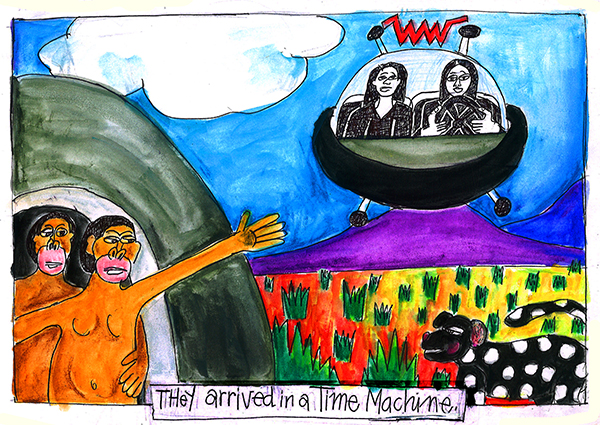
This post is a continuation of yesterday’s post regarding evolution and Harari’s book Sapiens. I’ve focused and commented on a few points of interest from the chapter “The Tree of Knowledge”.
Upright.
The most durable species ever (surviving for almost 2 million years) was one of the first: homo erectus (upright man). But before homo was walking around, he was living in trees. Living in trees was safer for him and his family than living on the ground where they could easily be attacked by predators. That’s why they built big nests to sleep in and moved around by swinging from tree to tree.
Brachiaton is the term used for arm swinging arboreal locomotion.

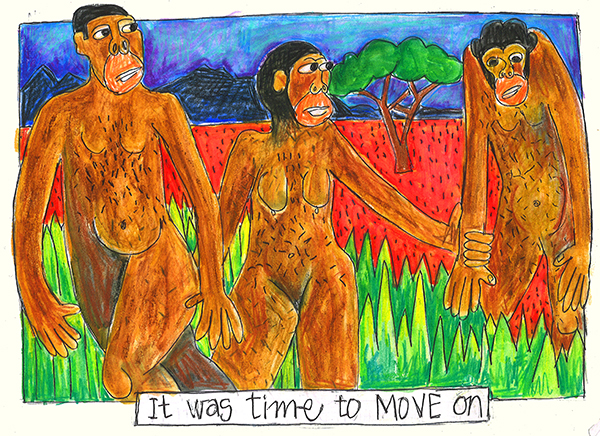
When the climate began to change and subsequently modify the environment, these early humans were forced out of the trees and onto the savannah. Once on the ground, they metamorphosized and started walking upright. With the development of bipedalism, our evolution took a big leap forward.
Hands now had a new role. The more hands did, the more humans learned thus helping the brain to evolve. The increased use of the hands brought about the concentration of nerves and haute couture muscles in the palms and fingers. Hands could now make tools that would facilitate labor and make us more productive.
Hands also changed our rapport with one another. Desmond Morris, in The Naked Ape, explains that walking upright dramatically changed our bodies. Male shoulders became wider as did females’ pubic bones. Upright, the sexual organs became more visible. The female breasts became more evident especially as they started getting bigger in size.
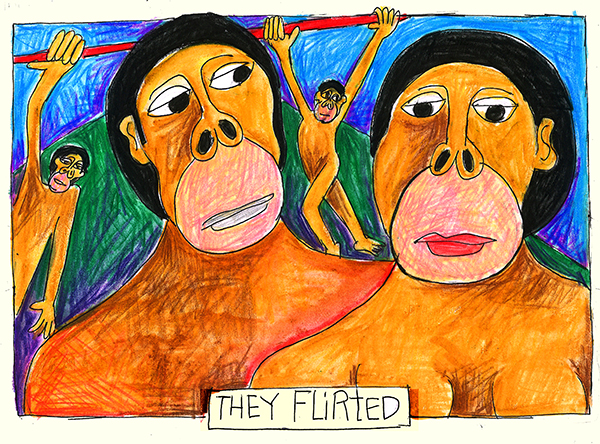
Hands could now permit us to hug and hold and caress. Upright, males and females could mate while looking one another in the eye. Eye contact made the rapport even more intimate. Walking upright changed our sexuality.
Fire.
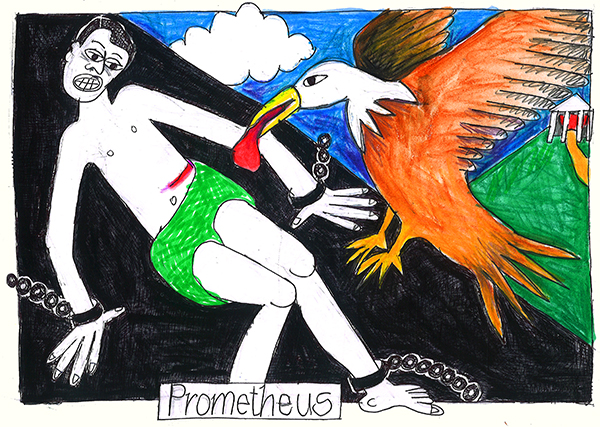
Once upon a time, only gods had fire. Zeus, afraid that humans would become too powerful, forbade humans from having it. But the altruistic Titan, Prometheus, thought it unfair and decided to give humans fire anyway. Zeus, whose ego was bigger than his heart, punished Prometheus by chaining him to Mt. Caucasus where every day a vulture would come daily to eat the Titan’s ever-regenerating liver.
The gift of fire provided a significant step in human evolution. Fire made it possible to cook plants such as rice, potatoes, wheat that were not edible if raw. Cooking also helped kill germs and parasites in food.
Not only was cooked food more digestible, it took less time to chew. A chimpanzee can spend even 5 hours a day chewing food whereas a human, thanks to their food being cooked, spends only an hour. Furthermore, the way we chew affects our teeth and our jaws. New eating habits led to genetic modifications.
Large brains and long intestines consumed a lot of energy. Eating food that’s easily digested shortened the intestine permitting more energy to go to the brain. and this, too, helped humans evolve.
Immigrant, migrants, and emigrants.
About 70,000 years ago, sapiens from East Africa began migrating towards the Arabian Peninsula and the rate of evolution picked up speedNow there are two conflicting theories as to how human evolution continued:
1. Interbreeding Theory claims that as African immigrants moved around, they bred with other humans. People today are the result of this interbreeding.
2. Replacement Theory claims that the differences between species (including different mating practices) provoked incompatibility and revulsion. So, the species remained distinct one from the other.
We would not have evolved as we have had it not been for humans on the move.
In the end, we are all immigrants, no?
TO BE CONTINUED…

-30-
Related: Neanderthal extinction + Neanderthal Extinction Was “Genocide” Committed By Humans, Argues Researcher + Ancient DNA Reveals a Tragic Genocide Hidden in Humanity’s Past + The original mass genocide +
Desmond Morris and Surrealism +
From Hunters to Settlers: How the Neolithic Revolution Changed the World +


