Closed for Mourning
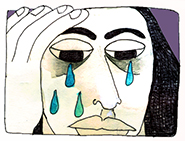
Women need to take themselves seriously or nobody else will.
Just think of it, the history of every human begins inside a woman’s body. It may have been provoked by a male orgasm, but the responsibility of the new life will be a woman’s, not a man’s. What took a man just minutes will take a woman years.
Before there were gods, there were goddesses. Many cultures worshipped the Great Cosmic Mother. Because adoring a mother meant adoring life itself. Then warlike patriarchal cultures took over and attempted to destroy women’s sacredness. Men, to feel superior, placed women in a subservient role. But this need to feel superior alienates men from the needs and struggles of others. This need to feel superior alienates men from women. And, in the end, this need to feel superior alienates men from themselves.
Man is superior if and only if he does not consider himself as such.
Women, thanks to their biology, are wired for empathy, the capacity to recognize and understand the feelings of another. Empathy permits women to protect and better care for their offspring. For example, how could a mother and her tiny baby communicate otherwise? Thus, empathy and maternal instinct are often entangled.
Empathy, a means of inter-relating, is fundamental for our survival and evolution. It is an awareness that we are all dependent one upon the other. Empathy is the basis of a sense of community, of a healthy society. Without it, there is nothing civil about civilization.
Being maternal does not necessarily mean being a mother. Being maternal means nourishing and protecting the lives of those who cannot defend themselves. Being maternal is listening when someone needs to talk, to hug when someone needs affection, to make someone smile when they are fatigued from frowning. Being maternal means respecting the lives of others even if they are not part of your family or your social milieu.
Today we live in such a conflictual world that’s constantly fragmenting itself. So, Ladies, please, do not underestimate yourselves. Remember that we are the glue that keeps the world together.
For my American lady friends getting ready to vote, please remember your role as a woman. Remember to maintain your maternal instinct towards all the babies of the world–yours and everyone else’s. Please, please, please, do not underestimate your importance!

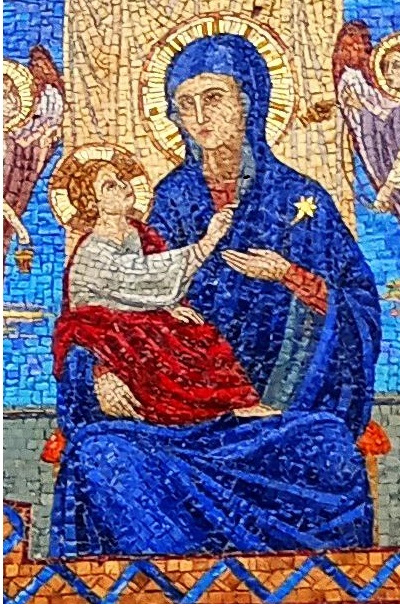
Below our balcony is a Madonella shrine. It depicts Mother Mary holding Baby Jesus. The inscription reads “Mater Divini Amoris, Ora Pro Nobis” that translates as “Mother of Divine Love, pray for us.”
Tiny urban street shrines portraying the Madonna such as the one above are known as “Madonelle” and there’s an abundance of them in Rome.
Madonelles were created to protect people on the streets. Generally, there were placed at intersections because that’s where demons often hid hoping to trap a passerby who, deciding which way to go, was temprarily distracted.
There’s also the popular belief that people are less likely to commit a crime or misbehave if Mary, the mom of all moms, is watching.
So don’t let mom down.
-30-
Related:
Ecofeminism, Barbara Mor and The Great Cosmic Mother +
The Great Cosmic Mother by Barbara Mor and Monica Sjoo + Monica Sjöö: The Great Cosmic Mother +
Watch Out For the Madonnelle street shrines +
Primates began to appear 60 million years ago. During the last 7 million years of this time, the first “hominids” evolved into being. Thanks to these hominids and all the efforts they made to survive, we sapiens exist.
But in our brief existence of c 50,000 years, homo sapiens have come to dominate the Earth. How did sapiens manage to survive when the other species didn’t. Why do sapiens feel the need to impose themselves on others as well as on nature? How did we evolve to become who we are?
Author Yuval Noah Harari writes that Homo sapiens are the “deadliest species ever in the 4-billion-year history of life on earth.” Spooky, no?
So just a few notes on our evolution from Harari’s book Sapiens, A Brief History of Humankind.:

The foragers
After their fall, finding food became a problem. Adam and Eve, once kicked out of the garden, became mankind’s first foragers. Eve, already an expert in picking forbidden fruit off trees, now had to learn food mining. That is, digging in the dirt looking for something edible.
For much of our species’ existence, we lived as foragers. It’s only in the past 200 years that we’ve become dependent more on others than on ourselves to produce the food we eat.
Evolutionary psychologists believe that our long pre-agricultural era left its imprinting on us. In Sapiens, Harari writes of the “gorging gene” and modern man’s instinct to gorge himself into obesity.
In prehistoric times, if, for example, a woman foraging for food came across a luscious fig tree full of fruit not only would she pick as much as possible to take home, but she’d also eat as many as she could right then and there because she couldn’t be sure to find such figs, or any other food, again soon. The motto was “Gorge yourself while you can”. Unfortunately, our DNA still thinks food is scarce, so we continue to stuff ourselves.
Foraging represents the original fast food, just pick and go.

Paleoanthropologists, after examining fossilized skeletons, summarized that foragers were less likely to suffer from starvation or malnutrition than their peasant descendants. The secret of their success was variety. Later, when farmers came around, they ate only what they produced thus a limited and unbalanced diet.
Ancient foragers lived in nomadic communities that had no concept of private property. They were able to interact with the world around them in a way that today’s sapiens can’t emulate. When sapiens foraged for survival, they obviously depended upon their knowledge of the natural world to obtain food. But today a person does not need this information to survive. All he has to do is go to the grocery store.
Technology has made us arrogant. And unappreciative. Our hubris will take us to hell.
Animism.
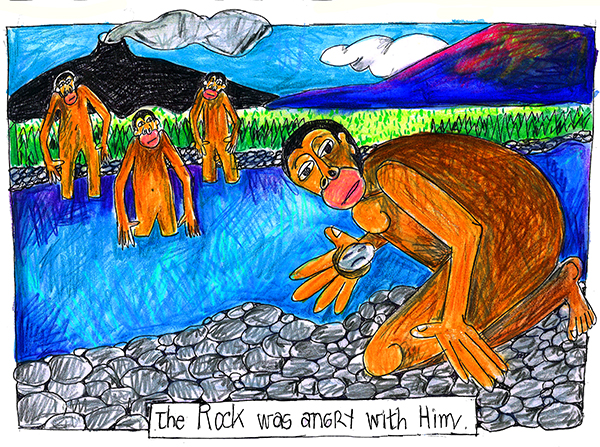
The world does not evolve around humans. And the ancient forager knew this. It’s commonly assumed that these foragers had animistic beliefs. That is, that every living thing and every natural phenomenon has awareness and feelings that can be communicated to humans. The world around the ancient foragers was animated and very much alive. Feelings were everywhere. Even rocks had feelings.
Dogs.
Living nomadically limited the number of possessions a clan could have. But from about 15,000 years ago, even before the Agricultural Revolution, humans had dogs. Dogs helped in the hunting and fighting and protecting. So, there’s no surprise he’s considered man’s best friend.

Conflict.
Although there’s little physical proof of prehistoric wars, there was obviously conflict. Especially in relationship to territorial domain and access to food.
When sapiens invaded the territory where Neanderthals had been living for generations, problems occurred. Although they began their evolution over 400,000 years ago, much earlier than sapiens, Neanderthals had not developed the sapiens capacity for abstract thought.
Neanderthals, whose population was much smaller than that of the sapiens, lived mainly in isolation. Therefore, they were prone to inbreeding as opposed to interbreeding. This meant that their genetic pool was not as varied and animated as that of the sapiens who enjoyed mixing and matching.
Being too genetically distant from each other, in theory, Neanderthals and sapiens couldn’t produce fertile children together. So why do we all have a slight percentage of Neanderthal DNA in us?
Neanderthals have been unfairly typed casted as slow witted. But that’s not the case. These archaic humans, more muscular than sapiens, had survived for more than 360,000 years before becoming extinct 40,000 years ago.
Homo sapiens and Neanderthals coexisted for thousands of years occasionally interbreeding (that’s why most of us have Neanderthal genes). But the Neanderthal’s population progressively diminished until none were left at all. Why?
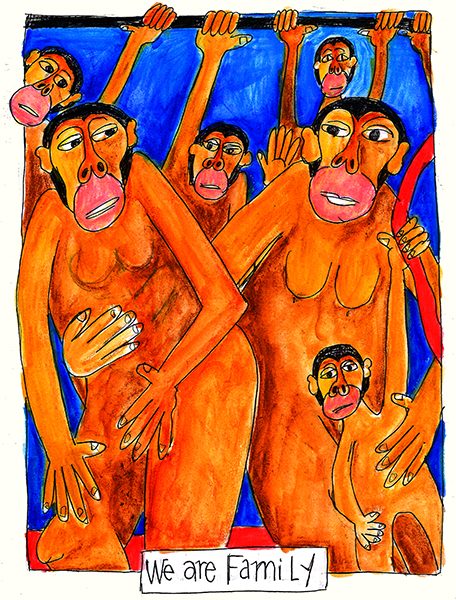
What caused the Neanderthal’s extinction? Many scholars believe 45 thousand years ago, the first act of human genocide was the massacre of the Neanderthals.
Dr. Yarin Eski, criminology expert, claims that “Genocidal violence and mass exploitation are perhaps the defining characteristics of being human…superior weapons and hunting strategies allowed sapiens to control food sources thus starving out Neanderthals.
Not all scholars agree with this theory. Some believe in the replacement theory claims that sapiens replaced all the other human species without merging with them.
The Neanderthals could not successfully compete with the sapiens’ organization and more advanced technology. This may have been the main reason for their extinction.
There’s always so much speculation when dealing with the past, especially the prehistoric past. New discoveries are being made all the time that often obliterate previous theories. Therefore, like a French film, there is no conclusion to this existential post.

-30-
Bibliography:
Harari, Yuval Noah. Sapiens, A Brief History of Humankind. Penguin Random House. London. 2011
Related: Gorging Gene: How Our “Hunter Gatherer” DNA Is Making Us Fat Now +
Yarin Eski: Unraveling Space Criminology + Space Criminology stands as an academic pursuit, committed to fostering a scholarly environment in the exploration of space-related crimes, policing, security, and justice. Our aim is to contribute to the academic understanding of this field, offering a nuanced perspective on the complexities inherent to the cosmic frontier.
How Much Neanderthal DNA do Humans Have? Our ancestors interbred with Neanderthals, and evidence of these ancient liaisons can still be found in the DNA of people living today. +Adam and Eve were the first foragers. For most of our “species” existence, we lived as foragers.
When Did God Create Adam and Eve? + **Early Hominin Childcare: A Community Effort** +
When Farmers and Foragers First Met +
Study: At Least Five Dog Lineages Existed 11,000 Years Ago +
Why Is Homo sapiens the Sole Surviving Member of the Human Family? +
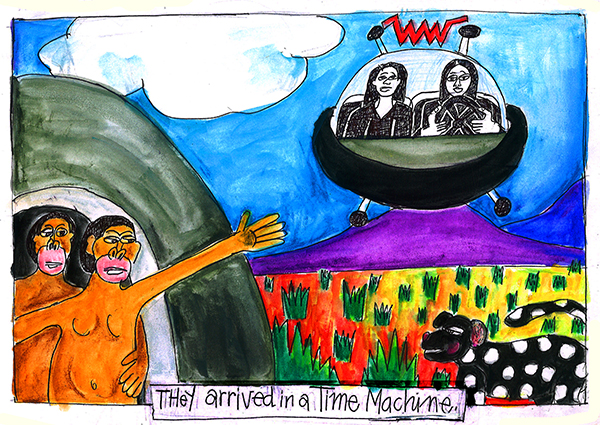
If you could really use a time machine to go back to the past, would you? Not me. Just how much would I have in common with someone, for example, from the 1800s? Just how out of place would I feel? How strongly would I feel the differences between myself and people from the past?
This post is a continuation of yesterday’s post regarding evolution and Harari’s book Sapiens. I’ve focused and commented on a few points of interest from the chapter “The Tree of Knowledge”.
Upright.
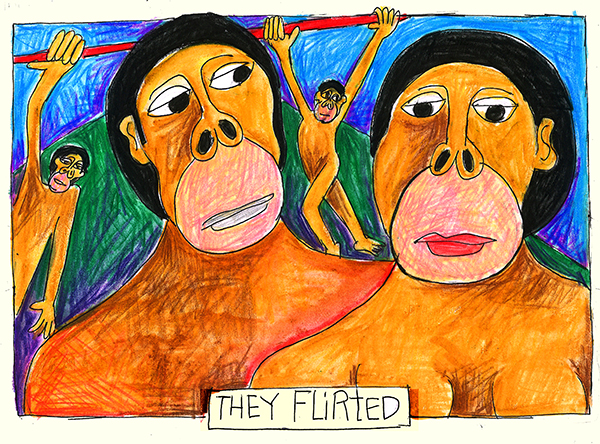
The most durable species ever (surviving for almost 2 million years) was one of the first: homo erectus (upright man). But before homo was walking around, he was living in trees. Living in trees was safer for him and his family than living on the ground where they could easily be attacked by predators. That’s why they built big nests to sleep in and moved around by swinging from tree to tree.
Brachiaton is the term used for arm swinging arboreal locomotion.

When the climate began to change and subsequently modify the environment, these early humans were forced out of the trees and onto the savannah. Once on the ground, they metamorphosized and started walking upright. With the development of bipedalism, our evolution took a big leap forward.
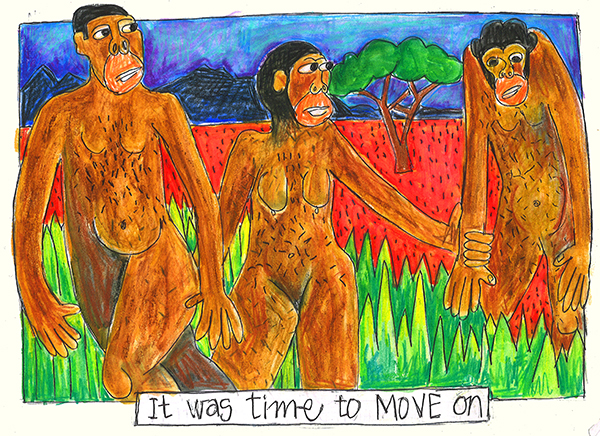
Hands now had a new role. The more hands did, the more humans learned thus helping the brain to evolve. The increased use of the hands brought about the concentration of nerves and haute couture muscles in the palms and fingers. Hands could now make tools that would facilitate labor and make us more productive.
Hands also changed our rapport with one another. Desmond Morris, in The Naked Ape, explains that walking upright dramatically changed our bodies. Male shoulders became wider as did females’ pubic bones. Upright, the sexual organs became more visible. The female breasts became more evident especially as they started getting bigger in size.
Hands could now permit us to hug and hold and caress. Upright, males and females could mate while looking one another in the eye. Eye contact made the rapport even more intimate. Walking upright changed our sexuality.
Fire.
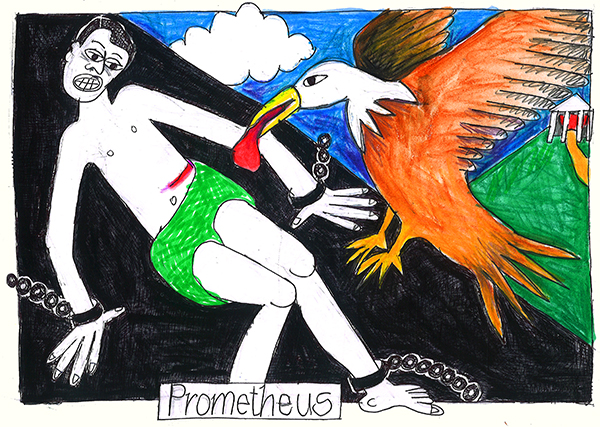
Once upon a time, only gods had fire. Zeus, afraid that humans would become too powerful, forbade humans from having it. But the altruistic Titan, Prometheus, thought it unfair and decided to give humans fire anyway. Zeus, whose ego was bigger than his heart, punished Prometheus by chaining him to Mt. Caucasus where every day a vulture would come daily to eat the Titan’s ever-regenerating liver.
The gift of fire provided a significant step in human evolution. Fire made it possible to cook plants such as rice, potatoes, wheat that were not edible if raw. Cooking also helped kill germs and parasites in food.
Not only was cooked food more digestible, it took less time to chew. A chimpanzee can spend even 5 hours a day chewing food whereas a human, thanks to their food being cooked, spends only an hour. Furthermore, the way we chew affects our teeth and our jaws. New eating habits led to genetic modifications.
Large brains and long intestines consumed a lot of energy. Eating food that’s easily digested shortened the intestine permitting more energy to go to the brain. and this, too, helped humans evolve.
Immigrant, migrants, and emigrants.
About 70,000 years ago, sapiens from East Africa began migrating towards the Arabian Peninsula and the rate of evolution picked up speedNow there are two conflicting theories as to how human evolution continued:
1. Interbreeding Theory claims that as African immigrants moved around, they bred with other humans. People today are the result of this interbreeding.
2. Replacement Theory claims that the differences between species (including different mating practices) provoked incompatibility and revulsion. So, the species remained distinct one from the other.
We would not have evolved as we have had it not been for humans on the move.
In the end, we are all immigrants, no?
TO BE CONTINUED…
-30-
Related: Neanderthal extinction + Neanderthal Extinction Was “Genocide” Committed By Humans, Argues Researcher + Ancient DNA Reveals a Tragic Genocide Hidden in Humanity’s Past + The original mass genocide +
Desmond Morris and Surrealism +
From Hunters to Settlers: How the Neolithic Revolution Changed the World +
Not all evolutions are the same.
“Homo” is a genus of great ape (family hominidae) that we’re a part of. This genus, that’s produced several species, began its evolution in Africa about 2.5 million years ago. But our species, the sapiens, began its evolution only 300,000 years ago. Although we sapiens are the only remaining species of the homo genus, our existence and subsequent evolution was possible because of those who came before us. Sapiens walked on their paths to make super highways.
Our evolution was gradual and slow. At a snail’s pace, we evolved from a simpler to a more complex being. We were sapiens, we were smart. But look at us now—what went wrong? We are no longer behaving intelligently. We are no longer evolving. We are, instead, degrading. Why? Why is humanity so carelessly destroying everything that took so long to evolve into existence?
There’s no need for me to give examples of what I’m talking about. All you need do is watch the news or read comments on social media.
This feeling of being surrounded by decadence is overwhelming. Suffocating. Alienating. Debilitating. And I need an explanation as to how we got here so I can take another road.
At present I’m reading Yuval Noah Harari’s Sapiens: A Brief History of Humankind (2011). Harari takes us on an odyssey through human history covering 13.5 billion years of prehistory and history.
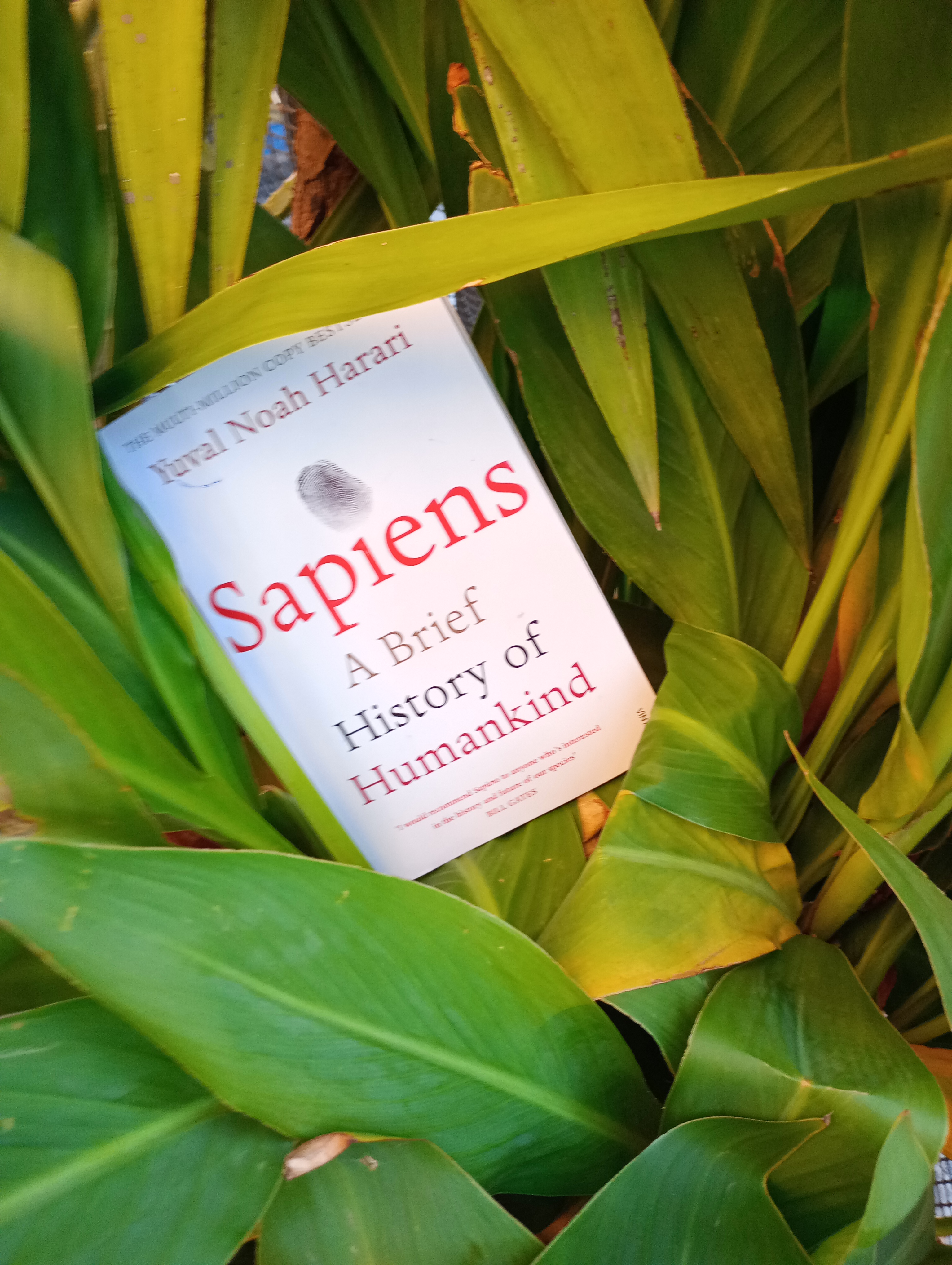
“There were humans long before there was history” says Harari and these prehistoric humans were insignificant animals who had little impact on the environment. But that would all change with their evolution. And that evolution got a booster when different species began interbreeding thus increasing their genetic pool.
Humans evolved from the genus of apes known as Australopithecus aka “Southern Ape”. They evolved according to the environment they were in and how they were able to adapt to it.
When it comes to dating the past, timelines are always changing. Because new discoveries are being made, because new technologies help facilitate these discoveries, because new approaches in interpreting the information occur. Initially it was said that the homo habilis (Handy Man) came before homo erectus (Upright Man) because man likes to have everything easily categorized. But the evolution of man did not follow some kind of precise sequence with one species evolving directly from another. It’s more than likely homo habilis and homo erectus co-existed in in Eastern Africa for almost half a million years.
We are overlapped and juxtaposed.
Regardless as to what species came first, the transition from walking on all fours to walking in an upright position gave a big jump start to our evolution.
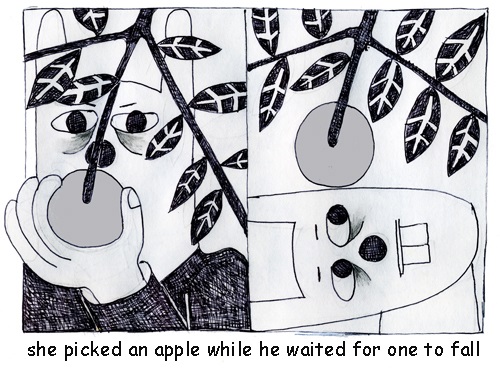
(from Bebina Bunny’s Cabinet of Curiosities)
I’ve written about the importance of hands many times here. Because hands help us accomplish things. They can help create new mental pathways. They make it possible to better observe things because we can bring them closer to our eyes and because we can touch, manipulate, and explore them. Hands help us explore the world in a way that our eyes can’t. Hands help our brains to grow.
However, the body is built on a budget and big brains are heavy and a drain on the body. Having a bigger brain meant, says Harari, that more time was spent searching for food to feed that hungry brain. It also meant that muscles atrophied as humans diverted energy from biceps to neurons.
Big brains need big skulls, and big skulls are a problem during childbirth. So, for humans, natural selection favored earlier births making babies small enough to come out of momma. But this also meant that babies had to have extra care after their birth for a long time. Giraffes, zebras, horses, and pigs are just a few examples of animals whose offspring can stand up and walk the same day that they’re born. Human babies, however, are dependent and needy. Raising children requires constant attention thus, in prehistoric times, “it took a village to raise a child”.
Evolution is not just about bodies.
So for today, Harari’s book can take a rest and I can take a walk.
TO BE CONTINUED…
-30-
Related:
Art for housewives and Hands:
In Praise of Hands + Lying with your Hands + The Case For Working With Your Hands + IN PRAISE OF HANDS: Knit yourself well. + Extend your hands with Needles and Pins and huipiles +
Bibliography:
Harari, Yuval Noah. Sapiens, A Brief History of Humankind. Penguin Random House. London. 2011
Other:
An Evolutionary Timeline of Homo Sapiens + What does it mean to be human? +
The 7 Homo Species Close to Present Humans That Existed on the Earth +
Oldest Known Neanderthal Engravings Were Sealed in a Cave for 57,000 Years, The art was created long before modern humans inhabited France’s Loire Valley +
La Roche-Cotard prehistoric site +
World’s Oldest Cave Art Found—Made by Neanderthals? +
Discovery of cave paintings and decorated shells reveals Neanderthals were artists, Artwork found in Spanish caves suggests ability to think symbolically and creatively was not unique to modern humans +
THE HAND, HOW ITS USE SHAPES THE BRAIN, LANGUAGE, AND HUMAN CULTURE book review +
Related: An Evolutionary Timeline of Homo Sapiens +
The 7 Homo Species Close to Present Humans That Existed on the Earth +
Oldest Known Neanderthal Engravings Were Sealed in a Cave for 57,000 Years, The art was created long before modern humans inhabited France’s Loire Valley +
La Roche-Cotard prehistoric site +
World’s Oldest Cave Art Found—Made by Neanderthals? +
Discovery of cave paintings and decorated shells reveals Neanderthals were artists, Artwork found in Spanish caves suggests ability to think symbolically and creatively was not unique to modern humans +


