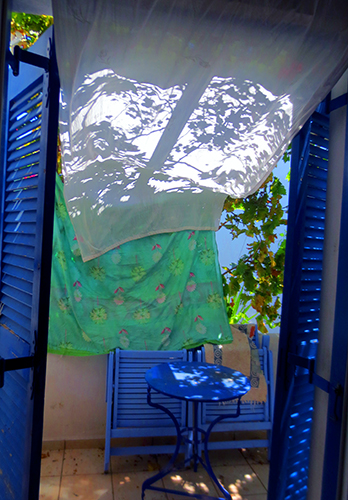
Covid has kept us away from our lovely Sussurrata. Our little family of plants has felt our absence. Some old friends have died while we were away. But then there are the unexpected new entries. Such as that of a very sauvage looking tree now growing in the pot that once was the home of a fragile lemon tree.
I have a habit of throwing seeds into pots (it seems such a waste to trash them) and in this way I’ve started two peach trees, one lemon tree, and numerous avocados. It’s possible that I threw berry seeds into the pot where the suspected mulberry is growing.
Volver the Cat napping as I prune the tree
mulberry tree?
mulberry
Volver and the Leaves
If it is a mulberry tree, I doubt that I will be seeing any fruit from it any time soon. However, I’ve read that the leaves are highly nutritious (as they contain polyphenol antioxidants, vitamin C, zinc, calcium, iron, potassium, phosphorus, and magnesium).
In Asia, mulberry leaves are not only used to feed silkworms but to make tea, too. I’d like to try making the tea but want to make sure my new little tree is indeed a mulberry. Can anyone help me out? Thanks.
I will be taking a break from “Toni O” stories for awhile. It will take some time to metabolize all that has happened. And I want to reflect on the best way to continue her story. In the meantime, I will share fotos of the beauty that’s always there just waiting to be noticed.
For her role in Fences, Viola Davis won the Oscar for best supporting actress. In her acceptance speech, she spoke of graveyards full of people who had stories yet to be told. Those stories—“the stories of the people who dreamed big and never saw those dreams to fruition, people who fell in love and lost”, said Viola, needed to be exhumed. My mother’s story is one of those stories that needs to be told because her story is that of so many other women who have had to adapt in order to survive. And adaptation is the keyword here.
Recently, tourists on a ship cruising Lago Argentino in the Patagonia were awed when they saw a puma adrift on an ice floe. After giving the puma the best photoshoot he’ll ever have, local authorities were informed. “No problem”, they said, “pumas are great swimmers.” It’s doubtful, however, that the drifting puma shared their tranquillity. And our total lack of respect for the Earth, this planet we call home, is provoking more and more situations like that of this puma living out of context.
Eighteen years ago, I began this blog after reading the Scientific Warning of 1992, an appeal to mankind written by some 1,700 leading scientists including Nobel laureates in the sciences. The warning begins like this:
“Human beings and the natural world are on a collision course. Human activities inflict harsh and often irreversible damage on the environment and on critical resources. If not checked, many of our current practices put at serious risk the future that we wish for human society and the plant and animal kingdoms, and may so alter the living world that it will be unable to sustain life in the manner that we know. Fundamental changes are urgent if we are to avoid the collision our present course will bring about.”
And that was 30 years ago. Unfortunately, the situation has only gotten worse. Mankind is actively pursuing his own self-destruction as we have been warned for years that we are reaching the tipping point, that is, the point of no return, and continue to do nothing about it. And so here we are, standing on the border of total disaster.
Remember the 1968 film “Planet of the Apes” where astronauts crash on what they believed to be a foreign planet controlled by apes. The astronauts are imprisoned and treated as inferior beings. One astronaut, George Taylor, manages to escape with Nova, a female captive. On horseback, they follow the shoreline until something shocks Taylor so much he gets off his horse. There in front of him is a broken Statue of Liberty. Only her head and arm holding up the torch remain. Taylor then realizes that he and his crew had not crashed on an alien planet but on their own planet, Earth. The Earth’s apocalyptic dive had been cause by the planet’s own inhabitants. The film ends with Taylor on his knees screaming “You maniacs! You blew it up! Damn you! God damn you all to hell!”
Before the theories of Charles Darwin were known, it was actually Herbert Spenser who promoted the theory of an evolution based on the inheritance of acquired characteristics. Darwin, instead, was more interested in the concept of adaptation.
Evolution and adaptation are not the same thing. Evolution is a process of growth whereas adaptation is a change needed for survival. Evolution comes with time whereas adaptation has a feeling of urgency– sometimes you must be able to quickly adapt in order to survive.
Adaptation can be passive or active. Conformity is an example of passive adaptation and, as seen in Nazi Germany and Fascist Italy, it is a form of adaptation often chosen by the masses.
Active adaptation has different levels of intensity depending upon the situation.
Providing trees to create shade for livestock is a form of active adaptation. Colombian farmers have discovered that shade not only protects the animals from suffering the heat, it can also, for example, make cows produce larger quantities of milk as well as make it more nutritional. Source HERE.
Brazilian photographer Sebastião Salgado and his wife Lélia Deluiz Wanick took active adaptation even further. Salgado was in Rwanda documenting genocide when a close friend, along with his wife and children, was murdered. The atrocities he saw traumatized him so much that when his parents offered him the family farm in Brazil, he and his wife immediately accepted the offer. But once there, they found a land with a devasted ecosystem. What the land needed was trees.
Before and After
The couple got others involved in their replanting program. They started with a donation of 100,000 seedlings and hired two-dozen workers to help with the planting. Many of the seedlings died but they kept on planting and seeking donations. It took years but eventually they were able to heal the land by restoring its ecosystem.
More examples of Active Adaptation: This Tower Pulls Drinking Water Out of Thin Air…Ethiopia collecting much needed water from the air + Have you ever heard of Hans Brinker, the little Dutch boy who put his finger in the dam? The story may not be true but the dam is. Without it, Holland would be flooded + What’s the Deal with Bamboo Scaffolding?… a 1918 earthquake in China was the catalyst for constructing buildings with bamboo
My mom grew up in the Ozarks. She believed that staying there would give her few possibilities in life. So she changed her condition of possibility by moving to San Antonio. Women at the time were raised to believe that their main objective as a woman was to find a husband. And my mom did only it didn’t work out. The brutal separation from my dad changed her attitude towards marriage and the traditional role society gave women. My mom understood that, despite her efforts, she wasn’t a conformist and no longer had any intention of becoming one.
Of course, in the late 1950s, being a divorcée with a small child to raise was a challenge. Even finding a place to live was difficult. My mom said that many many times she would try to rent a place for us to live only to be told “no pets or children allowed”. But my mom had a very strong survivor instinct. Despite all her struggles, I never missed a meal, always a clean bed to sleep in, and wore the loveliest of clothes.
I don’t know how they met but my mom and Gloria became so close that they considered themselves sisters. I used to call Gloria “Aunt Gloria” and Gloria’s kids called my mom “Aunt Toni”.
Aunt Gloria came from a Mexican culture and shared her love of Mexican music with my mom. The two “sisters” would often sit in the living room with the music blaring singing their hearts out as if it could help them exorcize their sadness.
Ray Charles said that he got involved with country music because it had a story to tell. Well, the lyrics to Mexican music are more than a story—they’re a telenovela! And as my mom sang along, she became the star.
I was not with my mom when she died…a sorrow I will carry within for the rest of my life. Mercifully, Dr. Salinas was there in the room with her. Together they were listening to her favorite singer, Chavela Vargas. When I told him that my mom’s theme song was “Echame a mi la culpa”, he put it on immediately and sang along while standing next to her bed. My mom, too weak to talk, attempted to move her mouth as if singing. She died a few hours later.
It had never occurred to me until then as to why my mom was so attached to this song. But really, all I had to do was listen to the lyrics. It was easy to imagine my mom saying these words to the man who’d broken her heart because of all the horrible things he’d done to her. Nevertheless, she wanted him to be happy so, when friends asked why they’d split,she told him he could blame her instead of revealing what a jerk he’d been:
Échame a mí la culpa De lo que pase Cúbrete tú la espalda Con mi dolor
“Cover your back with my pain” is a pretty heavy duty phrase, no?
If you’re going to suffer, sing about it. This is what Mexican rancheras have taught me. And no one respected this philosophy more than Chavela Vargas.
Ranchera songs are populated by the broken hearted who go to cantinas to drink away their sorrows. This music was traditionally dominated by men until Chavela elbowed her way in to make space for las borracheras, women who could drown in alcohol as easily as men could. And before criticizing these tequila drinking mujeres, it should be noted that Chavela & Co came from pre-feminists times. This Cantina Solution was a reply to conformity and fake respectability. Drinking like men suggested a form of emancipation.
Chavela Vargas was born in Costa Rica but moved to Mexico at the age of 14 where she sang in the streets until she got gigs in cantinas. Here she made no secret of her sexuality and was known as a cigar smoking, heavy drinking womanizer. Chavela sang in cantinas for years until she was discovered by singer and songwriter extraordinaire José Alfredo Jiménez.
Jiménez did not play a musical instrument and knew little about musical technicalities but he wrote over 1,000 songs many of which are still well-know today. Together, Jiménez and Chavela turned pathos into poetry.
Chavela felt at home with Jiménez’ songs. Take, for example, En El Último Trago where the singer asks an ex-lover to drink together until oblivion. Because:
The time hasn’t taught me anything, I always make the same mistakes, I drink again and again with strangers and mourn because of the same sorrows.
Once her career took off, Chavela came in contact with a new milieu. She became friends with Diego Rivera and Frida Kahlo and was often their house guest. It’s also rumored that Chavela and Frida had an affair together. Besides, Frida liked to wear huipiles, Chavela ponchos. If you saw the movie Frida, you can’t help but remember Chavela singing La Llorona.
But the Cantina Solution caught up with Chavela. She became a major alcoholic and, during the 1970s, gave up singing. But almost 20 years later, at the age of 81, Chavela returned to the stage. She debuted at a sold-out Carnegie Hall at the age of 83. After each song, she was rewarded with a standing ovation. The audience could not have enough of her. In the words of Pedro Almodóvar, Chavela made of abandonment and desolation a cathedral in which we all found a place.
The Spanish poet, Federico García Lorca, was one of Chavela’s passions. Unfortunately, García Lorca’s life was brief. In 1936, he died at the age of 38, assassinated during the Spanish Civil War.
In 1993, Chavela went to Spain and stayed in a room that once had belonged to García Lorca. Every day, she said, a yellow bird would come peck on the room’s window and she was sure the bird was the spirit of Lorca himself.
My childhood was greatly influenced by Fela. I don’t know when exactly she came into our lives. All I know is that my parents separated when I was a baby and my mom had to work. And then one day, voilà, there was Fela.
The relationship between my mom and Fela was a very complimentary one——two women with needs who were able to help each other out. Fela had found a home with us and earned money to send to her parents in Piedras Negras. And my mom had someone she trusted to care for me while she was working. Plus Fela kept our home clean as well as full of Mexican aromas coming from the kitchen and the sounds of the ranchera music she played full blast when ironing.
amusement park photo
This went on for a few years. Then Fela discovered she was pregnant and everything changed. For a while she went back to Mexico then back to San Antonio then she was gone again. For years we didn’t hear from her until one day my mom unexpectedly ran in to her. It made my mom happy to see Fela again and she wanted to share that happiness with me. So one evening we went to her tiny little house. The living room was dominated by a big TV set and on top of that TV was a huge photograph of me as a child. It was a shock—after all the years that had past and despite having lost contact with one another, Fela still kept the memory of me close to her. It was and continues to be one of the most touching experiences of my life. I left for Italy a short time afterwards but my mom kept up with Fela and even went to her son’s wedding.
When the Trump administration decided to use ICE to take small children away from their mothers only to lock them in cages, I was shocked and disgusted. But what I felt most of all was pain–—what if something like that had happened to Fela and her baby?
Separating a mother from her child is evil and against the laws of nature. It is also highly misogynist as it belittles the very foundation of motherhood. And it shows a total lack of respect for human life…the damage done to those children is irreversible. As just thinking about it all throws my biorhythms into tilt, I will stop here but with the invitation to read The Lace Collar a post about Ruth Ginsburg and her fight for gender equality.
Related: Single motherhood has grown so common in America that today 80 percent of single-parent families are headed by single mothers — nearly a third live in poverty.” + Parents of 545 children still not found three years after Trump separation policy