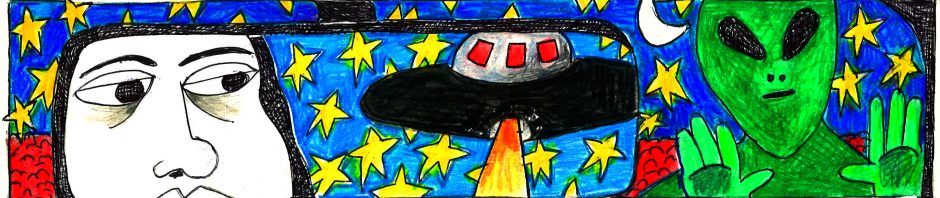
Living the Lockdown

Living the Lockdown

On Valentine’s Day of this year, Mattia showed up at the hospital in Codogno with a light case of pneumonia. Despite treatments, the pneumonia persisted. Annalisa Malara, doctor at the hospital, thought that if a standard illness is treated in a standard way and doesn’t go away, then maybe it’s not a standard illness. And thanks to her female intuition, she tested Mattia for the coronavirus. Once the results were known, life in Italy began to radically change.

The entire town of Codogna became “zona rossa” and quarantined. But the coronavirus kept spreading thus the extension of the zona rossa—first the entire region of Lombardy and now all of Italy. We are living a new version of la vida loca and it’s called lockdown.

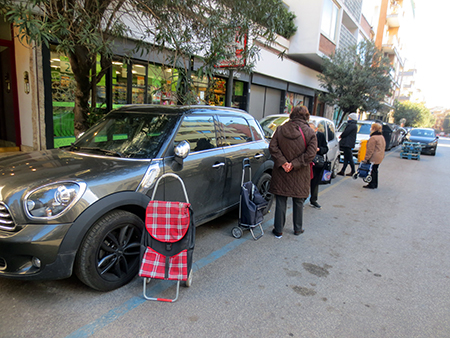
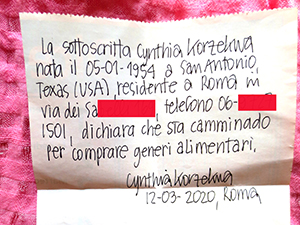
The coronavirus vade mecum put out by the government stresses the importance of social distancing to avoid contagion. Schools are all closed. Masses can’t be held. Museums, cinemas, sporting events are closed, too. You can go to the grocery store but must stay at least 1 meter away from other people. Even the banks limit the number of people who can go in at a time.

There’s also an emphasis on handwashing. Much contagion comes from touching contaminated surfaces. So we are all now cleaning communally used objects such as door knobs.

Italy has an excellent health care system. But it is not prepared to have so many people in such extreme conditions. Doctors and nurses who have been working non-stop are starting to crumble. Hospitals are full and intensive care is at its limit. And, we’ve read, it may get to the point that doctors will have to choose whose life to save. Precedence will be given to those with more possibilities of being cured. Thus the elderly, who generally have pre-existing medical conditions, are more at risk.

The coronavirus likes to travel and will soon be coming your way. So be prepared. I am very lucky to be living in a country with a socialized medical system. No one has to pay to be tested or to be treated. It’s better to pay for the health of everyone than it is to pay for Wall Street bailouts, wars, and walls. If nothing else, the coronavirus will help us reconsider our priorities.

It’s a beautiful day in Rome and I’m happy to be here!

Note: The root of Mattia’s COVID 19 contamination came from Bavaria…we are still wondering why, if it started there, so few cases from Bavaria are being reported.

Related: Annalisa Malara + CORONAVIRUS, DA MONACO DI BAVIERA A CODOGNO: IL VERO PAZIENTE 0 È LA GLOBALIZZAZIONE

-30-

Posted in Art Narratives, Rome/Italy | Tagged , | 11 Comments

Coronavirus

Fighting Back

Posted in Art Narratives, Drawings & Paintings, Lifestyle | Tagged , | 2 Comments

Façades

La Lupa e La Madonna

Rhea Silvia was a vestal virgin and daughter of a king. When she gave birth to Romulus and Remus, her brother ordered the death of his neo-nephews to avoid competition for the throne. But the god, Tiberinus, thought that killing babies was unethical and had their lives spared.  Left on the banks of the Tiber, Romulus and Remus were found by a she-wolf. La Lupa, as she is known in Rome, nursed the twins and helped them survive. Romulus and Remus being suckled by La Lupa has become the symbol of Rome and their image is found all over town.

Also commonly seen are the Madonnelles. That is, little Madonna representations meant to keep watch over the street thus placed near an intersection. Often the Madonnas are embedded in little shrines and probably took the place of the statues of ancient Roman gods.

We should feel very protected as above our balcony is La Lupa and below is La Madonna.

Our neighborhood is full of beautiful façades including that of our building. Our balcony is very narrow but I have filled it with yucca plants as they are so easy to care for. Plus plants are not only lovely to look at, they help clean the air. Phytoremediation is the use of plants to detox nature and one reason why green roofs and vertical gardens have become so popular. I would like to imagine all of Rome’s balconies full of plants but unfortunately so many are bare or used for storage. But if you are truly concerned about climate change, why not plant something?

-30-

Related: A Mended Umbrella and phytoremediation + Phytoremediation + Green Roof +

(“History of a Home”  Cynthia Korzekwa ©)


Posted in Art Narratives, Drawings & Paintings, Ecofeminism, Rome/Italy | Tagged , , , , , | Leave a comment

Miss Marple, My Favorite Profiler

During the 1970s, the FBI used much tax payer money to create their Behavioural Science Unit in Quantico, Virginia. Not only many books have been written about criminal profiling but the TV and film industry has made a huge profit from its concept. My main question is this: if we know, as we’ve learned from profilers, that most violent criminals have dysfunctional childhoods in common, why do we spend so much money on prisons and not on prevention? Why not help children grow up to be healthy citizens instead of provoking them into crime? Why not create adequate schools that work with child psychologists who can spot behavioural problems and try to resolve them in time? How much crime are you not preventing but promoting, for example, when you lock up babies in cages as a means of retaliating against illegal immigration?

Children in Cages

Before the FBI’s criminal profiling, there was Miss Marple. Miss Marple didn’t need an FBI profiler to know a criminal when she saw one. A careful observer of human behaviour, she relied upon her own experience to identify personality types. For example, she would observe someone then say “Oh, he reminds me of Jack, the butcher’s son, who was a petty theft.” Miss Marple had developed the art of abductive reasoning. That is, arriving at a conclusion not based on standardized theories but on careful observation followed by the search for the simplest explanation as to the why behind what’s been observed.

Miss Marple, profiler

We should focus less on the crime and more on the dynamics that lead to that crime. If you can obliterate the reason why the crime has been committed, you obliterate the crime. Elementary.

Ted Kaczynski aka Unabomber, for c. 20 years, lived in a 3 x 3.6 m cabin he’d built near Lincoln, Montana. It was here in his tiny spartanic home that he built bombs and wrote his manifesto. His mother said Kaczynski was a happy child until, because of an allergic reaction to medication, he was forced to stay in a hospital in isolation. Even visits from his parents were restricted. Once out of the hospital, his personality radically changed.

The Unabomber's Home

Kaczynski was extremely intelligent and his parents pushed to have him skip two grades thus forcing him to be the oddball among his fellow classmates. At 16 he went to Harvard on a scholarship and became even more of an oddball. And, at Harvard, Kaczynski also became the victim of experiments conducted by psychologist Henry Murray. During WWII, Murray had collaborated with the OSS (a predecessor to the CIA) specializing in interrogation methods. Once back at Harvard, Murray experimented personality manipulation (mind control) on students such as Kaczynski. The techniques Murray used were based on humiliation and nothing short of torture.

Linda Patrik is the Unabomber’s sister-in-law. The two have never met. Initially, it was because Kaczynski resented his brother’s marriage as it reanimated those feelings of abandonment he’d experience as a child left in the hospital. He was so angry that he wrote vicious things about Linda in a letter to his brother. Linda read the letter as well as other things written by Kaczynski. When the Unabomber’s manifesto was published in the newspaper, Linda, like Miss Marple, linked similarities. She was convinced that her brother-in-law was the Unabomber and insisted that the FBI be informed. When the Unabomber was apprehended at his cabin, a bomb ready to be sent was found under his bed. The Miss Marple in Linda had saved someone’s life.

The more children you desecrate, the more criminals you generate.

-30-


Related: The anatomy of motive : the FBI’s legendary mindhunter explores the key to understanding and catching violent criminals by Douglas, John E; Olshaker, Mark read for free on Archive HERE + Criminological and Forensic Psychology by Helen Gavin + Mindhunter: Inside the FBI’s Elite Serial Crime Unit read for free on Archive HERE + Criminal profiling by Jenny MacKay, read for free on Archive HERE + Miss Marple on Archive HERE + Christiana Morgan, Murray’s lover + MIND WARS and the US govn’t on Archive

Posted in Art Narratives, female consciousness | Tagged , , , , , , , | 1 Comment

The Significance of Neighbourhood

A home is also about place. The physical location of your home is an extension of your identity. Characteristics such as oriental or occidental, polar or tropical, urban or rural, swanky or slum will all affect the way the home is perceived. And experienced.

In a world full of dissociations, of Us versus Them, a neighbourhood has a special significance. It implies an interconnectedness with those who are part of the same place.

L'arco di via Doria

Our home in Rome is in the Trieste-Salaria neighbourhood. Long before we lived here, the area was inhibited by Neanderthals. But much has happened in the past 250,000 years. Such as the early 1900s construction of a fairy tale complex known as Coppedè. Named after the Florentine architect who designed it, Gino Coppedè, it’s a mix of Liberty, Gothic, Medieval, and Baroque. The area makes me think of Judy Garland walking around Oz saying “Lions and tigers and bears” as the buildings are embellished with murals and relief sculptures depicting all kind of hybrid animals. Since he was a freemason, Coppedè was fixated with esoteric symbols such as the huge chandelier hanging from the via Doria arch at the complex entrance. From the arch you can see the Fontana delle Rane (frogs) at Piazza Mincio inspired by Bernini’s Fontana delle Tartarughe (turtles) of Piazza Mattei. (Bernini is considered by some scholars to be a freemason, too.) It’s like walking into a picture book.

The European city is quite different than the American one. Most people live in apartment buildings surrounded by commercial activities. From my living room window, I can often smell the roasted coffee or the baking pastries coming from shops across the street. And anything necessary for daily life is within 100 meters so we don’t need a car. Walking helps me create a rapport with my neighbourhood. And going to the same shops all the time creates a feeling of familiarity making it almost mandatory to spend a few minutes “shooting the breeze” with the shopkeepers.

Neighbourhoods are a means of helping people stay connected.

-30-

Related: Coppedé, a magical neighborhood in Rome + The Coppede’ Quarter in Rome – an insider’s view of unusual architecture

P.S. Legend has it that the Beatles, after a concert at the nearby Piper Club, threw their clothes into the Fontana delle Rane.

(“History of a Home”  Cynthia Korzekwa ©)

Posted in Art Narratives, Drawings & Paintings, Rome/Italy | Tagged , , , , , | 2 Comments