
Circe becomes a mortal:
To better understand the gods, it’s important to keep in mind that they are immortal and, after thousands of years of living the same life over and over again, they are bored and seek distractions. That’s why gods like novelty and begrudge those who annoy them.
Chronically restless, a bored divinity tries to keep himself entertained by interfering in the lives of mortals. As gods are self-referential, they are indifferent as to the harm they provoke.
Gods are Divinity Supremacists and want all the power for themselves. They are petty, vindictive, sadistic, and thrilled to torment those who help mortals in any way.
When still a young girl, Circe saw her uncle, Prometheus, being whipped then chained to a rock where an eagle came every day to rip out his liver. His crime? He gave fire to mortals so othey could evolve. This made the gods furious because they wanted to keep humans in a state of fear and misery making them more easily manipulated. The more mortals were powerless, the more powerful the gods were. It was then that Circe first began questioning the gods. Do they get satisfaction only by being cruel to the less fortunate. Are gods little more than privileged bullies?

Circe’s first love was the mortal, Glaucus. She loved him so much that she was willing to risk her father’s wrath by making him immortal. But after his transformation, Glaucus, instead of being loving and kind, treated Circe with contempt as now he had his eyes on the beautiful Scylla. The heartbroken Circe gave vent to her pain by using her powers to transform Scylla into a monster with twelve feet and six heads. But revenge had not made her feel better.
And now, once again in love with a mortal, Circe had no intention of repeating her previous mistake. To the contrary, she wanted to give up her own immortality so that she and Telemachus could grow old and live the rest of their lives together.
Immortality is not about happiness, it’s about power. Yet as a mortal, Circe had a power the gods didn’t have–the power of empathy.
Gods were born gods but it took millions of years for man to evolve into his present state. Empathy contributed greatly to this evolution.
Years ago a student asked anthropologist Margaret Mead what the earliest sign of civilization had been. After a brief hesitation she responded “a healed femur”. The femur is the longest bone in the body and important for walking. If fractured, it takes weeks to heal. During prehistoric times, a person in such a condition could survive only had someone been there to care for him. In other words, helping another survive gave birth to civilization.*
Empathy is not just a form of compassion. It’s also a form of rational thought and decision making based on the capacity to understand the feelings of another. Women, being mothers, are more empathic than men. Empathy enables women to communicate with babies too small to speak and children too young to properly express their needs.
Empathy is a form of interrelating. And interrelating with others is fundamental for our survival. The study of man’s evolution shows us that we are more likely to survive if we work together. For this reason, in prehistoric times, it was important to belong to a clan. Every member of the clan was expected to contribute to the needs of the community. Who didn’t contribute was exiled. Exile was a kiss of death because surviving alone without the clan was impossible.
Circe and Penelope helped each other survive. Thanks to empathy, they were able to recognize themselves one in the other. This common recognition was the foundation on which they built their friendship.
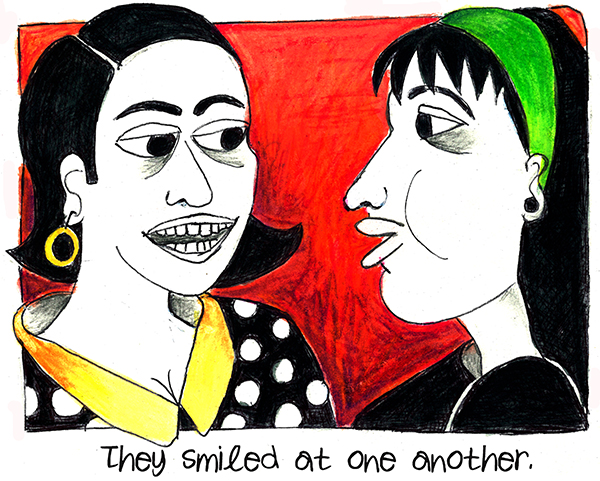
When you smile, empathy makes me smile, too. So please, smile as often as you can.
*Some scholars (male) claim Mead never made this affirmation. Whether or not she did doesn’t change the validity of such a consideration.



 The Narrative Within
Pingback: Taking care of Bro | The Narrative Within