The 1950s was a period of cultural evolution and modification. The Second World War had modified many beliefs related to the meaning of life. And for many, life became exceeding existential.
Lawrence Ferlinghetti (1919-2021), poet, publisher, and activist, was born in New York. His dad was an Italian and “wops” were not well liked in NYC at the time. The stress from being an immigrant caused his dad to have a heart attack just a short time before Lawrence was born. His mom, of Portuguese Jewish descent, was totally overwhelmed by the difficult situation she was in. She was susequently committed to a mental institution. The young Lawrence was shipped off to live with an aunt before being put into a foster home.
Your childhood follows you wherever you go and that of Lawrence was no different.
Struggling to find his place in the world, Ferlinghetti studied journalism at the University of North Carolina. He got his MA from Colombia having written his thesis on John Ruskin and J. W. Turner. Although he was intimate with words, he liked visuals, too.
In 1951, Ferlinghetti moved to San Francisco where he founded City Lights, an independent bookstore-publisher. Ferlinghetti now focused much of his energy on Beat Poets (although he is often categorized as a Beat poet, Ferlinghetti claimed with emphasis that he was not). In 1956, City Lights published Alan Ginsberg’s “Howl” provoking Ferlinghetti’s arrest for publishing obscene literature. Luckily, he was acquitted.

“Saturn devouring his son” byFrancisco Goya
Ekphrastic poetry was part of Ferlinghetti’s literary repertoire. One of his better known examples is “In Goya’s Greatest Scenes We Seem to See . . .” In this poem, Ferlinghetti writes of the “suffering humanity” in Goya’s paintings and describes gory scenes with groaning babies, butchered cadavers, and hollering monsters. Terrible stuff, says Ferlinghetti. But you can easily compare the suffering you see in Goya’s paintings with the suffering of Americans on their interstate highways. The landscape may be different but the theme is the same—people still seem to be victims of a “senseless, predatory power.”
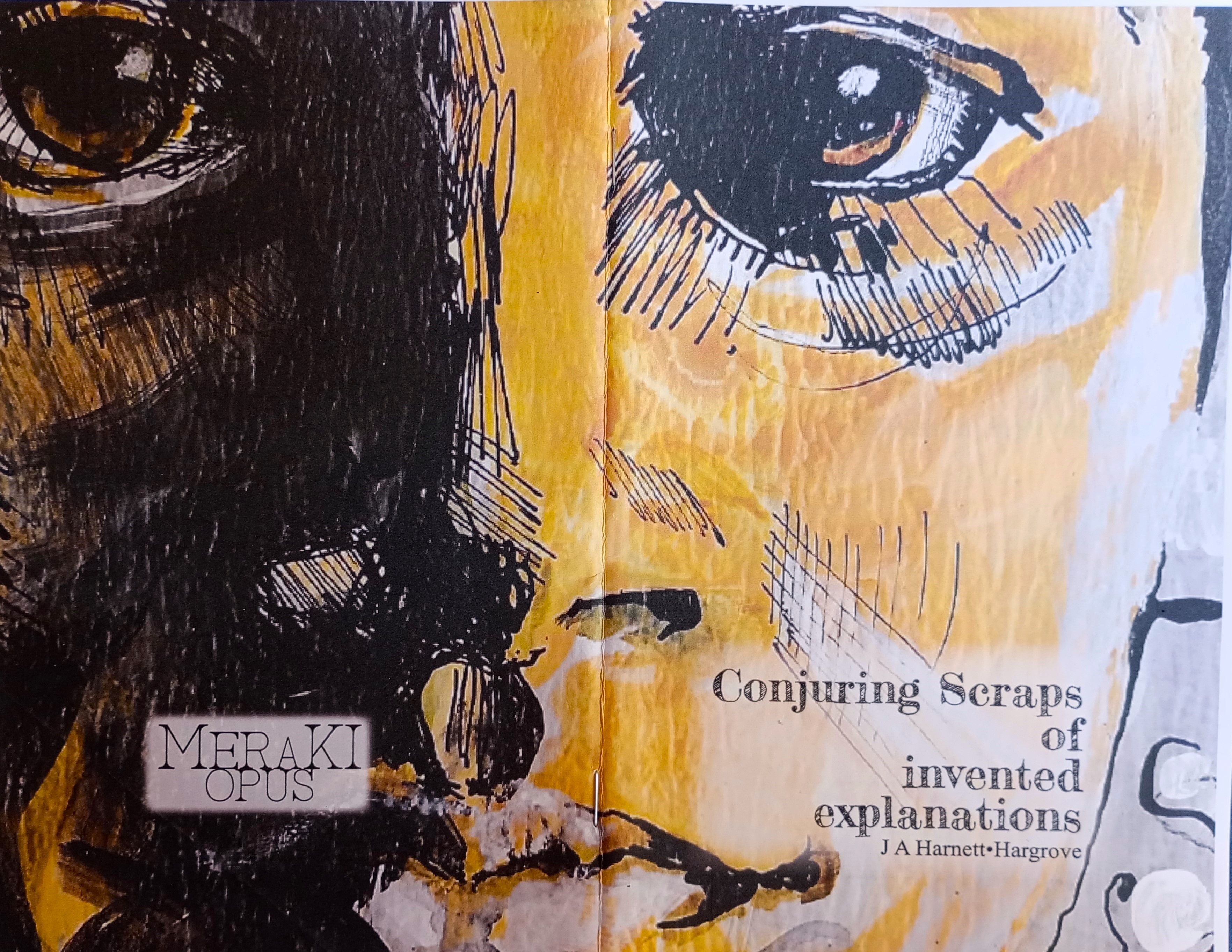
Cover of MERAKI; Meraki Opus Press 2019
Writer, artist, and designer Jayne Harnett-Hargrove publishes the quarterly “Meraki”, a seriously playful magazine exploding with visual poetry. Jayne and I have been Blog Buddies for some time so when I learned that she’d attended a performance of Ferlinghetti’s poetry reading, I asked if she would be willing to write her own ekphrastic response to Ferlinghetti’s reading:
“Onto Ekphrastic” by Jayne Harnett-Hargrove
Afterward, + for a long time, i wanted to publish something, ANYTHING, a chapbook,
broadside, or perhaps an omnibus while he was still top editor + curator at that SF City Lights
publishing house. Since he has past, not so much …
i don’t remember clearly, clearly my mind is a bit rough. But when Ferlinghetti took the stage, or
really, as he wedged himself in front of the stuffed-in crowd at the City Light Bookstore that
afternoon, i became spell-cast.
He introduced his book Seeing Pictures, a slim volume of ekphrastic poetry. Having introduced
the bait, we were all eager to bite. He was eloquent + humble in the reading. Amusing + candid.
A slight asemic art feel overtook me. The feeling of words blurring w/ optic meaning, + pictures
overlying words in time lapse – the way the i love lucy cursive was magically handwritten on the
tv show intro. i had always been a visual artist. i had never placed writing into a categoric queue.
Everyone i knew wrote; some much better than others. This turning a visual into words grew
provocative + engaging. If a picture is worth a thousand words what’s a word worth? Why nail
down an emotional feeling? Don’t words belie an essence? Isn’t visual a more universal +
immediate art? Can not the appointed picture convey what we feel to be true? i had a question
that needed answering. + the question kept changing.
i have always drawn quickly w/ a bit of an expressionism + i feel my best work is done fast,
never closing the lines. On the other hand i spend so-too much time organizing thoughts. i can
get them down quickly, but organizing words in such a way as to be understood becomes an
Atlasian struggle. There are rules, there exists a playbook, there are limits – perhaps the canon of
writing helps w/ the universality of understanding the intended.
Talking to me is much like playing charades, i know the word somewhere deep inside though i
don’t know the way to pull it out, nor do i often have the patience to do so. Too much hunting +
pecking for the right word, too much designing + crafting. Then the flash of relearning, every
time, somewhere in-process i can write as though i was painting. Make a sketch. Fill it in by
corralling words a section at a time, color it, push it toward an understandable meaning. Massage
it till it sings. As in visual art, by covering my mistakes w/ the next step the process becomes not
so difficult. Editing + spit polishing is deliberate. Actually i think that’s where the arts + letters
craft merge. No matter what process you use to write – in the end it becomes deliberate.
The quarterly experiment that is Meraki Issues came about in wanting to satisfy an urge to mix
the visual + the word. There is so very much work that does not have an out. The zine format
accommodates, keeps me on the rails + keeps me honest. Our minds crave stories + so can put
even the abstract sequential into meaning. Each issue is an attempt to create a themed work,
where i exhaust the possibilities in a n abbreviated way. i realize the outcome is tragically
truncated. But w/ this practice i raise other ideas that will be blown up + out in future work. Art
records the moment. + every moment has its own logic.
A friend has said, paintings are never finished they only stop in interesting places.
i can say the same for ekphrastic prose. Eloquently speaking in a thousand tongues. The intent is
to lay an image bare.
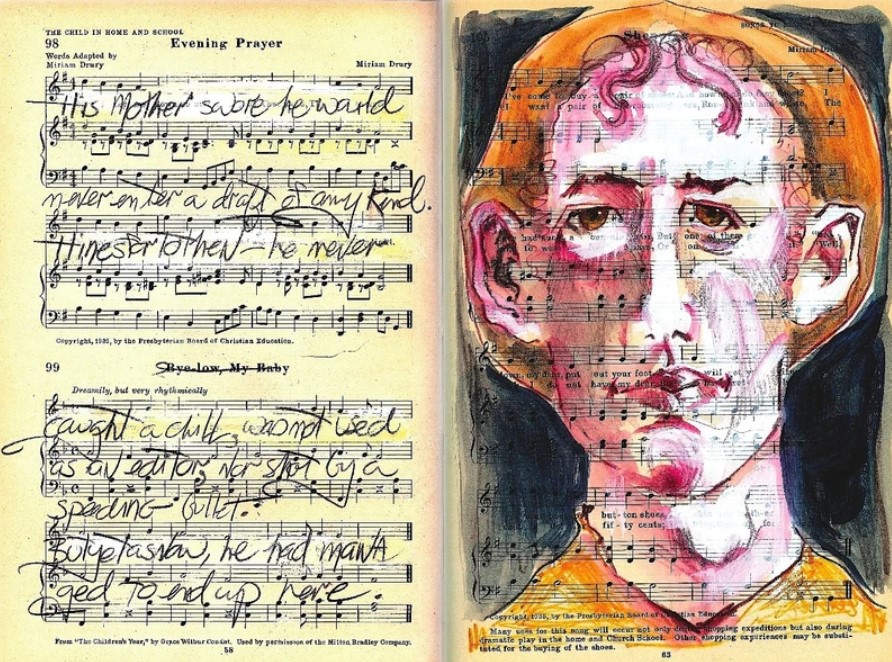
More Jayne:



-30-
Except for Goya, all images courtesy of Jayne Harnett-Hargrove ©

Related: Jayne’s Blog + Harnett-Hargrove site + Jayne is currently collaborating on the theatrical production “Impossible Things” + Jayne’s PATREON page +


 The Narrative Within
Thank you! Love Ferlinghetti & Jayne Harnett-Hargrove’s ekphrastic piece.
Mille grazie!
Pingback: Ekphrastic Tourists | The Narrative Within