
Primates began to appear 60 million years ago. During the last 7 million years of this time, the first “hominids” evolved into being. Thanks to these hominids and all the efforts they made to survive, we sapiens exist.
But in our brief existence of c 50,000 years, homo sapiens have come to dominate the Earth. How did sapiens manage to survive when the other species didn’t. Why do sapiens feel the need to impose themselves on others as well as on nature? How did we evolve to become who we are?
Author Yuval Noah Harari writes that Homo sapiens are the “deadliest species ever in the 4-billion-year history of life on earth.” Spooky, no?
So just a few notes on our evolution from Harari’s book Sapiens, A Brief History of Humankind.:

The foragers
After their fall, finding food became a problem. Adam and Eve, once kicked out of the garden, became mankind’s first foragers. Eve, already an expert in picking forbidden fruit off trees, now had to learn food mining. That is, digging in the dirt looking for something edible.
For much of our species’ existence, we lived as foragers. It’s only in the past 200 years that we’ve become dependent more on others than on ourselves to produce the food we eat.
Evolutionary psychologists believe that our long pre-agricultural era left its imprinting on us. In Sapiens, Harari writes of the “gorging gene” and modern man’s instinct to gorge himself into obesity.
In prehistoric times, if, for example, a woman foraging for food came across a luscious fig tree full of fruit not only would she pick as much as possible to take home, but she’d also eat as many as she could right then and there because she couldn’t be sure to find such figs, or any other food, again soon. The motto was “Gorge yourself while you can”. Unfortunately, our DNA still thinks food is scarce, so we continue to stuff ourselves.
Foraging represents the original fast food, just pick and go.

Paleoanthropologists, after examining fossilized skeletons, summarized that foragers were less likely to suffer from starvation or malnutrition than their peasant descendants. The secret of their success was variety. Later, when farmers came around, they ate only what they produced thus a limited and unbalanced diet.
Ancient foragers lived in nomadic communities that had no concept of private property. They were able to interact with the world around them in a way that today’s sapiens can’t emulate. When sapiens foraged for survival, they obviously depended upon their knowledge of the natural world to obtain food. But today a person does not need this information to survive. All he has to do is go to the grocery store.
Technology has made us arrogant. And unappreciative. Our hubris will take us to hell.
Animism.
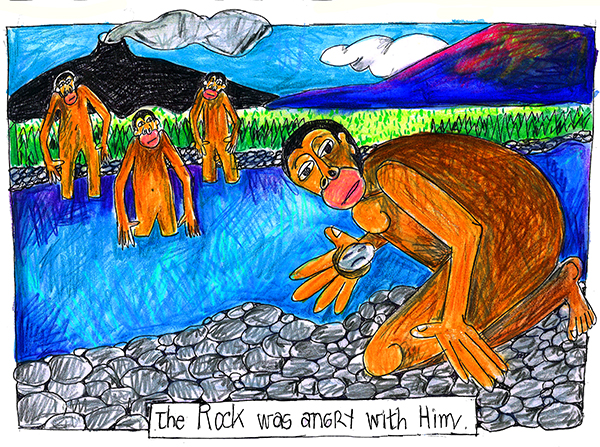
The world does not evolve around humans. And the ancient forager knew this. It’s commonly assumed that these foragers had animistic beliefs. That is, that every living thing and every natural phenomenon has awareness and feelings that can be communicated to humans. The world around the ancient foragers was animated and very much alive. Feelings were everywhere. Even rocks had feelings.
Dogs.
Living nomadically limited the number of possessions a clan could have. But from about 15,000 years ago, even before the Agricultural Revolution, humans had dogs. Dogs helped in the hunting and fighting and protecting. So, there’s no surprise he’s considered man’s best friend.

Conflict.
Although there’s little physical proof of prehistoric wars, there was obviously conflict. Especially in relationship to territorial domain and access to food.
When sapiens invaded the territory where Neanderthals had been living for generations, problems occurred. Although they began their evolution over 400,000 years ago, much earlier than sapiens, Neanderthals had not developed the sapiens capacity for abstract thought.
Neanderthals, whose population was much smaller than that of the sapiens, lived mainly in isolation. Therefore, they were prone to inbreeding as opposed to interbreeding. This meant that their genetic pool was not as varied and animated as that of the sapiens who enjoyed mixing and matching.
Being too genetically distant from each other, in theory, Neanderthals and sapiens couldn’t produce fertile children together. So why do we all have a slight percentage of Neanderthal DNA in us?
Neanderthals have been unfairly typed casted as slow witted. But that’s not the case. These archaic humans, more muscular than sapiens, had survived for more than 360,000 years before becoming extinct 40,000 years ago.
Homo sapiens and Neanderthals coexisted for thousands of years occasionally interbreeding (that’s why most of us have Neanderthal genes). But the Neanderthal’s population progressively diminished until none were left at all. Why?
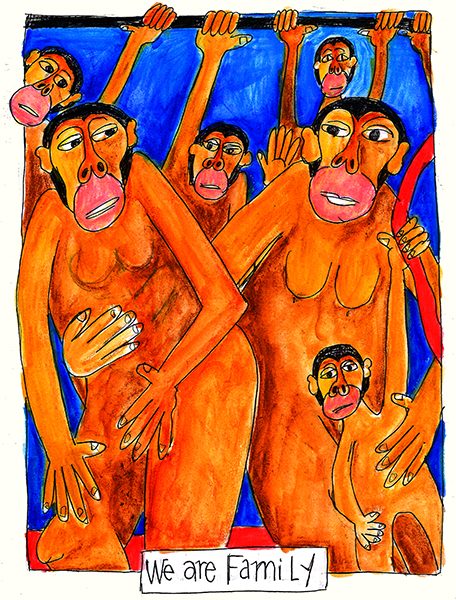
What caused the Neanderthal’s extinction? Many scholars believe 45 thousand years ago, the first act of human genocide was the massacre of the Neanderthals.
Dr. Yarin Eski, criminology expert, claims that “Genocidal violence and mass exploitation are perhaps the defining characteristics of being human…superior weapons and hunting strategies allowed sapiens to control food sources thus starving out Neanderthals.
Not all scholars agree with this theory. Some believe in the replacement theory claims that sapiens replaced all the other human species without merging with them.
The Neanderthals could not successfully compete with the sapiens’ organization and more advanced technology. This may have been the main reason for their extinction.
There’s always so much speculation when dealing with the past, especially the prehistoric past. New discoveries are being made all the time that often obliterate previous theories. Therefore, like a French film, there is no conclusion to this existential post.

-30-
Bibliography:
Harari, Yuval Noah. Sapiens, A Brief History of Humankind. Penguin Random House. London. 2011
Related: Gorging Gene: How Our “Hunter Gatherer” DNA Is Making Us Fat Now +
Yarin Eski: Unraveling Space Criminology + Space Criminology stands as an academic pursuit, committed to fostering a scholarly environment in the exploration of space-related crimes, policing, security, and justice. Our aim is to contribute to the academic understanding of this field, offering a nuanced perspective on the complexities inherent to the cosmic frontier.
How Much Neanderthal DNA do Humans Have? Our ancestors interbred with Neanderthals, and evidence of these ancient liaisons can still be found in the DNA of people living today. +Adam and Eve were the first foragers. For most of our “species” existence, we lived as foragers.
When Did God Create Adam and Eve? + **Early Hominin Childcare: A Community Effort** +
When Farmers and Foragers First Met +
Study: At Least Five Dog Lineages Existed 11,000 Years Ago +
Why Is Homo sapiens the Sole Surviving Member of the Human Family? +


 The Narrative Within
This was so interesting. Thank you.
Thanks Yvonne. Your opinion means a lot to me.
Now you’ve put on the pressure! 🙂