Luigi Pirandello’s bedroom
via Antonio Bosio 13b, Rome

Gustave Moreau’s bedroom
14 rue de la Rochefoucauld, Paris


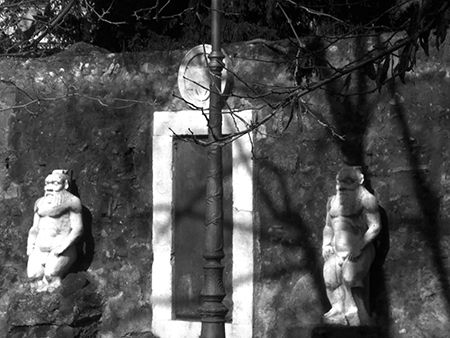
Framed Ivy with Lions on via Villa Albani, Rome.
English ivy has no backbone so it clings and crawls. And wraps itself around anything it can.
Thanks to their lusty affair, Semele and Zeus were about to have a baby. But Hera, Zeus’ wife, found out and, disguised as an old woman, made Semele doubt that Zeus was really the god he claimed to be. So Semele ingeniously insisted that Zeus appear to her in his divine form. Little did she know that gods are not meant to be seen as they really are. When Zeus finally exposed himself, lightning jumped out from the sky and struck Semele turning her into ashes. Miraculously, ivy starting growing wildly around the columns uniting them so they wouldn’t fall. The ivy also grew around Semele’s baby, Dionysus, protecting him from the flames. In honor of the plant that saved his life. Dionysus wears a crown of ivy.


Viale Liegi 6 is the address once shared by writers Massimo Bontempelli and Paola Masino. There’s a commemorative plaque outside the building with the inscription “The only instrument of our work will be the imagination.”
Way before Garcia Marquez wrote magical realism in Spanish, Massimo Bontempelli was writing it in Italian. He became even more magical in 1927 when he met Paola Masino. Despite the 30 year age difference and the strong objections of her parents, the two began a love story and literary collaboration. Paola, writer, translator, and librettist loved card games (she often played “scopone” with Pirandello) and convinced many of her artist friends to make playing cards for her. These artists included Alberto Burri, Carlo Carrà, Renato Guttuso, Massimo Campigli, and Carla Accardi.
When Paola and Bontempelli decided they no longer wanted to be fascists, they had to leave Rome. After Mussolini’s downfall they went back and started the magazine «Città» with the collaboration of Alberto Moravia, Alberto Savinio, and others.
Bontempelli died in 1960. Paola was only 52. She kept herself busy putting Bontempelli’s papers in order, translating French authors, and writing in her diary. Then silence. Paola was still living at Viale Liegi 6 when she died in 1989 at the age of 81.

Bontempelli and Paola lived previously at Corso Trieste 112 not far from Pirandello’s home

In 1939, Luchino Visconti moved to via Salaria 366 across the street from Villa Ada. Film director and antifascist, Visconti risked being arrested and went into hiding leaving his home in the hands of film star Maria Denis who was madly in love with him.
One day the SS arrived at Visconti’s villa and arrested Visconti’s gardner, Paolo Mocci, who was a resistance fighter. Mocci was taken to the infamous Pensione Jaccarino on via Romagna where he was tortured then forced to the Fosse Ardeatine where, along with 334 other prisoners, he was murdered.
Maria was taken in for questioning some time later. She was interrogated by Pietro Koch, Fascist police chief. A few days later, Visconti was arrested and condemned to death. Yet, strangely enough, released. Maria would later say that it was thanks to the infatuation Koch had for her that saved Visconti’s life. Nevertheless, on April 5, 1946, Maria was arrested for having collaborated with the Fascists and thrown in jail for 18 days. Visconti refused to be a witness in her behalf but did pay her legal fees. Despite being cleared of all accusations, Maria’s reputation was indelibly tarnished leaving her career in ashes.
A few years later, Franco Zeffirelli would live at via Salaria 366 with Visconti as would Helmut Berger. But in 1972, Visconti, victim of an ictus, was forced to give up his notorious home.

Related: Villa Visconti + Maria Denis + Le vittime della banda Koch ricordate con una targa

Wilma Montesi’s story is the story of an Italy in need of another Renaissance. An Italy scarred by war and Fascism. An Italy anxious to substitute misery with glamour.
Wilma, aspiring actress, was a young woman whose romantic dreams became a nightmare. On the day before Easter 1953, her body was found on a beach not far from Rome. Later it was said she’d participated in an orgy organized by men experts in making unfulfilled promises. But the coroner said that Wilma, whose modest underclothing had been mended, was still a virgin. Virgin or not, 64 years later, the case remains unsolved.
From our balcony, I can see the entrance to where Wilma once lived. It reminds me that the past is not always far away.