My Friend Mona

Even when she was sitting down, Mona was a moving picture.  Her presence commanded attention.  Mona was beautiful, had style and was intelligent. The last time I saw her was when she came to Rome for a post G8 anti-global demonstration. We marched together then had dinner at a trattoria in Piazza Farnese while talking and talking as we’d always done. But for some reason I can’t explain, the magical relationship we once had was swallowed up by nothingness. Now, more than 15 years later, I’ve learned that Mona died last summer of ovarian cancer. And the news has crushed me.

From the very start Mona and I had something in common–we were both foreign women living in a small provincial town in southern Tuscany. Born in Cairo, Mona grew up in London. She’d studied all over Europe, spoke four languages and had a doctorate in literature. Her love of literature made her good at description. Like the protagonist of a novel, Mona was glamorous and had the talent of making the world around her seem glamorous, too.

But beauty does not save you from pain.

Now that she’s gone, she’s always present because it seems, at this time of sorrow, I’m addicted to caressing memories of moments we shared.

My Friend Mona

Most every morning, after coffee, we’d call one another and she’d read our horoscopes.

My Friend Mona

During the summer Mona kept her perfumes in the refrigerator to make the fragrance last longer.
My Friend Mona

We both liked to laugh a lot. When I was in the hospital, she came to cheer me up.  We laughed so hard that a nurse came in and said You don’t laugh in hospitals! and this just made us laugh even more.

My Friend Mona

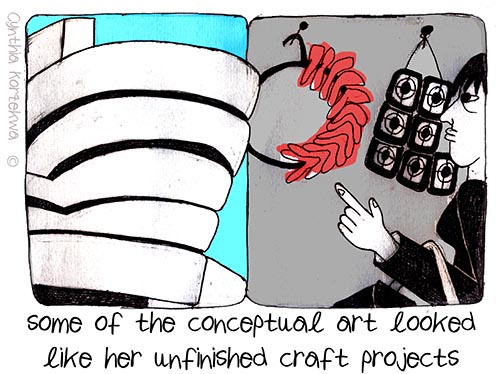
I’d been invited to Francisco Smythe‘s exhibition in Rome.  Before going, Mona invited me to her house for a brunch of salmon and spumante.  She lent me her mustard colored cashmere coat for the occasion then drove me to the train station.

My Friend Mona

At my birthday party one year, a small group of friends came over to celebrate with me. We all danced wildly save for Mona who sat on the sofa smoking dressed in red like Paolina Bonaparte.

My Friend Mona

One morning I went to visit Mona. She answered the door elegantly dressed wearing a light colored tailleur so I asked where she was going. Nowhere, she replied, I’m just reading Bulgakov’s The Master and Margarita (the book that inspired Mick Jagger’s lyrics to Sympathy for the Devil).

Portraits in words.

I recently read that if, in our diaries, we write about people who have qualities we admire, we can, in some way, appropriate those qualities for ourselves. By recognizing what we like in others, we give ourselves something to strive for.

There are many qualities about Mona I’d like to have for myself. She was scintillating, intriguing, fascinating, original, sophisticated, au courant and so much fun to be with. Mona, like all of us, had fears, too. But when she walked on egg shells, she did so to crush them.

I’ve been hesitant about posting this. But not having the possibility of saying goodbye to Mona while she was still alive has left me with a feeling of emptiness. Writing about her may not change that but it will give me the chance to thank her for all the abracadabras she gave me.

 Au Revoir Mona.

Posted in Drawings & Paintings, People, THE DIARY OF LUZ CORRAZZINI | Tagged , , , , , , , | 8 Comments

The Diary as a Thermostat

Plastic surgeon, Dr. Maxwell Maltz, noticed that some of his patients, even after facelifts, still saw themselves in a negative way.  After much research, he understood that the problem was not external but internal.  What was in need of a makeover was not their face but their self‐image. Further research led him  to elaborate a theory based on cybernetics he called psychocybernetics.

Psycho-Cybernetics

Cybernetics, a theory developed by Dr. Norbert Wiener, is based on the concept of self‐regulating systems aided by goal seeking mechanisms. For example: a self guided torpedo that’s propelled forwards towards a target using “sense organs” (sonar, radar, heat perception, etc) to stay on course. If the torpedo has positive feedback, it continues as is.  But if it has negative feedback, a corrective mechanism meant to steer the torpedo back in the right direction is automatically set off. The torpedo then zigzags  back and forth until errors are corrected and  it’s back on course.

Psycho-Cybernetics

Similarly, every time we give ourselves a direction, a self‐correcting mechanism goes off in our nervous system. And if an obstacle gets in our way, we don’t give up on our activity but, instead, make necessary adjustments. For example, if I’m pouring myself a glass of water and my cat gets in the way, my hand will automatically change its trajectory to keep from spilling the water. But still it will continue in its efforts to pour water.

Psycho-Cybernetics

For this self‐correcting mechanism to be activated, a goal is needed. Because you can’t get back on course unless you know where you want to go.

We set our goals based on the image we have of ourselves.  And if we have a poor self-image,  we’ve got problems. Solution? A self-image makeover! If we can change our thoughts, we can change our lives.

A diary can help. Not only can it help us learn more about ourselves, it can help us construct the image we want to have of who we are. In the words of John Lennon, “imagine!

So maybe it’s time to sit down and write in our diaries about the life we imagine for ourselves.  And write with all our will and desire to construct that image. And, if we ever feel lost, we can reread our words and self-correct to get back on course again.

Psycho-Cybernetics

So today in my diary I will write that I’m near the Eiffel Tower  wearing a Muy Marcottage huipil dress! À toute à l’heure!

drawing

(from THE DIARY OF LUZ CORAZZINI) Cynthia Korzekwa ©

Posted in Drawings & Paintings, THE DIARY OF LUZ CORRAZZINI | Tagged , , , , , , , , , , | 2 Comments

A Political Statement

They Tried Keeping Their Balance

In archaic Greek sculpture, figures were rigid with their weight resting equally on both feet. But then contrapposto was introduced where the body rested most of its weight on only one foot leaving the other foot ready for action.

When I was little, my very best friend, Laura, and I never tired of walking on curbs with our arms swaying up and down to keep from falling. Without knowing it, we were learning the art of equilibrium. Because, to keep your balance, sometimes you must counterpose one movement with another.

Too many people confuse balance with stasis. But they are not the same—one is about being ready to move whereas the other is about refusing to move. In other words, balance is about compensating if necessary whereas stasis is about refusing to accept necessary change.

 And this is my political statement for today.

drawing

Posted in Drawings & Paintings | Tagged , , , , , , , | 7 Comments

Daisy’s Diary

Dreams are formed in the imagination and some of us have more imagination than others.Zelda Fitzgerald

Ginevra King was a rich 16 year old debutant  and  F. Scott Fitzgerald a 19 year old penniless university student when the two met and fell in love.  In her diary, Ginevra wrote that she was madly in love with Fitzgerald but the thrill was gone after Ginevra’s  father said “poor boys shouldn’t think of marrying rich girls.” So Ginevra  dumped Fitzgerald and married someone else with lots of money. The rejection left Fitzgerald with a psychic scar that ripped into everything he wrote.

Daisy in The Great Gatsby was inspired by Ginevra. A pampered heiress, Daisy’s wealth and social status represented that carrot in front of the donkey called the American Dream. Gatsby and Daisy met and fell in love but, nevertheless,  Daisy married Tom Buchanan, the epitome of American wealth and privilege. But Gatsby refused to be deprived of his dream.

Zelda Fitzgerald

Sometimes love exists only in our imagination. Like I imagine us together but you don’t.  Or I imagine you to be someone special but you’re not.  Or I imagine that you can make me happy but all you do is make me cry.

Gatsby’s imagination will not free him of Daisy. So a few years later he resurfaces but  this time with money. Daisy, whose marriage to Tom has made her restless and pessimistic , lets Gatsby dazzle and distract her. The problem is that they have nothing in common except that they are looking for love in all the wrong places.

Zelda Fitzgerald

Gatsby wants Daisy to leave her husband so they can be together. But Daisy will never leave her husband nor he leave her.  Like all  the rich and elite who smash things up expecting others to clean up after them, Daisy and Tom are permanently united by their compatible vices.

Zelda Fitzgerald

Fitzgerald’s psychological imprinting led him to write love stories without happy endings like those he lived in his own life. After his breakup with Ginevra, he met Zelda, a woman who refused to be bored. Zelda liked to dance cheek to cheek, swim in the moonlight and bob her hair as a sign of emancipation. Fitzgerald wanted to marry Zelda but she, too, rejected him.  So, after a drinking binge, Fitzgerald decided to become a successful novelist in order to earn Zelda’s love. He wrote This Side of Paradise  which  provided him with money and celebrity status. So  Zelda agreed to marry him and the two immediately started to copy the lifestyle of the rich elite…the same lifestyle Fitzgerald criticized in his books.

Zelda, considered to be the first American flapper, liked to dance and write.  She also painted New York cityscapes, Biblical allegories, and paper dolls.  Psychedelic and whimsical, her paintings transformed the world into fairytales.

Zelda Fitzgerald

Pity that, despite what he wrote,, Fitzgerald was addicted to The American Dream– that same dream that gradually becomes a nightmare since it doesn’t permit you to enjoy what you have because you’re too busy wanting more.

Unable to be happy with Zelda, Fitzgerald persisted in gaslighting her.  Already fragile thanks to depression, toxic bootleg alcohol, and bipolarism, Zelda went over the edge and was committed to a mental asylum.

Fitzgerald, at the age of 44, died in 1940 of a heart attack.  Zelda died 8 years later when the asylum she was confined to caught fire. Locked in a room waiting for electro-therapy, she roasted to death.

Zelda Fitzgerald

Writer’s block appropriations.

Fitzgerald meticulously  kept a ledger mainly to document  the money he earned from his publications. But these ledgers were also filled with annotations meant to be recycled when, as often occurred, he suffered from writer’s block. After one block he writes in his ledger ”out of wood at last and starting novel” and began writing Gatsby.

When their relationship was over, Fitzgerald asked Ginevra to burn his letters which she did. She asked him to do the same but he didn’t.  Instead he transcribed them and had them bound adapting details from them for his stories and novels. Ginevra also sent Fitzgerald a short story she’d written that’s basically the outline for The Great Gatsby.  Later Ginevra would say that Fitzgerald was bright and witty but she always got the idea that he was on the outside looking in. In fact, he was a voyeur  who, instead of looking in  windows, looked in diaries and personal letters.

Zelda Fitzgerald

Zelda’s inner animation and active social life gave Fitzgerald much material for his writings. When Zelda would converse with others, Fitzgerald would often jot down her words on scraps of paper then stuff them in his pockets. Zelda was such a good writer that Fitzgerald’s editor wanted to publish her diaries but Fitzgerald prohibited this preferring to rip off parts of the diary for his own publications. So when Zelda was asked to review The Beautiful and the Damned for the New York Tribune, she wrote ”Mr. Fitzgerald-I believe that’s how he spells his name-seems to believe that plagiarism begins at home. ”

Zelda Fitzgerald

Visualization.

Before Fitzgerald even finished The Great Gatsby, his editor had the cover made. Designed by Francis Cugat, the brother of Cuban bandleader Xavier, the cover is dominated by a woman’s eyes and mouth floating on a dark blue background that well illustrated the description of Daisy as the  “girl whose disembodied face floated along the dark cornices and blinding signs…. “ Fitzgerald was so impressed by the drawing that he included a reference to it in the book.  He described  a billboard with faceless eyes looking out of an enormous pair of yellow spectacles. But although once brightly painted, the  sun and rain had faded the colors in the same way elements in life can weaken the vision one has of themselves.

Imagination is a visualization in need of direction.

(from THE DIARY OF LUZ CORAZZINI)

drawing

Posted in Books, People, THE DIARY OF LUZ CORRAZZINI | Tagged , , , , , , , , , | 2 Comments

Surrogates of Beauty

My Papier-mâché Plant

My diary research led me to Marion Milner’s  A Life of One’s Own. In the past, I’ve used a diary as a means of letting out negative tension.  But not Marion.  She focused on writing when she was happy because “if one really knew when one was happy one would know the things that were necessary in one’s life. “

Beauty makes us happy and the greatest source of beauty is nature.

And if nature is not available, maybe a surrogate could do.  Like a papier-mâché cactus made from recycled materials.  I have such a plant in the hallway.  And when I walk past it, it reminds me to be happy.

drawing

Posted in Beauty, THE DIARY OF LUZ CORRAZZINI | Tagged , , , , , , | Leave a comment