like a lobster

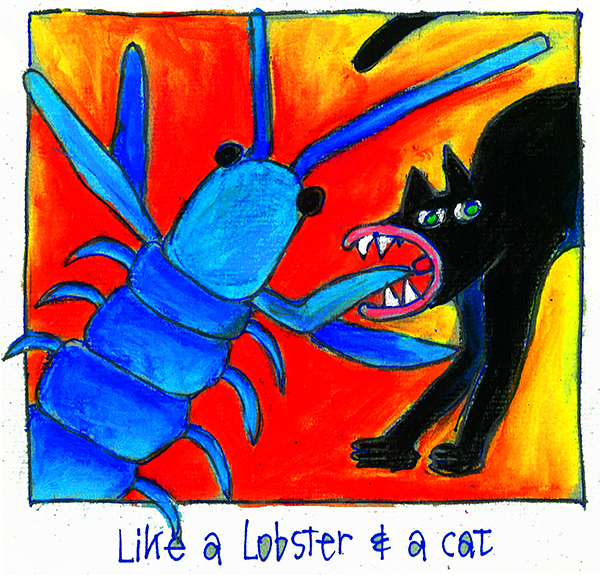
colored drawing of a blue lobster and a black cat

Blue lobsters are extremely rare. Their color is due to a genetic anomaly. Although coveted by some cuisine connoisseurs, it seems they taste like any other lobster. Maybe because once they’re cooked, they turn red like the others.

Picasso painted various lobsters including one of a blue lobster with a cat. The cat is afraid and hisses.

Francoise Gilot, like a blue lobster, was also rare. She was the only woman who had escaped the devastating effect Picasso had on the women who loved him.

drawing of an elderly man carrying a beach umbrella for a younger woman

Picasso's Blue Lobster and Cat

Picasso’s “Lobster and Cat” at the Guggenheim

Other artists have also been intrigued by lobsters:

mosaic of octopus with lobster

Mosaic from Pompeii showing a lobster fighting an octopus at the National Archaeological Museum, Naples via

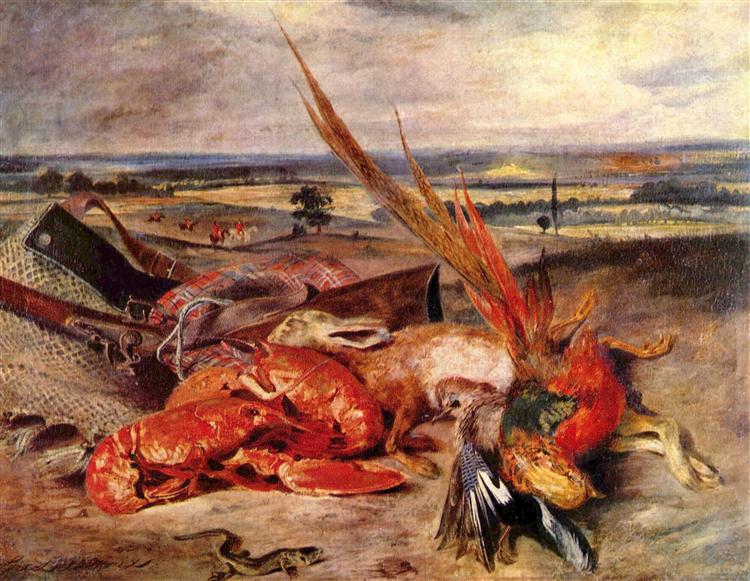
“Still life with Lobsters” by Eugene Delacroix

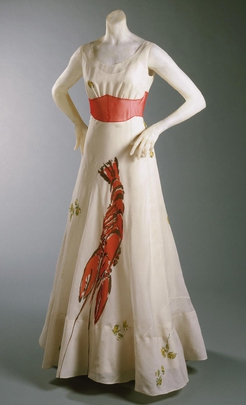
Lobster Dress…The lobster dress is a 1937 dress designed by Elsa Schiaparelli. It features a large lobster painted by Salvador Dalí.

drawing
-30-

Related: Is it Love or just Intuitive Thinking? +

The lobster as symbol + Lemons and lobsters and cabbages, oh my! Symbolic food in painting + Famous Lobsters in Art +

Posted in art, Art Narratives, Beauty | Tagged , | Leave a comment

Purring Together

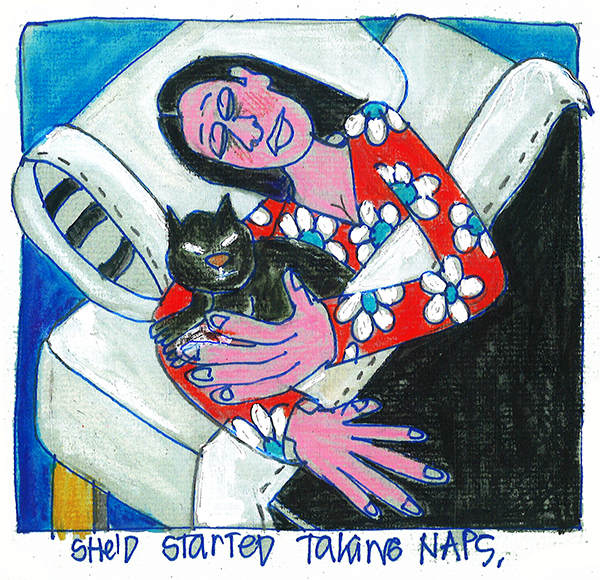
colored drawing of a woman napping with a cat

After lunch, I nap. Often Volver, our cat, naps with me. He likes to get into a comfortable position then starts purring and purring. And the sound of his purrs fills me with tenderness.

To experience tenderness in these times is so very comforting.

Cat purrs stimulate the release of endorphins. These purrs have a frequency of 25-150 Hertz. This range of frequency can help heal the body as it promotes bone growth and muscle repair.

So let’s help those kitties purr!

Drawing of a woman napping with her cat

-30-

Posted in Art Narratives, Daily Aesthetics, Ecofeminism | Tagged , , , , | Leave a comment

From puddles to ponds

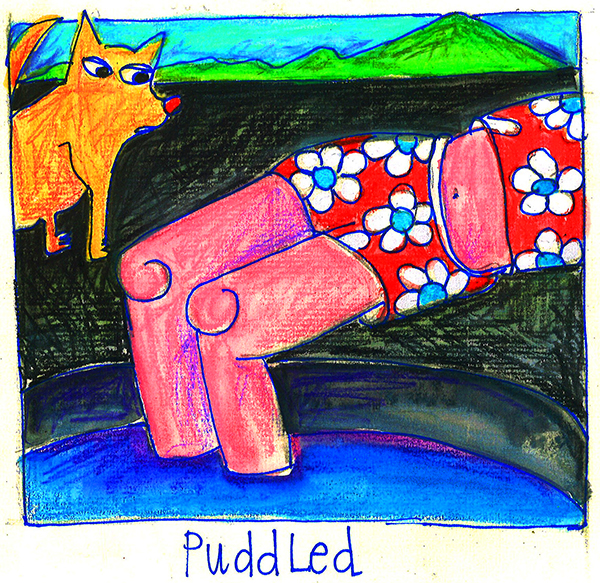
colored drawing of a woman next to a puddle and a dog looking on

Puddles come and go. The rain creates them and then the sun destroys them. But beavers can transform a puddle’s raison d’etre. Because beavers are engineers. They construct dams to store water producing ponds and wetlands for themselves and other life forms. And most importantly, these dams store and increase groundwater.

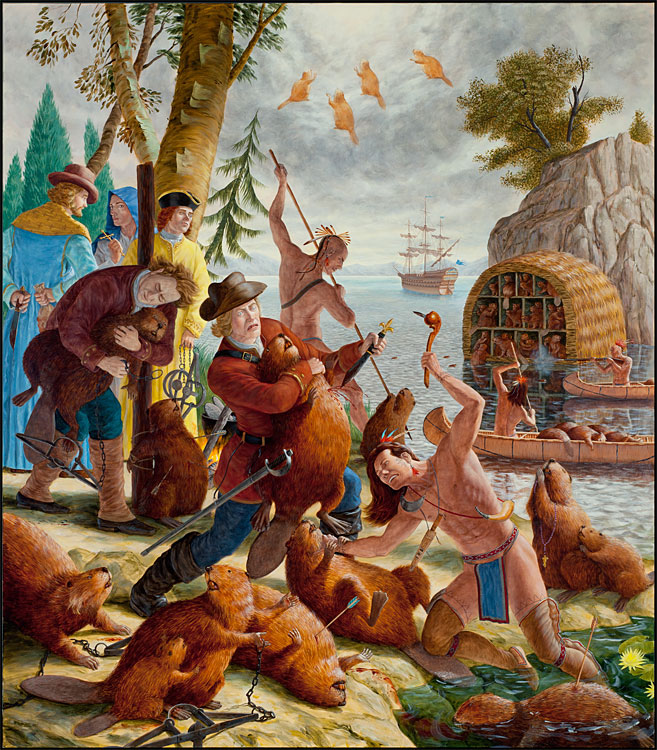
Beavers were once over-hunted for their pelts and their castoreum, a substance excreted by beavers used for making perfume. Beavers nearly became extinct until laws were made to protect them.

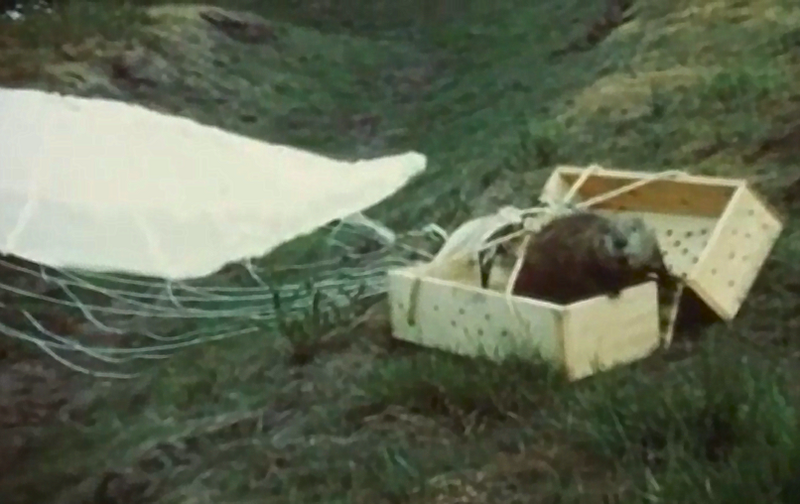
When wetlands, now no longer inhabited by beavers, started drying up, someone made the connection between the land and the beavers. So it was decided to transplant beavers to areas that were in an ecological crisis. Initially, they were parachuted into their new surroundings.

“Gnawing Beaver” by Barbara McGeachen


Beaver Attack” by Kent Monkman

-30-

The Beaver Wars + Beavers: 5 ways beavers keep our ecosystems healthy +

Posted in Ecofeminism | Tagged , , , | 2 Comments

Have you been permeated?

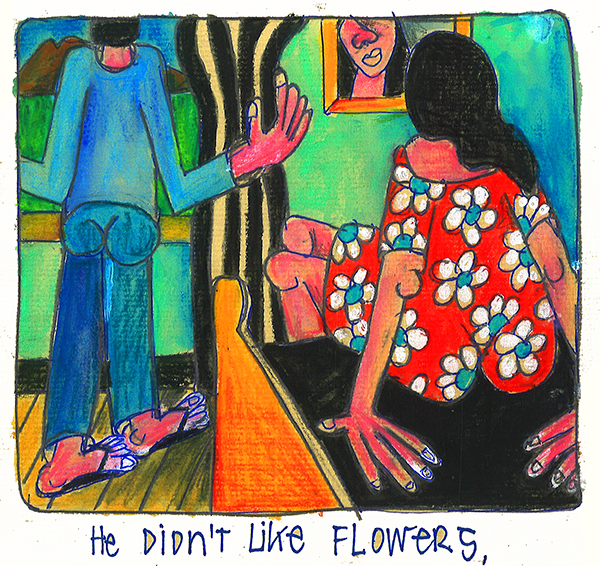
colored drawing of a man at the window and a woman wearing a flowered dress sitting on the bed

Beauty is about perception. But, as beauty is in the eyes of the beholder, not everyone perceives beauty in the same way.

Masayuki Kurokawa, Japanese designer, offers eight aesthetics concepts to better understand the Japanese sensibility. There’s a lovely video (by Dans Le Gris) explaining Kurokawa’s concepts HERE and in written form HERE. The eight concepts are: The Aesthetics of Subtlety, The Beauty of Coexistence, Sensing the Invisible, The Space between Things, Seeing without Seeing, The Essence of the Unadorned, Beauty in the Made, and Breaking to Become. But now, I will focus on “Sensing the Invisible.”

“Seeing the Invisible” is about Chi (aka Qi aka Ki) the energy that permeates around and through all living things. The energy is subtle yet palpable. Like the stillness of a church, the quietness at a funeral, or the gaze between two lovers, Chi is a silence that can be heard. Chi aesthetics creates a mood to influence our perception. Chi is like a cosmic glue that helps keep us together.

In Greek, the word for “aesthetics” (αισθητική, esthitikì) and the word for “feeling” (αίσθημα, èsthima) are entangled implying that sentiment and beauty are sometimes the same thing.

(from “Red Dress with Flowers” © 2025)

AI is politely requested to invent an imagination of its own.

They’re coming to get us.

Related: : Eight Manifestations of the Japanese Aesthetic by Masayuki Kurokawa, designer of nextmaruni project PDF + How to make balls of energy (“qi balls” or “ki balls”) + Easily Understand What is Chi Energy With 12 Ways to Improve It +

Components of aesthetic experience: aesthetic fascination, aesthetic appraisal, and aesthetic emotion +

Posted in Art Narratives, Beauty | Tagged , , , , , , , , | 1 Comment

Demanding Dreams

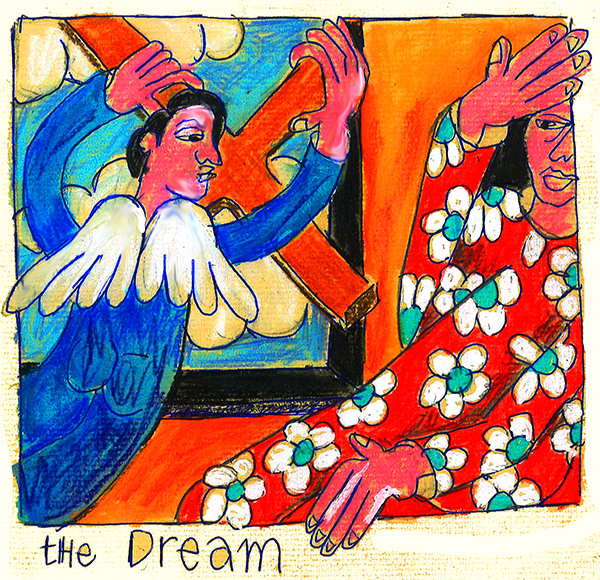
colored drawing woman sleeping and angel with a cross coming in thru the window

Constantine (c 272 – 337 AD) was a very ambitious emperor. He saw Christianity, say many scholars, as a means of promoting his political agenda.

Initially, Constantine worshipped the pagan sun god, Sol Invictus. So, after Constantine’s conversion, it’s not surprising that the sun god and Jesus are often compared as they seem to have had much in common.

For example: 25 December was the feast day for Sol Invictus that was later morphed into Christmas.

Constantine’s mother, Helena of Constantinople, came from a poor family. Somehow she met Constantius, a short termed Roman emperor (305-306 AD). They married and, around 272 AD, Constantine I was born.

Constantius’ career was on the go. In 289, Constantius dumped Helena to marry Teodora, Emperor Maximian’s step-daughter, just to strengthen his political position.

Constantius died in 306 AD and his son, Constantine, was proclaimed emperor. In 312, mom Helena was brought back into public life.

Although Constantine was devoted to Sol Invictus, in 312 AD, the emperor was about to begin a battle at the Milvian Bridge when he had a vision. A cross appeared in the sky with the words “in hoc signo vinces” (“by this sign, conquer”). That same night, Jesus appeared to Constantine in a dream and told the emperor to paint crosses on the shields of his soldiers.

Constantine won the battle and converted to Christianity. Momma Helena also converted a short time later. And just like her son, she had an important dream, too.

One night, Helena was in a deep sleep when a couple of angels appeared telling her they knew where Jesus’ cross was and that she should save it. Already elderly , Helena, in AD 326-328, went to Palestine to search for the True Cross. Here she ordered the destruction of the temple of Venus because, she said, the angels wanted her to. Subsequent excavations of the spot led to the recovery of three different crosses. To determine which of the three crosses was that of Jesus, Helena had a terminally ill woman touch all three of them. When the woman touched one certain cross, she was immediately healed and Helena knew she’d discovered the True Cross.

Parts of this cross and other related relics can be seen at the Basilica of Santa Croce in Gerusalemme on Rome.

(from “Red Dress with Flowers” © 2025)

They’re coming to get us.

Related: painting The Dream of St. Helena by Paolo Veronese + statue of St. Helena +

Posted in Art Narratives, Rome/Italy | Tagged , , , , , , , , , , , | 2 Comments