
I burn sage, listen to music, bathe in the sea, avoid energy vampires and try to smile as often as possible. Even though I still don’t glow in the dark, my aura is growing!
Related: Affirmations + Affirmation or wishful thinking?
.
.
I burn sage, listen to music, bathe in the sea, avoid energy vampires and try to smile as often as possible. Even though I still don’t glow in the dark, my aura is growing!
Related: Affirmations + Affirmation or wishful thinking?
.
.
A charismatic intellectual, Uruguayan writer Eduardo Galeano knew how to make history photogenic. His “Mirrors” is a series of snapshots that are easy to read and generally no longer than half a page. The stories are like concentrated dish soap—just one drop makes lots of bubbles. Below are a few examples:
“Women Against The Plague”
Long ago in Russia, men had taken nature’s gifts for granted so the land, offended by their lack of gratitude, retaliated with a plague. The women, also victims of thanklessness, well understood the problem. Naked, barefoot with hair hanging down, they began lovemaking with the earth and celebrated life by laughing and banging pots and pans to make music. And this Love for Life scared the plague to the point that it went away.
“Goodbye”
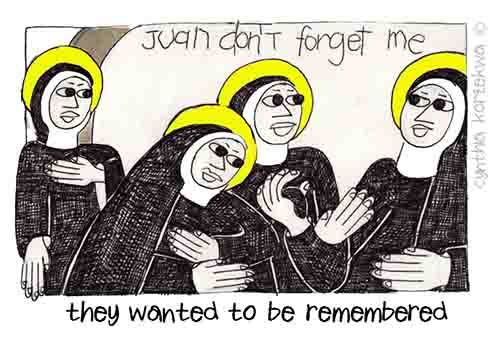
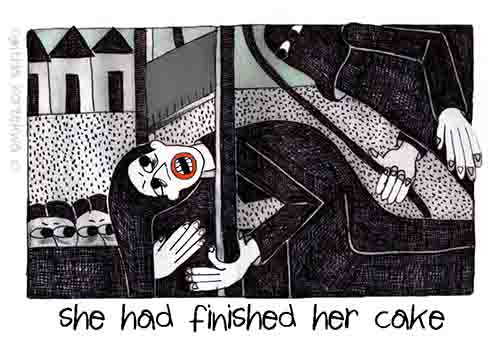
The Monastery of Pedralbes was founded in 1326 by Queen Elisenda and was home for the Poor Clare nuns. Elisenda probably had good intentions since she wanted to give an option for women with little possibilities of suitable marriages. In fact, families paid large dowries to send their daughters there to marry Christ. But not all of these brides were happy. Near a Ferrer Bassa fresco in the chapel, there are these words furtively written on the wall: Tell Juan not to forget me.
Who knows if Juan remembered.
“Universal tarantula”
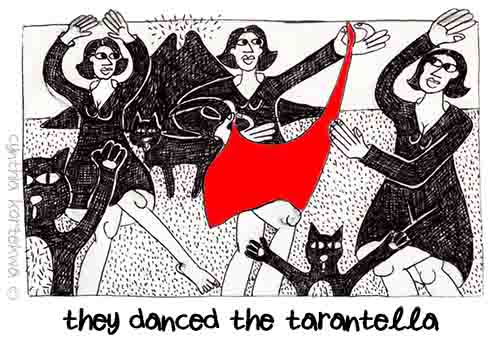
On May 1, 1886, workers in Chicago fought to form unions. What began as a peaceful protest ended in bloodshed. A newspaper claimed that laborers had been bitten by a tarantula and were dancing mad.
The tarantella is an Italian folk dance with origins in the southern town of Taranto. Taranto is also home for a spider commonly known as a “tarantula”. It was believed that if you were bitten by this spider, you would hysterically start non-stop dancing. Because it was only by dancing that you could sweat out the spider’s poison.
How wonderful it would be if, when angered, instead of shouting and shooting, we would start dancing until the anger went away! Yes, dancing in the streets!
“Origin of modern art”
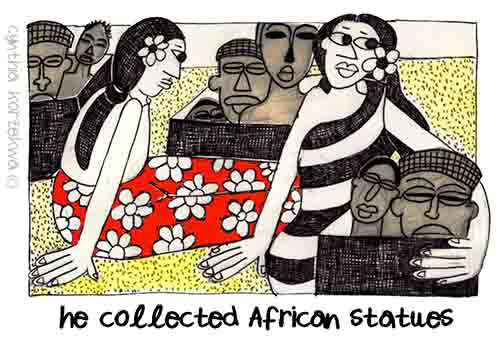
In 1910, Leo Frobenius discovered some statues in Africa that were so lovely he thought they had to be Greek.
European artists, already burned out on the Industrial Revolution, embraced these statues and began a new movement, Primitivism. Europeans, “colonializers” at heart, quickly appropriated the talents of the “primitives” and presented these concepts as their own.
It seems Gauguin put his name on some sculptures from the Congo. Picasso, Modigliani and others also saw no harm in copying the Africans. So maybe one can say that the origin of modern art was a kind of Copy & Paste.
Originality is in the eyes of the beholder.
(see, too, Inspiration or Appropriation?)
.
.
(#2 in my Verano Monumental Cemetery series)
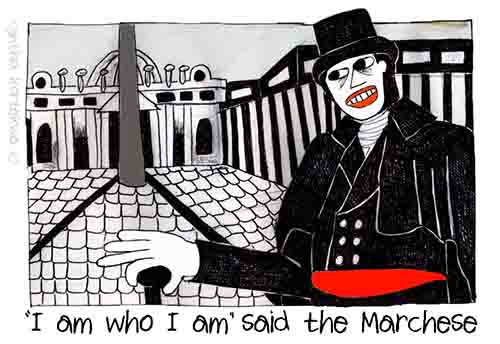
One of my first film experiences when I moved to Italy was Il Marchese del Grillo (The Marquis of Grillo, 1981) based on the life of Marchese Onofrio del Grillo. The year is 1809. The French have gone and Pope Pius II intends to use his “temporal power” in full. Marchese del Grillo is a Roman nobleman at the Pope’s court. He enjoys playing fastidious pranks without any kind of self-discipline because, as an aristocrat, he feels he’s entitled to do whatever he wants. One evening Marchese del Grillo is playing cards with a group of criminals. The situation degenerates. Everyone is arrested save for the Marchese because, as he says to the others, “Io sò io, e voi non siete un cazzo” (literally “I am who I am, and you are f…..g nothing”). The line comes from Giuseppe Gioachino Belli’s sonnet Li soprani der monno vecchio (The Sovrans of the Old World, 1831) and reflects how Italy was divided into the Haves and the Have Nots.
Belli was born in 1791 to an unsmiling father and a mother who loved luxury she couldn’t afford. His father was very severe that he once punished the young Belli by locking him in a dark room for 3 days.
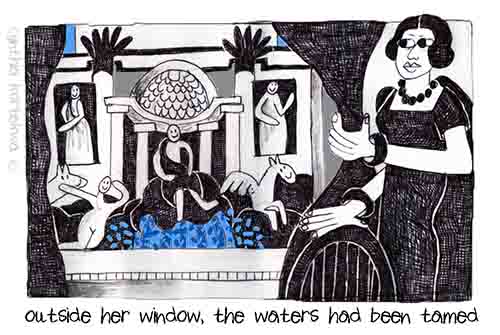
After his parents’ death, Belli went to live with an uncle. In 1815 he married Maria Conti, an older woman with money, and they lived together near the Trevi Fountain (Piazza Poli). Her money gave him the possibility to travel and see just how retro Rome was for the times and, with this newly found info, he began to write sonnets non-stop. Progress in Rome, under the influence of the Popes and their “temporal power”, was stifled.
Marriage didn’t keep him from flirting with Marchesa Vincenza Roberti (he called her Cencia). She was much younger than Belli and romantic. Obsessively, Belli began writing her letters that, often, were in the form of erotic sonnets.

But then his wife Maria died and he learned that she was not as wealthy as he’d thought. His lack of money made him feel sick and he became a hypochondriac. Depressed and forced to look for a job, the intensity of his writing mellowed out.

In the Roman neighborhood of Trastevere, there’s a monument to Belli, the poet who wanted his poems to be un monumento alla plebe di Roma (a monument to the plebs of Rome). To manifest their appreciation, the plebs of Trastevere took up a collection to pay for the monument.
The monument shows Belli standing on Ponte Fabricio next to a herma (erme quandrifront). A herma is a rectangular post with a four headed bust. The term “herma” comes from the god Hermes and herma posts were meant to serve as a marker to protect spaces. In ancient Greek times, hermae had erect penises meant to be rubbed for good luck.
Some of his poems were quite naughty but Belli was at his best when he observed and described the people of Rome. Writing in Romanesco, Roman dialect, he was the voice of Rome, a city intoxicated by decadence.
Belli’s Rome was a city in a state of existential crisis and, thanks to Papal rule, had no memory of their grandeur. The real barbarians, said Proust, are not those who never knew grandeur but those who knew it in the past but are unable to recognize it in the present.
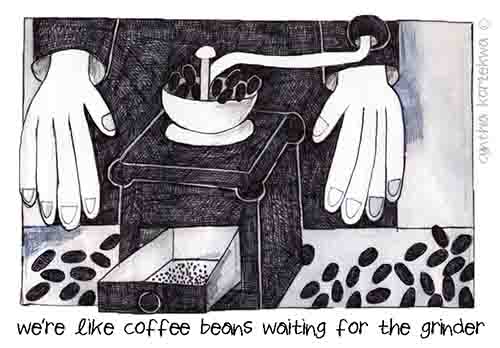
In Belli’s poem “ER CAFFETTIERE FISOLOFO” (THE PHILOSOPHIZING BARMAN ) he says men are like coffee beans in a grinder—it doesn’t matter if one is ahead or behind, all the beans move in the same direction. All are pushed towards the grinding blade thus all are transforms into powder. And this is how men live in the world. The constant motion of fate eventually pushes all of them into the throat of death.
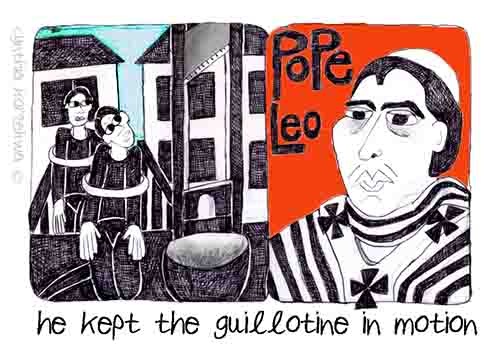
Belli made several jabs at the papacy in his writings including Pope Leo II.
Pope Leo ruled the Papal States from 1823-29. He liked ruling so much that he made one rule after the other. For example, Pope Leo kept the people illiterate and prohibited any kind of Bible societies just to make sure that only his interprestion of the scriptures was available to the masses. He also required all Roman citizens to study Catholic catechism regardless as to their religious background. The Jews were also subjected to his rule mania. They were forced to live in the ghetto and even locked in at night. And if that wasn’t enough, he also prohibited vaccinations thus provoking a small-pox epidemic.
Obviously, Pope Leo made many people mad. And since the concept of Free Speech didn’t exist, many secret societies started to form. One of the most popular was that of the Carbonari who conspired for the unification of Italy. The Pope went out of his way to persecute them.
They were called carbonari (charcoal burners) because they often held their secret meetings in the basement where the charcoal was kept. To become a member, as with the mafia and masons, initiation rituals were required.
Two members o the carbonari (Montari and Targhini) were condemned of treason, and, without proof, (you can see a plaque dedicated to them in Piaza del Popolo).
His real name was Giovanni Battista Bugatti but he was known as Mastro Titta. Officially his occupation was that of an umbrella painter and souvenir seller but his real job was cutting off people’s heads. He worked for the Popes as “Master of Justice”. For over 65 years (1796-1864) he killed for the Church executing over 500 people.
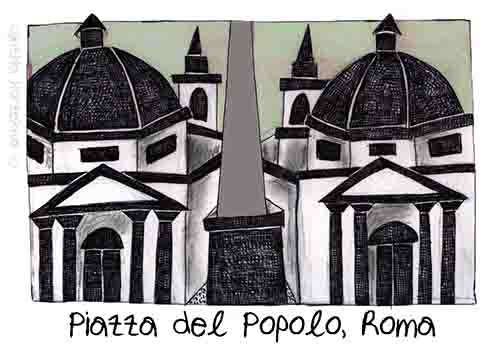
The executions were generally held in Piazza del Popolo so there was enough room for all the people who wanted to see. Mastro Titta wore a red robe so he could be seen from a distance. And, before the execution, he enjoyed giving snuff to those he was about to kill.
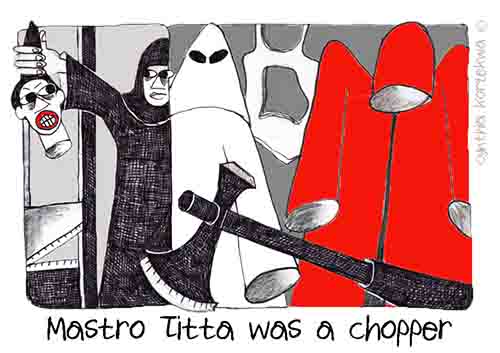
In 1845, Charles Dickens was in Rome talking a stroll when he happened to come across one of Mastro Titta’s executions. He later wrote about it in Pictures of Italy describing it as ugly and disgusting. Dickens also commented on how Mastro Titta held up the decapitated head for everyone to see then cleaned his blade and went home.
Lord Byron witnessed three of these executions and claimed to be shocked by them although it’s difficult to imagine Bryon being shocked by anything. He wrote a friend carefully describing the harshness of the scene—the priests wearing masks, the blindfolded prisoners, the sound of the falling axe, and the blood that squirted everywhere.
Mastro Titta referred to his executions as “justices” and the prisoners as “patients”. Before the French invention of the guillotine, an axe was used. The axe and blood stained robe can be seen at Rome’s Crime Museum.
Short and fat but, earning a good salary, Mastro Titta was always well dressed when not wearing his robe. Before cutting someone’s head off, he went to confession and took communion. Finally, too tired to hold a blade, Mastro Titta retired at the age of 85.
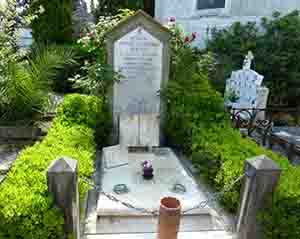
Giuseppe Gioachino Belli is buried at the Verano Monumental Cemetery (Altopiano Pincetto, riquadro 49)… Campo Verano grave locater
.
. IL MONUMENTO A GIUSEPPE GIOACCHINO BELLI E LE CASE IN CUI ABITO ’
One Sunday morning, Ute and I finally got together for a coffee at Marani’s. We mentioned our need for more physical exercise. She does yoga and I walk. Ute, unlike a flâneur, said she didn’t like to walk unless she had a destination. That word “destination” started buzzing around in my head. And I wondered if having a point of arrival would make a difference for me when taking my daily walk. So I decided to give my walks a direction.
Not far from my studio is the Verano Monumental Cemetery that I’d never explored before and , after my talk with Ute, decided to do so.

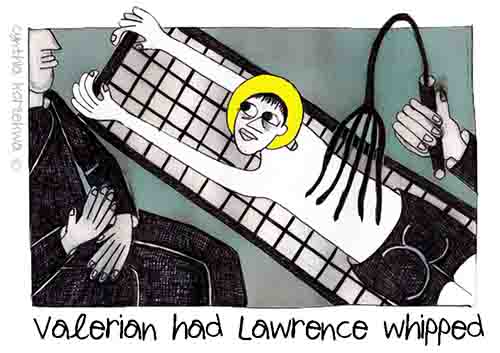
Roman Emperor Valerian, descendent from a distinguished Etruscan family, had to overthrow an emperor to become one himself. Believing that the Christians were subversive and threatened his power, around 257 AD he declared the Church a criminal enterprise and persecuted all of the Christians he could. There were so many executions that the widow Ciriaca donated land for a Christian necropolis. Initially the land was just a field of grass outside of Rome owned by her family and known as Campo Verani because Verani was the family name.
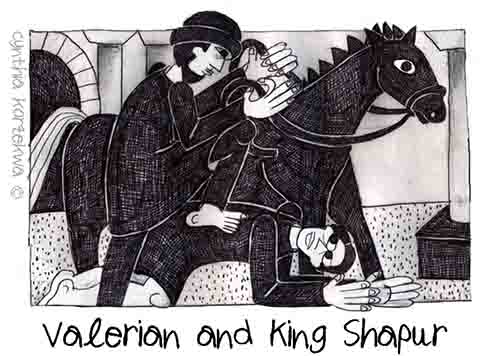
The Law of Retribution caught up with Valerian and he was captured and abused by the Persians. Before executing him (260 AD), King Shapur I used the emperor to mount his horse.
Today the remains of the martyred Ciriaca and St. Lawrence are buried in what is known as the catacombs of St. Ciriaca. During the Middle Ages, a basilica ( Basilica of Saint Lawrence outside the Walls) dedicated to St. Lawrence was built on the spot. Inside there’s an entrance to the catacombs whereas the outside façade is decorated with faded frescoes that includes a scene representing St. Lawrence’s martyrdom.
Adjacent to the Basilica is the Verano Monumental Cemetery. But first a little bit about the Napoleonic rule of Rome.
After the fall of the Roman Empire, the Papal States were founded in 754 AD. They monopolized all of central Italy and, in an attempt to ensure their power, prohibited the development of literacy and culture. Furthermore, they claimed that the desire for independent thought was a form of vanity.
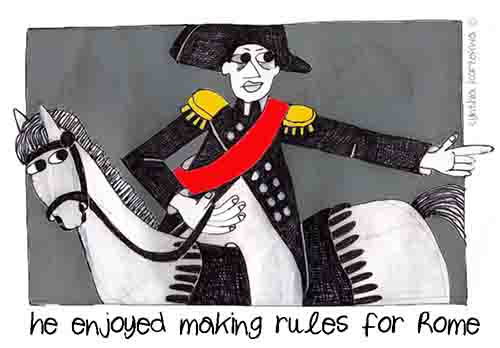
In 1793, Marie Antoinette was beheaded. Napoleon was 24 years old at the time and very ambitious. Five years later, Napoleon’s troops occupied Rome disrupting the equilibrium of the Papal States.
The French thus imposed many of their norms on Rome including that of the Edict of St. Cloud, a law stating that all urban cemeteries, for health reasons, were to be placed outside the city walls. And thus the birth of the Verano Monumental Cemetery. However, what we see today is mainly the plans of the architect Virginio Vespigani who completed the cemetery in 1871.

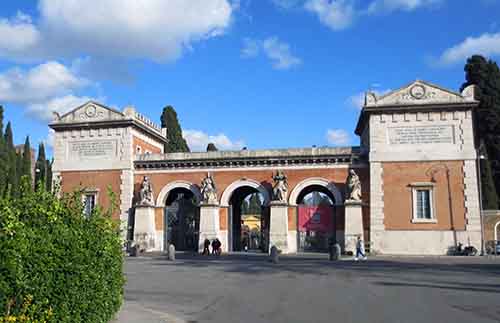
The Verano entrance has three arched doorways flanked by statues representing Meditation, Hope, Charity, and Silence. Because people keep dying, the cemetery has gotten bigger and bigger and now covers more territory than does the nearby Sapienza University.
Walking inside the Verano, the atmosphere is soft, silent and potentially melancholic. There is nothing more present than the past. After walking and looking and sighing for a couple of hours, I realized every tombstone has a story to tell.
The stories are of an Italy that no longer exists, of people who are remembered and forgotten, and of lives that have changed because of a life that‘s been lost.
So I plan incorporating the Verano into my Photogenic Lifestyle. First of all, it gives me a great place for a walk—it’s quite, full of cypress trees, and has incredible art to look at. In fact, it has been called a “ museo all’aperto”, an outdoor museum, because of the sculptures and paintings made for the tombs.
Secondly, the Verano Monumental Cemetery tells the history of Italy from the early 1800s to the present. It’s intrigued me so much that I’ve decided to use it as a point of departure for me to rediscover the country I’ve been living in for the past 35 years.
To be continued.
.
 .
.
Related: Monumenti al Verano. Un museo all’aperto. (scroll down for brochure in English) + Basilica of Saint Lawrence outside the Walls + the catacombs of Rome
The French have a not so photogenic privacy law that prohibits you from photographing anyone, even in a public place, without their written permission. Had the law been activated before 1970, we would not have had the pleasure of seeing many of the poetic works by street photographers such as Eugène Atget, Brassai, Henri Cartier-Bresson and Robert Doisneau.
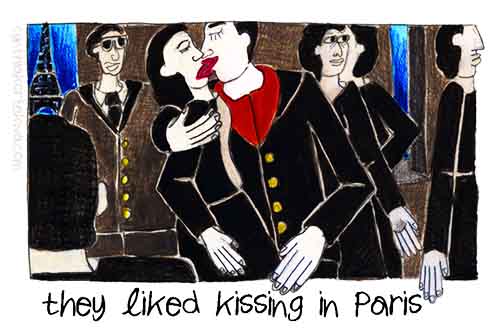
In the 1950s, Doisneau photographed a couple kissing in front of the Hotel de Ville in Paris. The photograph, extremely popular, was transformed into millions of postcards. Jean and Denise Lavergne claimed they were the couple and wanted to be compensated. They filed a suit against Doisneau who, to avoid legal penalties, had to confess that there was nothing spontaneous about the photo — the couple immortalized was that of Françoise Delbart and Jacques Carteaud, two unemployed actors.
So aren’t security cameras an invasion of privacy?
.
.


 The Narrative Within