Thread and Thrift and Mandy Pattullo

Mandy Patullo

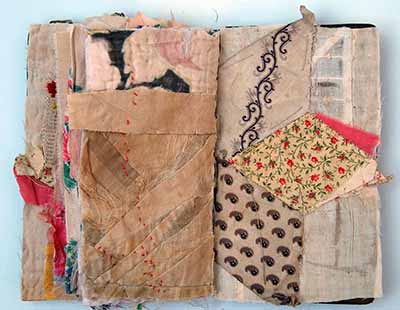
Mandy Pattullo is a British textile artist who’s work is delightfully yummy!  Her blog,  Thread and Thrift, features her art.

Mandy Patullo

Above are examples of her sample books.  A few years ago she bagan cutting up domestic hand embroidery and sewed them into books.  Often, the back of the work is shown as the front to highlight the element of stitching.

Mandy Pattullo

for more, visit her website Mandy Pattullo

Posted in People | Tagged , , , | Leave a comment

Best of Doily Fashion Remakes

Below, a great Repurposed Doily Complilaton!

Sophia's avatarDIY Fashion Sense

best of doily fashion remakes

The doily is possibly one of the oldest forms of crochet.  Crochet became popular in Europe in the 19th century, and white, crocheted lace doilies were a must-have accessory for any household. Doilies gained popularity in the Victorian Era, when women hand worked them in their spare time to add a little elegance to their households. They were originally used to protect table and dresser tops.

doily dresser decoration

At one time, doilies were considered so important that a young lady was expected to have at least 10 to be ready for marriage, and these were carefully stored in a trouseau chest to be used when she set up her household.

To make doilies certainly requires a lot of skill to make a beautiful doily and many hours of work.  I never had the patience to make them but luckily for us many considers doilies to be kitsch or granny decorations so you can always…

View original post 981 more words

Posted in Crafts | Tagged | Leave a comment

thrift store doily curtains

More recycled doilies:

Posted in Crafts | Tagged , | Leave a comment

Yūgen doilies

yugen doily

I often go to the outdoor market near my studio.  One of the main things I look for is the second hand table full of used linens because it is there that sometimes I can find “centrini”, that is, Italian doilies.

Many years ago, it was quite common for Italian women to crochet doilies. Obviously, they’d make them mainly at home but I have many memories of summer excursions to small villages where women would sit in groups outside their doorways and crochet together as they chatted.

yugen doily

Doilies were made to protect furniture and placed on dresser tops as well as on sofas and chairs.  In Victorian England, doilies called antimacassar were made to safeguard armchair backs from the Macassar hair oil men of the times wore. So doilies were not only decorative, they were practical as well.

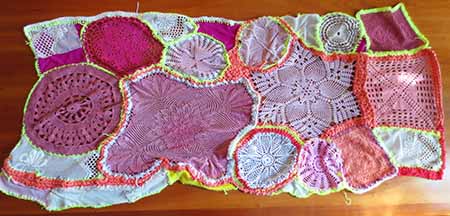
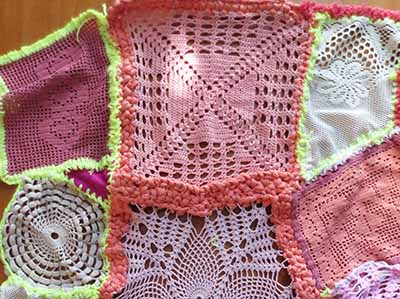
Then customs and tastes changed and  doilies were no longer valued.  That’s why they made it to the second hand markets.  Luckily, in recent years, they’ve been re-evaluated and old doilies are being used in new ways such as being sewn together to make dresses, tablecloths, lampshades, etc.

yugen doily

Aside from their beauty, there is something else that intrigues me about them. Handwork, since it requires focused attention, is a form of meditation.  Without a doubt, working with one’s hands changes brainwaves frequencies transforming the animated beta into a mild-mannered theta.  So, at the market, when I look at the second hand doilies, it’s like looking at  bottles of tranquillizers.  I image a woman sitting in her living room crocheting. Maybe she’d had a busy day answering the needs of others by cooking and cleaning, or maybe she’d had an argument with her husband, or maybe she was concerned about one of her kids.  But, whatever the source of anxiety, simply by crocheting a doily, she could, at least momentarily, have some tranquility.  Instead of focusing her attention externally, she  focused it internally.

yugen doily

Yūgen, a concept in traditional Japanese aesthetics, is an awareness that provokes emotions that can’t be described.  It is a feeling that is subtle yet profound.

yugen doily

By buying and reusing these discarded doilies, I hope to magically appropriate some of the tranquility they’d produced for their makers.  Thus seeing the handwork of these unknown women heaped together on a counter gives me a feeling of Yūgen.

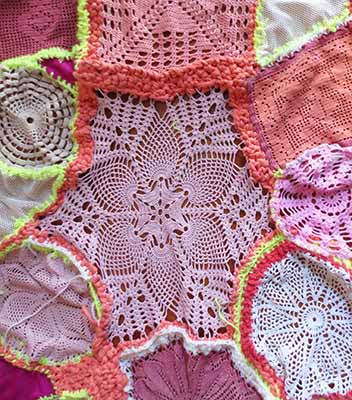
The doilies pictured above are for a Muy Marcottage creation such as Xαιρομαι/Delight huipil.

.

Posted in Muy Marcottage | Tagged , , , , | 2 Comments

Coppedé, a magical neighborhood in Rome

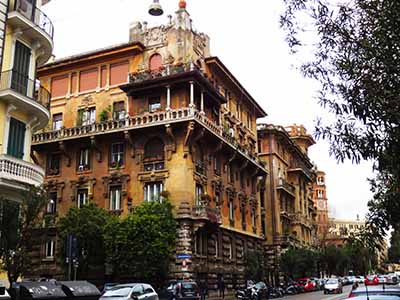
Recently I made reference to the Coppedé neighborhood in Rome.  It’s such a magical place that it’s worth writing about even though my fotos don’t do it justice.  And if you’re in Rome and interested in architecture, it’s a MUST SEE.

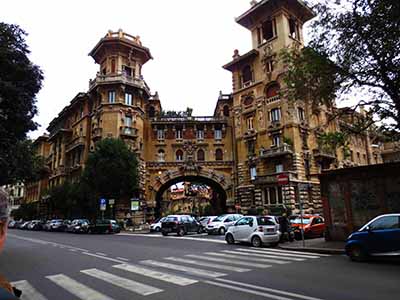
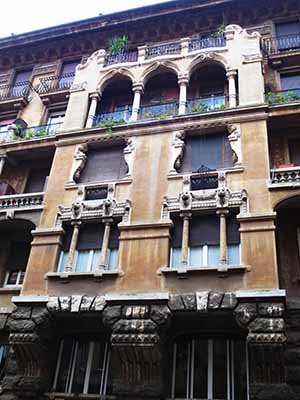
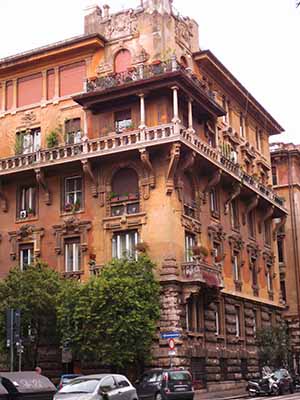
The  district,  between Via Tagliamento  and Corso Trieste, was designed by the Florentine architect, Gino Coppedé (1886-1927), Rome’s Mischievous Architect.  It is mystical & magical thus often included in the Esoteric Tours of Rome. Known locally as Quartiere Coppedé, the architecture is a mixture of Assyrian Babylonian, Baroque, Tuscan medieval, Gothic, Art Nouveau and much more.  Some decorative elements imitate scenes from the 1914 film “Cabiria”. Even spooky movie film director, Dario Argento, was so fascinated by Quartiere Coppedé that he used it as a location for two of his films, “Inferno” and “The Bird with Crystal Plumes”.
Coppedé

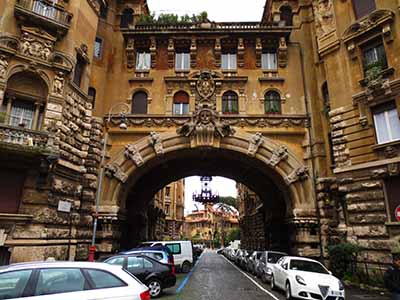
the entrance of the Coppedé neighborhood as seen from via Tagliamento

Coppedé

the arched entrance

Coppedé

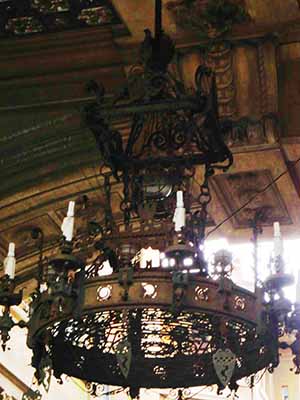
wrought iron lamp hanging at the entrance
Coppedé

Gino Coppedé was born in Florence and, after studying Industrial Decorative Arts, he began working at his father’s studio. He also taught at the Accademia  di Belle Arti di Firenze (where I also was lucky enough to teach one year) and the University of Pisa.

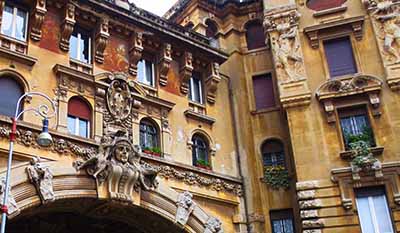
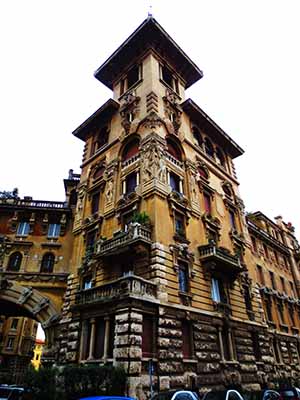
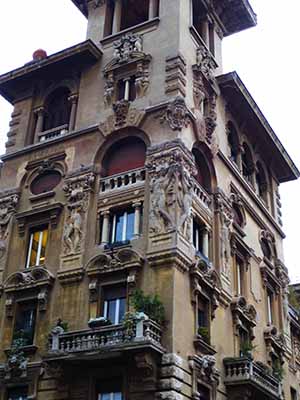
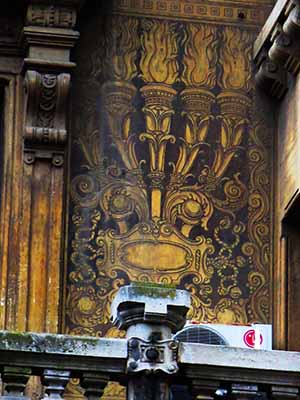
Coppedé designed many buildings in Italy but is probably best known for the Quartiere Coppedé. Built between 1915 and 1927, the district is composed of various buildings and villas.   Apparently, Coppedé intended to give every building a unique and mysterious aura of its own influenced by esoteric sciences. So full of relief sculptures, affrescoes and inscriptions, not even a dictionary of symbolism can help one understand everything represented.
CoppedéCoppedé

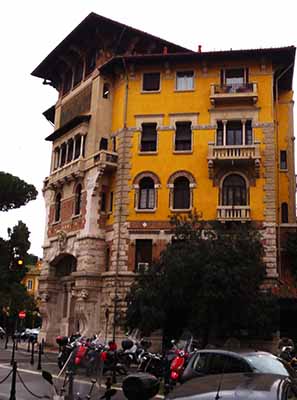
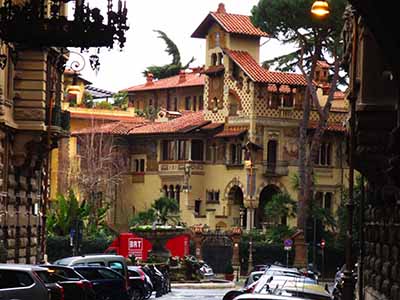
 a view of the Villini delle Fate (Fairy Cottages)
Coppedé

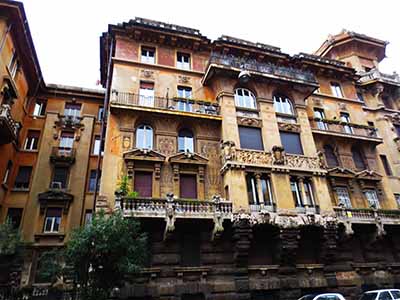
For example, there’s  the Spider Palace thus named because of a spider on a web that could symbolize The Great Mother and her weaving the destiny of man.

On another building there’s the representation of a chalice with dice that many have interpreted as the Sacred Graal.

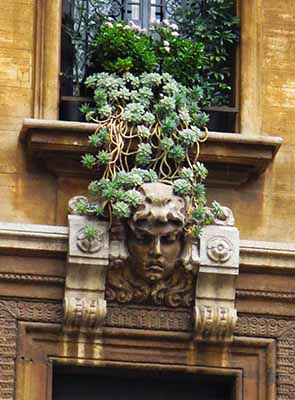
Since Coppedé was from Florence, it may explain why he included representations of Dante and Petrarca as well as views of the city itself.  But he also gives tribute to Venice because the neighborhood is full of lion’s heads jutting out from the wall and the lion is often associated with the lion of San Marco.  Another  affresco shows Rome’s famous she-wolf nursing Romolo and Remo.
Coppedé

Coppedé

corner relief sculpture

Coppedé

Coppedé

Coppedé

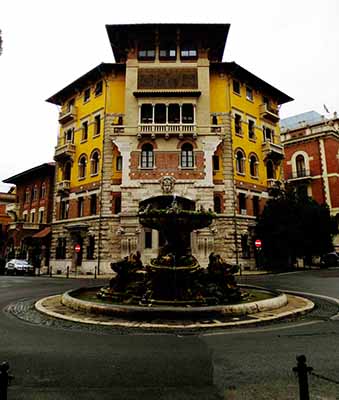
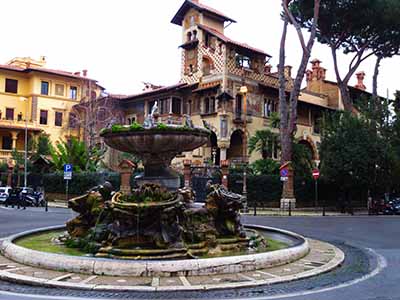
 Piazza Mincio and its Frog Fountain
Coppedé

Frogs adorn the rim of the upper fountain; whereas, the lower fountain is composed of four huge shells held up by men on their knees who are spitting out water.
Coppedé

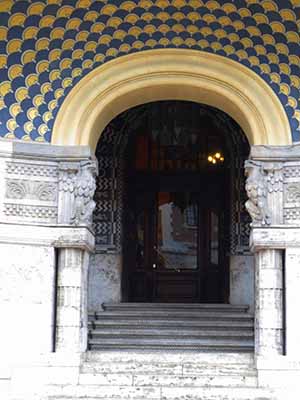
 mosaics and eagles are abundant as well

Coppedé

 the door framed with the words “OSPES SALVE” which roughly translates as “welcome”

Coppodé is not only rich in relief sculpture and affrescoes, but it’s also full of words and phrases written and sculpted on the walls (mainly in Latin).
Coppedé

notice the lions’ heads above the window columns

Coppedé

Coppedé

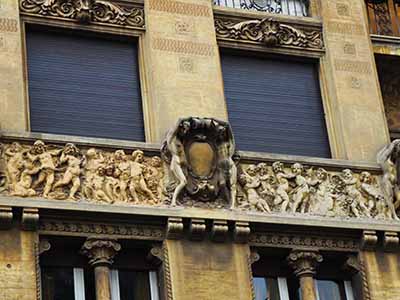
dancing cherubs

Coppedé

back part of the main entrance, Via Tagliamento
Coppedé

Coppedé died in Rome in 1927. Some say from gangrene of the lungs whereas others say he committed suicide.
Coppedé

Coppedé

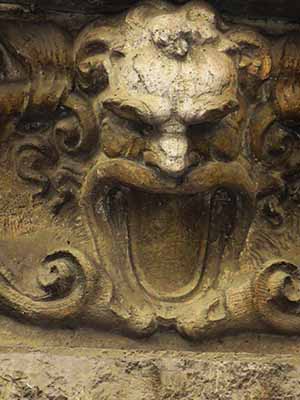
 relief sculpture in the style of Greek tragedy masks

Coppedé

one of the many Coppedé bees

Pope Urban VIII was Pope from 1623-1644. He came from the Florentine family Barberini. Their symbol was that of the bee.  So, with the help of his favorite artist, Bernini, Urban took advantage of his power to have bees embellish the buildings of Rome.
Coppedé lego street art at Coppedé

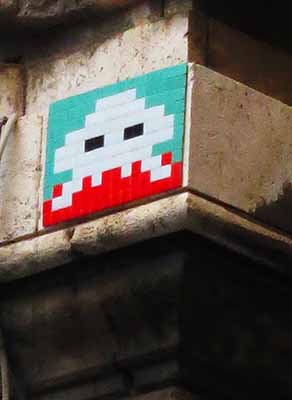
Legos have been used for some time now to create street art.  And above is an example found at Coppedé!  For more examples of lego street art, see Jan Wormann’s Dispatchwork

If you are in Rome and want to visit the area, you can get there with Tram 3 or 19 or bus 223, 86, 92.  The stop is at Piazza Buenos Aires.  And, depending upon what kind of shape you’re in, it’s within walking distance of  Villa Ada and the Catacombs of St. Priscilla.

A nice day in “Quartiere Coppedè” video

Posted in Rome/Italy | Tagged , , | 8 Comments