
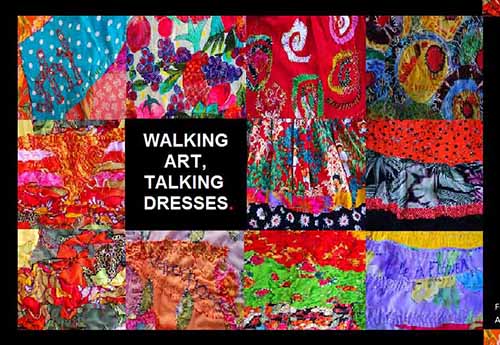
I will not be posting for a few days as I’m preparing for my Muy Marcottage exhibition”Walking Art, Talking Dresses”!
If you’re are interested in seeing some of the dresses that will be shown, click HERE.

I will not be posting for a few days as I’m preparing for my Muy Marcottage exhibition”Walking Art, Talking Dresses”!
If you’re are interested in seeing some of the dresses that will be shown, click HERE.
For sometime time now, I’ve been collecting information re: plants and how they can be beneficial for our health. As most of us are now faced with the challenge of living with less, medicinal plants, as opposed to expensive man-made drugs, are becoming more alluring. Recently, I wrote about aloe vera. Really, why buy face & body creams when you can use the aloe gel for free. And aloe is not only good for the skin, it halts colon cancer, heals the intestines and lubricates the digestive tract.

The Banyan Tree: The Indian Banyan tree is a type of fig tree that can store up to 25,000 gallons of water and often lives for more than 1000 years. It is huge and can cover enormous areas of land. Alexander the Great supposedly camped under a banyan tree that was large enough to shelter his army of 7,000 men.

Banyan Tree and Temples of the Angkor Complex in Cambodia: “Built from 802 to 1220 AD by the Khmer civilization, the temples at Angkor represent one of the most enduring and astonishing architectural achievements of humankind. …”
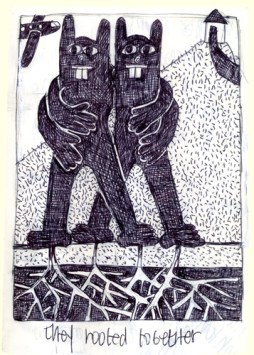
The Banyan Tree produces roots that grow so large as to form secondary trunks to support the tree’s expansive limbs. The trunks continue to produce roots and roots until the original tree is eventually crowded out.
The Ironwood Tree: Ironwood trees grow in the Sonaran Desert. Their seeds take a long time to germinate but, once they do, they alter the soil around them giving chemical cues that promote new plant life. And a new plant community.
Ironwood trees have roots that go deep into the ground searching for water. They suck in large amounts of water every day and then breath it out at night thus watering surrounding plants. The means that Ironwood trees can increase life around it by 88% and richness of species by 64% in any area in which it grows.

Keith Richards grew a lemon tree from a pip then germinated it by hand because, as he explains, “Somebody told me that in the winter, when the flowers come up, you’ve got to germinate them.” (see interview with Jimmy Fallon re: his lemons here) Since so many bees are tragically dying because of pesticides, in the future hand pollination may be the only means of growing fruit.
Janet Cooper is a friend and one of my favorite artists. She also owns the Muy Marcottage dress “Enjambment” and gave me a thrill by having herself photographed in the dress in various situations. Scroll below to see some of these fotos.

“Enjambment” dress on exhibit, Paros

Janet’s incredible dresses

more of Janet’s dresses “Birds & Babies”and “Blossoms”
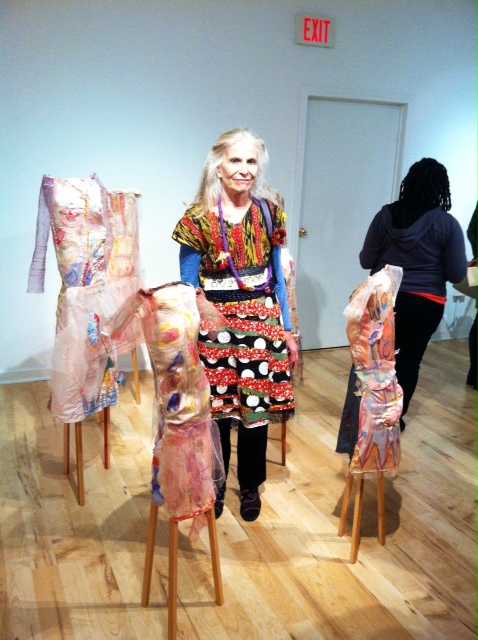
Janet wearing “Enjambment” surrounded by her delightful art dresses at the Die Formeister Exhibition.

Janet Cooper’s CHAIRS at the Die Formeister Exhibition.

Janet At the MOMA Opening for the Quay Bros Exhibit (Janet loves hats!)

Janet wore “Enjambment” while walking the last few miles of the El Camino de Santiago.
The term “enjambment” is a literary term. It indicates a line in poetry that continues going on beyond a line-break thus, in a certain way, goes beyond its boundaries. Just like the rows of fabric strips in the skirt of the dress “Enjambment“. This Muy Marcottage dress was made from a second hand, short, sleeveless dress as well as cut up discarded clothing and netting. The word “enjambment” is embroidered on the front. And, as you can see from the foto below, Janet looks fabulous in it!
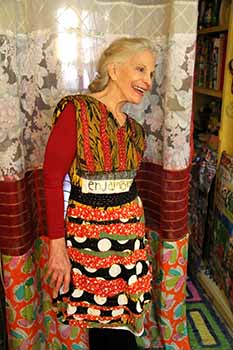
More about Janet in a previous posts (foto by Chiara Biagioli)
more links related to Janet: Janet Cooper began her artistic life working in clay but also had an interest in creating jewellery made out of recycled bottle caps and tins that she had collected + embellished dresses + I am in love with the patinas of the used and the mysteries of the discarded +
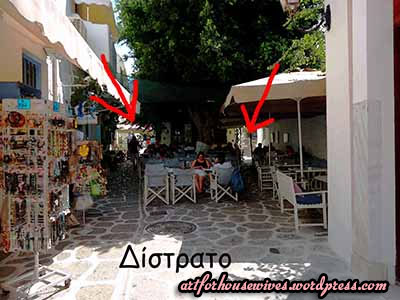
Here in Parikia, at the end of Market St. there’s a resturant where we sometimes go called Distrato. “Distrato” (Δίστρατο) in Greek means junction. In fact, the resturant is located where the street splits in two. It’s a name easy for me to remember as it’s pronounced liked “distratto”, the Italian for “distracted”. And isn’t that what a distraction is — a fork in the road where your thoughts have to decide which way to go?
My mind is full of these forks as I’m easily distracted.
There are many kinds of distractions. Some good, some bad. Good distractions are those that keep your attention away from negative thoughts. For example, if you are feeling down, a good distraction can keep those negative thoughts from going into loop thus saving you from depression.
Bad distractions are those that prevent you from focusing on what you have to do. For example, if you’re a brain surgeon and operating on someone, the last thing you need is a distraction. Another kind of bad distraction is that of mass media. They often make big deals about things that are insignificant in order to distract your attention from that which is far more important.
Maybe it’s time to pay attention.

Detail of Muy Marcottage dress I’m Easily Distracted
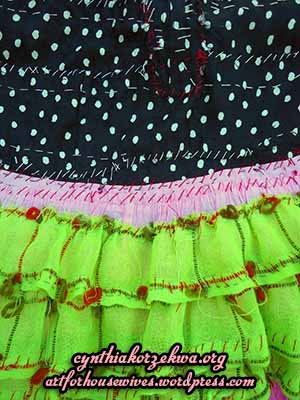
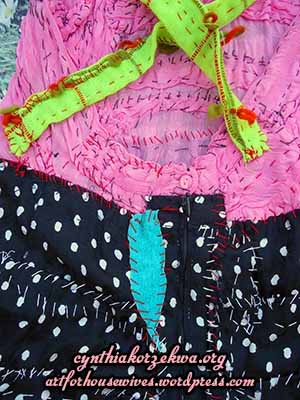
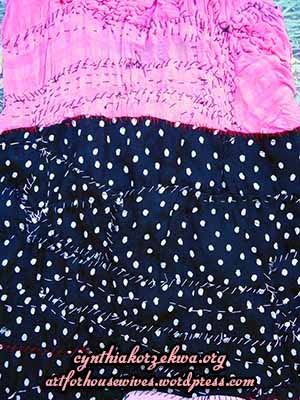
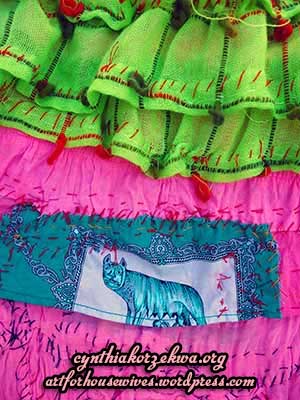
Above more details of the Muy Marcottage dress I’m Easily Distracted


Front Back
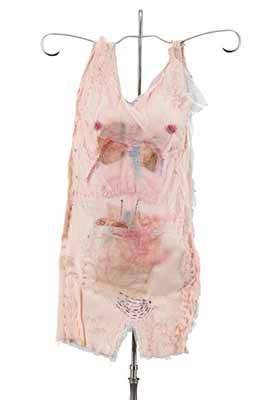
This is a short, shoulderless dress made from a variety of different fabrics (predominately secondhand clothing) formed on a mannequin then handsewn into place. It has a zipper to make it easier to get into and thin straps that tie around the neck to keep the bodice in place.
 To see more Muy Marcottage dresses, go HERE.
Some time back, my mom sent me one of her books, The Reader by Bernhard Schlink. Set in Germany, it’s the story of an adolescent male, Michael, who has an affair with an older woman, Hanna. Years later, Michel learns that Hanna, before being his lover, had been a guard in a Nazi concentration camp and was now being tried for her crimes. Much of the book focuses on the concept of guilt but The Reader presents another idea much more intriguing — that of numbness.
At Hanna’s trial, Michael observes that those who spasmodically attend the trial are always horrified at what they hear. But, attending every day, he risponds differently:
«It was like being a prisoner in the death camps who survives month after month and becomes accustomed to the life, while he registers with an objective eye the horror of the new arrivals: registers it with the same numbness that he brings to the murders and deaths themselves. All survivor literature talks about this numbness, in which life’s functions are reduced to a minimum, behaviour becomes completely selfish and indifferent to others, and gassing and burning are everyday occurrences. In the rare accounts by perpetrators, too, the gas chambers and ovens become ordinary scenery, the perpetrators reduced to their few functions and exhibiting a mental paralysis and indifference, a dullness that makes them seem drugged or drunk».
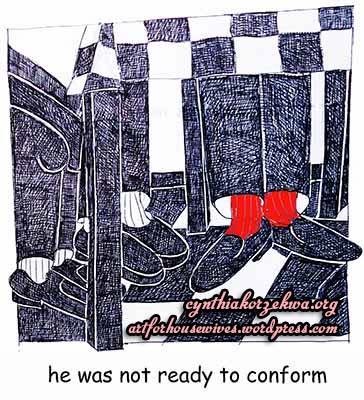
And how many of us have conformed to a certain kind of lifestyle to the point that we no longer know how to consciously evalute it. Because conformity numbs your perception.
Hanna’s true crime was that of being a conformist. And, like all conformists, she was just “obeying orders”. In 1944, SS Captain Erich Priebke ordered the shooting of 335 Italians in the Ardeatine Caves. The victims were males ageing from 14 to 75 and were considered, said Priebke, terrorists. Fifty years later, Priebke was tried for this crime in Rome. He admitted to having ordered these men’s death but was found not guility for the reason that he had acted under orders. Eventually this verdict was appealed and Priebke was sentenced to house arrest for life. In fact, just the other day, Priebke celebrated his 100th birthday at his home in Rome. Champagne included.
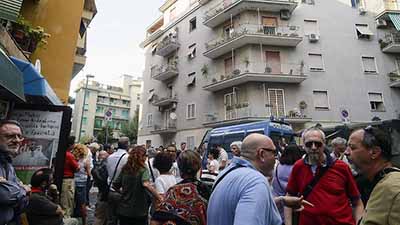
A group of protestors outside Erich Priebke’s house in Rome (foto Andreas Solaro/AFP via)
It’s easy to condemn Hanna and Prebke for their crimes. But what puzzles me is this: how was it possible for an entire nation to follow Hitler in his madness? Ok, so we know that WWI destroyed the German economy and that Hitler was charismatic and told the people what they wanted to hear and blah blah blah. But is that all it takes? Why were the people so ready to conform? And when was it that the numbness began — a numbness that obliterates compassion. And the concept of “fellowman”. The numbness that makes you ignore the needs of other just so you can obsessively focus on yourself. Yet when you look at yourself in the mirror, you are too numb to see how you really are.
The book is called The Reader in reference to Michael who reads to Hanna not knowing, at the time, that she was illiterate. And it was this illiteracy that caused her so many problems. For illiteracy makes you dependent upon others. But Hanna’s true illiteracy had nothing to do with reading and writing as much as it had to do with ethics. Ethically uneducated, she conformed because conformity is allowing others to think for you instead of doing the thinking for yourself. And that’s when the numbness sets in.
Is numbness the current epidemic?


 The Narrative Within