It had been a while since we’d walked together in the moonlight. So, hand in hand, Hugh and I took a stroll around Montparnasse. We wound up at Le Jockey Bar where Kiki de Montparnasse was singing “La Haut Sur La Butte”. We enjoyed it so much that we offered her a drink. Kiki was wild and exciting in a debauched way. She was living with the Surrealist photographer, Man Ray, who often used her as a model. To accommodate his surrealistic fantasies, he completely redesigned Kiki’s face. He’d removed her eyebrows just so he could redraw himself and gave her stenciled lipstick lips.
Too bad for him that it was easier to manipulate her face than it was to manipulate her personality. He should have taken that into consideration when he dumped her for Lee Miller. I was there in the café when Man Ray told Kiki that it was over. Kiki went into a rage and started throwing plates at him with such violence that he was forced to hide under a table.
Afterwards I lost contact with her but later heard that, not only had she opened her own cabaret, Chez Kiki, she’d also started painting. Self-taught, Kiki’s Naïf paintings sold out at her first exhibition. In 1929, she wrote her memoirs with an introduction by Hemingway.
But living in a whirlpool caught up with her. Without an anchor, she drifted away from her talents and mimicked herself when she sang for tourists in the Montparnasse cafes. Although always in need of money, Kiki said that she could survive with an onion, a piece of bread, and a bottle of red wine and she could always find someone to offer her that.
Kiki’s addiction to cocaine and alcohol eventually killed her. She was only 52.
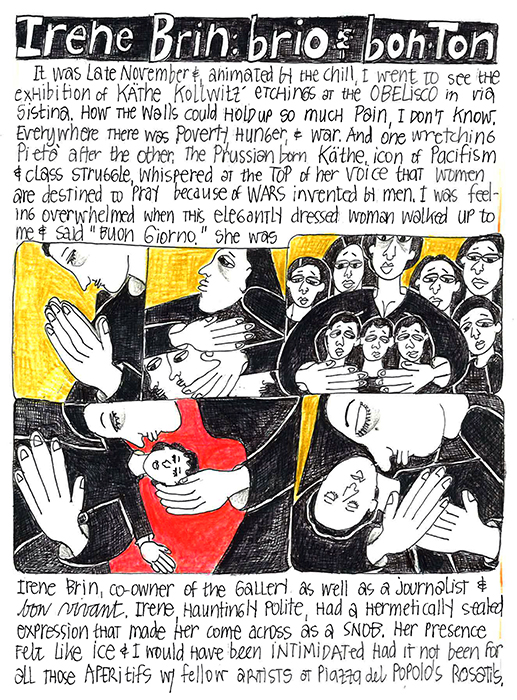
It was late November and, animated by the chill, I went to see the exhibition of Käthe Kollwitz’ etchings at the Obelisco in via Sistina. How the walls of the gallery could hold up so much pain I don’t know. Everywhere there was poverty, hunger, and war. And one heart wrenching Pietà after the other. The Prussian born Käthe, icon of pacifism and class struggle, whispered at the top of her voice that women are destined to pray because of wars invented by men. I was feeling overwhelmed when this elegantly dressed woman walked up to me and said “Buon Giorno”.
She was Irene Brin, co-owner of the gallery as well as journalist and bon vivant. Irene, hauntingly polite, had a hermetically sealed expression that made her come across as a snob. Her presence felt like ice and I would have been intimidated had it not been for all those aperitifs with fellow artists at Piazza del Popolo’s Café Rosati.
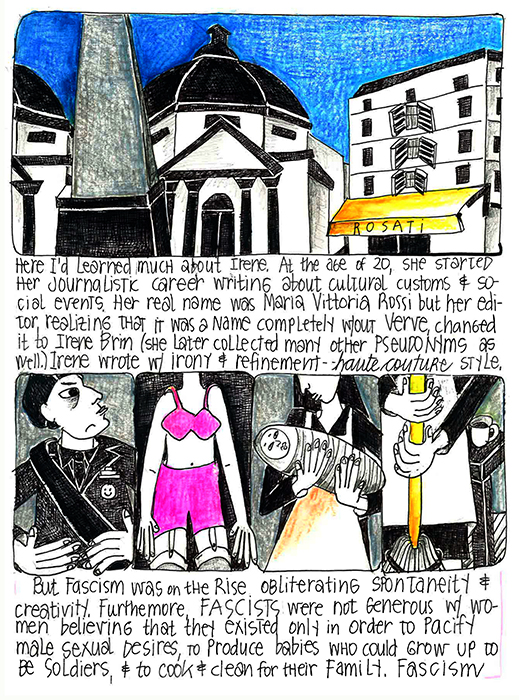
Here I’d learned much about Irene. At the age of 20, she started her journalistic career writing about cultural customs and social events. Her real name was Maria Vittoria Rossi but her editor, realizing that it was a name completely without verve, changed it to Irene Brin (she later collected many other pseudonyms as well). Irene wrote with irony and refinement—haute couture style.
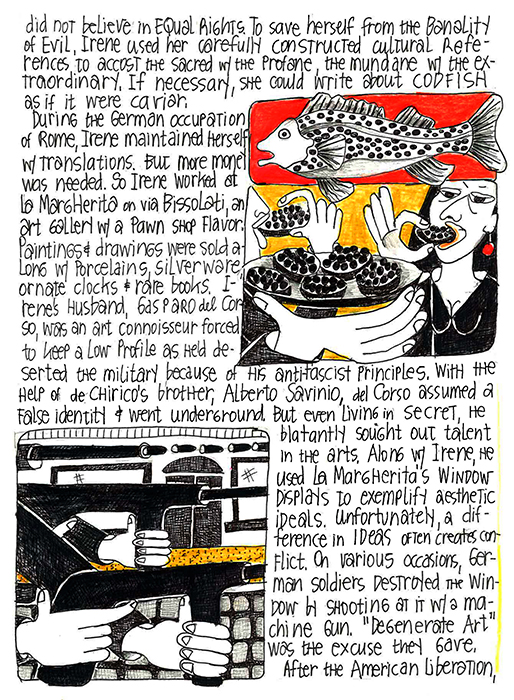
But fascism was on the rise obliterating spontaneity and creativity. Furthermore, fascists were not generous with women believing that they existed only in order to pacify male sexual desires, to produce babies who could grow up to be soldiers, and to cook & clean for their family. Fascism did not believe in equal rights. To save herself from the banality of evil, Irene used her carefully constructed cultural references to accost the sacred with the profane, the mundane with the extraordinary. If necessary, she could write about codfish as if it were caviar.
During the German occupation of Rome, Irene maintained herself with translations. But more money was needed. So Irene worked at La Margherita on via Bissolati, an art gallery with a pawn shop flavor. Paintings and drawings were sold along with porcelains, silverware, ornate clocks, and rare books. Irene’s husband, Gasparo del Corso, was an art connoisseur forced to keep a low profile as he’d deserted the military because of his anti-fascist principles. With the help of de Chirico’s brother, Alberto Savinio, del Corso assumed a false identity and went underground. But even living in secret, he blatantly sought out talent in the arts. Along with Irene, he used La Margherita’s window displays to exemplify aesthetic ideals. Unfortunately, a difference in ideals often creates conflict. On various occasions German soldiers destroyed the window by shooting at it with a machine gun. “Degenerate art!” was the excuse they gave.
After the American liberation of Rome, a new life began. In 1946, the couple opened an art gallery, l’Obelisco, named after the many obelisks in Rome. The first exhibition was that of the then unknown Giorgio Morandi who had a talent for elegantly depicting ordinary bottles. Exhibitions of Kandinsky, Dalì, Burri, Calder, Bacon, Rauschenberg and so many others later followed.
The years of isolation had finally ended and Rome was now exploding. So was Irene. The Italian capital had become the center of the world. Suddenly Rome was full of American film directors ready to make better use of the Cinecittà Studios created by Mussolini. William Wyler arrived at the Hollywood-on-the-Tiber ready to film A Roman Holiday. Now Irene could encounter Audrey Hepburn, Gregory Peck, and other stars as well.
Star struck and ready for glamour, Irene decided it was time for her own Hollywood makeover. She lost weight (her idea of a diet lunch was that of eating three bites of risotto followed by a glass of champagne). She always wore open-toed heels, collected Jaques Fath hats, and was a frequent visitor at Alberto Fabiani’s atelier on via Frattina. And with her new look established, Irene headed for New York City to show it off. And show it off she did. One day, while walking down Park Avenue, she was spotted by Diana Vreeland. “Just where did you get these clothes?” Diana asked. Diana, also polyglot and well read, was so impressed by Irene that she invited her to be the Rome correspondent for Harper’s Bazaar. And this was the beginning of Made in Italy.
But style is not just about fashion. In 1950, Irene made her debut as Contessa Clara, the name used for her bon ton column. “La buona educazione”, wrote the Contessa, “comes before everything else.”
Contessa Clara had advice about everything. For example: Eating ice cream while walking is slovenly as is standing at a bar to drink coffee if you are alone. And, when talking with someone, learn to use your eyes. Always look directly at your interlocutor frankly even if you are false, with serenity even if you are shy. Use interest, curiosity, and sympathy to make your eyes seem brighter. This was the same trick the photographer Cecil Beaton had taught the Duchess of Windsor. When being photographed, said the photographer to the duchess, look animated and amused as if you’ve just heard an entertaining story. Pleased with the results, it became the technique she’d often use when listening to the Duke.
Irene Brin dedicated herself to fashion and the arts until 1969 when, at the age of 59, she died of cancer.
LESSONS LEARNED: From Irene Brin we learn that elegance emanates from within. Wearing a designer dress or raising your pinky when drinking champagne is not enough. Because elegance is not a surface quality.
In September 1943, Italy signed an armistice with the Allies and, to conserve its artistic patrimony, Rome was declared an Open City thus a demilitarized zone. Nevertheless, the Germans occupied the Italian capital and made life difficult for everyone.
Irene and her husband, finding an existential conflict with Nazi and Fascist ideals, had secretly hidden a group of political exiles in their attic. Every morning Irene, well-dressed and made-up, would leave her home at Palazzo Torlonia to procure food for these secret guests. To finance their meals, Irene sold her wedding presents including a painting by Picasso.
The German soldiers were ruthless and without pity (as seen in Roberto Rossellini’s film “Rome, Open City”). To give shelter to these men took great courage because, in doing so, Irene and her husband risked their lives.
There is nothing more elegant than courage. And sometimes it takes courage to grow old gracefully.
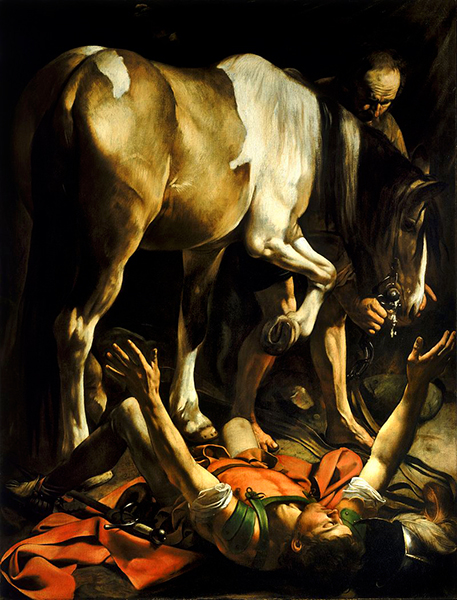
‘Ottobrate Romane’, October in Rome when the light has a special magic and seems to give everything an orange glow. But not at Piazza del Popolo. One of Rome’s largest squares, Piazza del Popolo is vast and grey. The most notable monument is the stolen Egyptian obelisk in the middle of the piazza followed by the twin churches, Santa Maria in Montesanto and Santa Maria dei Miracoli. Next to the doors of the piazza is the lacklustre entrance to the Basilica of Santa Maria del Popolo, the home of Caravaggio’s painting The Conversion of Saint Paul on the road to Damascus.
Conversion of Paul the Apostle
Saul of Tarsus, educated in Jerusalem by a famous rabbi, was a zealous Pharisee who actively participated in the persecution of Jesus’ disciples. So much so that he was sent to Damascus to arrest, imprison, and execute followers of the Jesus movement who’d fled Jerusalem to avoid persecution. But on the road to Damascus, Saul was blinded by a big burst of sunlight and fell to the ground. He heard a voice coming from the Heavens asking “Saul, why are you persecuting me?” “Who are you?” asked Saul. And the voice replied “I am Jesus.”
For three days Saul was unable to see but once he recovered his sight, he became Paul the Apostle and a protagonist in the Jesus movement.
Paul and Jesus
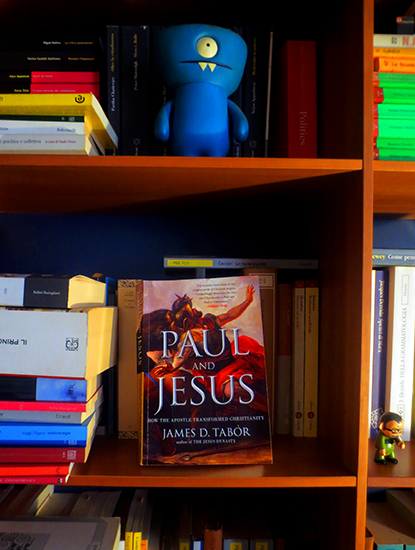
In Paul and Jesus, Biblical scholar James D. Tabor explains how Paul the Apostle radically transformed the Jesus movement and made it his own. The date for Paul’s conversion is given as AD 37, seven years after Jesus’ death. Although Paul had never known Jesus personally, he claimed that he and Jesus had frequent visionary encounters.
When Jesus died, his brother James assumed the role of leader of the Jesus movement. Nevertheless, the neo-converted Paul opposed many of the movement’s teachings and, basically, developed a movement of his own. He worked independently and preached his own gospels in Asia Minor for a number of years. It was only ten years after Jesus’ death that Paul finally met original apostles James and Peter. The meeting was not a pleasant one and basically divided the movement in two: the Jewish Jesus movement led by James and the Gentile Jesus movement led by Paul.
There were many differences between James’ and Paul’s interpretation of the Jesus movement. One of the big differences regarded circumcision. Traditionalist Jews who saw Jesus as Messiah continued to believe in circumcision as Jesus and his apostles had all been circumcised. But Paul felt that circumcision was no longer necessary as it would alienate Gentiles. For Paul, becoming a Christian didn’t mean being a Jew. So Paul focused on the rest of the Roman Empire leaving Jerusalem to James.
Probably one of the most interesting elements in Tabor’s book relates to how much of the New Testament was written and/or orchestrated by Paul. Written between 50 and 100 AD, way after Jesus’ death, the New Testament falls into two categories: the Gospels and the Letters. The Letters were written by Church leaders but mainly by Paul (who wrote many of his epistles while imprisoned in Rome). And of all the New Testaments 27 books, it seems Paul wrote about half of them thus determining much of the religious narrative. But what happens when there’s a leak in the narrative?
The last restoration of the Sistine Chapel frescoes took place in 1989. After seeing the makeover, a friend claimed that the removal of years of candle soot from the colors reminded him of Andy Warhol. Skeptical, I went to the Vatican to see for myself. A huge group of tourists and I were herded into the chapel and, after about 15 minutes with our necks stretched back looking at the ceiling, we were herded out. The exit hall was very crowded and the motion forward slow. Behind me were two women exchanging thoughts about the fresco. One woman remarked that the God she prayed to didn’t look anything at all like the God Michelangelo painted. It seemed such a peculiar thing to say and made me wondered how this image mix up could affect the outcome of one’s praying. The Bible says that God created man in his own image. But what kind of image can man create of something he’s never seen before?
In 1934, Sherlock Holmes enthusiast and writer, Christopher Morley, created The Baker Street Irregulars. Detective Rex Stout was a member of this exclusive Sherlockian literary society but shocked the members when, in 1941, he presented a speech “Watson Was a Woman”.
Rex Stout
Why would Stout even suggest such a thing? Now there had been rumours that Holmes and Watson were gay (so much speculation for two people who never actually existed) so could it be that Stout was just mocking Holmes’ homophobic fans? Or was there another reason?
Stout, in his speech, lists a number of examples where he believes that Watson acts more as a wife than he does as a friend. For example, Watson asks Holmes to play Mendelssohn’s “Lieder” on his violin and Stout cannot believe a man would do something similar. Or that fact that Holmes and Watson are described being together during various times of the day but never at bedtime (obviously for reasons of bon ton). Or that when Watson complains of the thick toxic smoke in the room, Holmes brusquely tells him to go open a window. And when Watson discovers that Holmes is not dead but alive, Watson faints as only a woman would do.
More than proving that Watson was a woman, these examples seem to indicate that Stout shared the same stereotyped misogynist depictions of women as his claim to fame character, Nero Wolfe. Feelings also shared by The Baker Street Irregulars who did not allow female members until 1991.
Lady Detectives
During the Victorian era, a variety of factors facilitated the introduction of a great number of female literary detectives: new technology permitting mass production of cheap publications, the shift towards universal education had more women reading, and the adventures of female detectives provided women with new experiences even if only in their imagination. But something else was involved. Female detectives solved crimes thanks to the kind of reasoning women use so women could easily related to them.
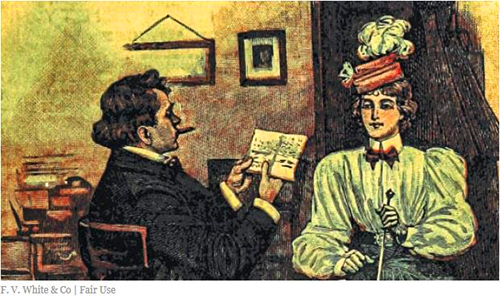
A Study in Scarlet, the first story to feature Sherlock Holmes, was published in 1887. However, way before Holmes, there was a female detective. Revelations of a Lady Detective, attributed to William Stephens Hayward, was published in 1864. A cheap pot-boiler, the protagonist was Mrs. Paschal, a female detective employed by the police. Of her past we know little save that she was widowed and forced to earn a living for herself. And thanks to her intuition and courage became an excellent detective. But this was only the beginning for female detectives.
There are three standardized methods of reasoning: inductive, deductive, and abductive.
Inductive reasoning tries to turn a specific into a generality. If all your life you have only seen white swans, you will assume all swans are white.
Deductive thinking is extracting information from what is already there without adding anything new. All dogs have ears so if Chihuahuas are dogs they must have ears, too.
Abductive reasoning is coming to a conclusion based on what you already know. That is, arriving at a conclusion not based on standardized theories but on careful observation followed by the search for the simplest explanation as to the why behind what’s been observed.
Women have a tendency to prefer the use of abductive reasoning as do female detectives. Look at Miss Marple. Her success was due to her use of abductive reasoning, that is, relying on her own experience as a form of knowledge.
In 2012, Tamir Pardo, chief of Israel’s Mossad, told The Jerusalem Post that women made better spies because they were better at multitasking and, as opposed to men, were better able to suppress their ego in order to attain their objective.
Furthermore, a few years ago, the chief of the British Secret Intelligence Service revealed that the real-life equivalent of Q, a technology expert, in the James Bond movies is a woman.
This said, maybe Stout would have been better off saying that it Holmes, and not Watson, was a woman.
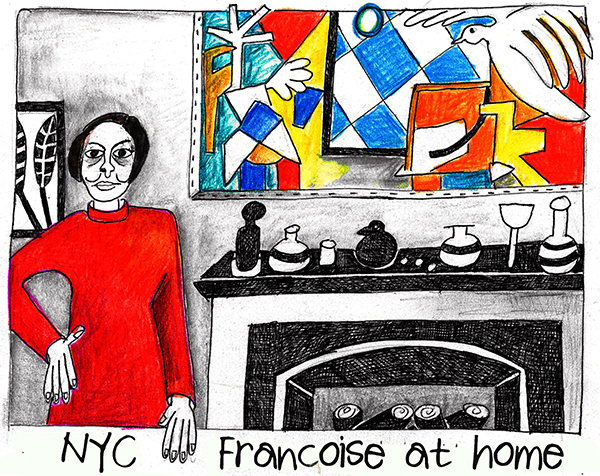
It was the spring of 1943. He was 61 and she was only 21 when Pablo Picasso put a bowl of cherries on the table where Françoise Gilot was dining. Seeing her as his new muse, Picasso immediately dumped his girlfriend, Dora Maar, for Françoise. For ten years Picasso and Françoise were involved in a relationship until Françoise realized that Picasso was a tyrannical energy vampire and would consume her as he had all the other women in his life. So she did something no woman had ever done—she left him.
In 1947, Jonas Edward Salk, virologist and researcher, accepted a professorship in the University of Pittsburgh’s School of Medicine. Here he devoted himself to developing a vaccine against polio. But despite working sixteen hours a day, seven days a week for years, he just couldn’t arrive at a conclusion. So Salk decided to take a break and left for Italy where he stayed in the monastery of San Francesco d’Assisi’s Basilica.
The atmosphere here was a dramatic change from his lab in Pittsburgh. Built into the side of a hill, the Basilica of San Francesco d’Assisi, with its cloisters, expansive exterior and semi-circular arches, is a synthesis of the Romanesque and Gothic style. The interior, decorated with frescoes by Italian artists such as Cimabue and Giotto, is particularly impressive because of the light coming in from the rose window. The spirituality of the architecture, Salk would later say, was so inspiring that it allowed him to do intuitive thinking far beyond any he’d ever done in the past. His mind liberated, once back in Pittsburg, he developed the world’s first successful polio vaccine.
Years later, in 1969, Françoise Gilot and Jonas Salk met thanks to a mutual friend. Salk was immediately smitten by the French artist but Françoise was a bit more cautious. Six months later, Salk asked Françoise to marry him. But, before accepting, Françoise insisted on certain conditions one of which being that they lived six months apart so that he could pursue his scientific endeavors in La Jolla and she her artistic ones in NYC and Paris. Salk agreed saying that, especially at their age, more than romance, what they needed was an emotional fortress. So agreeing to give one another shelter, the two married in 1970 and were together for 25 years until Salk’s death in 1995.
After his marriage to Françoise, Salk focused much of his writing on the subject of human evolution and the potential of mankind. His concept of intuitive thinking is particularly intriguing. In 1983, Salk published Anatomy of Reality: Merging of Intuition and Reason. Here are my notes:
For the human mind and consciousness to evolve, intuition and reason must also evolve. Intuition and reason is a dual relationship. They must be studied separately as well as together. Some of us have a better developed intuition just as some of us have a better developed reasoning.
Our intuition, which responds subjectively, is quicker and more sensitive than our reason which responds objectively.
Although an innate quality, intuition can be developed and cultivated.
The intuitive way of thought is the evolutionary way of thought. Like instinct, it is the extension of a natural process. Reason, says Salk, can be seen as that which man adds to explain his intuitive sense.
We must learn to let our intuition play. Because it is this intuition which helps us create the basis of our reasoning. Because it is intuition that will tell the thinking mind where to look next.
When reasoning becomes conscious of intuition and reflects on what it observes, it will automatically correct, modify, and impress its process.
Although we often speak of evolution of man’s mind, we speak of it as if we are detached from this evolution. We do not see ourselves and our minds as part of the process of evolution. But we are.
We must no longer confront the universe as objective observers as we are also part of the universe.
And what can make you part of the universe more than love?
Françoise Gilot was born on November 26, 1921. This year she will be 101 years old.












 The Narrative Within