
The backyard BBQ had been cancelled because of the rain so I stayed in that evening to watch TV. Eleanor Roosevelt was being interviewed by two males who routinely interrupted her answering one question by asking her another one. But she got their attention when, using carefully formed sentences spoken with a Mid-Atlantic accent, she defined a liberal. A liberal, said Eleanor, is a person who keeps an open mind, a person who can move forward instead of always looking back. In essence, a liberal is a person who is not afraid of change. Impressed, I wrote her a letter expressing my admiration for her aplomb. You can imagine my surprise when not only did she respond, she also invited me to tea the next time I was in New York.

Eleanor came from an affluent and socially prominent family. Her mother had more beauty than maternal instinct and often called her daughter “Granny” to indicate she was homely in her looks and in her ways. Eleanor would feel so ashamed that she’d want to sink through the floor. Her father was loving but an alcoholic and exiled from the family by Theodore Roosevelt, his brother and future president. By the time Eleanor was 10, both her parents were dead and she was sent to live with her frigid grandmother.
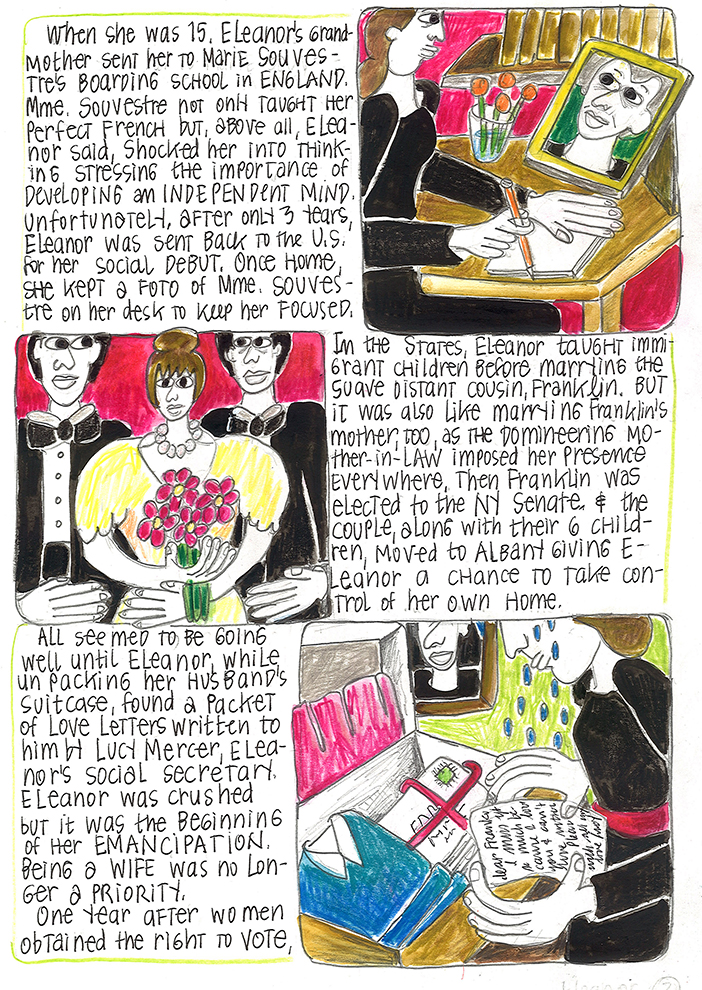
When she was 15, Eleanor’s grandmother sent her to Marie Souvestre’s boarding school in England. Mme. Souvestre not only taught her perfect French but, above all, Eleanor said, shocked her into thinking stressing the importance of developing an independent mind. Unfortunately, after only three years, Eleanor was sent back to the US for her social debut. Once home, she kept a photo of Mme. Souvestre on her desk to help keep her focused.
In the States, Eleanor taught immigrant children before marrying the suave distant cousin, Franklin. But it was also like marrying Franklin’s mother, too, as the domineering mother-in-law imposed her presence everywhere. Then Franklin was elected to the NY senate and the couple, along with their six children, moved to Albany giving Eleanor a chance to take control of her own home.
All seemed to be going well until Eleanor, while unpacking her husband’s suitcase, found a packet of love letters written to him by Lucy Mercer, Eleanor’s social secretary. Eleanor was crushed but it was the beginning of her emancipation. Being a good wife was no longer a priority.

One year after women obtained the right to vote, Franklin contracted polio and that’s when equilibriums radically changed. Not only did Eleanor help him with his cure, she also encouraged him to stay in politics making sure her voice would be heard as well. The Ugly Duckling was now a beautiful swan and it had nothing to do with looks.
Politically Eleanor fought for civil rights, feminism, and underprivileged youth. When the Daughters of the American Republic prevented the black opera singer Marion Anderson from singing at the Constitution Hall, not only did Eleanor resign from the DAR, she helped organize a concert for Marion on the steps of the Lincoln Memorial. And when Marion belted out “My Country Tis of Thee”, hearts quivered.
During Franklin’s presidential campaign, Eleanor had become friends with the bourbon drinking, cigar smoking, AP journalist Lorena Hickok. The two became very close and Hick, as Eleanor called her, moved into the White House where she remained for the next 13 years. Hick was a media expert and helped Eleanor, who had never wanted to become a President’s wife, learn how to deal with the press. Thanks to Hick, Eleanor began her popular newspaper column “My Day” about her activities as First Lady. Eleanor also had routine press conferences inviting only female journalists as they were barred from presidential press conferences. Yin yang.

Probably what most impressed me was Eleanor’s role in promoting the United Nations. She was instrumental in having the Four Freedoms included in the UN’s charter. These Freedoms are: 1. Freedom of Speech 2. Freedom of Worship 3. Freedom from Want 4. Freedom from Fear.
One thing I understood, had it not been for Eleanor, FDR would never have become president.
Finally I planned a trip to New York City to have tea with Eleanor. She lived in a lovely townhouse on East 67th Street. A housekeeper led me to a lovely room with leaded windows where I nervously sat until Eleanor walked into the room. She was about 70 years old, tall, wore a violet printed dress, pearls and a hairnet. Eleanor’s eyes were like blue seas that made you want to jump inside of them and swim.
As she poured the tea she said: “A woman is like a tea bag–you can’t tell how strong she is until you put her in hot water.”

Looking around the room I noticed there was a knitting bag full of yarns and needles. “Oh, you knit?” I asked. “Yes, my dear, you see knitting use to help me so much when discussing politics with Franklin. Sometimes he would say the most outrageous things and, instead of commenting, I would simply speed up the stitching. Knitting also helps me think things out and I always take some knitting with me when I travel. Here, take these.” And she gave me the most unusual pair of mittens I’d ever seen.
Eleanor knew how to spread her presence in the same way I knew how to butter my bread…a little here, a little there until you’re just about everywhere. I told her that I admired her courage as she’d often expressed opinions that had not been popular especially coming from a president’s wife. Eleanor just smiled and said: “Do what you feel in your heart to be right—for you’ll be criticized anyway. Instead of letting my role as First Lady influence my actions, I used it as a means of influencing the actions of others. Because the future belongs to those who believe in the beauty of their dreams. Furthermore, remember no one can make you feel inferior without your consent.”

“And don’t be afraid of growing old either” she said as she took one of her chocolate covered garlic pills for her memory. “Because beautiful young people are accidents of nature, but beautiful old people are works of art.”
As we grow old, we fear not only for our physical health but for our mental health as well. Mental health is about equilibrium. Insecurities are destabilizing because they make us rigid and fearful of change. But rigidity is not stability. Often it’s the lack of flexibility that provokes chaos. Bamboo doesn’t break when the winds blow hard because it knows how to bend.
The five things, according to some research, that most affect us when we’re old are: health, relationships, economics, sense of purpose, and discrimination.
Whatever we do often, we will do well even if it is bad for us. Because repeated actions create neural pathways. To create a path in a field of grass, you simply repeatedly walk the same route until you flatten the grass. In the same way, habits are formed. Thanks to neuroplasticity, the brain’s ability to change itself, we can create new pathways and transform ourselves no matter what our age.
Good mental health begins with good thoughts. If you want a positive change in your life, start with positive thinking. When a bad thought comes into your mind, nip it in the bud before the negativity goes into loop. Substitute the negative thought with a positive one. Or use a talismanic action such as making the word “happy” in sign language as you smile and say “I’m feeling glad all over”. To say “happy” place your hands in front of your chest, palms inward, then toss your hands up and down creating a circular motion. Repeat this motion with a smile on your face.
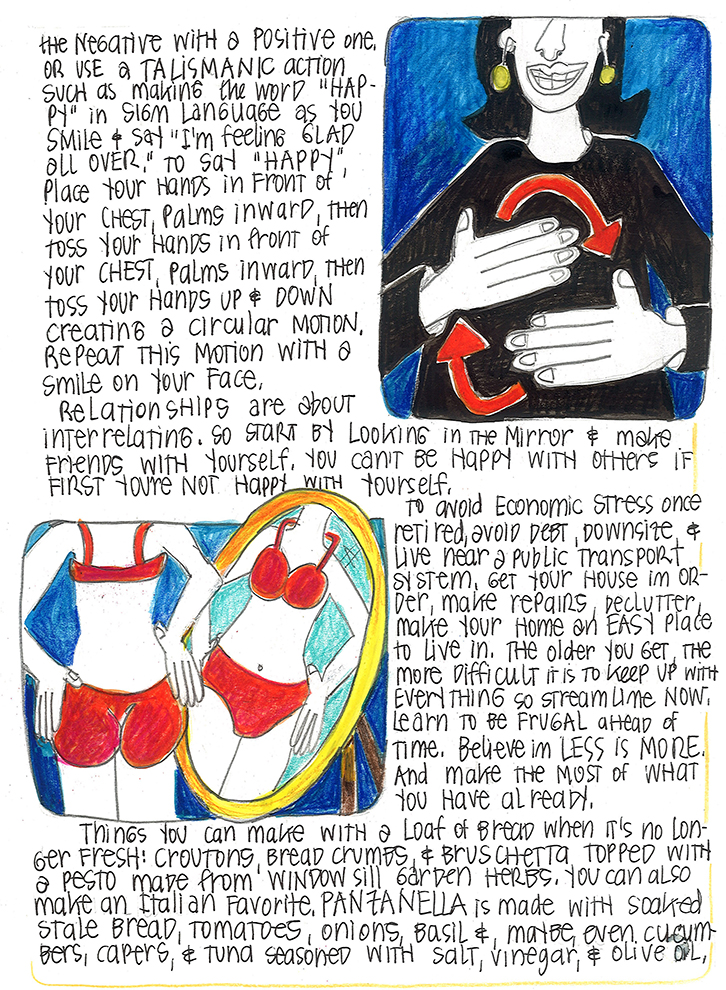
Relationships are about interrelating. So start by looking in the mirror and make friends with yourself. You won’t be happy with anyone if first of all you are not happy with yourself.
To avoid economic stress once retired: avoid debt, downsize and live near a public transport system. Get your house in order, make repairs, declutter, make your home an easy place to live in. The older you get, the more difficult is to keep up with everything so streamline now. Learn go be frugal ahead of time. Believe in less is more. And make the most of what you already have.
Things you can make with a loaf of bread when it’s no longer fresh: Croutons and Bread crumbs, bruschetta topped with a pesto made from windowsill garden herbs, and an Italian favorite, panzanella. Panzanella is a Tuscan salad made with soaked stale bread, tomatoes, onions, basil and maybe even cucumbers, capers and tuna. It’s seasoned with salt, vinegar and olive oil.

Learn to joy in activities that don’t require money: Have a picnic in the park, pretend to be a tourist in your own town and take walking tours, organize a romantic Evening in Paris at home (OK, maybe some money for the wine!).
Young or old, you need to give your life a purpose. Like Rita Montalcini. Despite her father’s objections, Rita went to medical school and became a biologist. Afterwards she became a university assistant but, because of the 1938 Italian Racial Laws, was forced to give up her position, flee, and assume a new identity. But that didn’t keep her from creating a lab in her bedroom to study the nerve growth of embryonic chicks. This eventually led to the discovery of Nerve Growth Factor (NGF) and, later on, a Nobel Prize.
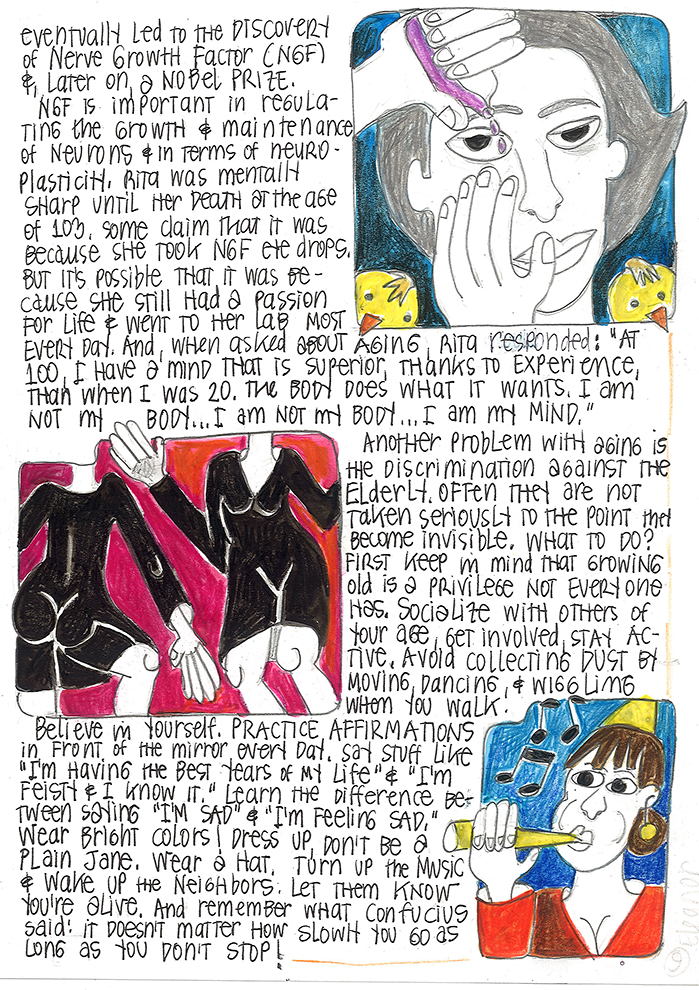
NGF is important in regulating the growth and maintenance of neurons. NGF is important in terms of neuroplasticity. Rita was mentally sharp until her death at the age of 103. Some claim that it was because she took NGF eye drops. But it’s possible that it was because she still had a passion for life and went to her lab most every day. And when asked about aging, Rita responded: “At 100, I have a mind that is superior, thanks to experience, than when I was 20…the body does what it wants. I am not my body, I am my mind.”
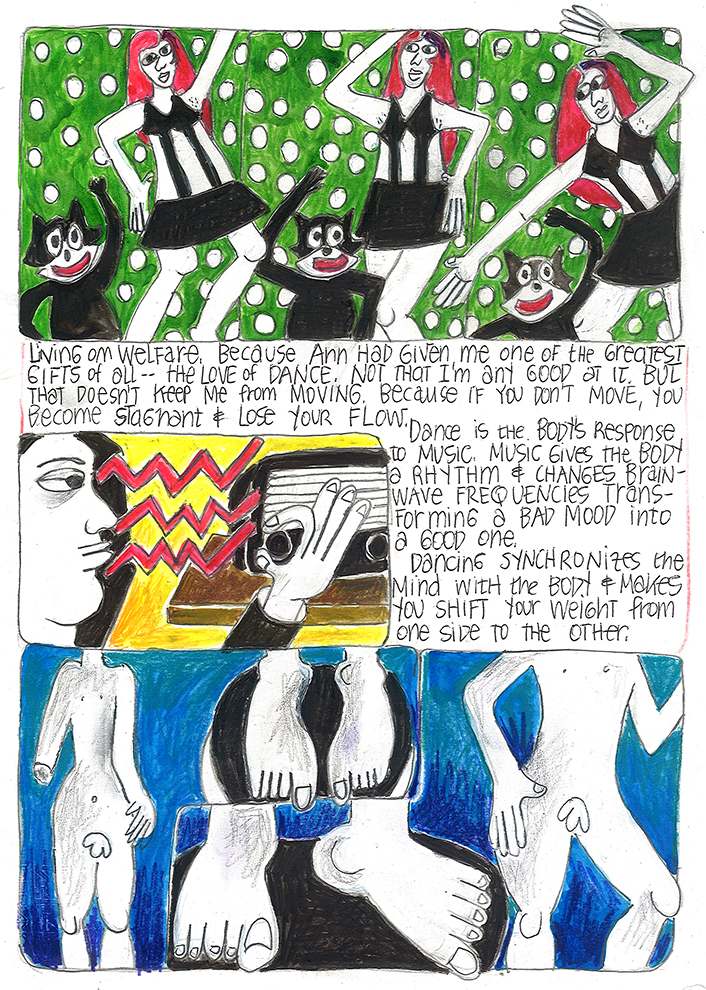
Another problem with aging is the discrimination against the elderly. Often they are not taken seriously to the point they become invisible. What to do? First keep in mind that growing old is a privilege not everyone has. Socialize with others of your age, get involved, stay active. Avoid collecting dust by moving, dancing, and wiggling when you walk.
Believe in yourself. Practice affirmations in front of the mirror every day. Say stuff like “I am having the best years of my life” and “I’m feisty and I know it”. Learn the difference between saying “I’m sad” and “I’m feeling sad”. Wear bright colors! Dress up. Don’t be a Plain Jane. Wear a hat. Turn up the music and wake up the neighbors. Let them know you’re alive.
And remember what Confucius said: It doesn’t matter how slowly you go as long as you don’t stop!
-30-
Related: Eleanor Roosevelt interviews JFK video + Eleanor Roosevelt Speech Human Rights video + Whats my line? Eleanor Roosevelt video + “White Houses” book about lesbian love affair between Eleanor Roosevelt, journalist, White Houses by Amy Bloom interview + Eleanor and Franklin (1976 television movie) + Eleanor Roosevelt: The Definitive Biography of America’s Most Important First Lady (1999) + Eleanor Roosevelt interview with Bill Downs and Edward P. Morgan (people who do things for you generally expect something in return, that’s why some nations are suspicious of US help…getting these people back on their feet is necessary because we need markets…in this interview Eleanor also explains her concept of liberalism) + Eleanor Roosevelt Papers Project + Eleanor Roosevelt interview (1957)
(from Cool Breeze, aka The Age of Reconfiguration ©)











 The Narrative Within