Profiling Storytellers

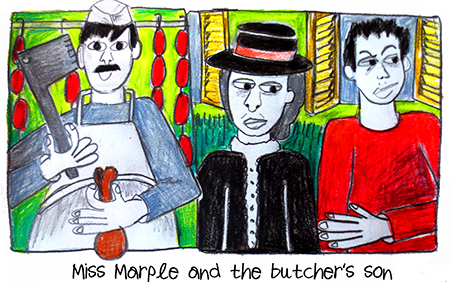
Before the FBI’s criminal profiling, there was Miss Marple. Miss Marple didn’t need an FBI profiler to know a criminal when she saw one. A careful observer of human behaviour, she relied upon her own experience to identify personality types. For example, she would observe someone then say “Oh, he reminds me of Jack, the butcher’s son, who was a petty theft.” Miss Marple had developed the art of abductive reasoning. That is, arriving at a conclusion not based on standardized theories but on careful observation followed by the search for the simplest explanation as to the why behind what’s been observed.

Jane Marple is a fragile looking old lady with twinkling blue eyes. She is not a busybody as much as a sleuth searching for answers. She has found a way to let her unsentimental understanding of human nature help her solve murders.

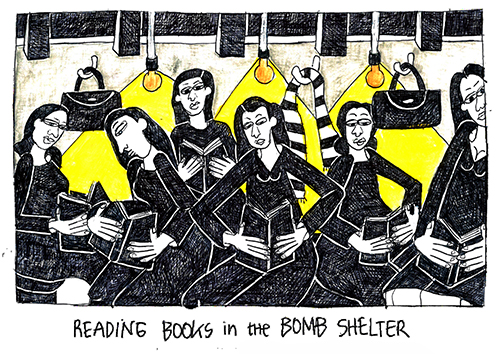
Agatha Christie (1890-1976), the creator of Miss Marple, was already a well-known author when the WWII broke out.  The summer of 1940, Germans had decided to bomb London to smithereens. The Blitz, as it was called, lasted for 57 days in a row with the Germans systematically dropping bombs on the capital of England. London’s 8 million inhabitants went underground like moles. It took people time to get used to the blare of sirens sending them off to shelters. But once it became the norm, people went to shelters prepared to spend time there. Books were a must as not only did they helped to pass time waiting for the raid to stop, it helped distract them. As a result, sales of books increased dramatically. Crime fiction was a favorite.

Agatha was homed schooled and, not having classmates to play with, she invented them. Agatha called her imaginary playmates “The Girls” and for each one of them she invented a physical look, a personality of her own. When playing with The Girls, as she called them, Agatha talked for herself and for them as well. This is probably where she learned to become so good at dialogue.

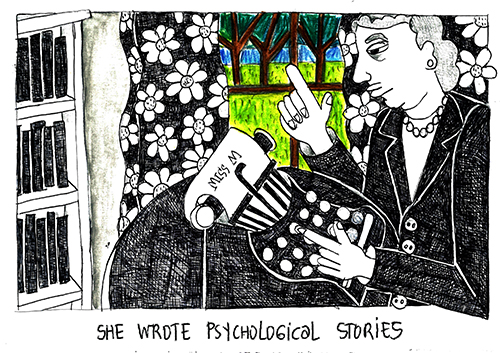
A writer of both novels and short stories, Agatha’s style was simple and easy to ready. She liked puzzles so the plot was more important that the murder itself. But her real interest was human nature. Every novel has at least one character who is going through a psychological struggle.

Much had been written about what had made her so successful. One theory was that, by keeping things simple via the use of plain language, short sentences, and much dialogue, she made it easier for the reader to follow the plot. Even experimenting neurolinguists had their say and said Agatha owed much of her success to repetition. If the author repeats words at least three times in a paragraph, the reader becomes more easily convinced.

-30-

Related: My Friend Agatha + Miss Marple, my favorite profiler +

Posted in Art Narratives, Books, storytelling | Tagged , , , , , | 1 Comment

Bedtime Stories for Adults

Insomnia is still stalking me. I know, it’s all in my brain. Wide awake at 2 a.m. once again, I understood that I needed help in redirecting my thoughts. Maybe by reading.

Reading for just six minutes, according to some studies, can reduce stress related insomnia by at least 65% thus helping the body fall asleep. So what I need is a bedtime story–a bedtime story for grown-ups. A story that can distract me from myself.

My middle school Speech & Drama teacher, Ms. Bardwell, focused on getting her students to express themselves in a comprehensible way. One exercise she used was that of having the students learn a short story well enough to retell it in front of their classmates. The story I chose was Frank R. Stockton’s “The Lady or the Tiger?”

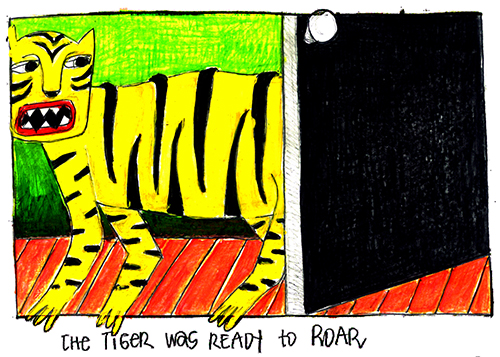
In a far-away land, a barbarous king used public trials and chance to decide a man’s fate. Once accused of a crime, the accused was taken to a public arena and told to choose between two doors in front of him. Behind one door was a lady and behind the other, a tiger. The accused must choose between the two doors. If the door he chooses has the lady behind it, it means he is innocent. However, he must marry the lady immediately whether or not he wants to. If he chooses the door with the tiger behind it, it means he’s guilty and, as punishment, must be devoured by the tiger.

When the king learns that the princess, his daughter, is in love with a handsome, young and caring man but who has zero social status and no money, the king has his daughter’s lover put on trial.

The princess, alarmed by what awaits her lover, is consumed by fear, jealousy, and doubt. She’s forever lost her lover regardless as to the door he will pick. Because he will either be eaten by the tiger or be forced to marry another woman.

The princess uses her connections in the palace to learn what’s behind each door. Once at the trial, the lover looks to the princess for help. Her eyes indicate the door on the right so he chooses it.

It’s a DIY ending as the reader is never told what’s behind the chosen door leaving the lover’s fate in the hands of the reader’s imagination.

“If you decide which it was—the lady or the tiger—you find out what kind of person you are yourself.”  Frank R. Stockton

Epilogue: Choice is a power.

-30-

Related: “The Lady or The Tiger” by Frank R. Stockton pdf + The Lady, or the Tiger? Wikipedia + Short Stories: The Lady or the Tiger? by Frank Stockton online + Five Short Stories pdf + The world’s shortest stories on archive.org HERE + Chris Advansun Bedtime Stories to make you fall asleep, Sleep Stories

Posted in Art Narratives, Books | Tagged , , , , , | Leave a comment

The Aesthetics of Reading

The Uffizi in Florence is a historical gallery containing masterpieces of the Italian Renaissance. One of the most visited paintings is that of Botticelli’s The Birth of Venus, a painting also famous for provoking Stendhal’s Syndrome. But the Uffizi is also the home of Botticelli’s St. Augustine in his Cell (1490). St. Augustine, a Manichaean, converted to Catholicism after coming in contact with the bishop of Milan, Ambrose.

In his “Confessions”, Augustine describes Ambrose as a small man with a neat beard and delicate hands. But what amazed Augustine the most was the time Ambrose dedicated to reading and, even more surprising, silent reading.

Initially, people read out loud. In fact, during the Middle Ages, carrels (cubicles) were used in monasteries to help minimize the cacophony created by all the monks reading out loud simultaneously. And that’s why Augustine was so surprised at Ambrose’s ability to read silently to himself. Surprised and irritated because, at the time, it was considered rude to read to yourself instead of aloud if other people were present.

Eventually reading became a more common practice and, as late as the 1700s, reading became a social activity. But with the spread of literacy, it became more and more common to read silently to one’s self. By the 1800s people began wanting to read alone. By silent reading, the reader was able to develop an intimacy with the written word and the meanings they tried to construct.

Psychologically, silent reading helps the reader create an interior space and thus emboldens them. It so emboldened women that by the late 19th cen. there was much concern about women reading in bed alone and risking having their thoughts provoked. Lying in bed to read was considered depraved. But silent reading in bed has many positive benefits.

The more you read, the easier reading becomes. Reading can improve one’s memory, lower the risk of Alzheimer’s, as well as increase brain connectivity. Reading can also lower the blood pressure and heart rate facilitating sleep.

Reading helps develop visualization skills—how can you not have images come to mind, for example, when this description given by Anne Bronte in The Tenant of Wildfell Hall:

“His heart was like a sensitive plant, that opens for a moment in the sunshine, but curls up and shrinks into itself at the slightest touch of the finger, or the lightest breath of wind.”

Visualization contributes to our everyday functioning. Being able to imagine scenarios, for example, helps us plan our future. Visualization can also influence our perception.

What I enjoy most about reading non-fiction is that it transports me elsewhere and helps me go beyond boundaries. It’s like taking a vacation from the self.

Reading increases empathy. Because imagining the scenes in which others find themselves is like “walking in their shoes” and helps us better understand why they did what they did.

-30-

Related: The Material Culture of Literacy

Posted in Art Narratives, Books, storytelling | Tagged , , , , , | 4 Comments

Back to Rome

Once back in Rome and far away from Revolutionary France, I felt safe again. But that feeling quickly disappeared in 1798.

It was a February morning and I was climbing down the Spanish Steps when an overpowering noise like thunder made me quiver. Suddenly there were soldiers on horseback everywhere. I got knots in my stomach when I saw their uniforms—they were French troops. There was no doubt as to what was happening—Napoleon was taking over Rome. The same Napoleon who called himself a “son of the revolution”.

So, this is why they’d cut off the head of a queen? To put France in the hands of the power hungry Napoleon Bonaparte? And what did sequestrating Rome have to do with “liberté, égalité, and fraternité”?

Using military force, Napoleon’s General Berthier invaded the Papal States and took Pope Pius VI prisoner. Rome was then renamed the Roman Republic and annexed into France.

From Rome, General Berthier then went on to Egypt where he joined Napoleon in his efforts to take control of Ottoman territories. But Napoleon’s campaign there ended in defeat and he was forced to retreat. But not before looting many Egyptian antiquities such as the Rosetta Stone.

Ahhh, I know men so well. I’ve learned from my many suitors that the most dangerous men are those lacking in stature. A man who feels the need for power is a man who is basically insecure. And insecurity can make you do devious things.

Napoleon wasn’t interested in getting rid of the French monarchy. He just wanted to get them out of the way so the power could be his. Fixated with conquering the world, Napoleon took control of northern Italy and declared it a kingdom. Then, in 1805 in Milan’s cathedral, he crowned himself king. Napoleon had betrayed the very revolution he’d helped to create.

(from “TONI O, The Beholder” 2021 ©)

-30-

Posted in Art Narratives, Toni O | Tagged , , | Leave a comment

Fantasies

Versailles—where too much is not enough. At first I was dazzled but it didn’t take long for the Rococo style to wear me out. All that theatrical exuberance, all those asymmetrical curves, all those volutes and festoons made me dizzy. However, I must admit that my vanity can be very Rococo. I, too, wanted to have my portrait painted while flying high like the woman in Jean-Honoré Fragonard’s The Swing. You know, fluffy and extravagant and excessive.

The painting portrays a young woman flying high in a swing pushed by an elderly man. She kicks off one of her shoes so that, with her leg raised, a young man hiding in the bushes can see under her dress. Rumor was that it had been commissioned by Baron de Saint-Julien and that the woman in the painting was his mistress. On the left is a statue of cupid looking on with his finger to his lips indicating that there’s a secret to be kept. Such a naughty painting, decadent with frills, is a real bijou!

Rococo, Italian Baroque translated into French, robbed its name from “rocaille”, a kind of decoration where pebbles and seashells were cemented together to create an ornamentation that refused to stay still.

Louis XV loved Rococo but his mistress, Madame de Pompadour, thought it to be too de mode preferring, instead, the trendy Neoclassical. And since artists tend to be trendy, Fragonard toned it down, too. Nine years later we have him painting a young woman sitting not on a swing but in a chair reading a book. It’s difficult to believe that the paintings are by the same artist. Now bon ton obliterates risqué.

There’d been much speculation as to who A Young Girl Reading was. And, with some disappointment, we learned that there was nothing scandalous about her. In fact, she didn’t even exist and was just one of Fragonard’s many figures de fantaisie existing only in the artist’s imagination.

In this painting, the magic of reading is embraced. An author provides the words whereas the reader’s imagination provides the images. And as one’s imagination is the product of their own experiences and interactions with the world around them, every reader visualizes the author’s words in their own way. This means that the more there are people reading the book, the more images the book creates permitting just one book to create zillions of images. Now that’s très jolie magic!

My only question now: just what was the young girl reading?

(from “TONI O, The Beholder” 2021 ©)

-30-

Related: Fantasy Figures + Fragonard and the Fantasy Figure + A Brief History of the Books Depicted in Western Painting + Aphantasia: A life without mental images +

Bibliography:  The Creation of the Rococo by Fiske Kimball on archive.org HERE

Posted in Art Narratives, Toni O | Tagged , , | Leave a comment