Lying with your Hands

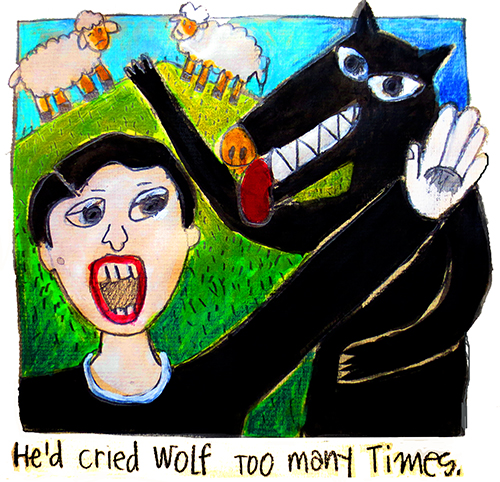
Some people are easier to believe than others. Because some people like to tell the truth whereas others prefer to lie.

So why do people lie?

Lying is a form of deception. Wikipedia lists various types of lies such as a bold face lie, a cover-up, a bluff, fake news, and perjury.

Lying is not just for humans. Koko the Gorilla once ripped a sing out of the wall and, when her caretaker confronted her about it, Koko, an avid Mr. Rogers fan, blamed her cats despite her great love for them.

When asked where animals go when they die, Koko, using sign language as always, answered “a comfortable hole”. In 2018, Koko died in her sleep at the age of 46.

-30-

Posted in Art Narratives | Tagged , , | 1 Comment

Joints

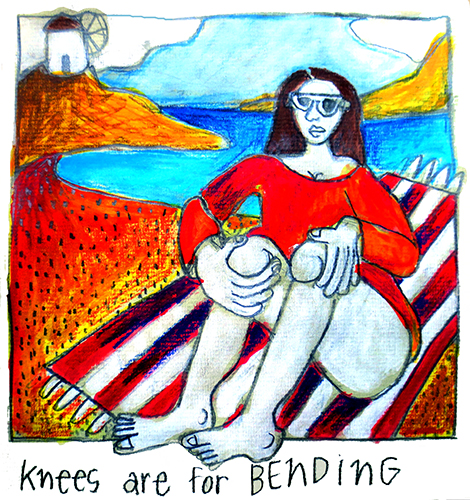
The knee is the articulation point of the leg responsible for mobility and flexibility. It plays a primary role in the body’s movement.

Knees are like shock absorbers and carry the weight. But not just a physical weight. Sometimes emotions affect our knees, too. And inflamed knee indicates unresolved frustration with someone whereas a dislocated knee shows a resistance to giving in.

The sun warms the joints and helps ease knee pain. So, when I can, I take my knees to the beach.

Of interest: METAPHYSICAL CAUSE OF KNEE AND JOINT PAIN

-30-

Posted in Art Narratives, Health & Healing | Tagged , | Leave a comment

Love Turns Stone to Flesh

“We never live; we are always in the expectation of living.”  Voltaire

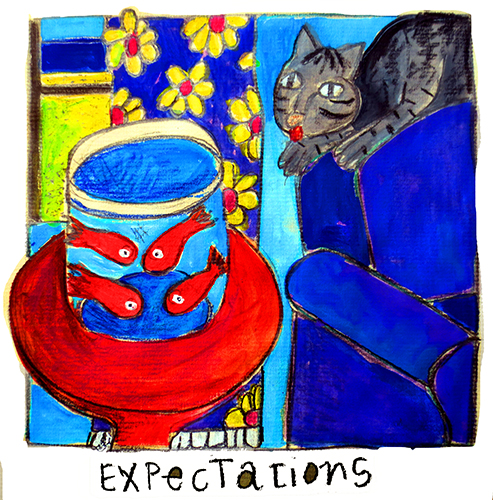
Have you ever read Emily Dickinson’s poem #807? The one that starts off with “Expectation—is Contentment…” Well, I’m not sure what that means. However, in 1968, psychologists Rosenthal and Jacobson published a book, Pygmalion in the Classroom, indicating that a teacher’s expectations of his students will affect their performance. If you expect a student to do well, he’ll do well just as if you expect him to do poorly, he’ll do poorly.

Rosenthal and Jacobson referred to this phenomenon as the Pygmalion Effect, named after Pygmalion, the Greek sculptor who fell in love with one of his statues. In Ovid’s Metamorphoses, Pygmalion was so disgusted by prostitutes that he declared women no longer interested him. Nevertheless, he carved a statue of a woman who was so beautiful that he fell in love with her.

Imagine, preferring stone to flesh.

The lovesick Pygmalion prayed to Aphrodite, the goddess of love, to bring his statue to life. And, after receiving many gifts from Pygmalion, Aphrodite granted the sculptor his wish. But isn’t that what a goddess of love supposed to do—make love happen?

Pygmalion named his new love Γαλάτεια (“Galatea” meaning “she who is milk-white”). The two married and had a couple of kids.

Moral: expect love and you’ll get it.

-30-

Posted in Art Narratives, My Imaginary Diary | Tagged , , , , | Leave a comment

Artist Needed

Inanimate objects of no great beauty become art in a still-life painting. So why not turn myself into a painting! But, I say to myself while lying on my kitchen table posing as if I were a basket of fruit, I wonder what good will it do if there is no one around to paint me?

-30-

Posted in art, Art Narratives, My Imaginary Diary | Tagged , | 4 Comments

Kindness and Cultural Editing

Myths are for grown up, fairy tales are for children. But sometimes nostalgic grown- ups long for their childhood and often find solace in fairy tales.

Scottish folklorist, Andrew Lang (1844-1912), set about collecting fairy tales from all over the world. He relied much on his wife, Leonora Alleyne, and a team of female editors. Mrs. Lang, feeling that some of the fairy tales collected would not be appreciated by an Anglo-Saxon mentality, took the liberty of “restyling” the stories to make them culturally more accommodating. One such story is “Kisa the Cat”.

Kisa was the daughter of the Queen’s smoke colored cat with cerulean blue eyes. And when the Queen had a daughter of her own, Ingibjorg,  Kisa became the best of friends with her. But one day Kisa disappeared and couldn’t be found.

The years past. One morning, while playing in the garden, Princess Ingibjorg saw Kisa and went towards her. But Kisa escaped back into the forest.

The next day Ingibjorg went to the forest looking for Kisa but, instead, encountered a giant who cut off her feet. Luckily Kisa came along and took the princess home to nurse her then snuck into the giant’s home to recover Ingibjorg’s severed feet. Now the princess could walk again. The Queen & King who were so grateful that they offered Kisa a reward. But all she wanted, she said, was the chance to sleep at the foot of Ingibjorg’s bed.

The next morning, the princess woke up to find not a cat lying next to her but another beautiful princess. It was Kisa who explained that she’d been placed under a spell by an evil fairy and couldn’t be freed from the spell until she’d done a kind deed.

I’m not really sure what the moral of the story is supposed to be—shouldn’t an act of kindness be spontaneous and not a kind of barter where you hope to get something in return?  

Like the fairy tales, it looks like the meaning of kindness has been edited, too.

-30-
Posted in Art Narratives, My Imaginary Diary | Tagged , , , , | 2 Comments