
“The Betrothed” (“I promessi sposi”) by Alessandro Manzoni is the hero of Italian literature. Set in 1628 when Milan was under Spanish Hapsburg rule, it’s a love story describing the struggles that Lucia and Renzo must go thru just to be together. Although plans for their wedding had been made, they were cancelled because don Abbondio, the priest who was to perform the ceremony, chickened out. A powerful local baron had prohibited the priest from marrying them.
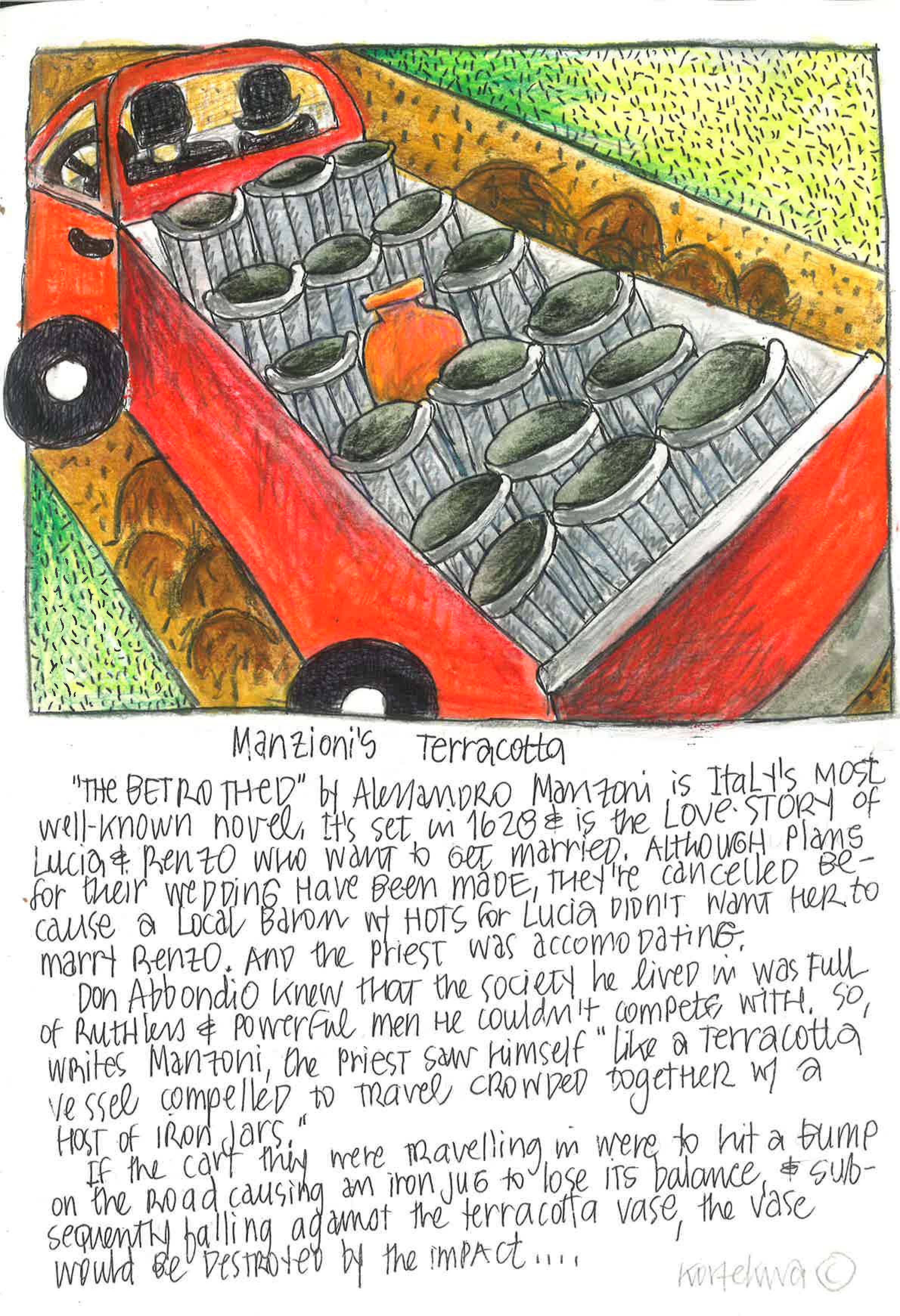
In the first chapter of “The Betrothed”, Don Abbondio is described as weak of character. Abbondio knew the society that he lived in was full of ruthless and powerful men who he couldn’t compete with. So, writes Manzoni, the priest saw himself “like a terracotta vessel, compelled to travel crowed together with a host of iron jars.”
It’s easy to see this image in one’s mind—one lonely terracotta vase surrounded by numerous iron jugs. And it’s also easy to understand how being in such a situation could heavily influence one’s perception of their own fragility. While travelling, the truck hits a bump in the road causing an iron jug to fall against the terracotta vase. As a result, the vase cracks. Unfortunately, the road’s bumpy and the jugs surrounding the terracotta vase kept knocking up against it until the crack gets so big that the terracotta vase splits into two.
It had not been the intention of the iron jugs to destroy the terracotta vase. But that’s what power often does—it destroys whether or not it wants to.
It’s easy to become a coward when you feel powerless.
Carlo Emilio Gadda had a particular adoration for Alessandro Manzoni. When he was nearing death, Gadda asked his friend Pietro Citati to read the 8th chapter of “Promessi sposi” to him. In this chapter, Renzo and Lucia present themselves as man and wife even though they are not married.

Related:


