Pillow Books and Lingering Lists

My mother had a knack for collecting unusual acquaintances. One such acquaintances was an English Lord who’d fallen madly in love with her while in Texas buying mustangs for his stables. Bertie, as she called him, insisted that we visit him in London.  And my mother, born for adventure, agreed. So we loaded our trunks with woolen underwear and silk blouses then departed.

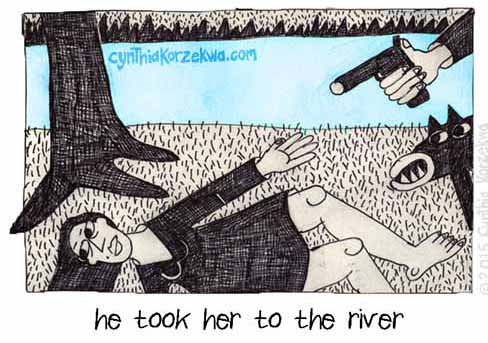
she petted his horse then packed a trunk

Bertie lived in the lovely area of Bloomsbury giving me the chance to go to Bedford Square every day to sketch. Sometimes I had difficulty concentrating on drawing because I was too busy looking at all the  peculiar  people.  One woman in particular caught my attention. Tall and haggard dressed in Typical Tweed, she had an intensity to her that wasn’t easy to ignore.  We saw one another every day in the square and soon began nodding our heads in recognition. Then one cloudy afternoon I saw her sitting on a bench crying. I didn’t know what to do as the Brits are known to be so formal and stuffy. But empathy took over and I went to her and, using the most discreet voice I had, asked if she needed help. Initially she gave me a glare but then burst into tears. She indicated the space next to her on the bench so I sat down as she wailed about how desperately sad she was. Her name was Virginia and she was a writer and part of an artistic group called Bloomsbury. Once she’d relaxed, just to liven the atmosphere, I showed her the sketches I’d been making. Virginia said they were delightful and invited me to her house for tea.

she went to Virginia’s for tea

Virginia lived in a charming house on Gordon street that was always full of people.  The day I went for tea there was T.S. Elliot, a most unpleasant man,  the economist John Maynard Keynes, the writer with a view, E. M. Forester and Leonard, Virginia’s husband. Virginia seemed rather intimidated by another guest, Katherine Mansfield. I heard her gossiping with Elliot about Katherine. Virginia had called her  ‘a civet cat that had taken to street-walking’.  Quite rude of her, no? But later I was to learn that Virginia and Katherine had become the best of friends and regularly discussed their work and other writers while drinking tea and smoking cigarettes. Katherine said that the pleasure of reading is doubled when you can share books with someone else.

she drank tea with a civet cat

Virginia was a bit jealous of Katherine and I could easily see why. Even though both used interior monologues, they didn’t speak to themselves in the same way. The sea had already started to roar inside Virginia’s head whereas Katherine was coughing up blood. One retreated while the other expanded.

Katherine’s relationship with Beatrice Hastings, caustic critic of literature and just about everything else, also put stones in Virginia’s shoes. More than a literary competition, the jealousy stemmed from the intimate relationship Katherine had had with Beatrice before the latter moved in with Modigliani. I remember seeing one of Modigliani’s portraits of Beatrice and thinking, okay, another woman with a long neck and a pinched up little mouth.

Modigliani made portraits of Beatrice

Years later I would better understand both Katherine and Virginia after reading their diaries (is it okay for husbands to publish their dead wives’ diaries?) and how writing simultaneously regenerated and exhausted them. One day sinking, the next day swimming, they both struggled to make the inside come out.

Katherine died of TB in 1923. Haunted by her death, Virginia became quite needy and often invited me for tea.  On one occasion, Arthur Waley was there. Arthur was an expert in Japonism, the study of Japanese aesthetics. I, too, was an enthusiast due to my studies on Degas and his collection of Hokusai prints.

he collected Hokusai wave prints

Arthur was shy but had the greatest range of friends of anyone I’d ever known…not just the artsy Bloomers but other writers such as Ronald Firbank, as well as politicians, spiritualists and Eskimo stuntmen. He was known for his translations of Asian literature including that of The Pillow Book.

When I think of pillows I certainly don’t think of books.  I think of sleep, of course, but also of magic rituals such as filling the pillow with herbs or, as taught to me by a curandera in Texas, sleeping with scissors and a photograph of someone you want to forget  under your pillow. It makes forgetting easier. Believe me, I know.

she slept with scissors

But in classical Japanese literature,  Waley told me, a pillow book is a kind of diary and the most famous one is that of Sei Shonagon (966-1017). Sei was a lady-in-waiting for Empress Consort Teishi in the Heian court.

Sei’s pillow book described her life at court, interesting events and her personal observations.  She was exceptional fixated with making lists.  She made lists like “Things that arouse a fond memory of the past”, “Things that cannot be compared”, “Things that should be large”, “Things that give a clean feeling”, “Things that are distant though near”, and” Deeply irritating things”. My favorite is  “Things that make one’s heart beat faster” that includes:

Sparrows feeding their young. To pass a place where babies are playing. To sleep in a room where some fine incense has been burnt. To notice that one’s elegant Chinese mirror has become a little cloudy. To wash one’s hair, make one’s toilet, and put on scented robes; even if not a soul sees one, these preparations still produce an inner pleasure. Plus, it is night and one is expecting a visitor. Suddenly one is startled by the sound of raindrops, which the wind blows against the shutters.

sparrows feeding,  washing hair, rain drops on the window

When Tesishi’s gig as an empress was up, Sei was forced to leave the court.  It’s not certain what happened to her but speculation is that she either became a Buddhist nun or died alone in poverty.

Umberto Eco also loved lists and often included them in his novels. If he were to be stranded on a desert island, Eco once said, he would want to have a telephone book so he could use the list of names to make stories. A narrative can be conceived as a list of events. Furthermore, said Eco, a list is the origin of culture because, to make infinity comprehensible, lists help create order. Cultural history is full of lists such as lists of saints, armies and medicinal plants, or of treasures and book titles.

Barthes liked sandals but not women wearing pants

Not just history, but people as well like lists. In his book, Eco included Roland Barthes lists of likes and dislikes thus we know that Barthes, among other things, liked cinnamon, the smell of freshly cut hay, flat pillows, writing pens, Médoc wine, and wearing sandals while walking on paths in southwestern France. But Barthes disliked, among other things, white Pomeranian dogs, women in slacks, geraniums, TV cartoons, Mirò, and spending evenings with people he didn’t know.

It must have been around 1995.  I was teaching at the Academy of Fine Arts in Milano and taking advantage of the city’s cultural events.  One evening at the Feltrinelli near Brera, Eco was presenting one of his many books. After his talk, Eco was surrounded by adoring book groupies and, from the expression on his face, I could telling he felt bliss. Then his wife showed up pointing at her wrist watch saying “Umberto, Umberto, dobbiamo andare!” and his mouth went down like a landslide.  It reminded me of Nora, James Joyce’s wife, who asked her husband why he didn’t write books that people could understand. There’s nothing like a wife to keep an ego in place.

at the bistro quai des grands augustins

It was 2002. I was in Paris visiting Chloe and we were having lunch at a bistro near Quai des Grands Augustins.  Sitting next to us was a jaded looking woman oblivious to the world so intensely involved  she was in writing.  Chloe was, as usual, taking photos. After the mandatory selfies, she stepped away from our table to take pictures.  Knowing that, like the Mayans, I fear photographs can steal a part of the soul and imprison it forever, Chloe carefully avoided me as subject matter.

The Croque Monsieur was busting inside of me and I felt the need to get up and move. As we were walking away, Chloe in a whisper asked if I had recognized the woman who’d been sitting next to us. No, I said, who was she? Susan Sontag, she replied.  Well that in itself was curious but later in the day, Chloe downloaded the photos she’d taken.  We were amazed that, unintentionally, Chloe had not only captured Sontag writing but had photographed the notebook she was writing in as well. I’m ashamed to admit it, but I was very curious to read what Sontag had written and asked Chloe to enlarge the writing. Chloe was aghast that I could so blatantly invade someone’s privacy but, curious herself, she finally agreed.  What we saw seemed little more than lists in all their variations which was, I learned years later, basically how Sontag kept journals. A journal, she said, was like a confidante who is deaf, dumb, and illiterate. It gives you the possibility to express yourself but, more importantly, to create yourself as well.

she liked voitures-lits but not being photographed

From Sontag’s many lists we learn that she liked fires, tequila, silent films, coarse salt, large rooms, maple sugar candy, taking taxis, and Wagon-lits. But she didn’t like cold weather, being photographed, wearing a wrist watch, taking showers, TV, baked beans, Ezra Pound, and freckles.

I, too, make lists. You know, the Things to Do kind. Makings lists can be exciting because, without doing anything at all, just making a list already gives you a feeling of accomplishment even though, as in my case, you rarely bring intention towards a conclusion.

she walked around the block and counted the trees

Inspired by the lists of others, I’ve tried giving a new twist to my own Things to Do ones.  Instead of writing things like: pick up the laundry, buy milk, pay the light bill, and mend the sheets, I’m going to experiment with a new kind of Things to Do such as:

  1. Take a walk around the block and count the trees
  2. Pick the dustiest unread book on the shelf and read it
  3. Recycle a postcard by sending it back to the original sender
  4. Write a haiku every day for a week
  5. Memorize the words of a song then sing it out loud every morning before breakfast


drawing

(from The Diary of Luz Corazzini, Cynthia Korzekwa ©)

Posted in Bebina Bunny, THE DIARY OF LUZ CORRAZZINI | Tagged , , , , , , , , , , , | 1 Comment

Nick Cave’s Weather Diaries

room on via Garibaldi

It was our first night together in the big room with a little bed on via Garibaldi.  Nick Cave and the Seeds provided the background music.  Hugh found it all so poetic but, to tell the truth, Nick kinda unsettles me.  There’s always that deflating element of sadness and tragedy.  Take, for example, The Weeping Song where a father tells his son to go to the water to see the women weeping then to go to the mountain to see men weeping, too.  The women are weeping for their men and the men are weeping back at them. So many tears that have nowhere to go.

everyone was weeping

What I do like about Nick Cave is his handwritten dictionary. It’s like a loose leaf address book but instead of names and numbers, it has words and their definitions. Words like amuck, avouch, and avast. Or  murk and mort and moot. I also like his Weather Diaries.  Well, actually, I’ve never read them but I do like the idea of writing a diary based on weather.

the sky was crying all the time

Nick is from Australia but moved to London. That could explain his concern with the weather. I mean, he’s got a skylight in his home and is forced to see the sky crying all the time. The only thing, he said, that gave him hope was spring but one year spring let him down. It depressed him and, as many of us know, there’s nothing like depression to make you start a diary. That’s when Nick began documenting the weather. He bought a trendy little notebook and a rubber date stamp. Everywhere he went, he’d jot down the fluctuations in the weather and soon began to prefer bad weather to good weather because it gave him more to write about. The intention was to write about the weather for  a year then publish the diary.  But the birth of his twins changed all that. However he did conclude that “I can control the weather with my moods.  I just can’t control my moods.”

even on TV it was raining

We all know there’s a relationship between weather and mood.  Even Stefano of Dolce & Gabbana said “I love the Weather Channel because my mood changes a lot according to the weather!” That’s why I was somewhat surprised when Hugh said he wanted to go to Bordeaux to meet Montesquieu, the philosopher who’d become famous for his theories on how  climate influences people and the society they live in. His theory was that people coming from warm climates tend to be passionate yet laid back when it comes to work whereas people from cold climates have rigid personalities but a stronger work ethic. Well of course! If I know it’s going to freeze during the winter, I’m going to work my butt off to prepare for the cold. But if I live somewhere where the sun always shines, I’m going to spend my days on the beach in a red bikini! Really now, it always amazes  me how men can write about the obvious and call it philosophy.

wine with Montesquieu and his wife

My friend Mona had rented a villa in Bordeaux and immediately organized a big fête with liters of Château Margaux. That’s where we met Montesquieu and his wife, Jane. I was dying to ask her what she felt about her husband’s belief that women were not equal to men and, being weaker, should obey their husbands. But Hugh, afraid that the wine had unleashed my tongue, quickly led me away. Peccato, I said to myself, that Hugh didn’t know about The Champion of the Weather.

the magnolia tree on south presa

Even a block away you could see that big lusty magnolia tree on South Presa Street where my best friend Laura lived. Every Sunday morning I’d go to her house for coffee and pie. Sometimes her neighbor, a writer named William, would be there, too.

Will, as we called him, had a terrible cough. He’d moved to San Antonio hoping the climate there would dry out his lungs.  Laura and I truly enjoyed his company because he always told us interesting stories with unexpected endings.  Unfortunately, Will had the bad habit of touching Laura’s magnolias and making them turn brown.

he touched her magnolias

San Antonio had a good effect on both Will’s health and his writing. But, afraid of collecting dust, Will was always on the move. Luckily, he was a writer and often sent letters. That’s how we knew  he’d moved to Austin, was married and working in a bank. Pity that Will was good with words but lousy with numbers. After being fired for missing funds, Will fearfully ran off to Honduras but was forced to go back to the States when he learned of his wife’s illness. Arrested for embezzlement and sent to prison, he took advantage of his free time to develop his writing skills. It wasn’t long before Will was sending short stories to publishers. Afraid no one would publish them if they knew he was a convicted felon, he used the pen name O. Henry.

he spent his time in jail writing

Once out of jail, Will moved to New York but came back to San Antonio one summer for a  visit. Like old times, we sat at the kitchen table for coffee and pie.  Laura and I pretended not to notice when he’d whip out a flask of bourbon to spike his coffee. Such a waste of time, too, because  his stories were such a hoot  that we would have given him all the bourbon he wanted just to keep him talking.

he poured bourbon in his coffee

When we asked Will what it was like to live in New York, he replied that it was a great place for his writing career.  But making friends was difficult as New Yorkers were generally aloof and distant. To give us an idea, he told us the story of Bud or, as Will called him, The Champion of the Weather.

Bud, a man who enjoyed the pleasures of sociable vocal intercourse, never had had any problems  striking up conversations with strangers until he went to New York. Trying to converse with a New Yorker on the street, he said, was like talking to a lamp post.

he talked to lamp posts

He frequented the same café and was quite surprised one evening when the manager came up to him and said “‘Nice day!”  Bud, hungry for dialogue, immediately  started talking but the manager just turned his back and walked away.

he turned his back and walked away

Bud was incensed. A few days later, he went back to the café with the intent of  giving the manager a lesson in the art of continuous conversation. He cornered the manager and showed him his pistol before calling  him something like a frog-hearted muzzled oyster. The manager, fearing for his life, forced himself to make small talk. Satisfied, Bud told the manager to go back to his job but warned him to keep his hands off the weather unless he was ready to follow up in a personal manner.

he showed him his gun

So why is talking about the weather so important? Because the weather affects us all. Knowing we have something in common shortens the distance between us.

So have a nice day!

drawing

(from The Diary of Luz Corazzini, Cynthia Korzekwa ©)

Posted in Drawings & Paintings, THE DIARY OF LUZ CORRAZZINI | Tagged , , , , , | 2 Comments

Eudora Welty (1909-2001)

the fan was blowing full blast

Even though the fan was going full blast, I was suffocating.  It was a night in June of 1963 and I was in Jackson visiting my friend Eudora.  There’d been much tension in town due to the demonstrations. Nerves were so frayed that their fibers easily tangled. Eudora and I  were watching TV when we saw the news about Medgar Evers, a civil rights activist who protested against segregation.  I’d seen Medgar in town a couple of times.  He was a nice looking man who walked with his shoulders held high.  But his furrowed brow gave him away.  I knew from Darwin’s book on facial expressions that that corrugation meant only one thing—Medgar was chronically stressed out.  I would be, too, if the KKK were threatening to kill me.

he was murdered in front of his home

Medgar and his wife, Myrlie, feared for their family. But fear offered them no protection.  Just a few hours after JFK’s Civil Rights Address, Medgar returned home from a meeting only to be shot in the back before arriving at his front door. His wife rushed him to the hospital and was told that blacks were not admitted. Maybe fearing retaliation, the hospital finally took him in but it was too late.

The news of Medgar’s death devastated Eudora.  She cried and cried until her eyes looked like muffins. Then she went to her bedroom and closed the door. The next morning, while I was sitting at the kitchen table drinking coffee, a ragged Eudora walked over to me and handed me a bundle of densely written pages.  It was the draft of her short story “Where Is the Voice Coming From?”

she showed up with a manuscript

Eudora told me that after  initial outrage and sadness, she felt bewildered as she couldn’t comprehend such deprivation. Why would someone gun down another human being in such a vile and cowardly way?  Needing to understand, Eudora tried entering the mind of the murderer and did so by having him be the narrator of her story, a story about a white man who needs to believe that he’s better than blacks. Because the idea of having someone inferior to him is the only thing that gives him status.

Writing had calmed her down some but Eudora continued to be depressed so I decided to prolong my visit–sometimes having someone around who’ll listen to you express your pain is better than valium. We spent the next three days talking non-stop taking breaks only to make meals. Eudora even made a crabmeat casserole and served it with bourbon and water.  The bourbon made us giggle and talk even more.

they ate crabmeat casserole and drank bourbon

Eudora came from an intelligent and warm southern family. But her sheltered life didn’t keep her from being daring. And empathic. Before writing stories, she listened for them. Listening for a story is not the same as listening to a story. Listening for a story is an awareness that stories exist and you just have to be ready to pounce on them when they appear. Like waiting for a mouse to come out of its hole.

she waited for the mouse to come out

Early on, Eudora got a job as a publicity agent for the WPA which gave her the possibility to travel around and take photographs. It was photography, she said, that taught her how to write.

A good snapshot keeps a moment from running away. Because life doesn’t hold still, to capture transience, you have to be ready at that crucial moment. Like a photographer, the writer must stalk his existence.  And when that existential truth appears, he must follow it in its tracks until a story worth telling is constructed.

Storytelling is  a form of perception.

she exhibited her fotos in NY

In 1936, Eudora exhibited her photographs in New York next to the Julien Levy Gallery featuring Surrealists. Mesmerized, she bought the catalogue Fantastic Art, Dada and Surrealism and even experimented with surrealism in her writing. In an issue of the surrealist magazine View, she saw a reproduction of Joseph Cornell’s A Crystal Cage, and was so impressed that she wrote him a fan letter. Cornell, in turn, wrote back stating his admiration for her short story “The Winds” and even sent her a collage that she hung in her dining room.

When Eudora was about 28 years old, she met Katherine Anne Porter.  Apparently the outwardly shy Eudora and the glamorously animated Katherine had nothing in common save for their interest in Jane Austin, Virginia Woolf, and the idea that a good short story was a journey towards self-awareness. But after meeting in the mid 1930s, they knew they were kindred spirits. And when the two spent a couple of months at an artists’ colony in upstate New York, they got little work done. Eudora taught Katherine how to drive and the two roamed the countryside enjoying what women love so much—companionship.

together they drove around the countryside

Katherine, like me, grew up in Texas. Her mother’s death when she was only two inaugurated a troubled childhood. For years she bounced around people and places.  In 1920 the magazine she was working for sent her to Mexico to write about the current political situation. Her experience with Diego Rivera and the Viva La Revolution lifestyle inspired several  short stories.

they drank together at the cantina

Both Katherine and Eudora created characters inspired by people they’d met. Both were keen observers of the élan vital. When I asked Eudora what makes people the way they are she replied: “People are mostly layers of violence and tenderness wrapped like bulbs, and it is difficult to say what makes them onions or hyacinths.”

One evening Eudora and I ran out of bourbon so our conversations became more anchored. I asked Eudora about Delta Wedding, a story set in 1923 evolving around the Fairchild family and their southern lifestyle. Why was the character, Shelley, so fixated with writing in her diary?

Reading, explained Eudora, opens doors but writing gives you wings. It’s a form of emancipation and Shelley, who doesn’t want to end up like her mother, uses her diary to set herself free. Sitting on her bed dressed in her pajamas, she initially uses her diary for daydreaming. But when she starts to use  her diary as a tool for self-examination, Shelley learns to fly. The diary makes her world bigger and gives her a personal space she can’t find at home or in her milieu.

she sat on her bed and dreamed of flying

But, confessed Eudora, it took a pincushion to write Delta Wedding. Her writing method was basically that of eavesdropping on conversations then taking notes on what people said and how they said it. These notes made it ever so easy to write a short story but writing a novel was much more complicated. So for Delta Wedding,  Eudora would type a chapter then spread the pages out on her bed.  If a paragraph or sentence seemed out of place, she would cut it out and move it around. Then, once she’d clipped  and moved all that was necessary,  Eudora would fix everything into place with straight pins then re-type the new arrangement. Like Jane Austen, she used straight pins to edit her manuscripts.

a pincushion helped her keep it together

I told Eudora that this seemed like a very time consuming process to which she replied: “it doesn’t matter if it takes a long time getting there; the point is to have a destination.”

drawing

(from The Diary of Luz Corazzini, Cynthia Korzekwa ©)

Related: Eudora Welty, The Art of Fiction No. 47 + Eudora Welty : photographs book on archive +

Eudora Welty biography by Harold Bloom on archive+ The collected stories of Eudora Welty on archive +

Posted in Drawings & Paintings, THE DIARY OF LUZ CORRAZZINI | Tagged , , , , , , , , | 10 Comments

I’m nobody and so are you

she watched the leaves fall

It was the fall  of 1884 and I was in Amherst watching the leaves fall to the ground. The maple trees were dripping red and yellow foliage. In awe, I signed up for a watercolor class with the intent of immortalizing their beauty forever.  It was here that I met Mabel, the wife of an astronomy professor who was often away to look at stars.

he looked at the stars, she looked around

Mabel and I enjoyed taking long walks together. As our walks grew longer, so did our exchange of secrets. I told her about the exasperating crush I had on a local philosopher. In return, Mabel confided that she was having an affair with a much older and married man named Austin.

Being an accomplished piano player, Austin would sometimes invite Mabel to play for his reclusive sister and invalid mother.  The sister, Emily, was a strange type.  While Mabel would play, the sister would listen near the stairwell hidden by the shadows. And when Mabel would finish playing, Emily would have a glass of sherry sent to her as well as a poem she’d written to express her gratitude.

first the piano then the sherry

Mabel kept a diary but, fearing someone would find it, she could never be as explicit in her writing as she could when talking with me. Nevertheless, Mabel truly enjoyed writing in her diary as it was here that she was always the protagonist.

Her husband, although often nice and naughty with her, did not give her the feeling of uniqueness  Austin did. And Austin, whose wife was a frigid nag, adored Mabel because she was sexually uninhibited and called him her king. Their fixation with one another did not go unnoticed and inspired much gossip.

Mabel and I kept in touch even after I left Massachusetts.  Of course she was always writing about Austin. But it was the stories she told me about Emily that interested me most.   Even though practically neighbors, the two never visited vis-à-vis communicating only by letters. Emily’s agoraphobic nature had given her an incredible mystique. Curious, the townspeople turned into amateur sleuths collecting info about her as if collecting clues for a whodunit.

They knew only that she wore white dresses with pockets sewn onto them for her poems, liked to garden and to bake bread, and spent much of her day in her rose papered bedroom writing poetry. Sometimes, from her window, she would lower a basket tied to a rope with little treats for the neighborhood children.  Mesmerized, the children would stare at her window to see those skinny little arms lowering and raising the basket.

she lowered the basket full of treats

The first time Mabel  actually saw Emily was in her coffin. After her death, Emily’s sister, Lavinia, asked Mabel to help publish Emily’s poems even though there was much bickering in the family as to their ownership.  Once they were published, Mabel sent me a copy. Although I struggled to understand many of the poems, the one that starts out “A charm invests a face” intrigued me. Basically it’s about Emily standing in front of a mirror asking herself whether or not she should lift the veil covering her face. Metaphorically or not, she knew that veils are provocative as the imagined is more erotic than the real.

she looked at herself in the mirror

Throughout history, sculptors have used the Wet Drapery Effect to create veil covered  bodies. The cloth clings so tightly that it becomes part of the body itself. Naked is no longer nude. My favorite such statue is that of St. Cecilia in Rome by Stefano Madero.  Lying face down, the recumbent martyr has replaced the veil with the ground.

she no longer needed a veil

Female slaves and prostitutes in ancient Greece, as opposed to aristocratic women, were prohibited from wearing veils.

In the Koran, it’s written that the most tempting part of a woman’s body is her face. Thus, to avoid lusty desires, it’s covered.

Traditionally, women wear veils during their wedding ceremony. But, once married, the groom lifts the veil–maybe to be sure he’s gotten the right bride.

he lifted her veil

When the Countess of Castiglione, Virginia Oldoini, aged and her beauty disappeared, she acquired an appreciation for veils.  But instead of wearing them, she put them over her mirrors.

she put veils on her mirrors

Itching to see beneath Emily’s veil, I abandoned any sense of discretion and pumped Mabel for information. She told me that, an avid gardener, Emily spent years collecting and pressing flowers for her Herbarium (she had over 400 specimens!)  Often she collected plants while taking long walks with her dog, Carlo, named after the dog in Jane Eyre.  Her father was very strange and would give Emily books he’d then prohibit her from reading.  But he did build a conservatory next to the house where Emily could care for her plants all year long. She referred to flowers as “ the Beautiful Children of Spring”.

she cut flowers for her herbarium

Emily’s knowledge of horticulture influenced her writing.  Via her knowledge of floriography,  she used flowers as metaphors to describe emotions.  Since every flower was symbolic of a particular sentiment, it was very fashionable in Victorian times to use little bouquets to convey feelings. These nosegays were also used as fashion accessories.

Some floriographic examples: roses = beauty, irises = eloquence, violets = faithful love, larkspurs = levity, daisies = innocence, foxglove = insincerity, daffodils = rebirth, sweet peas = delicate pleasure, etc.

their flowers spoke to one another

Emily, taught as a young girl to embroidery, used her sewing skills to make little books of poetry. After editing then recopying a group of poems several  times, she would  sew them into little fascicles.  More than a seamstress, she was a self publisher.

she sewed poems together

Raised in a Calvinistic household, Emily was very frugal and often wrote on scraps of paper including used envelopes. Her pencil, like a loaded gun waiting for something to shoot at, wrote whenever and on whatever it could. Visually, Emily’s envelope poems are quite lovely and gave me the idea of creating an envelope diary. By punching holes in envelopes from invoices to be paid, I can create little pockets for paper souvenirs that are held together with notebook rings then cover the envelops’ surface with cryptic phrases.

Envelop book


drawing

(from The Diary of Luz Corazzini, Cynthia Korzekwa ©)


Posted in Drawings & Paintings, THE DIARY OF LUZ CORRAZZINI | Tagged , , , , | 3 Comments

Every day is a short story

One should count each day a separate life. Seneca

A short story is a work of fiction limited in length and meant to be read in just one sitting. It is based on a plot, that is, a series of events provoked by a conflict. Generally the conflict is that of man against himself, man against others, or man against nature. The story evolves around how the conflict is affronted.

I would like to transform my diary posts into short stories. Like the short stories of Lucia Berlin.  Because by simultaneously contracting and expanding the world around her, Lucia has this way of turning subtle observations into motion pictures.

Lucia’s stories are populated by The Marginalia—people who, not part of the main text, are forced to live on the edge. People who suffer from terminal illnesses such as fear, poverty, alcoholism, and loneliness. People who are loitering in their own lives. Just like the Statue of Liberty, Lucia’s stories say:  “Give me your tired, your poor, your huddled masses yearning to breathe free.”

they looked toward the Statue of Liberty

Straightforward with bumps, Lucia  says “I don’t mind telling people awful things if I can make them funny.” And in the middle of this deadpan drama, Lucia throws around metaphors as if they were  carnival confetti.

The point of departure for Lucia’s writing was her difficult upbringing. Her childhood featured an absent father, an alcoholic  mother, and an abusive grandfather.  Lucia also suffered from sclerosis.  She married three times, had four kids she raised on her own, worked numerous jobs, and continued the peripatetic lifestyle of her childhood. What else could she write about if not her own horror vacui reality. As to her auto-fiction, Lucia says  “I exaggerate a lot and I get fiction and reality mixed up, but I don’t actually ever lie.”

sights to see near the station

December 30.

I woke up feeling sad because, later in the day, Chloé was going back to Paris. Which meant waiting all day for her departure. Waiting is like holding your breath so we spent the day in apnea until it was time to go to the train station. It was a 20 minute walk and luckily the weather  was good. The walk included visuals of the Angiolo Mazzoni Tower, the Aurelian Wall, Porta Tiburtina, the Arch of Pope Sixtus V, and some unidentified caged archeological remains.  We said little on the way but our silence was camouflaged by the wheels of Chloé’s trolley that went clink clank clink clank clink clank on the uneven sidewalk.

she pulled the trolley towards the station

Termini is Rome’s largest train station. Constructed mainly during the Fascists period, it has a series of arches like those of the Colosseum  only severely geometrical.  Mussolini was fixated with the idea of a Born Again Roman Empire and tried imitating the look.

Once we arrived at Termini, Rome’s main train station, we waited again. This time  in line for the automatic ticket machine.

Many many years ago De Sica made a film there, Stazione Termini.  It was about Mary, a married American in Rome visiting her sister.  While walking around Piazza di Spagna, she meets an Italian teacher, Giovanni.  The two become lovers but, at a certain point, Mary must return to the States. Giovanni doesn’t want her to go.  He meets her at Termini in hopes of convincing her to stay in Rome. The couple walks around the station discussing their situation.  They’re caught grubbing in an abandoned train car and taken to the police station for improper behavior.  There the Commissioner, who undoubtedly knew much about infidelity, resolves Mary’s conflict of “should I stay or should I go” by telling her to leave Rome or risk a scandal.  Forced to depart, Mary promises Giovanni her eternal love. Abandoned and overwhelmed, Giovanni leaves the station.

they grubbed in the dark

The film wasn’t considered much of a success. An Italian Neo-realistic film with dialogues written by Truman Capote, in my opinion, didn’t have much of a chance.

Termini has radically changed since De Sica’s film. Demographics and security measures have modified the look and spirit of the place. Once I could have accompanied Chloé directly to her train but now there are barriers and guards and ticket checks. So we said our melancholic goodbyes in front of the plexiglass barricade before she turned and left me standing there alone. My last image of Chloé  is that of her walking away pulling her trolley. I watched and watched until she became a blur engulfed by other blurs.

lucia5b

Termini makes me think of Lucia Berlin’s stories. Both are full of transient people—some with a destination and some without. The ones without look frayed like unraveling rope waiting for the final tug.

Lucia writes about overwhelming and depressing situations with great buoyancy. But I don’t have her talent. The train station ambience just brings me down and all I wanted to do was to go home.

train stations are full of stories to tell

If it’s true that everyone has a story to tell, then Termini is a library. And today I feel like a book.

drawing

(from The Diary of Luz Corazzini, Cynthia Korzekwa ©)

Posted in Drawings & Paintings, THE DIARY OF LUZ CORRAZZINI | Tagged , , , , , , , , | Leave a comment