Edith Holden (1871-1920)

Edith Holden (1871-1920)

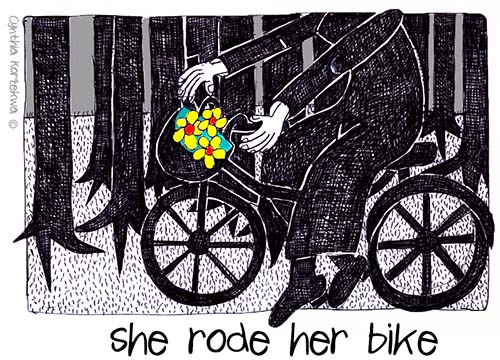
Born in the waxing Victorian era, biophile Edith Holden was an artist and teacher who liked getting on her bike and riding around the countryside to observe nature, the flora and fauna of the British countryside, and the changing season.  She transcribed these observation into drawings and descriptions in a journal she called “Nature Notes”.

Edith came from an unconventional family.  Her parents were Unitarians with a strong interest in Spiritualism and regularly held séances in their home.

Edith Holden (1871-1920)

William Morris’ Arts & Crafts movements influenced her greatly. Edith married the sculptor Ernest Smith and left the countryside.  But she continue her nature outings.  One March morning, she went to collect some nature near the banks of the River Thames.  While trying to break-off a bough of chestnuts buds with her umbrella, she slipped and fell into the river. The current was too strong and fast for Edith. She drowned at the age of 49.
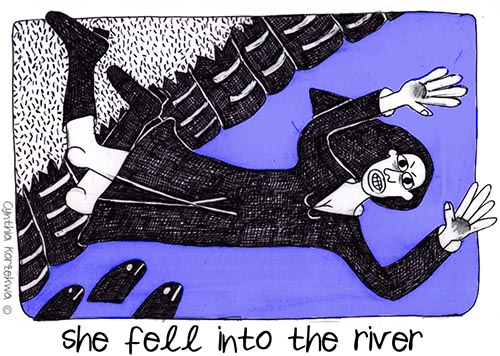
Edith Holden (1871-1920)

Sixty- four years later, the journal was discovered in a dining room cupboard and published as The Country Diary of an Edwardian Lady.

Snowflake

Diary excerpts:

December 9 “We woke up to a storm of whirling snowflakes this morning.”

Edith Holden (1871-1920)

December 28. Skating has commenced in the fens.
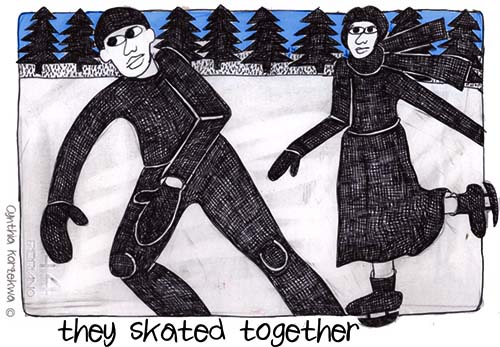
Edith Holden (1871-1920)

March 10. When I got to the bottom of the lane, I set my bicycle against a bank and pic-niced on a fence.

Jan.2,3: Sharp frost and a thick fog in the early morning. The fog cleared off about 9:30 and the sun shone brightly. Went for a country walk. Every twig on every tree and bush was outlined in silver tracery against the sky; some of the dead grasses and seed vessels growing by the roadside , were especially beautiful, every detail sparkling with frost crystals in the sunlight…

Edith Holden (1871-1920)

March 20: Went to the daffodil  field again; the buds are just breaking into yellow. Found two thrush’s nests, both in holly bushes; one nest was empty, the bird was sitting on the other. She looked at me with such brave, bright eyes, I could not disturb her, much as I would have like a peep at her speckled blue eggs…

April 29: Saw a lovely little Hedge-sparrow’s nest in a Gorse bush with four eggs in it. The Gorse was in full bloom and made a glowing contrast with the blue eggs in the mossy nest.
drawing

(from The Diary of Luz Corazzini, Cynthia Korzekwa © )
 

Posted in Drawings & Paintings, THE DIARY OF LUZ CORRAZZINI | Tagged , , , , , , , , | Leave a comment

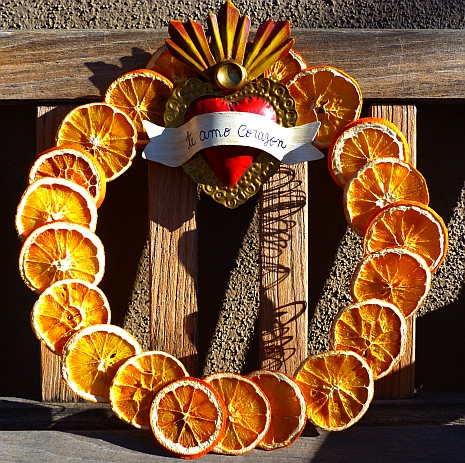
A Wreath of Oranges

orange wreath

Orange wreath at Recuerda mi Corazon

Why not make a wreath for the holidays? Tutorial HERE

Posted in Beauty, Plants & Gardening | Tagged | Leave a comment

When love leaves without you

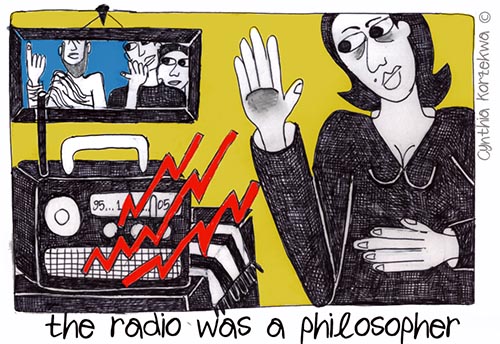
This morning I had the radio on full blast. Bruce was singing “ nobody knows honey where love goes but when it goes it’s gone gone “.  Sofia no doubt would have agreed.

the radio was a philosopher

Sofia Tolstoy (1844-1919) was just a babe in the woods when she met Leo Tolstoj.  He was ambitious, she was romantic.  When they married Sofia was only 19 years old, Tolstoj 34.  Right after the honeymoon,  Tolstoj gave his bride his sexually explicit diary to read.  Not only was she overwhelmed, but Sofia’s dreams were so shattered that it was impossible to glue them together again.

For about 57 years, Sofia, too, kept a diary.  She was a gifted writer and effortlessly created portraits of  Tolstoj and their entourage.  From the diaries we learn that it was Sofia who was responsible for creating a Happy Home for her husband and their numerous children.  Not only did she organize home and finances, she also copied Tolstoj’s manuscripts over and over again as well as oversee their publication.

she lived in his shadow

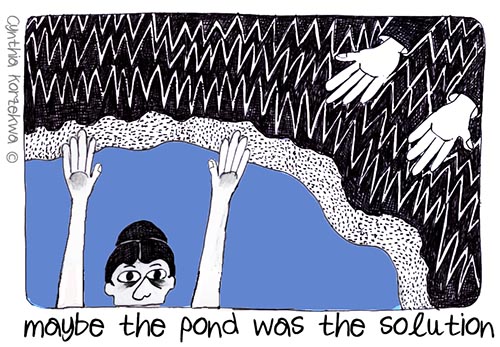
Sofia’s diaries show just how much her life was dominated by her husband and how she felt stressed out by his demands. His lack of appreciation made her feel lonely and used.  On more than one occasion, she flung herself into the family pond hoping to die and free herself from delusion and depression.

maybe the pond was a solution

Fame went to Tolstoj’s head. He gave up writing to become a guru attracting a variety of followers.  Some were in good faith, others were simply schemers the most ferocious being Vladimir Chertkov.  Chertkov competed with Sofia for Tolstoj’s affection and consideration.  She truly loved her husband whereas Chertkov wanted to appropriate his guru’s genius for himself.  Chertkov successfully alientated husband and wife and  organized Tolstoj’s departure from the beloved family home he’d shared with his wife of almost 50 years. But the boys’ odyssey was brief ending up in a tiny railway station 80 miles away from home. Tolstoj became gravely ill and when Sofia learned of her husband’s whereabouts, she rushed to be near him.  But his followers prohibited her from visiting her dying husband.

she watched his death from the window

Love is not always fair.

drawing

(from The Diary of Luz Corazzini, Cynthia Korzekwa © )
Related : Sophia Tolstoy, Not the Woman You Thought She Was + Una vera Karenina dietro ‘Guerra e pace’ + The Diaries of Sofia Tolstoy review + James Meek: rereading Anna Karenina by Leo Tolstoy
Posted in Drawings & Paintings, THE DIARY OF LUZ CORRAZZINI | Tagged , , , , | 3 Comments

Why not write the unthinkable?

A Capricorn like me, Lynda Barry grew up in a racially mixed neighborhood in Seattle. She herself was a blend of Irish, Norwegian and Filipino. Unfortunately, diversity only created conflict. Looking for distractions from her unhappy family life, Lynda started drawing cartoons, inspired by the idealized The Family Circus, a syndicated comic strip consisting of a single captioned panel set inside a circle.

some families live in circles, come in squares

Lynda finally escaped her yucky ducky home life when she enrolled in college. Here, at Evergreen State, she met two people who were to have a major influence on her life: her painting teacher, Marilyn Frasca, and fellow student, Matt Groening, who would later become famous for The Simpsons. When Groening became editor of the college newspaper, he published Lynda’s outlandish cartoons often based on her own childhood. Lynda not only found a way to smooth the edges of her abrasive childhood by transforming it into comic relief, she also initiated a cartooning career. Her comic strip, Ernie Pook’s Comeek, (1979-2008) brought her recognition and several invitations to the Late Night Show with David Letterman.

one ate the donuts, the other ate the holes

Today Lynda is not only an award winning author, she also teaches. Her highly popular workshop, “Writing the Unthinkable”, focuses on memory and mind excavations using the diary as format. The method underlines the relationship between the brain and the hand, between the written and the visual.

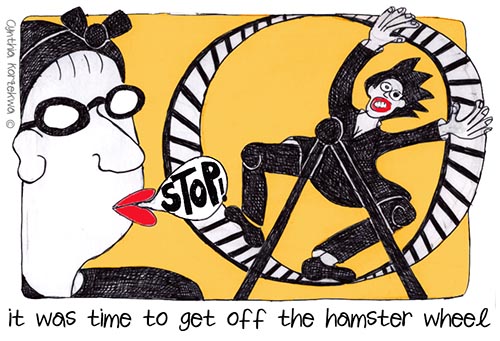
The diary, says Lynda, is not about recording what you’ve done in the past 24 hours. What goes in the diary is all you notice once you get off the hamster wheel and become aware of the present like a Be Here Now experience inviting you to become aware of the world around you. Her Syllabus: Notes from an Accidental Professor is basically the lesson plan book for her workshop.

it was time to get off the hamster wheel

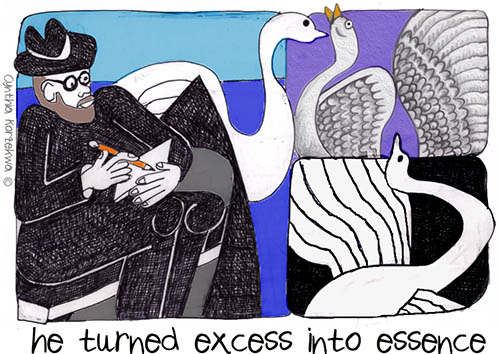
One popular workshop assignment is taken from Ivan Brunett’s cartooning book: draw a cat, a car, a castle first in three minutes, then in one minute then in 15 seconds then in 5 seconds. This exercise reminds me of Matisse’s swans. Matisse often spent the day sitting in a boat drawing swans. He drew their every detail only to later carve them down into contour lines. Going from Baroque to Minimalism, Matisse was a master at turning excess into essence.

he turned excess into essence

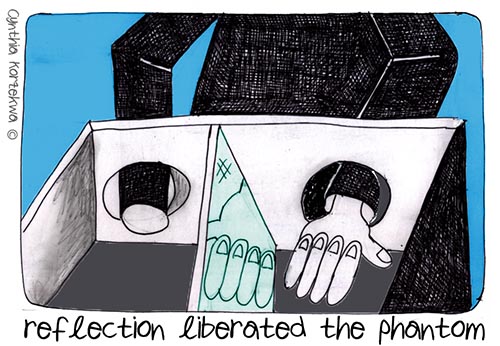
Lynda stresses the importance of the image.  She sites  V. S. Ramachandran’s Phantoms in the Brain experiment. A patient who’d lost his hand had the feeling that the hand was still there clenched in a fist.  It caused him much  pain but he didn’t know how to release the tension.  So Ramachandran built a box with two holes on the same side and a mirror dividing the box in half.  When the patient put his hands, real and phantom, into the box, the real hand was reflected in the mirror. When he clenched then unclenched his real hand while looking in the mirror, the phantom hand unclenched, too. The reflection of the real was able to liberate the ghost.

reflection liberated the phantom

For those who complain they have no time to write every day, Lynda suggests the Six Minute Diary: in just six minutes, reflect on your day then write a list of what happened, what you saw, what you heard and then an image related to these observations. Because drawing is a form of observation.

when you see the world, the world sees you

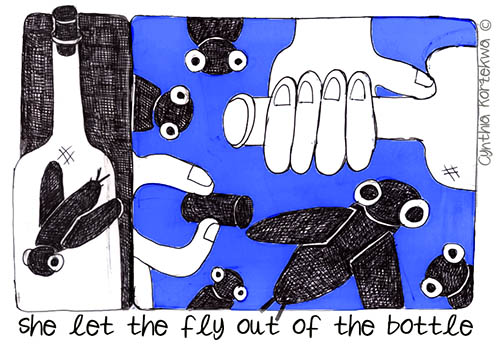
 Wittgenstein said that the aim of his philosophy was to show the fly  how to get out of the bottle. Just as the role of the diary is to open ourselves up and experience another level of awareness.

Wittgenstein's Fly


drawing

(from The Diary of Luz Corazzini, Cynthia Korzekwa ©)


Related:  LYNDA BARRY BRINGS THE COMEDY on ‘LETTERMAN’ + Lynda Barry: The answer is in the picture + Six Minute Diary + Lynda Barry youtube chanell + The Nearsighted Monkey tumblr blog + Lynda Barry Bio + Lynda Jean Barry + Lynda Barry’s Illustrated Field Guide to Keeping a Visual Diary and Cultivating a Capacity for Creative Observation + Drawing as Observation, Jan Altmann
Posted in Drawings & Paintings, THE DIARY OF LUZ CORRAZZINI | Tagged , , , , , , , , , | Leave a comment

Volver the Cat and Emoticons

Volver is our cat.  We talk to him all the time and he understands us.  When he is scratching the furniture and we say NO, he stops scratching.  When it’s time to eat, we say PAPPA* and he comes running. When he snuggles next to us and we say WE LOVE YOU, he purrs.    (*pap)

PAPPA makes him run

Once upon a time, humans were like Volver. They didn’t need to know the meaning of words in order to communicate.

More complex than verbal communication, non-verbal communication is somewhat telepathic and uses body language, eye contact, and, above all, empathy. Once upon a time we used much more non-verbal communication but when demographics drastically changed, standardized communication was needed. Words replaced sensation. And, instead of integrating one form of communication with the other, the verbal mode of thinking completely took over.

they exchanged vibrations

Not too long ago, I was feeling a bit stressed and went to a wine bar near my studio to mellow out.  The place was packed. I looked around for an empty table and, not finding one, decided to leave.  A man sitting near the door made a gesture with his hand indicating the empty chair next to him.  It was an obvious invitation to sit down. The man, old but not elderly, had a pleasant face and seemed perfectly harmless. So I accepted his offer.

she drank wine with a stranger

He told me his name was Leonard and that he’d given up being a surgeon to write books.  A storyteller, his books sometimes put scholars on the spin cycle. His theories regarding the written word, for example, had created a lot of polemics.

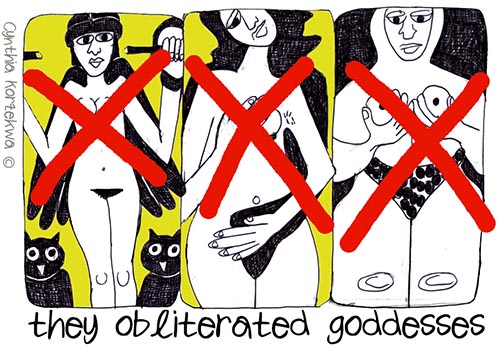
According to Leonard, the invention of writing rewired the human brain. It created a society dominated by left-brain mentality typical of men.  That is, the abstract substituted the actual.  As a result, the holistic and iconic feminine right-brain  was put into limbo. The word was preferred to the image. Goddesses were substituted with a patriarchal monotheism that totally obliterated the female principle. Thanks to the written word, said Leonard, the misogynist manipulators had stigmatized the role of women in society.

they obliterated goddesses

Recently I decided to use homemade emoticons/emoji  for Facebook commentary for two reasons.  For one, I don’t like being transformed into part of a social engineering algorithm (as posted about HERE). Secondly,  the written word has a rigidity to it that the image doesn’t have. And, if you use any kind of social media, you need to protect your bio-rhythms from people out there desperate to externalize their anger and frustration.

Instead of word ping pong, why not use some emoticons/emoji of your own?  Not interpreted in the same way as words, images can intrude upon verbal thinking which will  frustrate troll-like thinkers. I mean, how can you fight with an emoticon?

Meaning and words are not necessarily synonymous.

drawing

(from The Diary of Luz Corazzini, Cynthia Korzekwa ©)

Related:  The Alphabet Versus the Goddess + timeline + The Alphabet vs. The Goddess Lecture by Dr. Leonard Shlain VIDEO + and, for art lovers and historians, ART AND PHYSICS is a must read! + Empathy and Ecofeminism + Alphabet vs. Goddess TIMELINE + Emoji as a language


Posted in Drawings & Paintings, THE DIARY OF LUZ CORRAZZINI | Tagged , , , , , , , , , , | 1 Comment