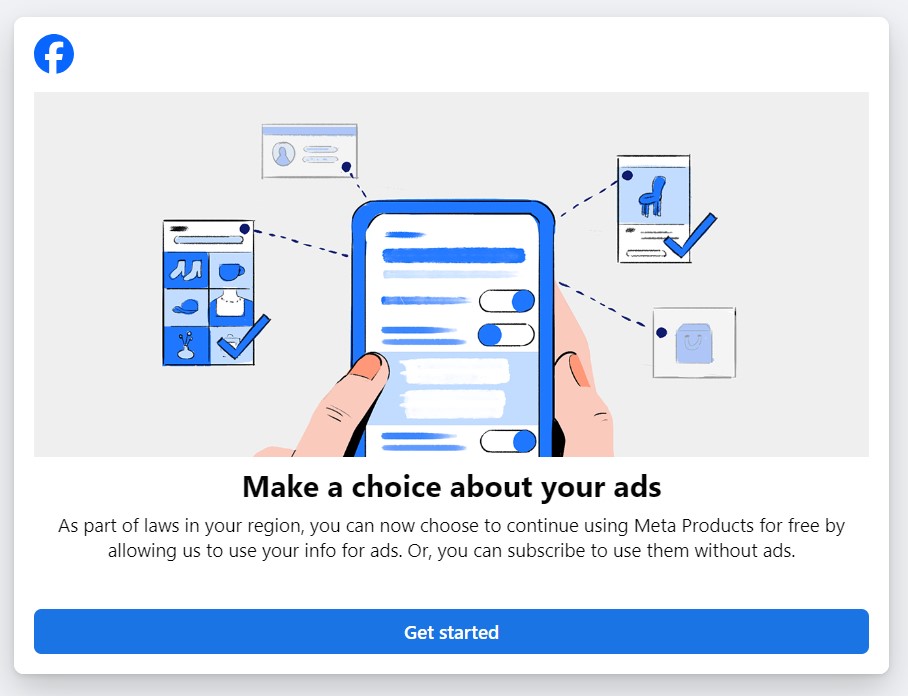
I’m writing this post for my Facebook friends to explain my absence. If I try to access to my FB page, I get this message:
It begins with “As part of laws in your region…” I live in Italy where, after a major investigation, the Guardia di Finanza (fiscal police) calculated that Meta should pay around 22 million euros in sales taxes. Furthermore, the European Union also fined Meta €1.2 billion for privacy violations. This lack of respect for my privacy that’s violated just so they can make more money is not something I want to be a part of.
Now Meta is giving me two options: either pay $9.99 monthly or give Meta free access to my private data that they can then use for their own needs. Obviously, I have no intention of paying them anything at all. Nor do I plan to let them have liberal access to my personal information.
Therefore, after reading FB’s Privacy Policy, I decided it would be best for me to avoid using Meta. It’s a long read but there are a couple of things that stood out:
“Information and content you provide. We collect the content, communications and other information you provide when you use our Products, including when you sign up for an account, create or share content, and message or communicate with others. This can include information in or about the content you provide (like metadata), such as the location of a photo or the date a file was created.”
It’s like being spied upon and that throws my biorhythms in a spin.
“Networks and connections. We collect information about the people, accounts, hashtags and Facebook groups and Pages you are connected to and how you interact with them across our Products, such as people you communicate with the most or groups you are part of. We also collect contact information if you choose to upload, sync or import it from a device (such as an address book or call log or SMS log history), which we use for things like helping you and others find people you may know and for the other purposes listed below.”
Facebook is also using private photos (also from Instagram) to train their AI team. In other words, your private photos are being used to feed the AI vortex. Who knows where your personal images could end up.
And the spying continues. Facebook, served with a warrant, gave chats between a mother and her daughter to Nebraska police who were investigating into an illegal abortion. And now a 17-year-old girl and her mother have been charged with a series of felonies and misdemeanors.
Then there’s the algorithm manipulation. Algorithims can spread fake news with ease and pilot the posts that are seen. They are not democratic and censor your own wants so that they can impose their own. You see what they want you to see.
All this collected data needs to be stored. And that storage is anti-ecological. But that’s for another post.
To abandon FB is not easy because it is the main means of communication I have with friends and family in the U.S. But, then again, there are always emails, no?
Hopefully, I will be able to post this on FB thanks to the WordPress “share” button. But if you wish to comment, write via Messenger (that, for some reason, I still have access to) because, as I can’t access to FB, I won’t be able to see your comment.
-30-
Related: Social Engineering and Emoticons
How to Opt Out of Instagram and Facebook Using Your Posts for AI, Instagram and Facebook are using your photos and posts to train AI, and only European users can opt out +
Meta Uses Your Instagram and Facebook Photos to Train Its AI—Here’s How to Stop It …. Meta is using your public Facebook posts, Instagram photos and captions, data from third-party services, and your chats with the Facebook AI chatbot to train its AI. If you live in the UK or EU, you have the option to stop Meta from using your personal data. As a US citizen or resident who does not belong to the UK or EU, you can only raise your voice against Meta using your information present on third-party platforms +
Facebook Gives FBI Private Messages Of Users Discussing Capitol Hill Riot +
How Facebook Shapes your Feed +
Meta FB loses EU on anti-trust crackdown…Meta Platforms Inc.’s Facebook lost its European Union court fight over a German antitrust order that homed in on the US tech firm’s power to cash-in on a vast trove of users’ data…EU slaps Facebook parent company Meta with record fine for privacy violations + Meta fined record $1.3 billion and ordered to stop sending European user data to US +
What Data About You Can the Government Get From Big Tech? The revelations of a leak investigation started in the Trump administration are a reminder that Big Tech companies often hand over information about their users.
Facebook Admits It Gave Netflix, Spotify Special Access to User Messages, Social network says it only gave access to messages after users had consented by logging in with a partner’s app +
The Scary Truth About the Facebook Messenger App and Your Privacy (from 2020) +
Facebook–Cambridge Analytica data scandal + FTC Sends Refunds to Ring Customers Stemming from 2023 Settlement over Charges the Company Failed to Block Employees and Hackers from Accessing Consumer Videos +
Did you know this? Facebook users can apply for their portion of a $725 million lawsuit settlement +
Meta slapped with record $1.3 billion EU fine over data privacy +
How to Control your privacy on Messenger +
Facebook gave teen’s private messages about alleged abortion to Nebraska police +
Meta gave police access to private Facebook messages that allegedly detailed a Nebraska teen’s plans to get an illegal abortion, bolstering local authorities’ cases against the girl and her mother… Meta complied with a search warrant from Norfolk, Nebraska police in early June, according to court records +
Facebook let Netflix peek into user DMs, explosive court docs claim +
Reed Hastings is an American billionaire and co-founder of Netflix who supports using public money to help finance public schools +
The “PayPal Mafia” is a group of former PayPal employees and founders who have since founded and/or developed additional technology companies based in Silicon Valley. These include amoung many others: Tesla, Linkedin, and YouTube+
Pay Pal co-founder, Peter Thiel and JD Vance: What To Know About The Relationship Between Trump’s VP Pick And The Billionaire +
The billionaire who fueled JD Vance’s rapid rise to the Trump VP spot — analysis
Who’s Afraid of Peter Thiel? A New Biography Suggests We All Should Be + Peter Thiel Is Taking a Break From Democracy +
JD Vance and Mr. Paypal = Rachel Maddow says JD Vance’s rise is thanks to gay billionaire’s influence, not skill or merit + The name of JD Vance’s venture capital firm is a homage to fantasy author JRR Tolkien — and billionaire tech investor Peter Thiel +
Tech billionaire Peter Thiel had already donated a record-breaking amount of money to support J.D. Vance in the Ohio Republican Senate primary …With that previously unreported donation, Thiel had given $15 million in total to bolster Vance — the largest amount ever given to boost a single Senate candidate.
Vance and Thiel’s relationship dates back to 2011, when the senator met Thiel following a talk the venture capitalist gave at Yale Law School that Vance has characterized as “the most significant moment of my time” at the institution, according to a blog post he wrote for Catholic magazine The Lamp + The Seven Thinkers and Groups That Have Shaped JD Vance’s Unusual Worldview +
The Rise of the American Oligarchy, What targeting Russia’s wayward billionaires revealed about our own…Peter Thiel has used a loophole in the tax code to stash $5 billion in a Roth IRA. While the IRS targets working-class Black Americans, the list of billionaires who have paid no income tax in recent years is long
Paypal user agreement + PayPal to launch AI-based products as new CEO aims to revive share price +
From Facebook/Meta Terms of Service… (legal terms)
Permission to use content you create and share: Some content that you share or upload, such as photos or videos, may be protected by intellectual property laws.
You retain ownership of the content that you create and share on Facebook and other Meta Company Products you use, and nothing in these Terms takes away the rights you have to your own content. You are free to share your content with anyone else, wherever you want. To provide our services, though, we need you to give us some legal permissions to use that content.
A Consumer Reports study found that thousands of companies contribute to Facebook’s data stores on each person.
Algorithms, Manipulation, and Democracy PDF by Thomas Christiano: Algorithmic communications pose several challenges to democracy. The three phenomena of filtering, hypernudging, and microtargeting can have the effect of polarizing an electorate and thus undermine the deliberative potential of a democratic society. Algorithms can spread fake news throughout the society, undermining the epistemic potential that broad participation in democracy is meant to offer. They can pose a threat to political equality in that some people may have the means to make use of algorithmic communications and the sophistication to be immune from attempts at manipulation, while other people are vulnerable to manipulation by those who use these means. My concern here is with the danger that algorithmic communications can pose to political equality, which arises because most citizens must make decisions about what and who to support in democratic politics with only a sparse budget of time, money, and energy. Algorithmic communications such as hypernudging and microtargeting can be a threat to democratic participation when persons are operating in environments that do not conduce to political sophistication. This constitutes a deepening of political inequality. The political sophistication necessary to counter this vulnerability is rooted for many in economic life and it can and ought to be enhanced by changing the terms of economic life.
Anyone Can Turn You Into an AI Chatbot. There’s Little You Can Do to Stop Them | WIRED



















 The Narrative Within