Como La Flor

"Como La Flor"

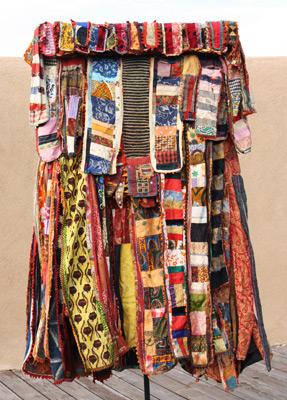
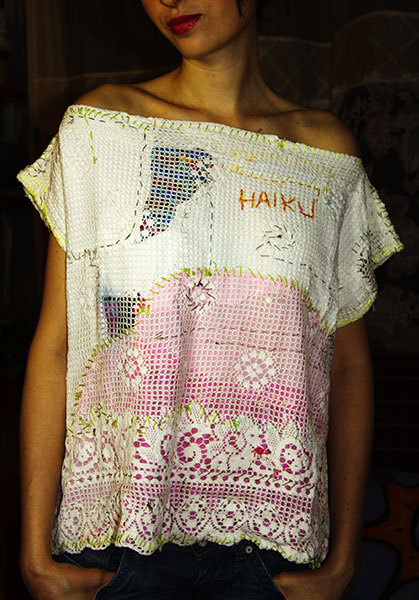
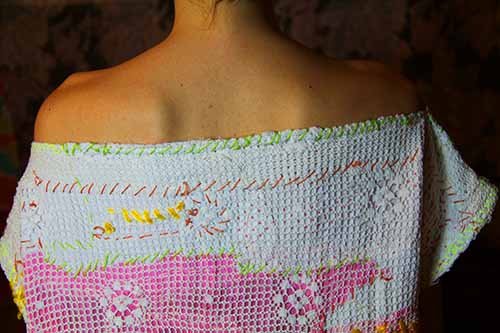
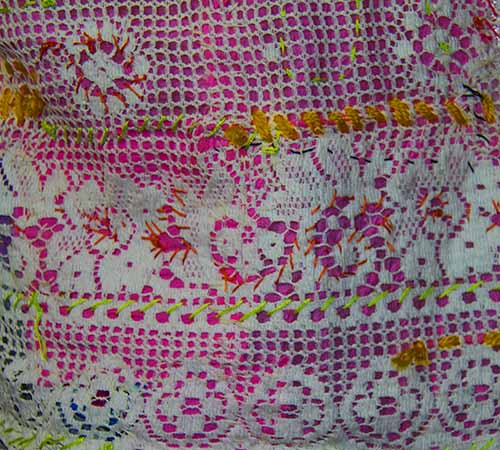
I had to go to a wedding but had nothing to wear.  But I did have a beautiful apron Anthy had given me.  She’d bought it from a Russian immigrant at the produce market in Athens. I don’t wear blues but knew that, despite the lack of time, it wouldn’t be difficult to quickly transform it into a huipil dress.  And for the back, I lucked out by finding a long straight skirt from many summers ago.  The color of the skirt was compatible with that of the apron so I got my colored thread out and started sewing the parts together.  A few considerations had to be made like how to do the shoulders but, with imagination, scissors and fabric scraps, I got it together just in time.

The name of this huipil dress is “Como La Flor” because, as I was putting the dress together, I watched the film about Selena, the young singer so tragically murdered by a flipped out fan. “Como La Flor” was one of Selena’s biggest hits and the title means “like the flower” (Like the flower With so much love You gave me It withered). Since the apron was full of embroidered flowers, it was the perfect title for my dress.

"Como La Flor"

"Como La Flor" "Como La Flor"

"Como La Flor"

"Como La Flor"  "Como La Flor"

"Como La Flor"

drawing

Posted in Uncategorized | 4 Comments

The Streets of Paros

At least once a year (especially before August 15, the Feast of the Dormition), you will see the women of Paros bent in front of their homes and shops repainting the whitewashed outlines of the streets’ dark flat stones.  They trace those lines often created years and years before by their ancestors.

Actually, the paint used today is not whitewash but a synthetic varnish.  Originally, whitewash was made of calcimine or lime.  Because of its anti-bacterial properties, whitewashing streets was done mainly for reasons of sanitation. But today it’s done mainly for tradition and aesthetics.

No one is forced to do it. It’s an instinct that comes naturally if you have a sense of community.  Everyone has their own style depending, in part, upon what kinds of street you have, what’s already been painted and how much paint you can afford.

The Streets of Paros

The Streets of Paros

The Streets of Paros The Streets of Paros The Streets of Paros

The Streets of Paros

The Streets of Paros

The Streets of Paros

The Streets of Paros

The Streets of Paros

The Streets of Paros

whitewash14 whitewash15

The Streets of Paros

The Streets of Paros The Streets of Paros The Streets of Paros The Streets of Paros

The Streets of Paros

drawing

Posted in Uncategorized | 5 Comments

”Walking Art, Talking Dresses” exhibition

This past Sunday, we installed the exhibition of my Muy Marcottage dresses.  The exhibition, ”Walking Art, Talking Dresses”, was held at The Library (Voutakos, Paros) and, thanks to my friend Anthy, was a great success.

Years ago, when I was making big paintings, exhibitions were a lot more stressful.  The biggest headache was that of transportation. But with Muy Marcottage, that has changed. Ready to be displayed were 35 garments that I neatly packed into two plastic milk crates.  Pierluigi  strapped the crates onto our rented dune buggy then off we went!

Exhibit

Exhibit

Exhibitexhibition on wheels!

Below, one of the dresses exhibited:

Il Gattopardo

This dress is called “Il Gattopardo”.

After the fall of the Roman Empire, Italy was no longer a country as much as it was a series of city-states with a Papal presence.  Then the Habsburgs took over and saw Italy little more than “a geographic expression”. But Italians did not agree with this vision and thus began the Risorgimento (Resurgence) which led to the unification of Italy , a long process that began with the end of Napoleonic rule and terminated with the Capture of Rome in 1870.

Change is a part of life and provokes a period of transition. And this transition often provokes an element of decadence—the old must die out to let the new come in. Il Gattopardo is a story about such a transition.

It was written by Giuseppe Tomasi di Lampedusa, Prince of Lampedusa, born in Palermo in 1896. He led a privileged lifestyle until he was drafted into the army  in 1915. Giuseppe was caught by the Austro-Hungarians and held prisoner in Hungary.  But he escaped and went back to Italy to live with his mother.

In 1932 in Latvia, he married Licy, a German noblewoman who studied psychoanalysis. Initially, Giuseppe and Licy lived with Giuseppe’s mother.  But Licy had difficulties living with a Sicilian mother-in-law and returned to Latvia. A few years later, WWII came along and the Lampedusa palace in Palermo was bombed causing Giuseppe to sink into depression.  That’s when he started writing Il Gattopardo.

Giuseppe finished writing Il Gattopardo in 1956 and sent it to publishers twice and twice it  was rejected.  He died a year later. And a year later, Il Gattopardo was published.

Posted in Muy Marcottage | Tagged , , , , | 3 Comments

Walking Art, Talking Dresses

Walking Art, Talking Dresses

I will not be posting for a few days as I’m preparing for my Muy Marcottage exhibition”Walking Art, Talking Dresses”!

If you’re are interested in seeing some of the dresses that will be shown, click HERE.

drawing

Posted in Muy Marcottage | Tagged , | Leave a comment

Give your plants a smile

For sometime time now, I’ve been collecting information re: plants and how they can be beneficial for our health. As most of us are now faced with the challenge of living with less, medicinal plants, as opposed to expensive man-made drugs, are becoming more alluring.  Recently, I wrote about aloe vera.  Really, why buy face & body creams when you can use the aloe gel for free. And aloe is not only good for the skin, it halts colon cancer, heals the intestines and lubricates the digestive tract.

the lost language of plants
  “The Lost Language of Plants”  by Stehen Harrod Buhner

Thinking it was along the lines of “The Secret Life of Plants” or “Grow Your Own Drugs“, I ordered this book a few months ago but was a bit disappointed after reading it.  The first half of the book dragged but probably because I had had other expectations. Nevertheless, the book offers some interesting information:

The Banyan Tree:  The Indian Banyan tree is a type of fig tree that can store up to 25,000 gallons of water and often lives for more than 1000 years.  It is huge and can cover enormous areas of land. Alexander the Great supposedly camped under a banyan tree that was large enough to shelter his army of 7,000 men.

Banyan tree

Banyan Tree and Temples of the Angkor Complex in Cambodia: “Built from 802 to 1220 AD by the Khmer civilization, the temples at Angkor represent one of the most enduring and astonishing architectural achievements of humankind. …”

The Banyan Tree produces roots that grow so large as to form secondary trunks to support the tree’s expansive limbs.  The trunks continue to produce roots and roots until the original tree is eventually crowded out.

The Ironwood Tree:  Ironwood trees grow in the Sonaran Desert.  Their seeds take a long time to germinate but, once they do, they alter the soil around them giving chemical cues that promote new plant life.  And a new plant community.

Ironwood trees have roots that go deep into the ground searching for water.  They suck in large amounts of water every day and then breath it out at night thus watering surrounding plants.  The means that Ironwood trees can increase life around it by 88% and richness of species by 64% in any area in which it grows.

they rooted together

Artemisias and ambrosias: The name “artemisia” derives from Artemis (the Greek goddess of the hunt yet protector of women with diseases).  There are several varieties of this plant and one variety is known as wormwood.  Wormwood is mentioned several times in the Bible. Although bitter in taste, it has medicinal qualities and is used to relieve melancholia and to fight neurasthenia. Wormwood also is used to make liquers including absinthe (Van Gogh’s favorite) and Wermuth, “preserver of the mind”.

keith richards

 Keith Richards grew a lemon tree from a pip then germinated it by hand because, as he explains, “Somebody told me that in the winter, when the flowers come up, you’ve got to germinate them.”  (see interview with Jimmy Fallon re: his lemons here)    Since so many bees are tragically dying because of pesticides, in the future hand pollination may be the only means of growing fruit.

drawing

Posted in Plants & Gardening | Tagged , , , , , | 4 Comments