Is there a difference between naked and nude? Kenneth Clark, in his classic, The Nude: A Study in Ideal Form, seems to think so. But what determines this difference? Could it be that nudity is conceptual whereas nakedness is not. That is, a porn film makes you naked but a painting makes you nude.
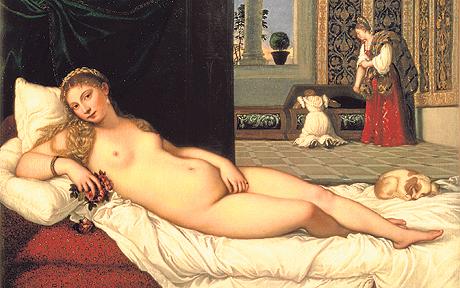
Titian’s Venus of Urbino
The Venus of Urbino was painted in 1538 when Titian was 50 years old and depicts a young woman identified as the goddess Venus. But there is nothing mythological about her surroundings. This Venus is reclining on a bed inside a luxurious Renaissance palace. She holds a small bouquet of roses with one hand whereas the other hand is in an ambiguous position. A little dog sleeps on the bed while maids rummage through a wardrobe chest trying to find something for their mistress to wear.
The Venus of Urbino was inspired by Giorgione’s Sleeping Venus which Titian himself completed after Giorgione’s death. However, there is a big difference between one Venus and the other: Giorgione’s Venus has her eyes closed, Titian’s Venus has her eyes opened. Looking directly at the viewer, contact is made.
Alone I am nude. In front of you I am naked.
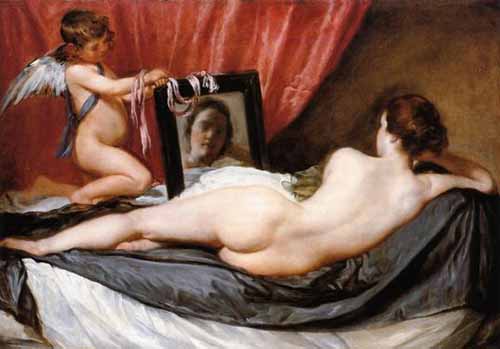
Diego Velazquez’ Venus at her Mirror
Diego Velazquez was born in Seville, Spain in 1599. From a wealthy family, he was able to study art and eventually wound up painting portraits for the royal family. But, in 1649, he took a trip to Italy. Inspired (he bought a painting by Titian), Velazquez then painted the nude, Venus at her Mirror. With the mirror, Venus could now look at herself being looked at.
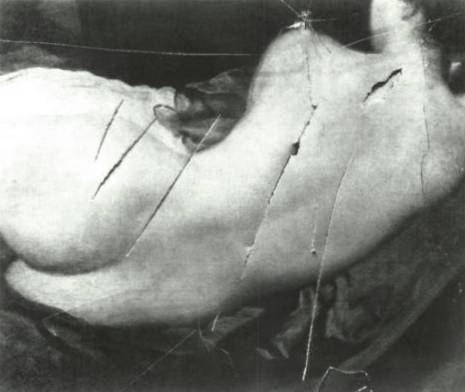
Venus slashed by Mary
Mary Raleigh Richardson was a suffragette active in the United Kingdom. Frustrated by political failures, like other suffragettes, she became increasingly militant. That’s why Mary stopped marching in the streets and began setting fires, smashing windows and bombing railroad stations. But this wasn’t enough for Mary. On March 10, 1914 she entered the National Gallery in London and began slashing Velazquez’ Venus with a meat cleaver. And, to make things worse, Mary, like many other middle and upper class suffragettes, became a fascist.
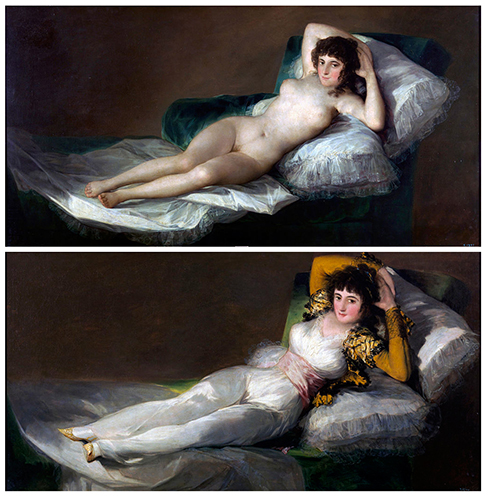
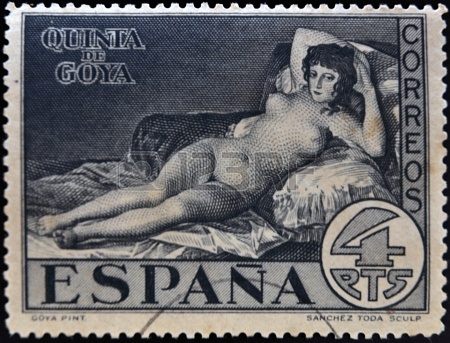
Francesco Goya’s La Maja Desnuda and La Maja Vestida
Francesco Goya painted the same woman twice–once with clothes on, once without. The woman is known as “maja” which implies a woman who is not only beautiful but also a bit brazen. There has been a bit of speculation as to why Goya painted the “before & after” versions of the maja.
After the French Revolution (in the 1790s), the Spanish government gave more power to the Inquisition. Paranoid, many of the elite hid their paintings of nudes in “gabinetes de desnudos”. But Manuel Godoy, Prime Minister who had commissioned Goya to paint the majas, came up with another idea. The Clothed Maja was hung directly in front of The Naked Maja so, when Godoy wanted to see the nude, all he had to do was raise a rope to expose her. One painting dressed another.

In 1930, long after the Inquisition, the Spanish Postal Authority approved the use of the naked maja for postage stamps. The United States government, instead, banned them and refused to deliver any mail bearing the stamp.

Manet’s Olympia
In 1865, Eduoard Manet caused an uproar when his painting Olympia was publically exhibited. Part of the scandal came from the idea that a woman wearing slippers but no clothes obviously had to bea prostitute. But she was not. The model was Victorine Meurent who had already posed for Manet’s Le Déjeuner sur l’Herbe (without clothes on there as well). To earn a living, Victorine would play the violin in café concerts. Then she met Manet and modeled for him until she decided to be an artist, too. Unfortunately, today there is only one surviving example of her work.

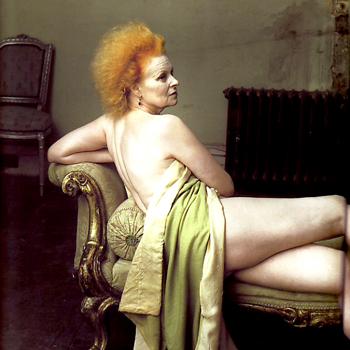
Vivienne Westwood (unfortunately, I am unable to find the name of the photographer)
Dame Vivienne Westwood gained recognition when members of the punk band, Sex Pistols, began wearing her designs. Somewhat of a status quo activist, Westwood likes to provoke. Despite her advanced age, she has no problem stripping down for a photo shoot. Initially, the above foto made me admire what I considered the courage to have no shame about the effects of time–effects that so many women fear and refuse to accept.
But Westwood, at the age of 68, posed naked for the photographer Juergen Teller causing my admiration to evaporate. Not everything that is private should be made public.
So what is the difference between naked and nude? Probably just the ability to distinguish decorum from vulgarity.