
Many many years ago, I was charmed into reading Dino Buzzati’s THE TARTAR STEPPE (1940). The feel of the book was inquietante, that is, disturbing and gave me no real pleasure. However, it did give me more insight as to the mentality of the person who recommended it.
The story is that of Lieutenant Giovanni Drogo who’s sent to Fort Bastiani at the limits of the Tartar Steppe. So, along with a bunch of other soldiers, Drogo waits to defend the fort from the Tartars. They wait and wait a non-stop wait that goes on for two years. Every day it’s the same old thing, nothing changes. Life has become immobile causing the mind to wander and the soldiers start going wacko. They begin to doubt that the Tartars will ever show up. Unfortunately, in the habit of waiting, they are unprepared for action and when the Tartars finally arrive, the soldiers are no longer in touch with reality thus doomed.

After reading THE TARTAR STEPPE, I had no particular urge to read anything else by Buzzati. But a few days ago, after talking together about graphic novels, my friend Connie lent me POEM STRIP (1967), a graphic novel by Buzzati. It’s a take off on Orpheus and Eurydice and tells of Orfi’s search for his missing girlfriend, Eura. The story takes place in a Gothic Milano, Buzzati’s adopted city, full of fear and mystery. It has a film noir attitude towards sex and a Dante’s INFERNO attitude towards life. In other words, another inquietante book!

From “Poem Strip”
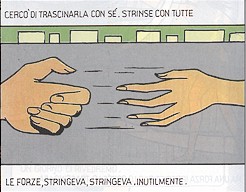
From “Poem Strip”
Now I have nothing against Buzzati. He was not only a novelist and painter, but a well-known and respected journalist for Corriere della Sera as well. And I have nothing against men, but Buzzati’s work, in my opinion, reflects a male mentality that is not compatible with my own. And it is this same mentality that seems to dominate the realm of comic strips and graphic novels.
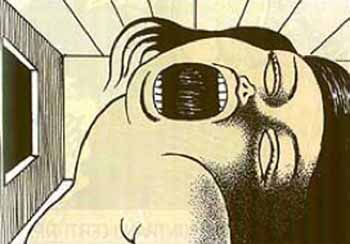
From “Poem Strip”
On many many occasions, I’ve been to Feltrinelli’s in Rome looking for comics and graphic novels finding mainly works by Milo Manara, Guido Crepax, Hugo Pratt and Andrea Pazienza. Rarely did I find anything by women. Too bad as there are many many talented female artists out there. Aside from the well-known Marjane Satrapi, author of PERSEPOLIS, others of interest include Nicola Streeten of Laydeez do Comics, Liz Prince, and Kate Beaton. Just to name a few.
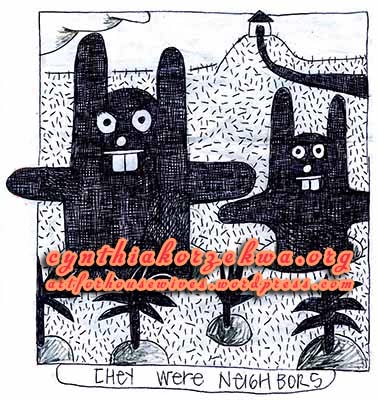
I am happy to announce that I am now collaborating with Sir Joe Works and we will publish, in the not too distant future and in ebook form, BEBINA BUNNY’S CABINET OF CURIOSITIES. It is a graphic narrative focusing on ecofeminism.
Ecofeminism is a term of ambiguous nature. It evokes the idea of a feminist who simultaneously fights against patriarchal oppression as well as against environmental exploitation. This is true in a general sense. However, I would like to elaborate on the term.
The prefix “eco” comes from the Greek “oiko” meaning house. And the word “ecology” comes from “oiko” that’s mated with “ology” (“the study of”) thus means “the study of the house”. So ecologists can be defined as those who study their dwellings. And since I dwell in my body and my mind, they are a part of my home and to be considered an extension of my personal ecology.
A feminist is a woman who believes in and fights for the equality of the sexes and for the right to follow her own principles. Democracy was invented c. 2,500 years ago but women have been voting only for the last 100. Which means that for 2,400 years, society and its standards have been established by men. And this causes women to be defensive.
An ecofeminist is a woman who defends her home.

For more related links, go HERE.
 p.s.
p.s.Writings on Visual Culture by Mario Naves“The Bewitched Bourgeois: Fifty Stories” by Dino Buzzati
“The Bewitched Bourgeois: Fifty Stories” by Dino Buzzati


 Rembrandt’s self-portrait
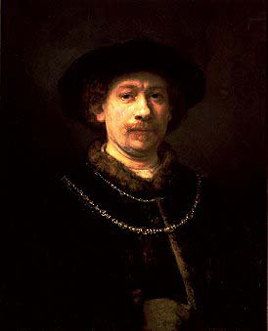 Rembrandt’s self portrait
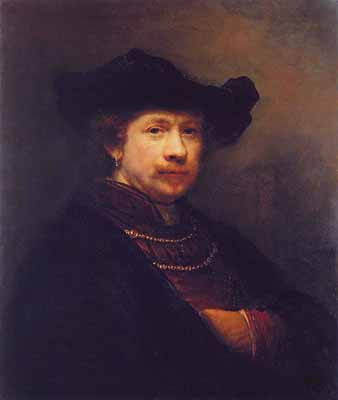 Rembrandt’s self-portrait
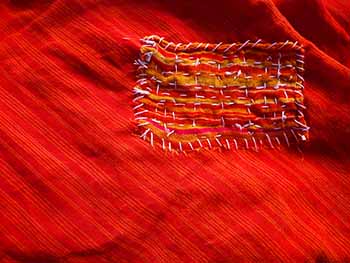
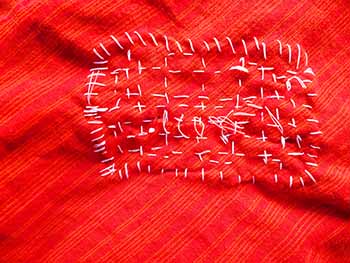
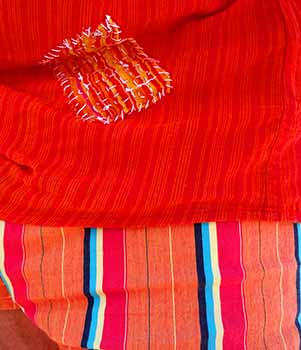


 The Narrative Within