My home starts with my body

The first home is the womb. It’s where our life begins. Ancient cultures had a respect for it that, unfortunately, is now obsolete.

Prehistoric human figurines have been found throughout Europe dating from c.25,000 BC to c.2,000 BC which means they’ve been around much longer than written history (which has been around for about 5,000 years).

These figurines are small generally 4 – 22 cm in height making them portable. The majority are of women and have a tendency to emphasize breasts and hips.  Facial features are not taken into consideration.

Votives by Cynthia Korzekwa

Many such figurines have been found in the Cyclades. Those representing women are stylized and static. Whereas figures representing animals or men are often shown engaged in some kind of activity such as that of the famous harp player.

On Market St. here in Parikia, there’s a shop selling souvenir Cycladic figurines. Most of these little white statues are similar in that they have arms folded under the breasts and triangular incisions indicating female genitals.

Like a statue she waited by Cynthia Korzekwa

Archeologists still have not been able to come up with an explaination for the existential purpose of these little statues. But, because sexual characteristics were exaggerated, it’s logical to assume that the concept of fertility was involved.
The Cycladic civilization flourished in the Aegean from about 3300 – 2000 BC. Much of what is known regarding Neolithic Cycladic art comes from excavations at Saliagos off Antiparos, Paros’ “little sister” island. Figurines from this area were found mainly at grave sites.
The Cyclades are a group of about 30 islands. They were called kyklades by the ancient Greeks who imagined they formed a circle, kyklos, around the island of Delos. Delos was a sanctuary dedicated to Apollo. But it also hosted the Shrine of Dionysus with its many gigantic phallus sculptures and related reliefs.

yria ceramics

Cycladic salt shaker from Yria

Life begins in a woman’s body post male orgasm. A woman takes a man’s pleasure and turns it into life. Certainly, if pregnancy were based on female and not male orgasms, the world population would be a fraction of what it is today. But instead of receiving gratitude, women have been minimized and stripped of their sacredness. The aims that today’s patriarchal societies have for us are no longer spiritual but, instead, political. So ladies, isn’t it time to stand your ground when it comes to defending your first home, that of your body?

Body types figurines front by Cynthia Korzekwa Body types figurines back by Cynthia Korzekwa

Figurines made from dish detergent bottles

For more related links, go HERE.

drawing

Posted in Ecofeminism | Tagged , , | 8 Comments

Spirals

A spiral is a curved line that starts from within then moves out. It is one of the oldest symbols dating back as far as the Neolithic period.

This ancient symbol can be found all over the world. The Minoans of Knossos saw it as a symbol of infinity. The Celts saw it as a symbol of birth, growth and expansion.  In essence, the spiral represents the cycles of nature, the spiral of life. Cycles indicate change — the old leaves making room for the new.

The spiral, associated with the life force, is often considered a female symbol reflecting the womb and fertility.

Coiled snakes are spirals, too, and thus often related to goddess cults.

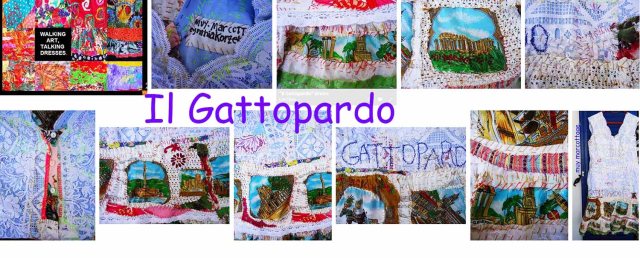
Muy Marcottage dress spirals by Cynthia Korzekwa Muy Marcottage Rouge detail by Cynthia Korzekwa Muy Marcottage Rouge spirals by Cynthia Korzekwa Muy Marcottage coiled spirals by Cynthia Korzekwa Muy Marcottage stitching spirals by Cynthia Korzekwa Muy Marcottage spirals Rouge by Cynthia Korzekwa Muy Marcottage Rouge stitching by Cynthia Korzekwa Muy Marcottage Rouge dress by Cynthia Korzekwa Muy Marcottage Rouge button by Cynthia Korzekwa Muy Marcottage Riuge label by Cynthia Korzekwa

Muy Marcottage Rouge front by Cynthia KorzekwaFront

Muy Marcottage Rouge back by Cynthia KorzekwaBack

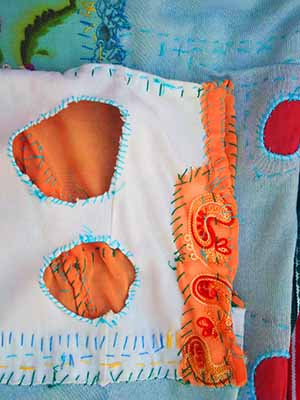
The above Muy Marcottage dress is named “Rouge” because it was made from a red fabric (probably once curtains) that looks like sangallo (eyelet). It has thin straps and is body hugging until the buttocks where it then is attached to a gathered skirt of the same fabric.  It is completely handsewn into place with white thread and has a zipper in the back. The skirt, trimmed  with a yellow print, is covered with spirals made from fabric scraps.

For more Muy Marcottage, go HERE.

For more links regarding spirals, go HERE.

drawing
p.s. My friend, Franca, sent me this message:   Baudelaire… «Il disegno arabesco è il più spiritualista (spirituale) dei disegni…». Tante spirali insieme... «Le dessin arabesque est le plus spiritualiste des dessins» = «The arabesque design is the most spiritual drawings». Arabesque art is, in fact, full of spirals.

Posted in Muy Marcottage | Tagged , , , | Leave a comment

Talking Dresses

Cows with names produce more milk. Why is that? Researchers believe that being treated as an individual makes the difference.

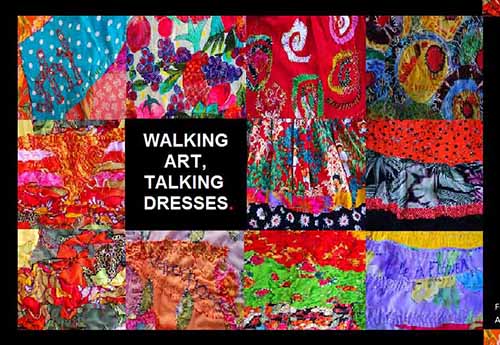
So I’ve given all of my Muy Marcottage dresses names — words or phrases to make them dialectical. In other words, Talking Dresses.

I’ve always enjoyed combining the written with the visual. Years and years ago when I was still living in Texas and making huge paintings, I always “framed” the image with phrases Edward Hicks style.

Edward Hicks

Peaceable Kingdom

And when I started focusing more on drawing be it using a pencil or using a mouse, I incorporated the written word even more.

dialectical2

 “Surrender” computer drawing (using mouse)

The Catholic Church has such a huge artistic patrimoney due, in part, to the fact that the image was used to propagate their teachings. Just think of Giotto’s affrescoes in Assisi or Michelangelo’s Sistine Chapel. The Protestants, aided by Gutenburg, relied, instead, on the written word of the Bible. Eventually, when the emphasis was selling a product and not a religion, image and word were mated. Commerce has done more to create change than we often realize.

The combination of word with image really took off in the 1800’s with the beginning of advertising. Newspapers began using drawings to make their message more immediate.

The affiché is where the profane goes sacred the most blatant example being that of Toulouse-Lautrec.

dialectical3

Toulouse-Lautrec , Jules Chéret & affiché via

dialectical4

Toulouse-Lautrec, while living in Paris, hung-out in the Montmarte area and was frequently at the Moulin Rouge. Intrigued by the dancers, he began drawing them and these drawings eventually led to publicity posters. Thanks to the technology of lithography, these posters were made in huge quantities and then splattered around town. And, violà, the introduction of a new art form.

The Paris-educated teacher, Rudolph Töpffer, is generally credited with creating the first graphic novel. Born in Geneva in 1799, Töpffer liked to entertain his students by drawing caricatures. He made so many of them that he decided  to make complete narratives by adding words to the images.

dialetical5

Rudolph Töpffer’s “Histoire de Mr. Vieux Bois

There are many WAYS OF SEEING therefore, there can be no standardization of perception.

This said, I would like to go back now to my Muy Marcottage dresses. These dresses are not just objects, they are also ideas.

They hope to be dialectical in that, via the words or phrases sewn onto them, an exchange is provoked. Muy Marcottage dresses want to interrelate with who wears them, with who sees them.

dialectical6Muy Marcottage

MUY MARCOTTAGE MOSTRA

Marcottage is a French term used for plant propagation — taking one plant to make another. Rodin’s “The Fallen Angel” is an example of marcottage in that Rodin took pieces from one sculpture to make another sculpture. And, since I take existing clothes to make others, I decided to call my reconstructed clothes “Marcottage”. But one day, while listing to The Kumbia Kings, I decided to add the “muy” meaning “a lot”. Thus Muy Marcottage.

Muy Marcottage

To see some Muy Marcottage dresses go HERE.

For other related links, go HERE.

drawing

Posted in Muy Marcottage | Tagged , , | Leave a comment

Graphic Thoughts and Ecofeminism

Many many years ago, I was charmed into reading Dino Buzzati’s THE TARTAR STEPPE (1940). The feel of the book was inquietante, that is, disturbing and gave me no real pleasure. However, it did give me more insight as to the mentality of the person who recommended it.

The story is that of Lieutenant Giovanni Drogo who’s sent to Fort Bastiani at the limits of the Tartar Steppe. So, along with a bunch of other soldiers, Drogo waits to defend the fort from the Tartars. They wait and wait a non-stop wait that goes on for two years. Every day it’s the same old thing, nothing changes. Life has become immobile causing the mind to wander  and the soldiers start going wacko. They begin to doubt that the Tartars will ever show up. Unfortunately, in the habit of waiting, they are unprepared for action and when the Tartars finally arrive, the soldiers are no longer in touch with reality thus doomed.

Dino Buzzatifrom “Poem Strip” 

After reading THE TARTAR STEPPE, I had no particular urge to read anything else by Buzzati. But a few days ago, after talking together about graphic novels, my friend Connie lent me POEM STRIP (1967), a graphic novel by Buzzati. It’s a take off on Orpheus and Eurydice and tells of Orfi’s search for his missing girlfriend, Eura. The story takes place in a Gothic Milano, Buzzati’s adopted city, full of fear and mystery.  It has a film noir attitude towards sex and a Dante’s INFERNO attitude towards life. In other words, another inquietante book!

from "Poem Strip"

From “Poem Strip”

Dino Buzzati

From “Poem Strip”

Now I have nothing against Buzzati. He was not only a novelist and painter, but a well-known and respected journalist for Corriere della Sera as well. And I have nothing against men, but Buzzati’s work, in my opinion, reflects a male mentality that is not compatible with my own. And it is this same mentality that seems to dominate the realm of comic strips and graphic novels.

from "Poem Strip"

From “Poem Strip”

On many many occasions, I’ve been to Feltrinelli’s in Rome looking for comics and graphic novels finding mainly works by Milo Manara, Guido Crepax, Hugo Pratt and Andrea Pazienza.  Rarely did I find anything by women. Too bad as there are many many talented female artists out there. Aside from the well-known Marjane Satrapi, author of PERSEPOLIS, others of interest include Nicola Streeten of Laydeez do Comics, Liz Prince, and Kate Beaton. Just to name a few.

Ecofeminism graphic bunnies by Cynthia Korzekwa
I am happy to announce that I am now collaborating with Sir Joe Works and we will publish, in the not too distant future and in ebook form, BEBINA BUNNY’S CABINET OF CURIOSITIES. It is a graphic narrative focusing on ecofeminism.

Ecofeminism is a term of ambiguous nature. It evokes the idea of a feminist who simultaneously fights against patriarchal oppression as well as against environmental exploitation. This is true in a general sense. However, I would like to elaborate on the term.

The prefix “eco” comes from the Greek “oiko” meaning house. And the word “ecology” comes from “oiko” that’s mated with “ology” (“the study of”) thus means “the study of the house”. So ecologists can be defined as those who study their dwellings. And since I dwell in my body and  my mind, they are a part of my home and to be considered  an extension of my personal ecology. 

A feminist is a woman who believes in and fights for the equality of the sexes and for the right to follow her own principles. Democracy was invented c. 2,500 years ago but women have been voting only for the last 100. Which means that for 2,400 years, society and its standards have been established by men. And this causes women to be defensive.

An ecofeminist is a woman who defends her home.

Ecofeminism Bebina Bunny by Cynthia Korzekwa

For more related links, go HERE.

drawingp.s.

Writings on Visual Culture by Mario Naves“The Bewitched Bourgeois: Fifty Stories” by Dino Buzzati

“The Bewitched Bourgeois: Fifty Stories” by Dino Buzzati

Posted in Ecofeminism | Tagged , , | 2 Comments

Aperitifs on a Parian Roof

sunsetSunset

moonriseMoonrise

We discovered that we can see summer sunsets from the roof of our house. So lately we’ve been climbing up with our picnic basket full of the basics for a Parian aperitif which means, in brief, ouzo and meze (μεζέ). A meze is a snack served with alcohol generally consisting of olives,tomato and cucumber. Eating food when drinking is always a good idea as it helps you absorb the alcohol.

Last night we had a special treat – after the sunset, the rise of the full moon. Spettacolare! A kind of yin-yang experience.

Full moons release a lot of energy and can affect us in various ways. “Lunatic” comes from the word luna meaning moon so maybe that’s why werewolves come out when the moon is full.

moon calendarOldest Lunar Calendar

The first calendars were based on moon and not sun cycles. There is a synchronous relationship between menstrual regularity and lunar rhythms thus creating a natural bond between women and the moon. Both are capable of  waxing and waning.

fotos via Pierluigi Fagan

drawing

Posted in Ecofeminism | Tagged , , , , | 2 Comments