O. Henry’s Leaf

One is a lonely number. It’s static and goes nowhere on its own. To move, it takes two. That’s why we need interrelations because, without them, we cannot evolve.

Sue and Johnsy were two young artists living in the art colony not far from Washington Square. They’d moved in in May but by November, Johnsy had pneumonia and risked dying. As Johnsy had already convinced herself that she was going to die, the doctor said her only chance of survival was to find the will to live.

Looking out of her bedroom window, Johnsy could see an ivy vine growing on a brick wall across the way. Initially, the vine was full of leaves but, as it was fall, they started dropping with increasing rapidness until there was only one leaf left on the wine. Johnsy was convinced that once that leaf dropped, she would die.

Behrman was a fierce little old man who lived in the apartment downstairs from the two young women. He was an artist who’d never managed to create a masterpiece and, without enthusiasm, modelled for Sue to earn needed money. After 40 years as an artist, all he had to show for it was a blank canvas on his easel that was still waiting to be painted.

Sue told Behrman about Johnsy’s conviction that she would die once that last leaf fell from the vine. But the elderly artist just grunted.

That afternoon, Johnsy wanted to keep the window curtains open so she could watch the last leaf fall. Fortunately, Sue convinced her to go to eat then sleep instead.

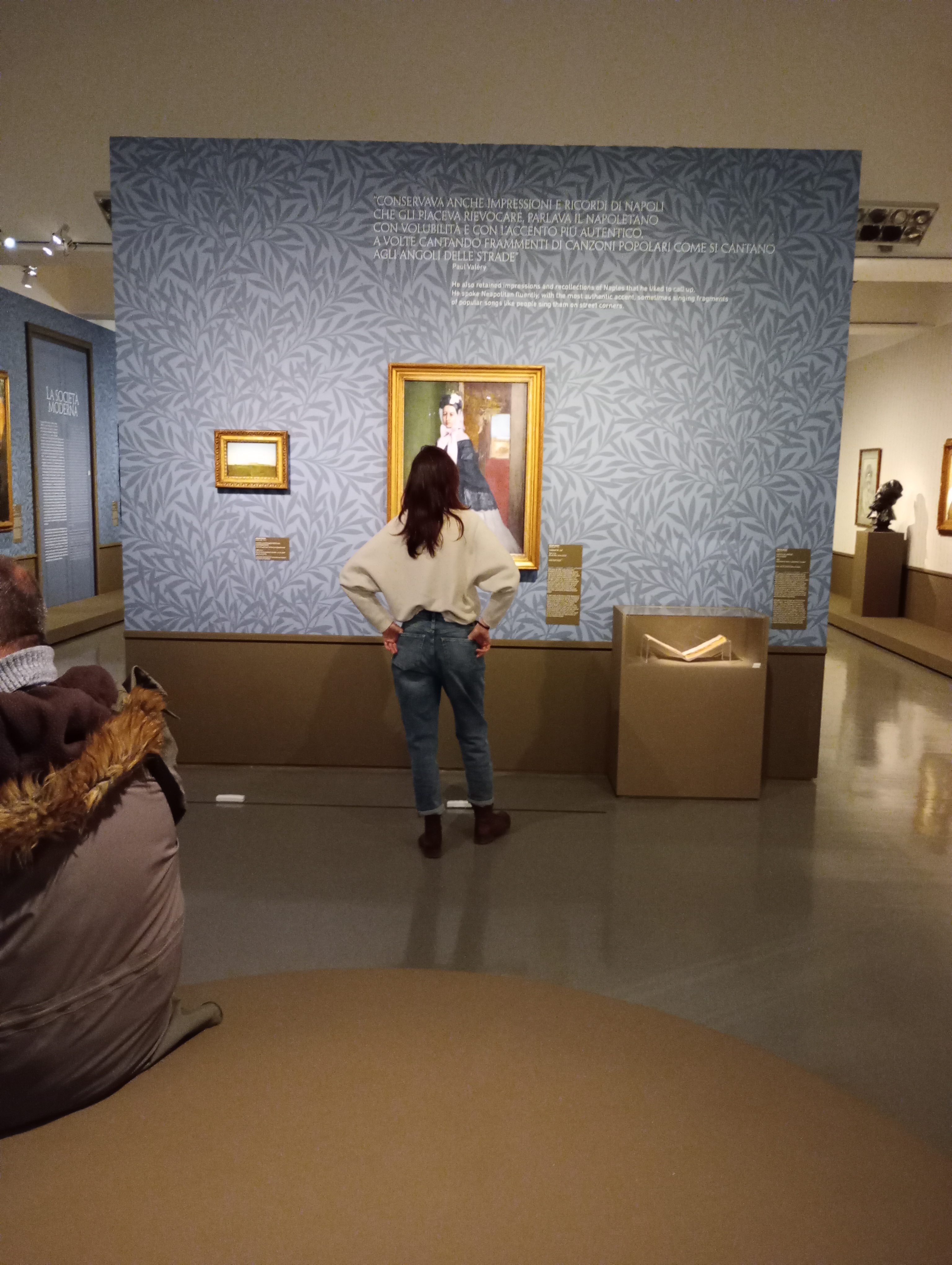
When Johnsy woke up the next morning, she saw that the leaf was still hanging on. So she decided to try hanging on, too, and thought about how lovely it would be to paint the Bay of Naples.

The doctor was amazed at Johnsy’s quick recovery of will and health. Unfortunately, now it was Behrman who was dying. The janitor had found him helpless and in pain, his body wet and icy cold. It seems Behrman had spent the night out in the cold painting an ivy leaf on the wall so Johnsy would not know that the last leaf had already fallen.

Behrman is portrayed as a failure who wasted his time drinking gin instead of painting. But was Behrman really a failure? He may not have been a well-known artist but his painting of the leaf did something most paintings don’t do—it gave someone the will to live and in doing so saved their life. And is there anything more successful than that?

So why not give someone a leaf?

The story is that of O. Henry’s “The Last Leaf” and you can read it online for free HERE

Posted in art, Art Narratives, Daily Aesthetics | Tagged , , , , , , | 2 Comments

Starry Starry Night

The year I graduated from high school, Don McLean’s “Starry Night” peaked the music charts at number 12 in the U.S. I was charmed by the song but not enamoured. Had I known it was about Vincent Van Gogh, I might have felt differently.

In the fall of 1970, Don McLean was gigging in schools playing guitar and singing. At school one day, he came across Van Gogh’s biography. After reading it, McLean’s heart went boom. The story of the artist’s life really moved him and he couldn’t stop thinking about it. So he sat down and, while looking at a print of Van Gogh’s 1889 painting “Starry Night,” wrote this song on a brown paper bag. The bag is now buried in a time capsule (along with the artist’s paintbrushes) beneath Amsterdam’s Van Gogh Museum.

McLean, years later in an interview, would say he felt compelled to write a tribute to the misunderstood artist.

Now, I understand what you tried to say to me
And how you suffered for your sanity
And how you tried to set them free
They would not listen, they did not know how
Perhaps they’ll listen now.

Sometimes a work of art affects you so much that, mentally, you want to keep holding on to it. So you write a poem or some prose about it. This attempt to verbally represent something visual is known as Ekphrasis/Έκφραση.

Van Gogh’s art has inspired much ekphrasic writing. For example, Anne Sexton wrote an ekphrastic poem about Van Gogh’s painting. But I read Anne’s biography and prefer not to write about her. Charles Bukowski also wrote about Van Gogh. It’s short and starts out like this:

Van Gogh cut off his ear
gave it to a
prostitute
who flung it away in
extreme
disgust.

Donut Hole

-30-

Related:  Ekphrastic Writing Responses: Vincent Van Gogh + 10 of the Best Ekphrastic Poems about Pictures + Introduction. The engaging eye: Ekphrasis and twentieth-century poetry + Vincent Van Gogh | The Starry Night | Saint Rémy, June 1889 | MoMa  + See 10 Songs Every Art Lover Should Know  + Burroughs and his `Van Gogh kick’  + Van Gogh and Kerouac + Julio Iglesias Vincent (Starry Starry Night) +

An analysis of W. D. Snodgrass‘s “Van Gogh: ‘The Starry Night’” +

Posted in art | Tagged , , , | 4 Comments

Motown Pesto

The basil growing on our balcony is out of control. It’s time to make a Pesto Zucchini Lasagna Texan style. Authentic pesto is made by crushing the basil with a pestle and mortar. But I am lazy and simply throw all the ingredients into the blender—basil, grated parmesan, garlic, and sunflower seeds (generally pine nuts are used but they are too expensive). I like a bit of lemon zest in it, too.

The boring part of making this lasagna is cutting the zucchini into long strips and grilling them on a skillet pan. To distract my boredom, I listen to music. Today I’m in the Motown Mood thanks to a BBC documentary I watched yesterday about Motown, “When Motown Came to Britain”. Wow.

Berry Gordy Jr, boxer, part-time pimp, and factory worker wanted to become a fulltime songwriter. After receiving next to nothing for successful songs he’d written, Gordy decided he’d be better off opening his own recording studio then finding his own artists to record the songs he’d written.  He was living in Detroit that, thanks to the growing automobile industry, had seen a number of Blacks arriving from the south in hopes of getting a job. Gordy named his label Motown, an abbreviation of “Motor City Town”.

In 1959, with financial help from his family, Gordy acquired a house at 2648 W. Grand Blvd known as “Hitsville U.S.A”. It was here that the Motown sound was born. In Detroit’s Black neighborhoods, young men generally belonged to either a gang or a group. The conditions of possibility were limited for young Blacks and the dream of becoming a recording artist had them lined up in front of Hitsville all day long hoping to meet Gordy, sign a recording contract, then have a hit record so they could get out of the ghetto.

Gordy, who had worked several months on a Ford assembly line, got the idea that young talent needed to be assembled, too. The young singers who signed on with Gordy came from poor and often dysfunctional families. Having known only hunger and hardship, all they wanted was a hit record and money. But Gordy knew that, if they made a hit, this would mean that they would have to go on tour.

Singing is one thing but performing is another. Talent does not guarantee a good stage presence. Motown had a lot of diamonds, but they needed a good cut and some polishing. Thanks to having spent Sundays singing in church, many of the singers already had a good vocal preparation. But if Gordy wanted to sell records to white people, his artists needed to dazzle and impress.

Motown created an artistic development department with the specific role of making the singers’ stage presence better. There was a voice coach and musical arranger as well as a choreographer, Cholly Atkins.  It was Atkins who taught the singers how to synchronize their moves so that they’d look like puzzle pieces falling into place.

“I believe in class. Class will turn the heads of kings and queens:” Maxine

And then there was Maxine. Maxine Powell (1915-2013), although she was from Texarkana, Texas, she was raised by her aunt in Chicago. Here Maxine worked as a manicurist to pay for her acting studies. She also worked as a model and a personal maid. In 1945 Maxine moved to Detroit where she opened a finishing and modeling school to transform ugly ducklings into swans. Gordy’s mom and sister had been Maxine’s students and suggested Gordy collaborate with her. Maxine’s role was to teach the performers good manners, social graces, and grooming skills. Her most important role was that of mentor and motivator. The first day of class she always told her students that they needed to know themselves. Without knowing what your strengths and your weaknesses are, it’s easy to crumble.

After Motown left Detroit for Los Angeles, Maxine did not have the same kind of rapport with her artists as before. But years later, she secretly went to see Diana Ross perform on Broadway to see if Diana was still following her advice. Someone told Diana that Maxine was in the audience and Diana insisted that Maxine go on stage. Here the pop star hugged Maxine and told the audience; I wouldn’t be her now had it not been for this woman.

Class.

David Godin was a soul music fan. He collected R&B records and encouraged his classmate at Dartford Grammar School, Mick Jagger, to do the same.  At that time, British music was very beige and only British music was allowed on British airways. But a pirate boat radio station invaded the frequencies and played Motown non-stop. Godin was so zapped by Motown that he founded the Tamla Motown Appreciation Society.

Gordy, who from the beginning wanted international fame, and, learning about the growing number of fans on the other side of the Atlantic, decided it was time for Motown to go to Britain. And in 1965, Motown arrived to tour England with performances scheduled in places like Liverpool, Wigan, Leicester, Manchester, Bristol, Cardiff, and Glasgow. So the Motown artists got on a bus and travelled around the English countryside going from one gig to another.

Unfortunately, the tour was not well organized. The singers (including The Supremes, Stevie Wonder, Martha and the Vandellas, Smokey Robinson and the Miracles) were forced to travel hours on a bus only to arrive at the venue and find it virtually empty. Sometimes they would only have a handful of people there to listen. Nevertheless, they would put on a professional performance.

But just a few weeks later, Dusty Springfield hosted a TV special introducing the British public to Motown. It was a big success.

Northern Soul.

Existence was bleak in Northern England. If you wanted to work, you had to work in a factory day after day, week after week, month after month. Life was repetitious and gray. Then an all-night dance club called the Twisted Wheel opened in Manchester playing only the Motown sound. The club was a hit and every Saturday, young people from all over the North, would take a bus or a train to go to the club with the intention of dancing all night. But to keep them animated enough to dance, they would take pills.

The success of Northern Soul hit a bump when, after the death of Martin Luther King, Jr and the return of Black American soldiers from Viet Nam, there was a major mood change in the music. The lollipop vibe turned into funk. But the Northern Soul dance style depended upon the 4/4 beat that new Motown releases were not providing. So old Motown songs that were B side or unknown were sought to keep the energy pumped up. But music is about taste and tastes change.

Motown was more than just music. It was entangled with the Civil Rights Movement and had an important role in boosting Black self-esteem. Jim Crow laws and racial segregation were still being practiced. But Blacks were ready for a major change. In 1955 in Alabama, Rosa Parks defied the bus driver’s orders to go to the “colored” section. In 1957, Elizabeth Ann Eckford was one of the first Black students to attend Little Rock High School in Arkansas. Thanks to a Supreme Court ruling in 1954, Brown vs. Board of Education, Elizabeth had a right to attend that high school. Nevertheless, the Arkansas National Guard blocked her and physically kept her from entering the school.

In 1963, Civil Rights groups united to organize the March on Washington. It was here that MLK made his famous “I Have a Dream” speech. The speech was so inspiring that King asked Motown Records if they could record for him.

LOTS OF LINKS!

When Motown Came to Britain (BBC Documentary) on Youtube

Related:  Motortown Revue UK Tour, 1965 + Dave Godin, Esperanto-speaking vegan who became an apostle of soul + Inside Motown’s first UK tour: ‘We were treated like royalty’ + Motown: Six Months That Shook The World + British Invasion? This Is About The Time Motown Invaded England + Geraldo 1990 “Ladies of Motown” video + RSG! The Sound Of Motown 1965 with Dusty Springfield +

What Really Happened To Florence Ballard? + DREAMGIRLS, movie based in large part on Supremes and Barry Gordy …Jennifer Hudson like Florence Ballard, Beyonce like Diana Ross, and Jamie Fox like Barry Gordy + Lady Sings the Blues (1972) HD Movie + Diana Ross Drug Addiction + DREAMGIRLS movie +  The Monarchs of Motown + Kennedy Center Honors Berry Gordy +

Berry Gordy Described Diana Ross as the Queen of His Life + Diana Ross’ childhood home + How Muddy Waters inspired The Rolling Stones + How Childhood Friends Mick Jagger and Keith Richards Formed The Rolling Stones + Songs That Influenced The Rolling Stones: 10 Essential Blues Tracks + the untold truth of Muddy Waters +

Maxine Powell, Motown’s Maven of Style, Dies at 98 + Maxine Powell – Former Director of Motown Charm +  Maven of Motown: Maxine Powell – Etiquette Coach for Motown’s Greatest Artists + Maxine Powell – Interview Part 1 – 7/6/1986 + MAXINE POWELL CHARM MAVEN OF MOTOWN

Read online (archive). Berry, me, and Motown: the untold story + The Motown Story +

Motown and Civil Rights: How to Listen to MLK Jr.’s “I Have a Dream” Speech in Full + Detroit’s Walk to Freedom and Motown’s Contribution to the Civil Rights Movement + Jim Crow laws and racial segregation + in 1955, Rosa Parks defied segregation + Elizabeth Ann Eckford and being one of the first Black students at Little Rock High School +

Posted in Beauty, Conditions of Possibility, Music | Tagged , , , , , , , , , , | 2 Comments

Just an Ordinary Day

Just an ordinary day. “And then gone.   Joan Didion

What a crass, loud, and inhumane world we are living in. It’s so easy these days to get distracted and to wander from one’s core. It’s so very easy to get lost.

To avoid feeling displaced, I’m focusing on the beauty found in ordinary days. It helps to keep me anchored. It also helps to keep me in charge of evaluating my own reality. To make this focusing a visual documentation, too, I’m making simple and unpretentious little “pro-memoria” paintings. They’re on cardboard and have plastic crocheted frames.

One day I will look at these colored vignettes and think how beautiful the ordinary has been to me.

Holding On

-30-

Posted in Beauty, Daily Aesthetics, exploring the self, Paros | Tagged , | 2 Comments

For those who die twice

It was a fabulous October morning and I was quite happy, for once, to run errands. I went to the bookstore just to buy a notebook and a pen but wound up buying a couple of “vacation from myself” books as well. One was The Man Who Died Twice by Richard Osman. It’s another “coming of age” for the elderly books that have become popular in recent years.

Elizabeth, Joyce, Ibrahim, and Ron are pensioners living in Kent. Close friends, they’ve started the Thursday Murder Club so that they can solve murder mysteries together. It helps to keep them fresh while growing old.

The book is easy to read and flies by quickly. It’s not very realistic but it’s meant to entertain and to present the elderly in a context that is not boring and obsolete. But the purpose of this post is another. Outside the bookstore where I bought The Man Who Died Twice, there’s a stand with free book review newspapers. The first review I saw was The Woman Who Died Twice. I didn’t know dying twice was a thing.

The Woman Who Died Twice is by author and lyricist Manos Eleftheriou. It’s the story of Eleni Papadaki, a famous Greek stage actress who was executed in 1944. She’d been accused of collaborating with the Germans so now, post war, it was time for retribution. Eleni was taken to the woods with other presumed Nazi sympathizers and shot twice. Her body was then dumped in a communal grave.

Although based on a true story, in Eleftheriou’s book Eleni is only grazed by bullets and left for dead in the snow. Her brother, too grief stricken to think beyond his emotions, identifies another woman at the morgue as his sister. But Eleni, although she had fallen unconscious after being shot, was still alive. After she comes to, Eleni manages to make it to a nearby farmhouse. Here, while listening to the radio, she realizes that her friends now reject her. Ostracized, Eleni understands that, if she wants to continue living, she must hide for the rest of her life.

No doubt Eleftheriou felt the need to write this book trying to make sense of what had happened to Eleni and to offer the martyred actress some form of atonement.

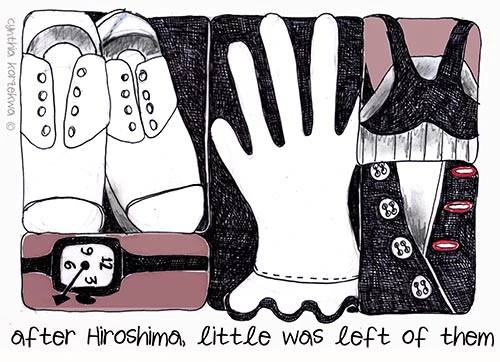
War is lethal. And it kills more than just bodies. Even after the departure of Nazis from occupied Greece, the brutality continued. In December of 1944, the tension between various political factions was so extreme that shooting broke out in Athens. Around 250,000 Greeks from the political left, while demonstrating in Syntagma Square, were shot at by police hiding on the rooftops. Many people were massacred including a six-year-old boy.

Because this took place in December, these events are referred to collectively as the Dekemvriana (December = Δεκέμβριος).

Years later it came out that Katina Paxinou, a well-known actress, was responsible for the accusations against Eleni. Katina and Eleni were professional rivals. Katina couldn’t stand the competition, so she accused Eleni of having an affair with the Greek prime minister who was collaborating with the Germans. As a result, Eleni was kicked out of the Greek Actor’s Association and executed without a trial. But not much time after her death, Eleni’s accusers admitted that they’d made a mistake and shouldn’t have killed her. Even Greek partisans called her execution “an idiocy”. In fact, the truth was that Eleni had helped to save and not destroy many Greeks lives.

This malformed desire for vendetta is an accessory to war and happens all the time. Women, subjected to wars created by patriarchal needs, are often accused of “horizontal collaboration” and subsequently subjected to humiliating punishments such as with the tondeurs and tondues:

“At the end of WWII, over 20,000 French women were accused of having had “horizontal collaborations” with the Germans.  Even prostitutes, who sold their bodies to the Germans in the same way bistrot owners had sold their wines, were singled out and publicly humiliated by having their hair shaved off then paraded in public semi-naked often with swastikas painted on their foreheads.  This punishment was obviously misogynistic as it was restricted to women.  Furthermore, because of a war instigated by men, many French mothers of young children had husbands in German prisoner-of-war camps. Without pleasure, they slept with German soldiers simply to feed their children.”

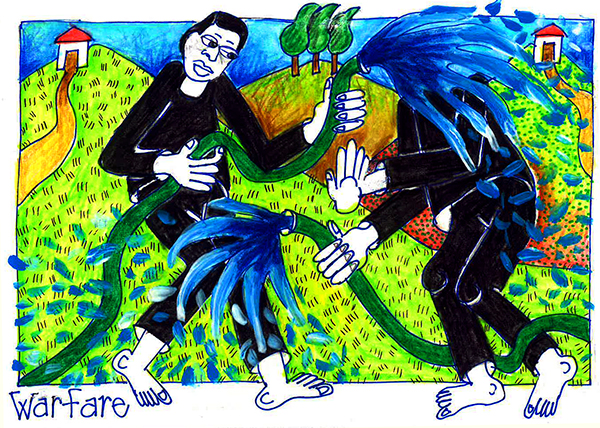
War is proof that man is not as intelligent as he thinks he is. War creates a fiction that one side is right and the other side is wrong. Thus war implies that we do not consider others equals because we consider our side superior and the other side inferior. Furthermore, the side that feels itself superior also feels the right to impose itself on others and these “others” must be complacent or die.

And it doesn’t matter whether or not you consider yourself superior because you’re not—war turns us all into slaves.

“Every gun that is made, every warship launched, every rocket fired signifies in the final sense, a theft from those who hunger and are not fed, those who are cold and are not clothed. This world in arms is not spending money alone. It is spending the sweat of its laborers, the genius of its scientists, the hopes of its children. This is not a way of life at all in any true sense. Under the clouds of war, it is humanity hanging on a cross of iron.”
― Dwight D. Eisenhower

There is no democracy in war.

-30-

Related:  Coco Chanel and Tondeurs and tondues +

Eleni Papadaki (1903-1944) +  Για τη δολοφονία της ηθοποιού Ελένης ΠαπαδάκηEleni Papadaki’s tomb and info (1903–1944)  +  Dekemvriana: Ground Zero in the Greek Civil War +  Dekemvriana +   The TV series Astheneis kai odoiporoi (2002) is actually based on the last few years of her life(her name was changed to Theano Galati for it though).

The Thursday Murder Club by Richard Osman is being adapted into a movie by Steven Spielberg

Posted in Books, female consciousness, growing old | Tagged , , , , , , , , , , | 4 Comments