One month after Marie Antoinette’s head was chopped off, the Louvre Royal Palace became a museum. Artists then started going there not only to see works by the Old Masters but to copy them as well. Because imitation is a form of learning. Even artists such as Degas, Picasso, Chagall, and Dalì continued the tradition because, as Cézanne once said, “The Louvre is the book from which we learn to read.”
Having goals doesn’t necessarily mean that we know how to actualize them. There is the trial and error method that can teach us much but role models also offer important learning experiences. Like the Louvre’s Old Masters, they give us something to copy.
Having a role model doesn’t mean being cloned as someone else. It simply means that we can learn from the successes of others just as we can learn from their mistakes, too. Potentially everyone has a lesson to share. All we have to do is look for it.
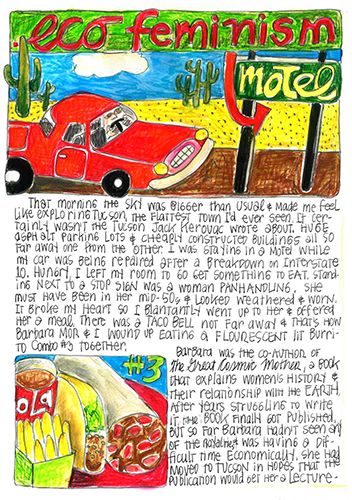
That morning the sky was bigger than usual and made me feel like exploring Tucson, the flattest town I’d ever seen. It certainly wasn’t the Tucson that Jack Kerouac wrote about. Huge asphalt parking lots and cheaply constructed buildings all so far away one from the other. I was staying in a motel while my car was being repaired after a breakdown on Interstate 10. Hungry, I left my room to go get something to eat. Standing next to a stop sign was a woman panhandling. She must have been in her mid-fifties and looked weathered and worn. It broke my heart so I blatantly went up to her and offered her a meal. There was a Taco Bell not far away and that’s how Barbara Mor and I wound up eating a fluorescent lit Burrito Combo #3 together.
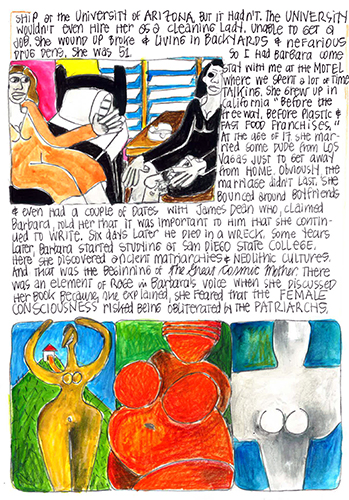
Barbara was the co-author of The Great Cosmic Mother, a book that explores the history of women and their relationship with the earth. After years spent struggling to write it, the book finally got published. But so far she hadn’t seen any of the royalties and was having a tough time economically. Barbara had moved to Tucson in hopes that the publication might get her a lectureship at the University of Arizona. But it hadn’t. The University wouldn’t even hire her as a cleaning lady. Unable to get a job, she wound up “broke and living in back-yards and nefarious drug-dens.” She was 51.
So I had Barbara come stay with me at the motel where we spent a lot of time talking. She grew up born in California “before the freeway, before plastic & fast food franchises”. At the age of 17 she married some dude from Las Vegas just to get away from home. Obviously the marriage didn’t last. She bounced around boyfriends even had a couple of dates with James Dean who, claimed Barbara, told her that it was important to him that she continued to write. Six days later he died in a wreck. Some years later, Barbara started studying at San Diego State College. Here she discovered ancient matriarchies and Neolithic cultures. And that was the beginning of The Great Cosmic Mother. There was an element of rage in Barbara’s voice when she discussed her book because, she explained, she feared that the female consciousness risked being obliterated by the patriarchs.
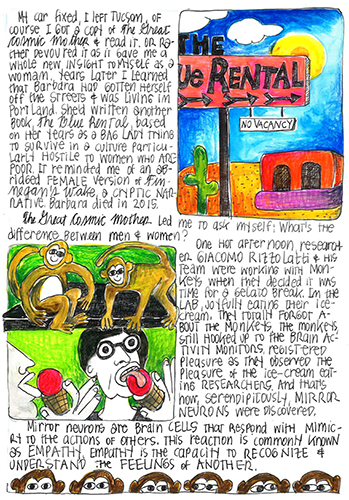
My car fix, I left Tucson. Of course I got a copy of The Great Cosmic Mother and read it. Or rather devoured it as it gave me a whole new insight to myself as a woman. Years later I learned that Barbara had gotten herself off the streets and was living in Portland. She’d written another book, The Blue Rental, based on her years as a “bag lady” trying to survive in a culture particularly hostile to women who are poor. It reminded me of an abridged female version of Finnegan’s Wake, a cryptic narrative. Barbara died in 2015.
The Great Cosmic Mother led me to ask myself: what’s the difference between men and women?
One hot afternoon, researcher Giacomo Rizzolatti and team, were working with monkeys when they decided it was time for a gelato break. In the lab, joyfully eating their ice-cream, they totally forgot about the monkeys. The monkeys, still hooked-up to brain activity monitors, registered pleasure as they observed the pleasure of the ice-cream eating researchers. And that’s how, serendipitously, mirror neurons were discovered.
Mirror neurons are brain cells that respond, with mimicry, to the actions of others. This reaction is known commonly as empathy.
Empathy is the capacity to recognize and understand the feelings of another.
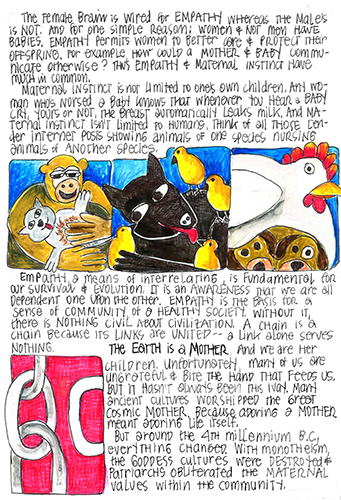
The female brain is wired for empathy whereas the male brain is not. And for one simple reason: women, and not men, have babies.
Empathy permits women to better care and protect their offspring. For example, how could a mother and a non-speaking baby communicate otherwise? Thus empathy and maternal instinct have much in common.
Maternal instinct is not limited to one’s own children. Anyone who has nursed a baby knows that whenever you hear a baby cry, yours or not, the breasts automatically leak milk. And maternal instinct is not limited to humans. Think of all those tender Facebook posts showing animals of one species nourishing animals of another animal altruism.
Empathy, a means of inter-relating, is fundamental for our survival and evolution. It is an awareness that we are all dependent one upon the other. Empathy is the basis of a sense of community, of a healthy society. Without it, there is nothing civil about civilization.
A chain is a chain because its links are united…the links alone serve nothing.
The Earth is a Mother. And we are her children. Unfortunately, many of us are ungrateful and bite the hand that feeds us. But it hasn’t always been this way. Many ancient cultures worshipped the Great Cosmic Mother. Because adoring a mother meant adoring life itself.
But, around the fourth millennium B.C., everything changed. With monotheism, the goddess cultures were destroyed and patriarchs obliterated the maternal values within the community.
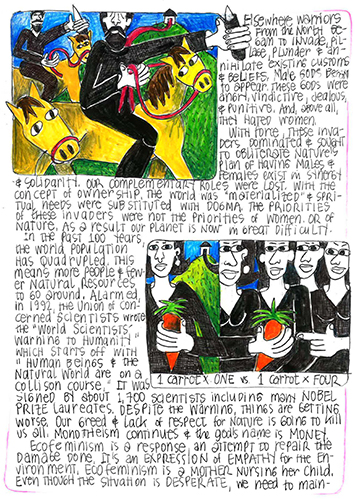
Elsewhere warriors from the north began to invade peaceful cultures. These Indo-Europeans were violent and on horseback. Their aim was to invade, pillage, plunder and annihilate existing customs and beliefs. Male gods began to appear. These gods were angry, vindictive, jealous and punitive. And, above all, they hated women.
With force, these invaders dominated and sought to obliterate nature’s plan of having males and females exist in synergy and solidarity. Our complementary roles were lost. With the concept of ownership, the world was “materialized” and spiritual needs were substituted with dogma. The priorities of these invaders were not the priorities of women. Or of nature. As a result, our planet now is in great difficulty.
In the past 100 years, the world population has quadrupled. This means more people and fewer natural resources to go around. Alarmed, in 1992, the Union of Concerned Scientists wrote the “World Scientists’ Warning to Humanity” which starts off with “Human beings and the natural world are on a collision course.” It was signed by about 1,700 scientists including many Nobel Prize laureates. Despite the warning, things are getting worse. Our greed and lack of respect for nature is going to kill us all. Monotheism continues and the god’s name is Money.
Even though the situation is desperate, we need to maintain a female consciousness. And to do so, we can contribute with daily acts of awareness that nature must be respected.
Here are a few examples of what we can do:
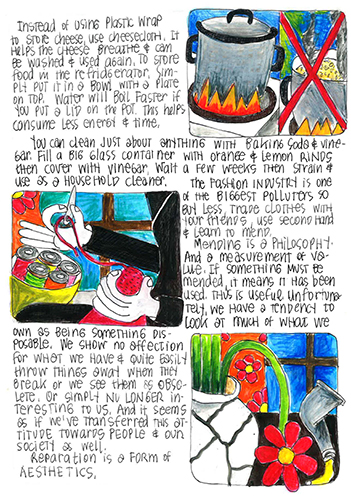
Follow the three R’s of reduce, reuse, and recycle and limit the amount of natural resources that we use.
Honor water as it keeps us alive. To help conserve water: keep a bucket in your shower to collect water and use it for your plants, turn off the tap while brushing your teeth, fix leaks, don’t flush the toilet at night, use less electricity as power plants use water to cool off.
Make your own cosmetics. Clean your skin with olive oil. Use aloe vera gel as it is antibacterial and has skin healing properties. That’s why Cleopatra rubbed it on her face every day. The gel can be used as a shampoo as well as a toothpaste. And put some of the gel in your smoothies if you have any kind of stomach disturbance (including ulcers).
You can also mix baking soda with water to use as a shampoo. You may want to rinse with vinegar afterwards. Baking soda mixed with salt can help whiten teeth.
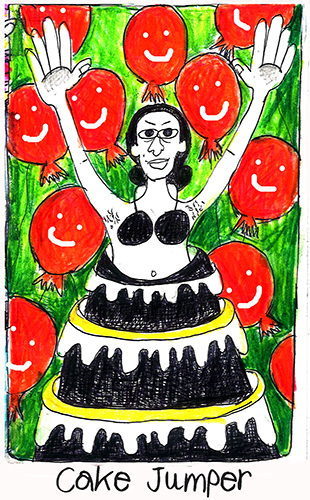
In this phase of my reconfiguration, I’ve become a professional cake jumper. That is, I’m paid for jumping out of giant cardboard cakes covered with icing. As strange as it may seem, there are many still willing to pay quite exorbitant prices just to see a scantily clad female jump out of a fake cake.
You may think but politely not ask: Aren’t you a bit dated to be jumping out of cakes? Well of course I am especially if it’s at some kind of wild and crazy bachelor party. But experience has taught me to choose my venues with care. Most of my gigs are at homes for senior citizens where, after I jump out of a fake cake, real cake is served. So I’m just an appetizer for the actual thing.
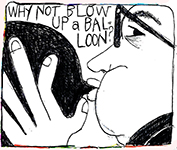
Aside from the cake, my seniors enjoy the festive atmosphere, the sing-alongs, and the pinning of tails on papier-mâché donkeys. Nevertheless, the cake jumping is such a favourite that many of the ladies at the home have decided to learn how to jump out of cakes, too. Initially, while the ladies were practicing their jumping, the men were trying to design a reusable cardboard cake. But after a few days of frustrated efforts, the men decided that it would be easier if they all chipped in for an inflatable rubber cake instead. Only the men hadn’t considered the problem of inflating it. So, once the cake arrived, it was so big that the men had to take turns blowing it up.
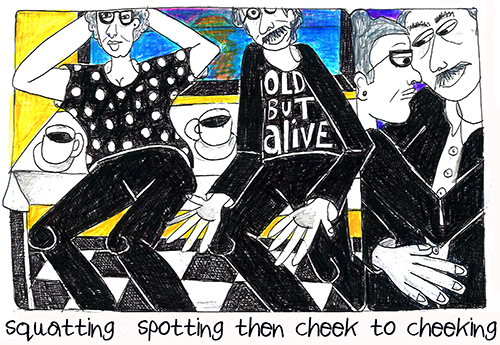
As for the ladies, they daily do squat exercises to reinforce their knees. Believe me, climbing in and out of cakes is not as easy as it may seem. But, as exercising can be boring, to spice it up a bit, I have the men come in to act as spotters telling them it’s up to them to keep the ladies from falling on the ground. Of course this makes the ladies giggle and the men puff up like roosters. Vintage hormones are the best.
So after my seniors have giggled and puffed for a while, I turn down the lights and turn on the music. Because there’s nothing better for your health than dancing cheek to check.
Nostalgia is not a sensation that I enjoy as it’s a longing for something that can never be had again. Therefore, if some memory from the past creeps into my thoughts, I immediately redirect my attention elsewhere.
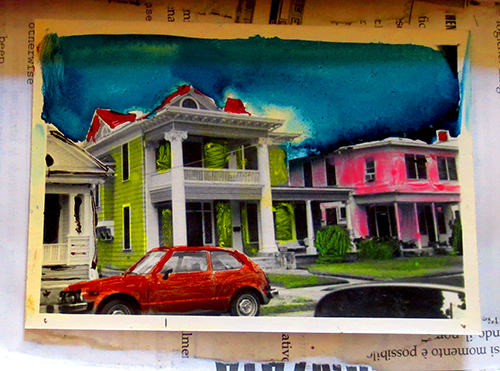
But today there was an exception. I have many photos that are not stored the Marie Kondo way. More than stored, they are stashed using a Here and There method. This can make finding a particular photo rather complicated. But the plus side is that when you least expect it, some long forgotten photo suddenly resurfaces. Like today. While looking for something in my overdosed archive cabinet, I came across a little box of photos. They were mainly of the family and thus taken for sentimental reasons. But then there were four small black and white photos that I’d hand-painted more than 40 years ago while in San Antonio, my hometown. At the time, I enjoyed photographing the city especially areas of historical charm—not the monuments but places on the edge of time that were slowly slipping away.
Hearne House, work in progress (the house is located at 300 W. French Place)
Monte Vista is a historic neighbourhood in midtown San Antonio. Development began in 1890 and was completed in the 1930s. Influenced by the Gilded Age, the homes were big and majestic. But not all the houses in the area were designed by important architects such as Atlee B. Ayres or Frost W. Carvel. On the periphery of Monte Vista are numerous homes that, despite fine architectural elements, suffer in grandeur and often are in a state of decadence. But decadence, for an inquisitive mind, can be intriguing—it’s like a whodunit. Because you wonder what brought on the decline.
Art House, work in progress
So impressed by the allure of decadence, I spent the morning driving around the neighbourhood taking photos of lonely buildings thinking I could “resuscitate” them by taking their picture then painting it.
Double Dormers, work in progress
Although I took the photos more than 40 years ago, I can still see that morning in my mind and remember my enthusiasm because I was curious and ready to make new discoveries. It is undoubtedly a memory worth remembering. So it’s the right time to take these photos out of their box, put them on the wall, and let the reminder remain.
Corinthian Columns House
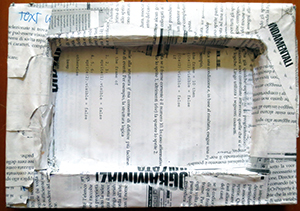
For frames I will use old books (mainly outdated manuals) whose pages have been glued together with watery glue. Once the glue is dried, a niche the size of the photo is carved out with a sharp blade then all recovered with a light layer of papier-mâché to finish it off (a great way to get rid of old love letters). Once dry, the frame can be painted before affixing the photo.
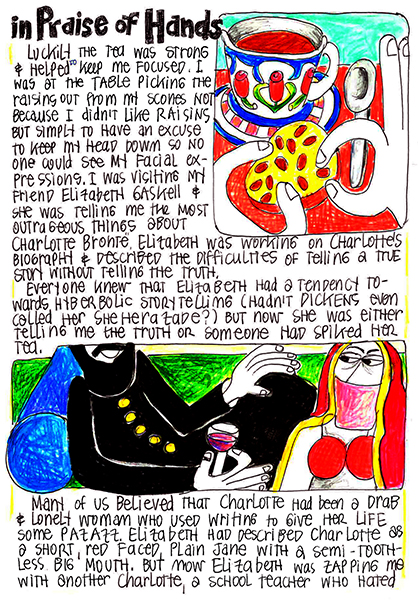
Luckily the tea was strong and helped keep me focused. I was at the table picking the raisins out from my scone not because I didn’t like raisins but simply to have an excuse to keep my head down so no one could see my facial expressions. I was visiting my friend Elizabeth Gaskell and she was telling me the most outrageous things about Charlotte Bronte. Elizabeth was working on Charlotte’s biography and described the difficulties of telling a true story without the truth.
Everyone knew that Elizabeth had a tendency towards hyperbolic storytelling (hadn’t Dickens even called her Scheherazade?) but she was either telling me the truth or someone had spiked her tea.
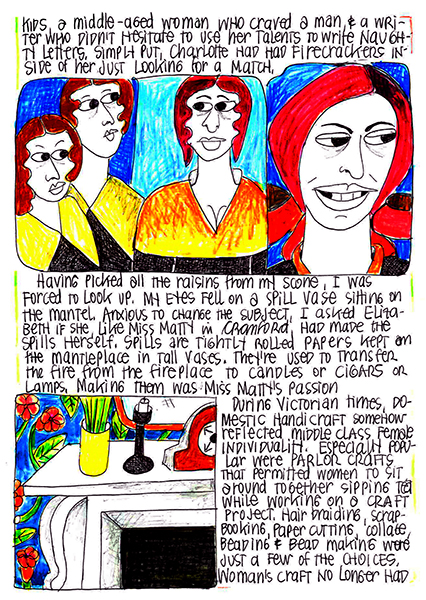
Most of us believed that Charlotte had been a drab and lonely woman who used writing to give her life some pAzAzZ. Elizabeth had described Charlotte as a short, red faced Plain Jane with a semi-toothless big mouth. But now Elizabeth was zapping me with another Charlotte, a school teacher who hated kids, a middle aged woman who craved a man, and a writer who didn’t hesitate to use her talents to write naughty letters. Simply put, Charlotte had had firecrackers inside of her just looking for a match.
Having picked all the raisins from my scone, I was forced to look up. My eyes fell on a spill vase sitting on the mantel. Anxious to change the subject, I asked Elizabeth if she, like her Miss Matty in Cranford, had made the spills herself. Spills are tightly rolled papers kept on the mantelpiece in tall vases. They’re used to transfer the fire from the fireplace to candles or cigars or lamps. Making them was Miss Matty’s passion.
During Victorian times, domestic handicraft somehow reflected middle class female individuality. Especially popular were parlor crafts that permitted women to sit around together sipping tea while working on a craft project . Hair braiding, scrapbooking, paper cutting, collage, beading and bead making were just a few of the choices. Women’s craft no longer had to be just useful. Now it could be decorative and fun to make as well. Recycled materials from old clothing to pieces of candles to old receipts were used. But hands were used not just for social activities. They were used for subversive activities, too.
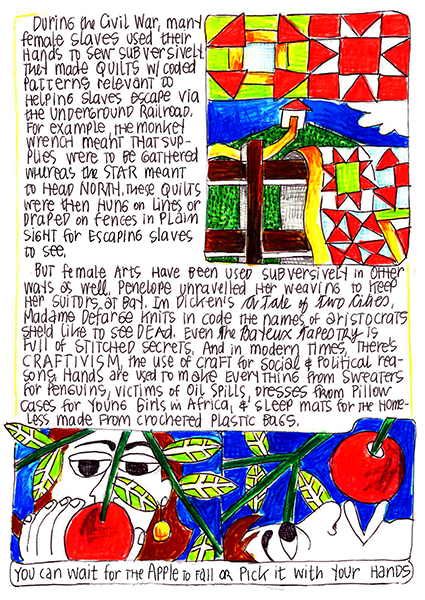
She was born and raised a slave. And as a slave Harriet Powers learned to sew and made quilts for her owners with the light of the day and for her family with the light of a candle. Harriet used an appliqué style similar to that used by the African Fon people. And with this technique, Harriet told stories. Her most famous surviving quilt is “Bible Stories” depicting eleven stories from the Bible.
During the Civil War, many female slaves used their hands to sew subversively. They made quilts with coded patterns relevant to helping slaves escape via the Underground Railroad. For example, the monkey wrench met that supplies were to be gathered whereas the star meant to head north. These quilts were then hung on lines or draped on fence in plain sight for escaping slaves to see.
But female arts have been used subversively in other ways as well. Penelope unraveled her weaving to keep her suitors at bay. In Dickens’ Tale of Two Cities, Madame Defarge knits in code the names of the aristocrats she’d like to see dead. Even the Bayeux Tapestry is full of stitched secrets. And in modern times, there’s craftivism, the use of craft for social and political reasons. Hands are used to make everything from sweaters for penguins, victims of oil spills, dresses from pillow cases for young girls in Africa, and sleeping mats made from crocheted plastic bags for the homeless.
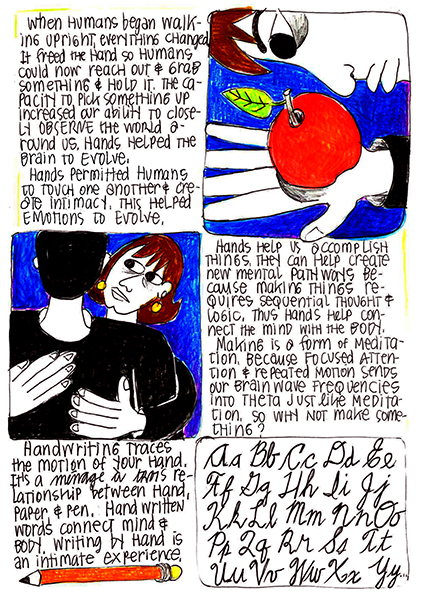
When humans began walking upright, everything changed. It freed the hand so humans could now reach out and grab something and hold it. The capacity to pick something up increased our ability to closely observe the world around us. Hands helped the brain to evolve.
Hands permitted humans to touch one another and create intimacy. This helped emotions to evolve.
Hands help us accomplish things. They can help create new mental pathways because making things requires sequential thought and logic. Thus hands help connect the mind with the body.
Making is a form of meditation. Because focused attention and repeated motion sends our brainwave frequencies into theta, just like meditation. So why not make something?
Handwriting traces the motion of your hand. It’s a ménage à trois relationship between hand, paper, and pen. Hand written words connect mind and body. Writing by hand is an intimate experience.
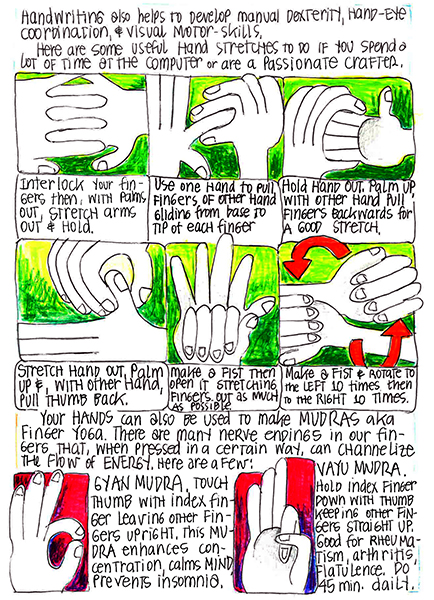
Handwriting also helps to develop manual dexterity, hand-eye coordination, and visual motor skills.
Here are some useful hand stretches useful if you spend a lot of time at the computer or are a passionate crafter.
Your hands can also be used to make mudras aka finger yoga. There are many nerve endings in our fingers then, when pressed in a certain way, can channelize the flow of energy. Here are a few:
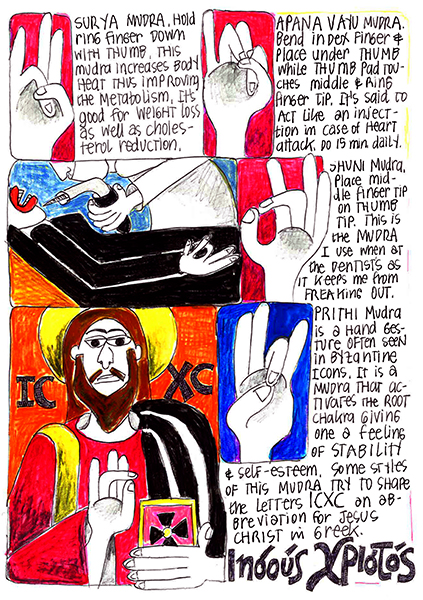
SHUNI MUDRA: The mudra is made by touching the tip of the middle finger to the tip of the thumb. This mudra encourages patience and the obliteration of negative emotions. When I go to the dentist, I always make this mudra then rotate the thumb and finger tips in circular motion to help keep me calm.
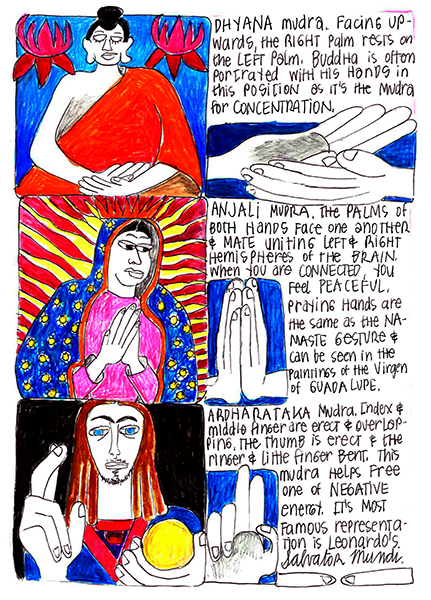
Mudras have often been depicted in art.
Prithvi Mudra: the thumb holds the ring finger down. It activates the root chakra thus promotes a feeling of stability. This mudra is most often represented in Byzantine icons.
Dhyana Mudra: facing upwards, the right palm rests on the left palm. Buddha is often portrayed with his hands in this position as it’s the mudra for concentration that leads to inner peace.
Anjali Mudra: the palms of both hands face one another and mate thus uniting the left and right hemispheres of the brain. When you are connected, you feel less stress and anxiety. Praying hands use this Namaste gesture. The Virgin of Guadalupe is represented making this gesture.
Ardharataka Mudra: the index and middle fingers are erect whereas the thumb, ring, and little finger are bent. This mudra helps free one of negative energy. Its most famous representation is that of Leonardo’s Salvator Mundi.
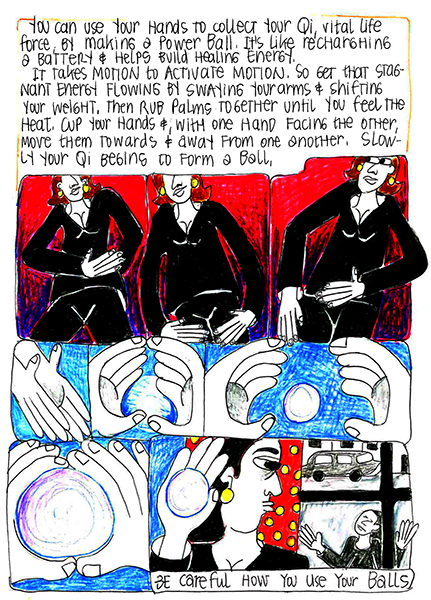
You can also use your hands to collect your Qi, vital life force, by making a Power Ball. It’s somewhat like recharging a battery and helps to build healing energy.
It takes motion to activate motion. So get that stagnant energy flowing by swaying arms and shifting weight. Then rub palms together until you feel the heat. Cup the hands and, with one hand facing the other, move them towards and away from one another. Slowly the qi begins to form a ball.
Schaffer, Talia. “Craft, Authorial Anxiety, and ‘The Cranford Papers’”. Victorian Periodicals Review, Vol. 38, No. 2, Interdisciplinary Work and Periodical Connections: An Issue in Honor of Sally H. Mitchell (Summer, 2005), pp. 221-239. Published by: The Johns Hopkins University Press on behalf of the Research Society for Victorian Periodicals, Retrieved Sept 5, 2018 HERE
Schaffer, Talia. Novel Craft: Victorian Domestic Handicraft and Nineteenth-Century Fiction.
Gaskell, Elizabeth. The Life of Charlotte Bronte. Everyman’s Library. London. 1997.
Dobard, Raymond jr and Tobin, Jacqueline. Hidden in Plain View. 1999
Fry, Gladys-Marie. Stitched from the Soul (1990) on archive.org HERE
Parker, Rozsika. The Subversive Stitch. On archive.org HERE
Korzekwa, Cynthia. Bebina Bunny’s Cabinet of Curiosities. On archive.org HERE
Paz, Octavio. In Praise of Hands. On archive.org HERE
Yoga Mudras in Orthodox Christian Art: Does it indicate a Hindu-Buddhist Influence? Retrieved October 28, 2018 HERE
The Underground Railroad: A Code of Secrecy, Part II by Fannette Davis. Retrieved October 28, 2018 HERE.











 The Narrative Within