The Power of a Gaze

It was at the Petit Trianon that I’d met the artist Elisabeth Vigée Le Brun. Elisabeth, after the royal family’s arrest, wisely left France taking her young daughter with her. At the time of Marie-Antoinette’s execution, she was in Vienna painting portraits of aristocrats.

J’adore how Elisabeth easily created whimsical atmospheres in her Ancien Régime paintings although her childhood had certainly not been whimsical. Her father, well-known pastel portrait painter Louis Vigée, had taught his daughter how to paint. Elisabeth was a natural talent but, being a woman, she wasn’t permitted to study at the Académie des Beau-Arts. And to make it worse, when she was 12, her doting father died and her mother, looking for security, married a wealthy but unscrupulous jeweller.

Just a teenager, Elisabeth attracted many rich clients because of her light and airy yet sophisticated and intimate painting style. Unfortunately, her greedy step-father took control of Elisabeth’s earnings. Maybe that’s why she married Jean-Baptiste Le Brun, a well-known Parisian art dealer who owned a vast collection of paintings Elisabeth could study from. Pity that he was greedy, too.

Marie-Antoinette became aware of the young woman’s talent and invited her to Versailles. Having gained the Queen’s patronage, Elisabeth painted more than 30 portraits of the Queen and her family depicting Marie-Antoinette as a devout mother and wife.

The saddest “Devout Mother” painting was undoubtable “Marie Antoinette and Her Children” (1783) with the young Dauphin pointing at an empty cradle. Originally her daughter Sophie had been in the cradle but was painted out after her premature death. Sophie had been born with an abnormally large head. Her various deformities were not uncommon with the Bourbons and Habsburgs perhaps due to centuries of inbreeding.

Despite her seemingly demur attitude, Elisabeth, was quite progressive and had a good understanding of human nature. Once at the Petit Trianon, we had an interesting tête-à-tête regarding the power of the gaze. Elisabeth confided that there was a reason behind her self-portrait where she is holding her palette with some brushes and is looking directly at the viewer. With this portrait, she is clearly establishing who she is—a painter and not a passive object for the male gaze.

Women were taught to control their eyes because a careless glance could be interpreted as a provocation.

But as a portrait painter, it was only obvious that Elisabeth would have to look at the sitter. In general, men make women the object of their gaze. They are not comfortable when the opposite occurs. Sometimes her male sitters would interpret her looking at them as an invitation to look at her in a lascivious way. It created a problem as this erotic attention impaired her concentration and the chance to get an appropriate likeness of them.

When she was still young, to avoid this problem, her mother would always be present when Elisabeth men were sitting for portraits. However, she eventually invented the “lost look” effect. By deflecting the male gaze, she could control and displace their visual advances.

Jean-Jacques Rousseau’s treatise “Emile” (1762) had made a huge impact on the French. The philosopher said a child’s initial environment would have an impact on him for the rest of his life. This inspired Elisabeth to do a series of child related paintings including several of her daughter. Of special interest is “Julie Le Brun Looking in a Mirror.” It’s unusual in that the reflection in the mirror would have been impossible considering the angle in which it’s held. Nevertheless, the painting shows how children have a natually innocent curiosity.

A quite different approach of looking at one’s reflection comes from one of Elisabeth’s tutors, Jean-Baptiste Greuze. In his “The Broken Mirror” (c. 1762), a dishevelled young woman is sitting looking down on a broken mirror that shows a shattered reflection. She sits gracelessly in a room that’s in total disarray while her frightened little puppy wonders what to do. It’s a painting with a self-reflection gone wrong. No innocence here just the feeling of male moralism judging a young woman living in a man’s world.

When the royal family was arrested, Elisabeth, along with her daughter, left France for 12 years living and working in Italy, Austria, Russia, and Germany. She painted mainly portraits of aristocrats as well as allegorical portraits. Elisabeth’s Rococo style so loved by Marie Antoinette was now substituted with the stiff, tight Neo-Classical style.

Elisabeth and I never saw one another again. But I know she continued to paint all her life and even wrote her memoirs (three volumes!) before dying at the age of 86.

(from “TONI O, The Beholder” 2021 ©)

Related: Elisabeth Louise Vigée-Lebrun: Art and Gender during the French Revolution + The Broken Mirror +

Bibliography:

Nagel, Susan. Marie-Thérèse, the Fate of Marie Antoinette’s Daughter. Bloomsbury Publishing. London. 2008.

Elisabeth Vigéè Le Brun (1755-1842)

Posted in Art Narratives, Toni O | Tagged , , , , , , | 1 Comment

Guillotined Styles

Charlotte Corday was just beginning to blossom as a woman when the French Revolution broke out.  She saw nothing liberating about the aftermath of the Revolution and its atrocities.  Believing Jean-Paul Marat to be a blood thirsty monster who sent innocent people to their graves, she felt that by murdering him she could save thousands of lives.

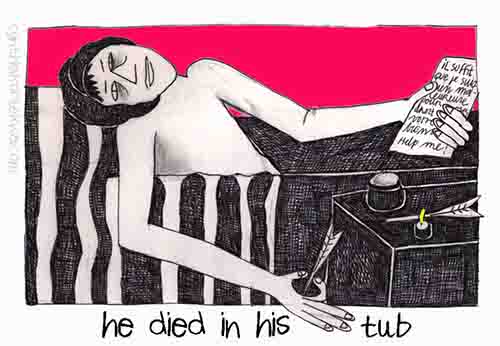
Because of a skin condition he’d developed while hiding in sewers, Marat was forced to bathe a lot.  So he transformed his tub into a kind of desk where he’d soak for hours while writing down his political theories. One day while he was bathing, 24 year old Charlotte Corday sneaked into his bathroom and stabbed him to death.

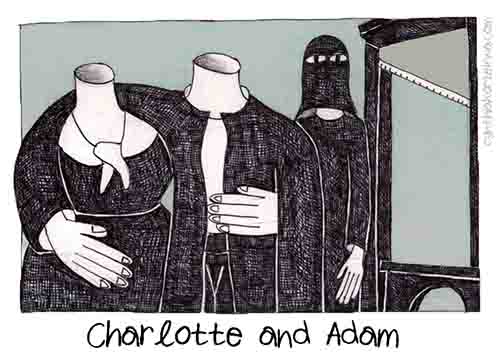
A young German living in Paris, Adam Lux, was so impressed by the actions of Charlotte that he fell in love with her.  He followed her trial and was present when she was beheaded. Adam saw Charlotte as a martyr and wrote a pamphlet in her defense which led to his arrest for treason. Tried, he was told he could save his life if he would retract what he’d written but he just smiled and thanked the judges because he was honored to be sacrificed on the same guillotine where Charlotte had met her death.

Jacques-Louis David was good friends with that terror loving Robespierre and actively supported the French Revolution. So to show what a groupie he was, David painted Marat dead in his tub. This earned him the power to dictate what was and wasn’t permissible art in revolutionary France.

As a youth studying in Rome, David had copied classical antiquity and read Wicklemann’s writings on ancient sculpture. And when, during the French Revolution, it came time for him to distance himself from from the frivolous Rococo popular under the Ancien Régime, David recycled his Roman studies to develop his austere and severe Neo-Classical style. Then his buddy Robespierre was guillotined, and Napoleon became Emperor so a new style was needed and, violà, the Empire style. But, when Napoleon fell from power, too, and was substituted with a Bourbon revival, David had to leave France as he’d run out of styles.

Style is not just limited to painting.

Holding On

-30-

Related: The Paris Commune Of 1871 – History Of A Revolution In Eight Sites + On 18th March 1871, the Paris Commune begun! For the first three French Revolutions of 1789, 1830 and 1848, it is People versus King. +

Posted in Art Narratives, Toni O | Tagged , , , , | 1 Comment

Born to be A Natural Woman

Sitting here with pen in hand, I ask myself if one can ever really know what they want from life. Because what I want in this moment may be true today but, by tomorrow, unforeseeable events can totally change my mind.

My axis has lost its stronghold. The inhumanity of the Revolution has destabilized the meaning I’d given to my life. I am an improvisatrice, an extemporaneous poetess, a storyteller whose stories are meant to entertain. But I am writing this story now not to entertain, but to share what I’ve seen. But I write, too, because I need a new narrative for my life to give it meaning once more.

After Marie-Antoinette’s death, all I wanted to do was to leave France as quickly as possible—to escape from the atrocities that surrounded me. But most of all, I wanted to leave France because I feared for my life.

The revolutionists were out of control. Their “Liberté, Egalité, Fraternité” was just a slogan used to dupe the discontented into following them. But there certainly was no liberty, equality, or fraternity in their actions and intentions. Anyone who was not accommodating was terrorized and executed. Just look at what happened to poor Olympe de Gouges. Olympe was a playwright and human rights activist who just wanted to help make the world a better place. That’s why, for example, she protested the slave trade in the French colonies that reduced man to an object thus degrading human life itself. Although initially elated by the proclaimed aims of the Revolution, Olympe soon understood it was a revolution for men only. So, to express her concerns that women were not given the same rights as men, she wrote the “Declaration of the Right of Woman and of the Female Citizen”. If, she wrote, a woman has the right to mount the scaffold, she must also possess equally the right to mount the speaker’s platform. Olympe also opposed the execution of Louis XVI because she was against capital punishment. Why not just exile him?, she asked. The revolutionists’ growing barbaric behavior and their summary executions led her to publically criticize them. For this Olympe was arrested, tried and convicted for being an “unnatural woman”, then guillotined.

Paris was hellish. Aristocrats and anyone associated with them were being slaughtered indiscriminately. As I’d perform so many times at Marie-Antoinette’s Petit Trianon, it was just a matter of time before they came for me, too.

(from “TONI O, The Beholder” 2021 ©)

-30-

Posted in Art Narratives, Toni O | Tagged , | Leave a comment

Fabriqué en France

Marie-Antoinette was only 14 when she married Louis-Auguste who was 15. They were not in love, they didn’t even know one another. They married simply to create a political alliance between France and Austria. Once engaged, the French snobs imposed a Hollywood Makeover on the then 12 year old betrothed Marie-Antoinette. A tutor was sent from France to educate her in the court’s oppressive ceremonial rituals. But that wasn’t enough. They didn’t like her crooked teeth so she was subjected to a very painful operation to straighten them. They didn’t like her high forehead so wigs and hairdos were created to hide it. They didn’t like the way she dressed so a new wardrobe was created for her. The French taught Marie-Antoinette that appearance was everything.

On her wedding day, the groom didn’t even show up. She was married by proxy on the French border but only after she’d been stripped of all her clothing and redressed with a “fabriqué en France” gown. All of her possessions were taken from her including her pug, Mops. Her personal companions were sent back to Austria isolating her even more. Even her name was taken from her. “Maria Antonia” now became Marie-Antoinette.

Marie-Antoinette’s problems didn’t end here. For seven years the marriage went unconsummated creating much anxiety as she was expected to give birth to an heir. Some believed that Louis XVI suffered from a sexual dysfunction until Marie-Antoinette’s brother, Emperor Joseph II, arrived in France to see what the problem was. He deduced that the young couple’s lack of sexual experience was partially to blame as they were both “two complete blunderers”. Luckily the couple resolved their problem and eventually had four children.

By the time I got to Versailles, Marie-Antoinette and Louis XVI had grown to love each other despite their differences in personalities. Yes, Marie-Antoinette loved to spend money on clothes and wigs and jewels. But hadn’t it been the French who had criticized her lack of Je Ne Sais Quoi. And now that Marie-Antoinette was the trendiest royal around and set fashion norms, they still criticized her. Marie-Antoinette was also very generous but the French failed to mention it. Before motherhood, the Queen adopted several children in need as well as establish a home for unwed mothers. During the Famine of 1787, Marie-Antoinette sold the royal flatware to buy grain for poor families.

Louis-Auguste, on the other hand, was a skilled locksmith, went hunting every day, and liked to read. His favorite book was Robinson Crusoe that focused on Enlightenment ideals. By the time Louis XVI became king, France was already a bankrupt country. Unfortunately, his admiration of Enlightenment philosophy didn’t help. The Enlightenment produced an economic theory that a nation’s wealth came from its land thus the price of agricultural produce should be deregulated. Pity that, for several years, climatic condition had created an agricultural crisis which led to a shortage of grain leading to an inflation in bread prices. Plus French demographics had radically increased during the 1700s making bread even more difficult to find. The poor people could no longer afford to buy bread, their main staple. Their fear of hunger intensified when it was rumoured that the rich were hording the food for themselves.

Mothers were unable to feed their children. Motivated by hunger and despair, women united and, on October 5, 1789, they marched from the Paris market towards Versailles with the intention of forcing the royal couple to resolve the situation. Revolutionary agitators (men, of course) took advantage of the march for their own political agenda and transformed the women into an armed, vicious and vindictive mob.

Although Louis XVI was the king and had the power, Marie-Antoinette became the scapegoat. The French hadn’t like Marie-Antoinette from the start simply because she was from Austria.  They called her the “Austrian Bitch” and Fake News pamphleteers engaged in a full blast character assassination falsely accusing her of horrible atrocities as well as having said “Let them eat Cake” .*

I, unlike those bloated by ignorance, prefer to feed myself on facts and not opinions and thus am quite a reader. That’s how I know that the cake phrase was never said by Marie-Antoinette and, actually, came from a revolutionist mentor. In Jean-Jacques Rousseau’s Confessions written when Marie-Antoinette was only nine years old, Rousseau writes of a great princess who, when told that the peasants had no bread, replied “Then let them eat brioches.”

Revenge had replaced reason and the revolutionists were blood hungry. Aristocrats and their friends were all in danger. Marie-Antoinette had tried to warn her friend and confident, Princesse de Lamballe, to leave France. But the loyal princess did not want to abandon her Queen. As a result, she was imprisoned and, when Princesse de Lamballe refused to swear hatred towards the King and Queen, she was taken to the streets where she was raped, mutilated, beheaded, and her head put on a pike and paraded beneath Marie-Antoinette’s window.

Unless I wanted my head on a pike, too, it was time for me to leave France.

(from “TONI O, The Beholder” 2021 ©)

* The actual phrase is “Qu’ils mangent de la brioche” that translates “Then let them eat brioches.”

-30-

Related: Robinson Crusoe, Enlightenment Man + Brittany and the French Counter-Revolution + The Women’s March on Versailles +

Posted in Art Narratives, Toni O | Tagged , , , , , , | 2 Comments

Crumbs from a Cake

The day Marie Antoinette was beheaded, I was standing by the side of the road when the cart taking her to the guillotine passed by. People in the street were screaming insults and shaking their fists at her. She was dressed in a simple white chemise, her hands tied behind her back. The Queen’s hair had been cut off so it wouldn’t interfere with the executioner’s blade.

When the cart arrived at Place de la Revolution, Marie-Antoinette stepped down, without assistance, and slowly climbed the scaffold steps. After accidentally stepping on her executioner’s foot, she whispered to him: “Pardon me sir, I didn’t mean to.” Those were the last words of the last queen of France before putting her head on the butcher’s block.

Once decapitated, Marie Antoinette’s head was help up for all to see. The crowds went wild and ran to the scaffolding to dip their handkerchiefs in her blood.

“So this is a revolution”, I said to myself.

My name is Toni O and I knew Marie-Antoinette well. I met her while performing as an extemporaneous poet. In Italy, poetesses such as myself are known as “improvvisatrici.” To be an improvvisatrice, that is, an improviser, is to be a woman who knows how to adapt, who knows how to take what she has to meet her needs. Like a bricoleur, whose skill is that of taking what’s at hand to create something new, an improvisatrice takes her knowledge and experience to create and perform extemporaneous poetry. I was quite good and recited in such a way that even the stones could understand me.

In Italy, I am known as La Tonya maybe because of my fair skin and dark hair (my Irish mother always claimed that my coloring was the result of some survivor of the Spanish Armada mating with a local woman).  I was quite famous in Turin and thus often invited to perform in some of the best salons. It was here that I met Maria Teresa Luisa of the Savoia family who was pushed into marrying Prince de Lamballe, Louis XIV’s grandson. Oh what an unhappy marriage that was. The prince was such an arrogant rich womanizer who made his young wife suffer so much. But all that changed when he got a venereal disease and died. Ha, talk about Divine Justice! Princess de Lamballe was only 19. Finally, freed from her unpleasant husband, she was ready to begin a life of her own.

Now living in France, Princess de Lamballe cleverly used her title to be introduced in court.  She was promptly presented to Marie-Antoinette, now wife of the future King of France. Marie-Antoinette, always somewhat intimidated by members of the French court, felt at ease with the young princess from Turin. Maybe because Marie-Antoinette saw that they had something in common—they were both outsiders. The two women became close friends so Marie-Antoinette appointed the Princess de Lamballe as the superintendent of her household, the highest rank possible for a lady-in-waiting at Versailles, causing much irritation among the court’s many insignificant social climbers.

After Louis XVI became king, he gave his 19 year old wife the château, Petite Trianon, and its surrounding park. He, too, like his wife, found court life a bit suffocating and the Petite Trianon offered a breath of fresh air from the stuffy rituals and formalities of Versailles not to mention the backstabbing, petty, social climbers whose squalid gossip often made Marie-Antoinette ‘s life a chore. Being very fond of the performing arts, Marie-Antoinette had a theater built where she herself would act. All Marie-Antoinette wanted to do was to play and escape the hostilities of Versailles.

At Versailles, nothing was improvised. There were rules for everything even for getting up out of bed. Poor Marie-Antoinette. Every morning she was forced to go through The Levee, the get up out of bed ceremony: Around 8 a.m., specially appointed women come in to wake up the queen. A tub was then rolled into her room where royal bathers washed her then wrapped her in taffeta. Once back on her bed with a breakfast tray, court intimates were admitted just to watch the queen eat her meal. These kind of ceremonies and formalities went on all day long. Even the most intimate of acts was turned into public pomp. A royal reality show. So it isn’t difficult to understand why Marie-Antoinette escaped to her Petit Trianon whenever possible.

One day Marie-Antoinette was feeling particularly down. She wanted to break with the routine, to improvise, to play. ”Novelty is what I need,” she told Princess de Lamballe. Well, Novelty is my middle name so the princess told her about me and my extemporaneous recitations. That’s how I got invited to the Petit Trianon.

I did not have an easy childhood and from an early age learned the importance of adapting in order to survive. That’s why improvising as an actress and poet came quite easily to me.  Some improvisatrice work as street artists but I prefer performing in the homes of rich people who are perpetually bored so that anything out of their typical, futile routine makes them quiver with elation. As a performer, once in front of an audience easily drugged by entertainment, I would ask for a topic on which to base an extemporaneous poem. The other evening a young man, totally without imagination, looked at the fan I was holding and said “Fan, talk about your fan”. So I took my fan and made it dance in front of his face while reciting Pignotti’s related tale. After all the practice I’ve had, I know well how to play the coquette. For an hour without pause, I swished and swayed continually inventing myself along the way. My fan is magical, I whispered out loud, because all I have to do is shake it in my hand to have a cool breeze embrace me. And with that I began walking around the room to fan some worn out faces. Some men, unaccustomed to such audacity, tried to climb inside my eyes hoping for more. Then I would quickly close my eyes and flutter away.

Now that I have properly introduced myself, it’s time to get back to Marie-Antoinette.

(from “TONI O, The Beholder” 2021 ©)

-30-

Related: Quanto era rigida (e affascinante) l’etichetta a Versailles + The Morning Routine of Marie Antoinette +  Joseph Campbell’s Woman Problem +

John Forsyth’s Remarks on Antiquities, Arts, and Letters, During an Excursion in Italy, in the Years 1802 and 1803 +

Posted in Art Narratives, Toni O | Tagged , , , , | 3 Comments