Olives Are Not Just for Martinis

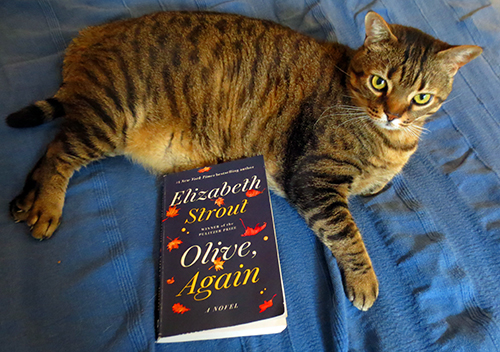
Volver the Cat with Book

My mom has always said that, when you become old, you become invisible as you’re no longer taken into consideration. So when I read Elizabeth Strout’s Olive, Again where the book’s protagonist says the same thing, I immediately thought of my mom. And the consequences of living a long life.

Olive, Again, a series of vignettes, evolves around the inhabitants of a small town in Maine. Olive, a crusty and unapologetic elderly woman, is the fil rouge that glues all the stories together. Although we have much in common with others, there is, says Olive, no simple truth about human existence. We all struggle because that’s the way life is and there’s nothing we can do about it.

The book focuses on growing old. Thus getting closer to death. Written in a matter of fact sort of way, it forced me to make certain reflections regarding my own life.

Age transforms you physically and mentally. Life expectancy continues to expand but, unfortunately, quality of life isn’t always compatible with this expansion. For example, the number of those affected b dementia continues to grow.

The thing about dementia really scares me. You spend all those years collecting memories only to forget so much—including important things like the people you most love. We can keep the body alive but not memories. And without our memories, a part of us dies.

Epilogue: Nothing is more democratic than death.

-30-

Things to do: make a “Good Memories” book for the self.

Posted in Books, Lifestyle, storytelling | Tagged , , , , , | 2 Comments

Placement

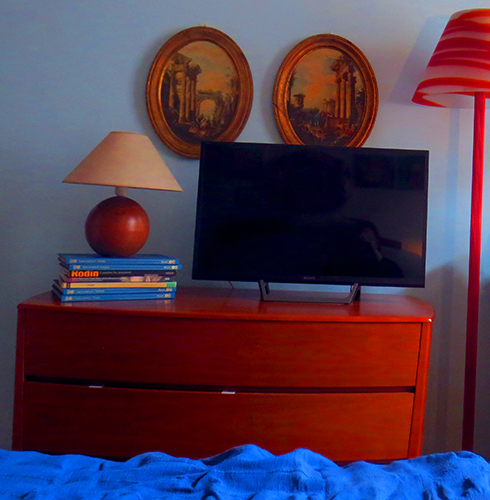
While shuffling stuff around to make space for painting the bedroom, unexpected compositions were made. Objects from one side of the room and objects from another side suddenly found themselves together. New interrelations were formed. In one such interrelation, the objects looked posed and rigid. It made me think of Wes Anderson’s staged compositions that are always slightly melancholic.

An object can be totally transformed by its setting. Just like people.

Epilogue: We are all pieces of a puzzle trying to fit together and find our place.

-30-

Related: How Wes Anderson Created the Aesthetic of a Generation

Posted in Art Narratives | Tagged , | 1 Comment

The Mended Curb

What is beauty if not that which gives our senses pleasure?

In 1904, George Santayana wrote his mentor, William James, about the aesthetic experience and its need to be stimulated. But unfortunately, writes Santayana, “one gets so dry in America with no food for the senses, especially if one is obliged to pump up theory every day.”

Santayana criticized the scientific community for their insistence on reducing aesthetics to just theory as his concern was not with creating a definition of beauty but, instead, of focusing on those conditions necessary to perceive beauty.  

mended

On via Tagliamento, there’s a curb that’s been repaired with sampietrini, the Roman cobblestone that once covered all the streets of Rome. Asphalt has replaced the sampietrini in terms of practicality but it cannot compete with the stone’s aesthetics—both visual and historical. Nevertheless, every time I reach that curb, I stop to look because reparation is a form of beauty.

Plus I like how geometric stones have been forced to adapt to a curve. And how the rebellious grass that, refusing to be obliterated by urban demands, grows in between the cracks. The mended curb gives me pleasure every time I step on it. For me it is beautiful. However, there are those who would not agree with me at all.

Epilogue: Beauty does not reside in an object but, instead, in the individual’s sense of beauty.

-30-

Related: The Aesthetics of Mending. + Sampietrini: the story of Rome’s iconic cobblestones + The Sense of Beauty pdf

Posted in Beauty, Mend & Repair, Rome/Italy | Tagged , , | 1 Comment

Budding Eyes

The other morning I had many errands to run. Luckily everything I needed to do could be done in our neighbourhood giving me the opportunity to take a nice long walk.

Since painting my bedroom walls, I have a new mission—that of focusing on the beauty that’s out there just waiting to be noticed. And I ask myself if it’s possible that someone can rewire their brain by simply ignoring what’s ugly and mentally surrounding the self with beauty?

On a street intersecting with Corso Trieste, there’s a building covered with naked windows save for one dressed in fuchsia cyclamens. Initially, I simply walked past the flowers thinking how pretty they were. Then, BOOM! George Santayana’s ghost jumped out in front of me and said: “Where are you going? I thought you wanted to experience everyday beauty.” So I quickly turned around and returned to the cyclamens. Then, standing in front of them, I began to observe the flowers as if they were a painting in a museum.

The cyclamen was one of Leonardo da Vinci’s favorite flowers and he used to draw them in the margins of his books. Dormant during the summer, the cyclamen wakes up during the autumn, dances its way through the winter then, exhausted, returns to its seasonal hibernation.

Epilogue: Don’t ignore beauty or it will ignore you.

-30-

Posted in Beauty, Rome/Italy | Tagged , , , | Leave a comment

Santayana’s Sense of Beauty

My studio is near Rome’s Verano Monumental Cemetery. The “monumental” refers to the numerous monuments honouring the deceased within the cemetery’s walls. Verano is often referred to as “un museo all’aperto”—an open air museum full of sculptures. But it’s also a smorgasboard of applied arts such as mosaics, stained glass, wrought-iron ornamentation, and bas-relief decorations.

Verano, although within the city limits, is an ocean of melancholy cypress trees hoovering over the departed. A few years ago I was so enthralled by the magic of Verano that I used to go there on the average of once a week. Totally mesmerized, I would walk for hours around taking notes and photos. Because walking around Verano is like taking a tour of Italian history and culture.

It was on one of those many walks that I became better acquainted with George Santayana (18863-1952) best known for his aphorism “Those who cannot remember the past are condemned to repeat it.” The Spanish philosopher is buried at Verano in an area known as the Panteon de la Obra Pia Espanola, burial space for Spaniards of interest who died in Rome.

George Santayana

The Panteon was designed by the Spanish architect, Javier Carvajal Ferrer, in 1955 when he was studying at the Academy of Fine Art in Rome. Carvajal, founder of Brutalist architecture which was bery formal and rational, used much cement, travertine, and black steel grating for the construction of the Panteon.

While teaching at Harvard, Santayana, always under pressure to publish something, the university let him know that “through ladies that I had better publish a book…on at of course. So I wrote this wretched potboiler.” The “wretched potboiler” was published in 1886 and entitled The Sense of Beauty.

Beauty is about emotion as it gives us pleasure. Beauty, therefore, is not found in an object but, instead, in the human experience. Beauty can’t be described in words. Because, to grasp its meaning, you must feel it on your skin.

and the painting continues…

-30-

Related: Verano Monumental Cemetery + George Santayana (1863-1952)

Other:  The Sense of Beauty Quotes by George Santayana + read THE SENSE OF BEAUTY on archive HERE.

Posted in Beauty, Books, Rome/Italy, Verano Monumental Cemetery | Tagged , , , | 1 Comment