Rocket Man

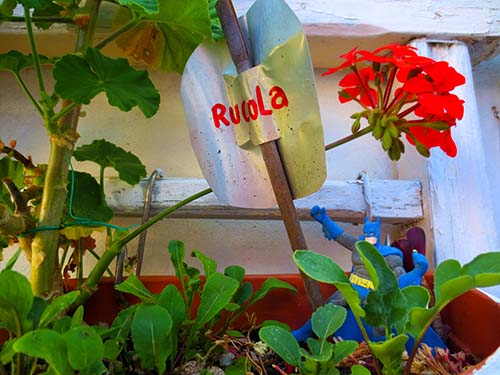
Rucola at La Sussurrata

Several years ago, I posted about Vigilant Things and the use of everyday objects, by the Yoruba of Nigeria, to create talismans. These talismans are known as aale and they are meant to warn someone with bad intentions to stay away.  Well, I’ve got some slugs that are annoying my rocket plants so I decided to create an aale of my own.  A Batman found on the beach said he was willing  to help and,  hopefully, use his superpowers to keep the slugs & Co  away.  Update to follow.

drawing

Posted in Plants & Gardening | Tagged , , , , , , , , | 2 Comments

Gaudy Gods

Artemis and Me

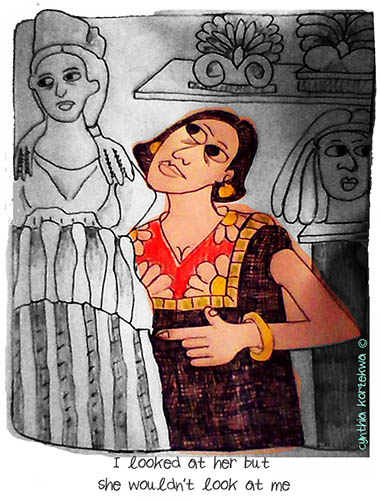
In the Archeological Museum of Paros, there is a statue of Artemis from her sanctuary at the Parian Delion. It’s dated 360 BC and was discovered in 1899. And, like most all of the Greek statues I’ve seen, it’s white.

When thinking of classical antiquity, neon white marble generally comes to mind. But ancient Greek statues were actually polychrome and the color stripped away by time. Some of these statues were discovered during the Renaissance and were, obviously, colorless and white.  So Michelangelo and his contemporaries just assumed that the statues had been white all along. Thus Neo-Classical aesthetics were based on wrong assumptions. Art historian Johann Joachim Winckelmann helped to perpetuated this myth.  He wrote: “The whiter the body is, the more beautiful it is as well.” Later on, some art historians claimed that the statues were originally painted and, subsequently, were treated as quacky eccentrics.

In the exhibition “Gods in Color”, German archaeologist Vinzenz Brinkmann presents vividly painted plaster copies of famous statues to show how they were intended to be. Many people have difficulties accepting the color because, for many, white is elegant but color is kitsch. However, say Brinkmann, color gave the statues vitality and an erotic energy that the Greeks were seeking.

Sometimes, because we’ve based our ideas on misconceptions, we are not only disorientated by the truth but regard it with hostility. When paradigms are pulverized, we lose our balance. We prefer to continue with our old beliefs because it’s a stress to reconfigure mental habits.

The earth is still flat.

drawing

Related: True Colors…Archaeologist Vinzenz Brinkmann’s colored reproductions of ancient Greek sculptures +  Archaeological Museum of Paros + Black Athena by Martin Bernal

Posted in Beauty, Drawings & Paintings, Paros, THE DIARY OF LUZ CORRAZZINI | Tagged , , , , , , , | Leave a comment

Propagation

Clippings

I collect clippings.  Some are from my neighbors but most are secretly stolen from plants I see when taking walks….SNIP SNIP SNIP.  Maybe it is A Very Naughty Thing to do.  But I prefer to see it as a way of spreading beauty and joy.

The clippings are then placed in jars of water and kept on the front porch until they start to root. At present I’m rooting basil, sage, mint, honeysuckle, bougainvillea, pomegranate and jasmine.

The propagation of beauty shouldn’t be limited just to plants.

Smiles are like clippings that cultivate goodwill. The more you smile, the more others will smile in return.

So let’s take a walk in a garden of smiles!

drawing

Related: Bebina Bunny: Aphorism #1    +    The Untapped Power Of Smiling

Posted in Beauty, Health & Healing, Paros, Plants & Gardening | Tagged , , , , | 3 Comments

Apricots and Amaretto

Apricots and their Seeds

Apricot season has begun and my neighbor’s tree is full of fruit. We save the seeds so we can crack them open for the kernels that we then crush and add to sugar cookie dough. The famous Italian amaretto liquer and cookies are  made using these kernels. Apricot kernels are also used in soaps.

There is controversy as to the dangers of eating apricot kernels.  They contain amygdalin that can cause cyanide poisoning.  But research also indicates that the kernels help fight cancer.

As always, moderation is the rule.  So, with some self-restraint, we will continue to eat our amaretto style cookies!

drawing

Posted in Health & Healing, Paros | Tagged , , , | 4 Comments

Critique Sheet #4 The Decisive Moment

Ζωοδόχου Πηγής

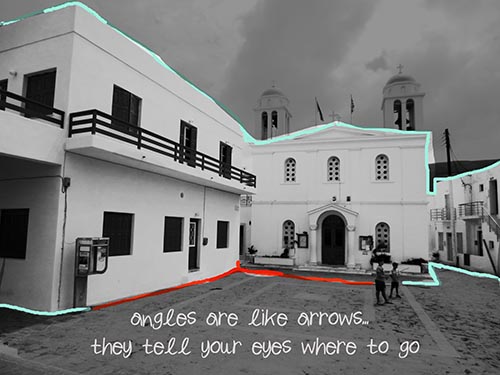
Identification of the Moment: in front of the Church Ζωοδόχου Πηγής (Zoodocho Piyis) in Parikia, Paros; May 2017

Description: a desaturated colored digital photograph of the church that faces the beach of Kato Yialo empty save for two children walking by.

Analysis: compared to color, black and white photographs facilitate concentrating on form and composition.  Because color demands a lot of attention.

Ζωοδόχου Πηγής

Interpretation: desaturation of the foto brought Henri Cartier-Bresson to mind as his photos were often of  people within a strong architectural context. Man made geometry has no meaning if it doesn’t include man himself.

Conclusion: like Cartier-Bresson, we need to select those Decisive Moments worth preserving  and, photographing them with our mind, help them last forever.

drawing

for more CRIITIQUE SHEETS
related: Iconic Photographer Henri Cartier-Bresson Takes You Inside His Creative World + Cartier-Bresson, Decisive Moments Catalogue + The Decisive Moment Article in International Journal of Applied Psychoanalytic Studies by John Suler · December 2012
Posted in THE DIARY OF LUZ CORRAZZINI | Tagged , , | 2 Comments