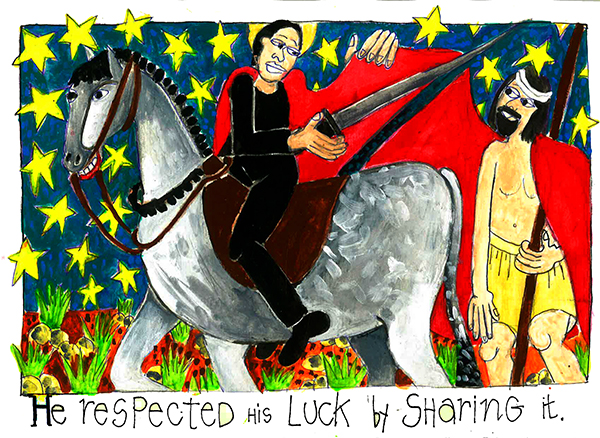
One extremely cold winter’s day in the year 335, Marin was doing his duty as a young soldier in the Roman army when he saw a beggar freezing from the cold. Without hesitation, Martin took his sword and with a big SWHISH sliced his cloak in half. He kept one half for himself and gave the other half to the beggar. Instead of using the sword to destroy a life, Martin had used it to save a life.
That night Jesus came to Martin wearing the cloak and said: “What you did for that poor man, you did for me as well.” And thanks to his generosity to someone less fortunate than himself, Martin became a saint.
St. Martin’s cloak became a popular theme in religious art.
After the conversion of Emperor Constantine, Romans were more or less forced to convert to Christianity, too.
Martin, born in what is now Hungary, was forced to join the calvary at the age of 15 and served for nearly two years after his baptism.
The Roman Empire, addicted to expansion and wealth, wanted Britain’s tin and the land that went with it. In 54 BC, Julius Caesar invaded Britain. The locals were not prepared for such an overwhelming military force. Britain at the time was full of small kingdoms. To avoid conflict and loss, many leaders became “client kings”. That is, in exchange for their loyalty to Rome, the kings would be permitted to maintain some degree of sovereignty. Accommodating client kings generally became wealthy making this compromise all the easier to accept. This form of governing went on for almost 100 years. But that all changed in 60 AD.
Claudius became Roman emperor in 41 AD. He was physically awkward as he limped and had difficulties hearing. Romans liked their men to be macho so the wimpy Claudius was snubbed by his contemporaries. That is, until Caligula was assassinated. Claudius, the only adult male remaining in the family, became Emperor. Despite being an efficient administrator, Claudius had enemies including his wife (and niece), Agrippina the Younger, who was also the sister of Caligula and the mother of Nero.
After their marriage, Claudius adopted Nero as his son. Big mistake. Once Agrippina moved into the palace, she took over. Her deleterious relationship with power convinced her to feed her husband poisonous mushrooms so her son, Nero, could become emperor.
In 54 AD at the age of 16, Nero became Emperor of the Roman Empire. Although he had little interest in ruling the empire, he had much interest in spending the Empire’s money.
Momma Agrippina was just as greedy as her son. And just as sleezy. She had a libido out of whack having sexual relationships with her uncle, her brother, and her son. Agrippina used sex as a means of maintaining control. But Nero grew tired of his mom’s interference so he had her killed.
Nero and Agrippina
In 60 AD, Prasutagus, king of the Celtic tribe, Iceni, died. He’d been a client king and, hoping to avoid conflict for his people, he declared that his daughters, along with Nero, would rule the Iceni. But Nero, a greedy spendthrift, decided he wanted all of Prasutagus’ wealth and property. He did not honor the terms of Prasutagus’ will and, instead, Nero sent Roman soldiers to take charge of Prasutagus’ patrimony. And as they pillage and plundered, the Romans also stripped and flogged Boudica, wife of Prasutagus and Queen of the Iceni before raping her daughters.
Now Boudica was a mom. Not a mom like Agrippina but a normal mom who was bound to protecting and defending her children. The violence and humilation her daughters had been subjected to gave her a super power she vowed to use to destroy the Romans and their allies. After uniting the other Celtic tribes to make a passionate speech about the need to reappropriate themselves of their own territory and their own culture, Boudica declared war on the Romans.
Fueled by a mother’s rage, Boudica led her troops to victory, successfully razing to the ground three major Roman controlled towns (including modern-day London). Not only had the Romans been humiliated, they’d been humiliated by a woman. Nero foamed at the mouth while ordering the Roman governor of Britain, Suetonius Paulinus, to obliterate Boudica and her people.
The Romans were brutal and destroyed everything they could. Boudica, seeing her defeat, reacted like Cleopatra. She and her daughters drank a poisoned cocktail because they knew it was better to be dead than to be a prisoner of the Roman army.
In The Gallic Wars, Caesar wrote that the Druids concerned themselves with all things sacred as well as in settling disputes decreeing both rewards and punishments. There were various groups of Druids each group having its own leader.
All Druids were Celts but not all Celts were Druids.
Most of what is known about the Druids comes from the Romans. The Romans were keen on writing the history for themselves and others. Because it was also a form of propaganda. The Druids were literate, but it was against their religion to write down the knowledge meant only for priests and sacred scholars. The Druid need for secrecy is reminiscent of the Eleusinian mysteries.
There were three categories of Druids: Druids the philosophers, Ovates the healers/seerers, and Bards the singers/storytellers.
Many of the Bards lived in Wales. So is it any wonder that the Welsh have an excellent choir tradition? Or any wonder that Tom Jones is from Wales?
“The relation between what we see and what we know is never settled.” John Berger
Simply looking at a great work of art is not always enough. We often feel the primordial need to possess it in some way. And the cheapest way of doing so is by being photographed with it.
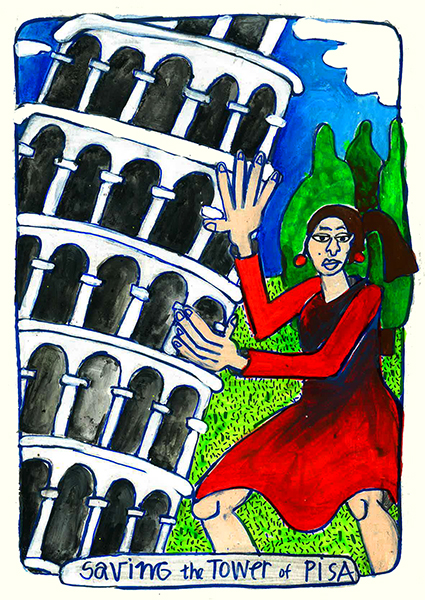
In Pisa, it’s almost mandatory to have a photo taken of yourself in such a way as to appear as if you are holding up the tower. Who doesn’t want to be a hero?
They felt like screaming so they did. Apparently, it is a big thing to take a photo of the self in front of Munch’s The Scream screaming (as can be seen HERE).
Thinking is for thinkers.
Rodin’s Thinker also inspires many ekphrastic photos. Even Robin Williams couldn’t resist as seen HERE once at the Rodin Museum.
Flashing in front of The Artist And His School by Arthur Siebelist. To keep the boys alert, sometimes you just have to flash back.
A photo of a little girl dancing in front of a woman dancing made the internet rounds for some time.
Art inspires imagination and imitation.
This is a photo I took years ago. It is of a young boy on the floor drawing one of Rodin’s statues at the artist’s museum in Paris.
Picnics are not just for parks. It was once trendy to have them in cemeteries.
Here’s a photo of a small group picnickers sitting on flat tombstones at St. Luke’s Ancient Cemetery. (photo via HISTORIC ST. LUKE’S)
Atlas Obscura provides an interesting article HERE citing how one reason people had picnics there is because many cities lacked parks and/or public green space to provide an alternative. Plus it provided a place for family get togethers where the deceased in the family could participate as well.
Detective Barbara Havers made a mistake and now seeks redemption. A lead on a Cambridge murder gives Barbara a chance to make amends and she goes for it. Elizabeth George writes all about it in her crime novel, A Banquet of Consequences. She appropriated the title from R. L. Stevenson’s famous quote “Sooner or later everyone sits down to a banquet of consequences.” The idea is much the same as “A man reaps what he sows” (Galatians 6:7) In other words, our lives are the cumulative result of all the choices we’ve made.
And we spend our days sowing, reaping, and gleaning.
A review of Elizabeth George’s A Banquet of ConsequencesREVIEW








 The Narrative Within
.jpg)