The Longstone Lighthouse, located on one of the Farne Islands, was built in 1826. In 1838 a paddle steamer crashed off the Northumberland coast. From her bedroom window, Grace Darling, the lighthouse keeper’s daughter, could see the wreck and some of its survivors on a nearby rocky island. Grace and her father rowed out into the rough sea to rescue them.
Grace Darling
News of Grace’s bravery reached the newspapers. Overnight she became a national hero. Queen Victoria praised her and artists from all over England sailed to the lighthouse island hoping to paint her portrait. Other admirers sent money and gifts. But life on a pedestal did not last long for Grace. Just a few years later, she died of tuberculosis. Grace was only 26 years old. The Heroine of the Farne Islands was now a part of national mythology.
Heroes are important in a society. They act as inspiration and as examples in overcoming adversity. They help glorify man and thus elevate the human spirit. But most importantly, they give us hope. And what is hope if not belief in the future?
Heroes inspire us to be heroes, too, even if just for one day.
Heroes are also useful for propaganda. Propaganda has been utilized throughout history to move the minds of the masses in a particular direction.
During the 1930s, Germans made many Nazi propaganda films. The most notable were those directed by Leni Riefenstahl. Mussolini had the Cinecittà* movie studios constructed just for the sake of promoting Fascist ideals. The British government, realizing that it needed a psychological commitment on the part of its citizens, began orchestrating their own propaganda. In her novel, The Finest Hour and a Half, Lissa Evans affronts this need.
It’s 1940 and France has fallen to the Nazis. Bombs are falling on London and the people are frightened and confused. What is needed is a morale boosting movie to inspire courage. But also to attract American interest.
So the Brits decide to make propaganda films of their own. But the war has dislocated the movie industry’s top talents. Nevertheless, a film production company is improvised by the Ministry of Information. Part of this new milieu is Catrin Cole conscripted by the ministry to go from writing ads to writing dialogue for propaganda films.
Now all they needed was a “true” story on which to base their film. This need was met when news broke out about twin sisters, Lily and Rose Starling, who supposedly helped to evacuate soldiers fallen at Dunkirk. Their story was similar to that of Grace Darling and no doubt would move the public.
Catrin takes a long train ride to interview the sisters only to learn that they had never reached Dunkirk because their boat broke down. But the propaganda machine had already been set in motion. And, for her own survival, Catrin helped embellish a lie—propaganda is not about truth in as much as it’s about truth as we would like it to be.
Evans’ book evolves mainly around the comic absurdity of making a film in that way at that time and how war influences the actions and interactions of those involved.
The book gets its name from a speech by Winston Churchill known as “This was their finest hour”. It was June of 1940 and Churchill had been Prime Minister for just a little over a month. What he wanted to do with the speech was convince the brits of the need to continue the war and that there was a reasonable hope for victory. Furthermore, it was up to Britain to save the world. Because “if we can stand up to him, all Europe may be freed” otherwise the world “will sink into the abyss of a new Dark Ages…” that’s why the British must brace themselves to their duties then even a thousand years later of them will be said “this was their finest hour.”
We are all governed by propaganda in some way. Being an autonomous thinker can be very fatiguing. So we often seek narrations to refer to. Many groups (cultural, religious, political) are united by a common narration of reference. Many people are often united not by personal creeds but by common propaganda. Many people base their ideologies on convincing propaganda.
How many identities are formed not by personal thought but on just wanting to belong somewhere?
-30-
*After WWII, Cinecittà was used as a refugee camp. Then in the 1950s, because of its location and low production costs, it became popular with foreign film makers earning it the name of Hollywood on the Tiber.
During the summer when the nights are hot making sleep difficult, I often seek refuge in short stories. This week has been particularly blistering but the books available don’t match my mood. On internet I discovered Olga Tokarczuk, a Polish author who won the 2018 Nobel Prize for literature for “a narrative imagination that with encyclopedic passion represents the crossing of boundaries as a form of life.”
Her short story “Seams” was available gratis so I read it. It’s about B., a man whose wife died a few months before and is having difficulties shifting to his new reality.
While sitting on the toilet, he notices for the first time that his socks had “full-length seams, from the toes up through the insteps all the way to the cuffs.” The discovery irritates him as he’d never noticed the seams before. So he goes to his sock drawer to see if the other socks have seams, too. He pulls out sock after sock and they all have seams. That socks are not smooth but have seams leaves him overwhelmed and angry.
Later while bagging his groceries at the store (bread and a can of pasztet*) he can’t help but ask the manager about seams in socks. The manager, “a big, strong woman with very light-colored skin and well-defined eyebrows that were as thin as threads” tells him that all socks have seams otherwise how could they stay together. When, B. asks himself, had socks ceased to be seamless and smooth?
Once home he notices that his windows need cleaning, that his wife’s clothing is still hanging around everywhere, that he has stacks of TV guides that need to be thrown away. Maybe, thinks B., he needs “to kick off this year—years began in the spring, after all, not on some number on a calendar—with an act of cleansing, like a ritual bath.”
B. becomes aware that there are many things he has never noticed before like the ink from his pens was not blue but brown like the color of rotting leaves. And that postage stamps are no longer square but round. “Dentate, colorful, the size of a zloty coin.” He goes to check old mail and finds that all the ink is brown and all the stamps are round. He’s sure that he isn’t losing his mind. Was it simply that he hadn’t paid attention before?
With the excuse of giving away his deceased wife’s clothing, he goes to his neighbor, Stasia. She’s hesitant to accept the clothes but offers B. cake and tea anyway. But when B. starts talking about seams in socks, brown ink, and round stamps, she becomes quite uncomfortable.
Although Olga Torakczuk rejects being considered a magical realist, her novels use many characteristics of this genre. The setting is defined by the perceptions of the protagonist and rational reality is disrupted.
My friend Bonnie had an unpleasant and unloving relationship with her mom. So, when her mom died, Bonnie felt no particular grief. But one morning six months later, she woke up and looked around her room in disbelief. She realized that she was seeing the world in color for the first time since her mother’s death. Up until then she’d been seeing only in black and white without realizing it. Bonnie’s rational mind refused to mourn but her psyche was not as accommodating.
Inside us all are realities we keep hidden even to ourselves.
The other morning I feared for our bougainvillea. The fear was based on recent actions by people living nearby. It’s taken years of care to have it grow so large and lovely and the idea that its beauty could be harmed put me in a foul mood. The bougainvillea is like a loyal friend who gives solace and pleasure because that’s what beauty does.
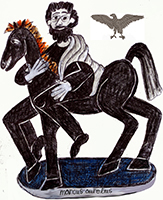
Not knowing how to respond to this fear, I went straight to Marcus Aurelius for advice. And found it: “Be like the rocky headland on which the waves constantly break. It stands firm, and round it the seething waters are laid to rest.” (Meditations 4:49)
The visualization of someone as a wave shattered into a mist of foam* just by my presence gave me much delight. So much so that I immediately felt better and tranquilly went on with my day.
Habits and routines can be very helpful. They can make us more efficient and thus save much stress. But life is not static. Certain changes in life can make our habits not only obsolete but counterproductive.
Habitual thought patterns can get us stuck in a rut. We move and wear ourselves out but without going anywhere.
Marcus Aurelius writes: “that all is as thinking makes it so” (Meditations, Book 12:22). In other words, we are our thoughts and these thoughts construct the world we live in.
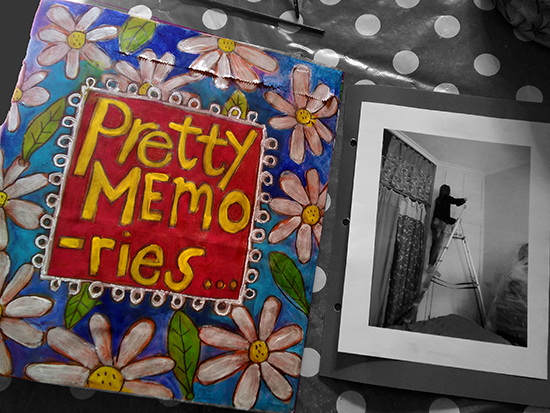
News of world events as well as personal situations can make it easy get stuck in a negative mental loop. That’s why I’ve started Pretty Memories, a catalogue of photos representing special moments to help remind me that my life is full of wonderful things and that’s where my thoughts should be focused.
“Your mind will take on the character of your most frequent thoughts; souls are dyed by thought.” (Book 5:16)








 The Narrative Within