Empathy and Evolution (part 3)

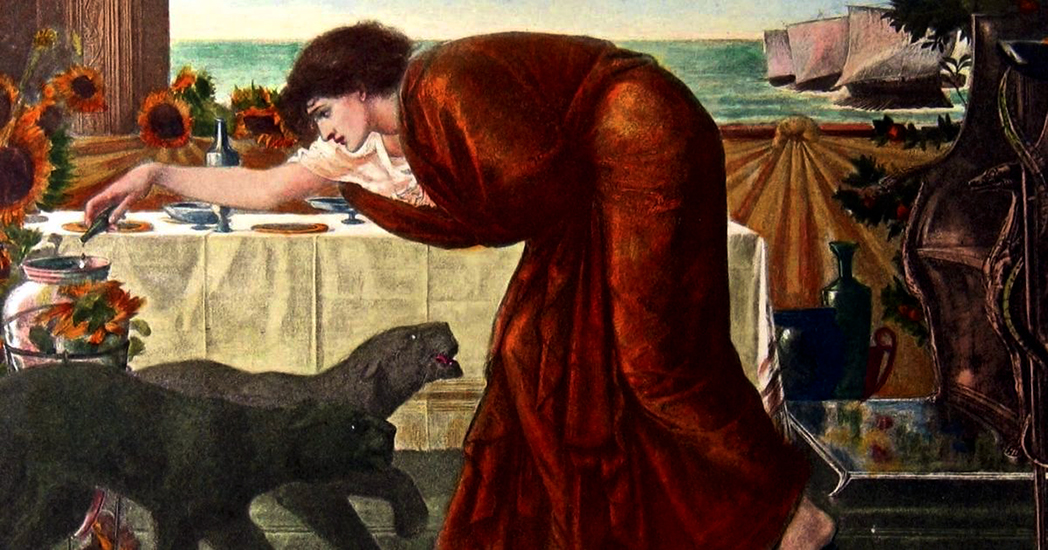
Circe becomes a mortal:

To better understand the gods, it’s important to keep in mind that they are immortal and, after thousands of years of living the same life over and over again, they are bored and seek distractions. That’s why gods like novelty and begrudge those who annoy them.

Chronically restless, a bored divinity tries to keep himself entertained by interfering in the lives of mortals. As gods are self-referential, they are indifferent as to the harm they provoke.

Gods are Divinity Supremacists and want all the power for themselves. They are petty, vindictive, sadistic, and thrilled to torment those who help mortals in any way.

When still a young girl, Circe saw her uncle, Prometheus, being whipped then chained to a rock where an eagle came every day to rip out his liver. His crime? He gave fire to mortals so othey could evolve. This made the gods furious because they wanted to keep humans in a state of fear and misery making them more easily manipulated. The more mortals were powerless, the more powerful the gods were. It was then that Circe first began questioning the gods. Do they get satisfaction only by being cruel to the less fortunate. Are gods little more than privileged bullies?

Circe’s first love was the mortal, Glaucus. She loved him so much that she was willing to risk her father’s wrath by making him immortal. But after his transformation, Glaucus, instead of being loving and kind, treated Circe with contempt as now he had his eyes on the beautiful Scylla. The heartbroken Circe gave vent to her pain by using her powers to transform Scylla into a monster with twelve feet and six heads. But revenge had not made her feel better.

And now, once again in love with a mortal, Circe had no intention of repeating her previous mistake. To the contrary, she wanted to give up her own immortality so that she and Telemachus could grow old and live the rest of their lives together.

Immortality is not about happiness, it’s about power. Yet as a mortal, Circe had a power the gods didn’t have–the power of empathy.

Gods were born gods but it took millions of years for man to evolve into his present state. Empathy contributed greatly to this evolution.

Years ago a student asked anthropologist Margaret Mead what the earliest sign of civilization had been. After a brief hesitation she responded “a healed femur”.  The femur is the longest bone in the body and important for walking. If fractured, it takes weeks to heal. During prehistoric times, a person in such a condition could survive only had someone been there to care for him. In other words, helping another survive gave birth to civilization.*

Empathy is not just a form of compassion. It’s also a form of rational thought and decision making based on the capacity to understand the feelings of another. Women, being mothers, are more empathic than men. Empathy enables women to communicate with babies too small to speak and children too young to properly express their needs.

Empathy is a form of interrelating. And interrelating with others is fundamental for our survival. The study of man’s evolution shows us that we are more likely to survive if we work together. For this reason, in prehistoric times, it was important to belong to a clan. Every member of the clan was expected to contribute to the needs of the community. Who didn’t contribute was exiled. Exile was a kiss of death because surviving alone without the clan was impossible.

Circe and Penelope helped each other survive. Thanks to empathy, they were able to recognize themselves one in the other. This common recognition was the foundation on which they built their friendship.
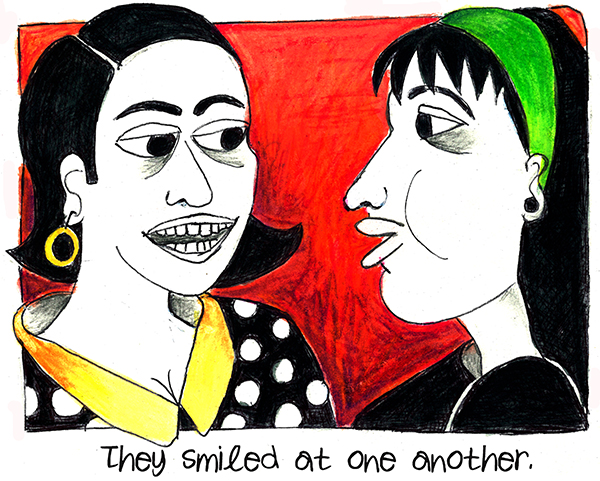
When you smile, empathy makes me smile, too. So please, smile as often as you can.

*Some scholars (male) claim Mead never made this affirmation. Whether or not she did doesn’t change the validity of such a consideration.

-30-
Posted in Books, female consciousness | Tagged , , , , , , , , , , , , , | 1 Comment

Empathy and Evolution (part 2)

Penelope’s story:

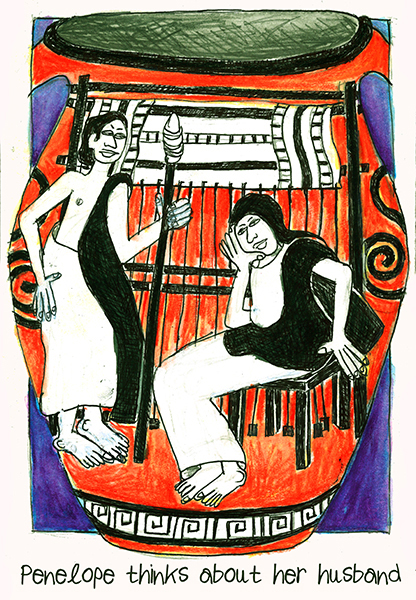
All my life there’s been a man around telling me what to do as if my only reason for existing was to fulfill his needs. Like my uncle who gave me away to some arrogant ugly man living on a boring little island. Then, once he’d collected his reward, my husband quite easily abandoned me and our child just to go off in search of glory. Could Odysseus or anyone else really believe that for 20 years I’d continue to be faithful to a man who preferred war to his family? That I’d think my life was so insignificant that I had nothing better to do than to weave and wait?

Then, ten years after the war had finished, everyone assumed Odysseus was dead since he hadn’t returned home. That’s when the vultures starting arriving. Although I was a queen, in a world of machos, women have no power.

At one point I had 108 suitors and decided the best way to manipulate them was by sleeping with all of them (obviously not simultaneously). It gave me a sense of balance because now my husband and I finally were on the same level—we were both unfaithful cheats.

And the whole story about me unravelling my tapestry every night just to be faithful to Odysseus was a joke. The only reason I held my suitors off was because I didn’t want another husband to sap me of my independence.

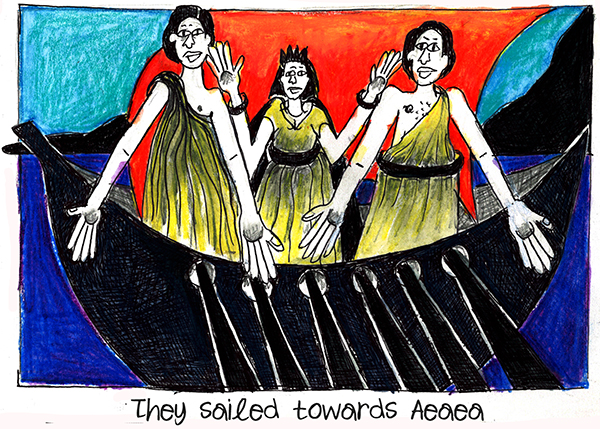
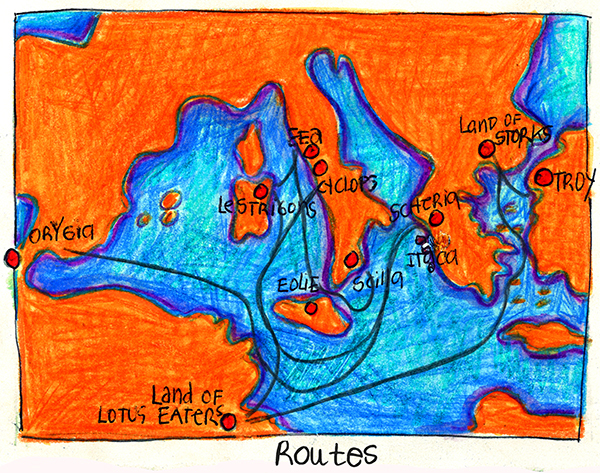
I knew Odysseus was still alive. I’d been instructed by the Moirai not to cut the threads from my weaving as it would also cut Odysseus’ life. He’d managed to survive all those dangerous adventures only because every day for 20 years I continued to weave, unravel, and reweave again the tapestry of his life. Only once he was back in Ithaca, Odysseus showed no joy nor gratitude in being reunited with his family. He was always belittling Telemachus saying that his son would never be the great man his father was.  And despite Odysseus’ being dismissive with me during the day, at night he demanded that I fulfil his petty sexual needs. He was a lousy lover and maybe that’s why, jealous of my suitors, he had them all killed leaving their blood everywhere. And in his typical way, instead of cleaning up his own mess, Odysseus had my maids do the cleaning for him. His lack of respect for others totally disgusted me. So I stopped weaving and cut my threads. A few days later Oysseus died. I didn’t feel at all guilty but I understood that, thanks to the vultures, my life was now in danger. And, since everyone wanted to believe that Telegonus was responsible for Odysseus’ death, his life was in danger, too. Telegonus, Telemachus, and I had no choice but to sail towards Aeaea, Circe’s island.

Circe was relieved to see her son alive. And, although hesitant at first, Circe welcomed Telemachus and me. Having lived with Odysseus for a year and having been a victim herself of his ego and rage, she knew exactly the pain my heart had born.

Thanks to Circe’s magic, Aeaea was well protected so for the first time in years I felt relaxed. Circe not only let me use the loom Daedalus had made for her, she also taught me much about the magic of plants. But the real magic came from Circe’s Synergy & Solidarity. For the first time in my life, I finally felt accepted as I was and that it was ok for me to be me.

When Circe understood that she was in love with my son and I understood that I was in love with her son, we had a long talk. Both our sons had been fathered by Odysseus and it seemed weird to be in love with the son of a man we’d slept with. But Circe said there could be no shame in loving for wasn’t love the greatest gift one being could give to another? Furthermore, wasn’t it some kind of divine justice that the man who’d broken our hearts had left behind sons to mend them?

Now, mended and reborn, we had a chance to live the life we’d always wanted to.

Athena, feeling guilty about all the damage she’d done to my family, offered Telegonus an empire in the west where the gods were trying to expand their kingdom. So Telegonus and I quickly married and headed towards the area now known as Italy. Here our son, Italos, was born.

Circe and Telemachus also wanted liberation from the past. My son had no desire to claim his father’s kingdom but, like his father, he wanted to travel. And Circe, oh my, she was no longer a witch but a kitten who loved to purr. For the first time in her life, thanks to my son, she experienced a man’s sincere love (this made me so proud to be his mom). Telemachus’ love meant more to her than being a goddess. That’s why she decided to do something revolutionary for a divinity. For the love of my son, Circe decided to give up her immortality.

Circe’s the best friend I’ve ever had. And the perfect wife for my son.

(to be continued)

-30-

Who were the Moirai, the Three Fates of Greek Mythology?

Posted in Books, female consciousness | Tagged , , , , , , , , , , , , , | Leave a comment

Empathy and Evolution (part 1)

The best way to live forever is in the hearts of others. Because to be physically immortal is wearisome and lonely. But to live in someone else’s heart is a form of eternal comfort.

In another life I lived in Tusculum, a lush lovely town in the Alban hills south of Rome. Surrounded by olive trees and vineyards, I spent much of my time growing plants for my beauty creams and medicinal concoctions—ilex for digestives, styrax for perfumes, and acanthus for my painful rheumatism.

Sometimes I would walk in the woods seeking new plants for my cures. It’s there that I first saw her. Although we’d never met, the weave of her cloak was her introduction. She was Penelope, Odysseus’ widow.

Although Penelope was discreet and kept to herself, everyone in town knew who she was. And not as the wife of a deceased hero but as the wife of Telegonus, son of Ulysses and Circe, and the mother of Italos, king of the Oennotrians.

It was an awkward situation as it was just the two of us there in the woods. I could hardly ignore her however, by the same token, it seemed a bit brash just to go up to her and start talking. But it was a useless worry as, once she saw me, she smiled and walked towards me. Introductions were made and then we easily talked about our mutual interest in plants and their magical properties.

After that Penelope and I would frequently search for plants together. And when the weather was cold and aggressive, we’d meet at her home or mine and, with a hot beverage, spend hours talking like we women love to do. That’s how I learned her story.

Penelope was a princess in Sparta as was her cousin, Helen. Helen was very beautiful and had many many suitors and Odysseus was one of them. Helen’s father, King Tyndareus, was a bit overwhelmed by the task of choosing among so many suitors afraid that the losers would rebel and seek revenge. So Odysseus suggested that all the suitors take a vow to protect Helen as well as the man she choose to marry. And (without knowing how her suitors’ vow would lead to the Trojan War) Helen picked Menelaus. Tyndareus, appreciative of Odysseus’ help, offered his niece, Penelope, as a reward.

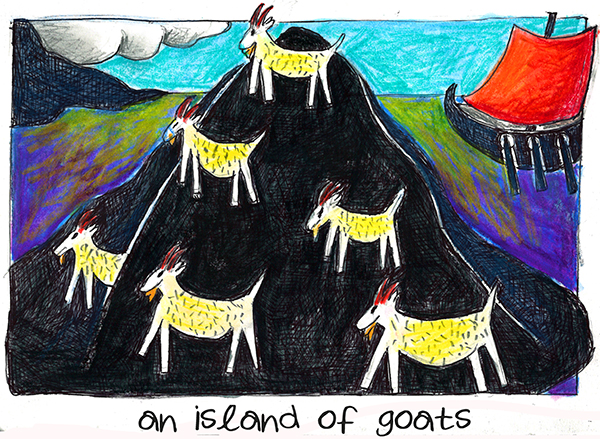
Despite being her husband’s second choice, Penelope tried very hard to be a good wife. She moved to Ithaca where Odysseus was king and tried her best to love him. But then Odysseus’ ego got in the way. When their son was just a baby, Odysseus, with dreams of becoming a glorious hero, joined Agamemnon’s crusade against Troy. He left Penelope to defend herself and their baby on Ithaca, a small, rugged island with more goats than arable land.

Ten years later the war with Troy was over but Odysseus was nowhere to be found. He’d been gone so long that everyone assumed he was dead so greedy suitors began bombarding Penelope with their proposals to take Odysseus’ place. Although Penelope was the Queen of Ithaca, she had little power to protect herself. To placate them, she agreed to marry once her work at the loom was finished.

So far everything that Penelope had told me was more or less the story I’d always heard. But one evening when we were drinking mead instead of tea, a totally new version of Odysseus’ story came out.

(to be continued)

-30-

Bibliography:

Graves, Robert. The White Goddess. Farrar, Straus and Giroux. NYC. 1948.

Walker, Barbara G. The Woman’s Encyclopedia of Myths and Secrets. Harper Collins Pub. NYC. 1983.

Related:  Circe’s Island Is Really about Reincarnation: An Allegorical Reading of Odyssey 10 + The Search for Homer’s Ithaca + Oath of TyndareusSpinning and Weaving in Ancient Greece + Absence and Presence of Human Interaction: The Relationship Between Loneliness and Empathy + The complexity of understanding others as the evolutionary origin of empathy and emotional contagion +

The birth of human compassion: Neanderthals ‘had feelings of sympathy and cared for others’ + human evolution + The birth of human compassion: Neanderthals ‘had feelings of sympathy and cared for others’ + The Evolution of Empathy: Learnings from Our Ancestors’ Decision to Work Together +

Empathy and Ecofeminism

Posted in Books, female consciousness, storytelling | Tagged , , , , , , , , , , , , , | Leave a comment

Circe’s Metamorphosis

for Fluffy mou

Every story has a point of view. Sometimes it is that of the narrator. Other times it’s that of the narrated upon.

The point of view most repeated is generally the point of view most believed. But repetition does not make it a fact.

A patriarchal society sustains the patriarchal point of view and, in doing so, obliterates a woman’s truth.

Women, tired of being silenced have, over time, attempted to voice their own truths despite the many obstacles. For what good is a voice if it can’t be used?

“Circe” by Madeline Miller

Many contemporary women writers are using their talents to bring women out of obscurity and to free them from culturally imposed muteness. Once such book is Madeline Miller’s Circe.

Circe is the daughter of the god Helios and the naiad Perse. Compared to her other siblings, Circe seems plain and boring so she’s largely ignored. Loneliness can mutilate one’s perception of themselves and Circe is no exception. She is so lonely that she keeps looking for love in all the wrong places. Despite knowing that it’s prohibited, Circe falls in love with a mortal. And to give her love story a chance, Circe decides to transform her mortal crush into an immortal man by using magic. Her father, like Zeus, is afraid of witchcraft as it challenges his own powers. So, with no concern for his daughter’s emotional needs, Helios banishes Circe to an uninhabited island.

Exiled and feeling more alone than ever, Circe struggles to survive and does so with the help of witchcraft.

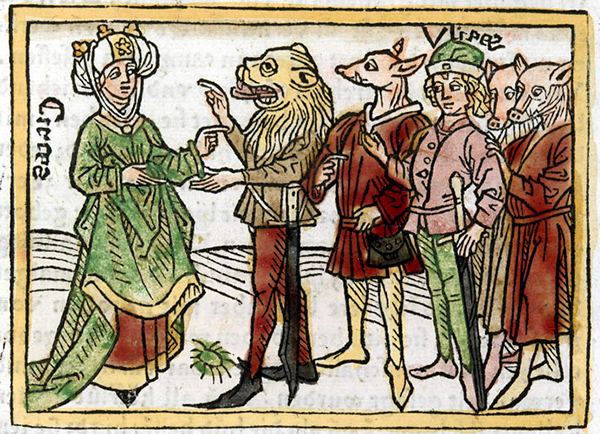
One day a ship full of sailors shows up on her shores. Circe gives them food and wine. Instead of gratitude, the captain rapes her and the sailors seek to steal whatever they can. Circe’s humiliation and despair is so great that she retaliates by using her magic to kill them. But, in doing so, she becomes more like them than like herself. Not wanting to destroy or to be destroyed, she no longer uses her magic to kill. But, if men prefer to behave like beasts, it’s only fitting that she transform them into pigs.

Boccaccio’s Circea

This concept of transformation, that is, metamorphosis, is a recurring theme in Greek mythology. Gods used it all the time. Zeus transformed himself into a swan in order to rape an unwilling Leda. Apollo lusted after Daphne so her father turned her into a tree. And when pirates kidnapped Dionysus to sell him as a slave, the angry god transformed them into dolphins.

“Leda and the Swan” by Paolo Veronese
“Apollo and Daphne” by Bernini
Dionysus and the Pirates

To transform others is a power but, even more powerful, is personal transformation via self-awareness.

‘The Wine of Circe’, 1900, by Edward Burne-Jone

“Humbling women seems to be a chief pastime of poets,” Circe says at one point. “As if there can be no story unless we crawl and weep.”

Tired of crawling, Circe understands she must gain control of her own life. And like every other woman, she must arrive at this self-knowledge by painful experience.

No longer willing to let patriarchal canons and its violent misogyny define her life, Circe begins to create her own narrative. And being a witch gives her more power than does being a goddess. Therefore, she is willing to work hard for this transformation.

What Circe has taught me:

You have to envision where you want to go because ideals are like a map and give you a direction.

We women need to create our own destiny. This means being willing to work hard and, when we fail, we must simply pick ourselves up and try again.

Stories shape reality. So chose the narrative you have of yourself wisely.

-30-

Related: Pompeii dig reveals erotic Leda and Swan fresco + Forms of Astonishment: Greek Myths of Metamorphosis + Circe by Madeline Miller review – Greek classic thrums with contemporary relevance +

Posted in art, Books, female consciousness, storytelling | Tagged , , , , , , , | 2 Comments

Marcus Aurelius writes to himself

These past two years have been a difficult chapter in my life. But now I’m writing a new one and looking for inspiration.

Many people, upon reaching a certain age, begin reflecting on their life and, subsequently, make an inventory of the things life has taught them. One of the best examples of such reflection is that of Marcus Aurelius. During the last ten years of his life, Marcus kept a journal exclusively for himself as if he were trying to create a “How to Behave in Life” guidebook. Much of what he wrote was written while he was busy with the Marcomannic Wars fought not far from the Danube. Although Roman, Marcus Aurelius wrote in Greek and the original title of this journal was “To Himself” (Στον εαυτο του) but in English it’s known as “Meditations” whereas in Italian it’s “Pensieri” (Thoughts).

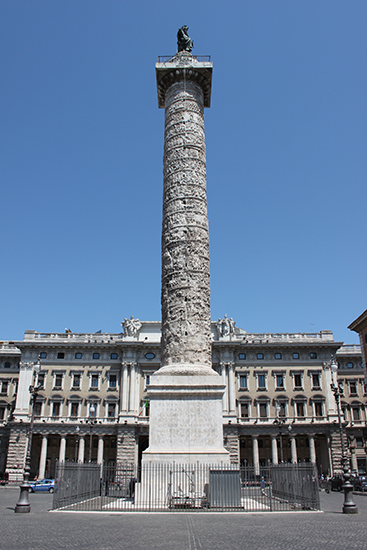
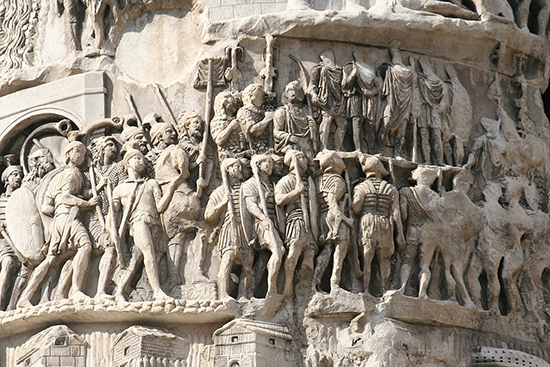
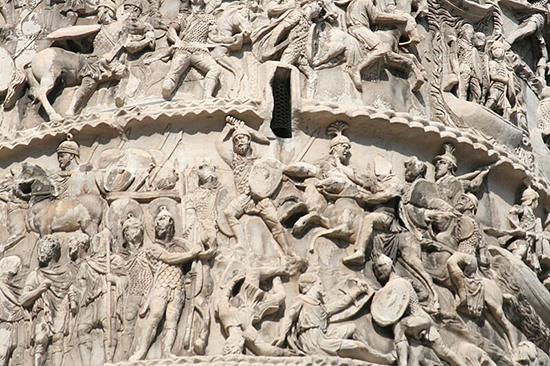
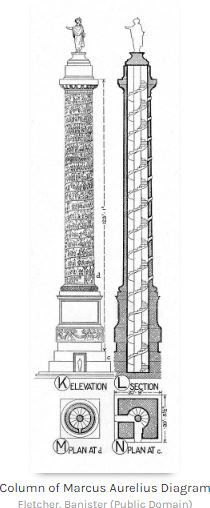
After the Romans won, to celebrate their victory, they erected a historiated column (colonna istoriata). A historiated column is a freestanding column decorated with spiralled figurative imagery that tells a story. In the middle of Piazza Colonna in Rome exists such a column erected between A.D. 176 and 193. It commemorates Marcus Aurelius’ greatest accomplishment—that of holding the empire together by defeating the invading Sarmatians and Marcomanni.

Marcus Aurelius Column
DETAIL, photos by Barosaurus Lentus
notice the openings the provided air and light for the interior part of the column

During the Middle Ages it was possible to enter the column and climb the internal spiral stairs to the top. However, today the column can only be seen from the outside.

Photos via Wikipedia

-30-

Related: Eugen Petersen’s photographs of the Column of Marcus Aurelius +  Column of Marcus Aurelius in Rome + The “Columnae Coc(h)lides” of Trajan and Marcus Aurelius on JSTOR + Colonna coclide + Rome, Column of Marcus Aurelius + Marcomannic Wars +

10 Stoic Choices You Can Make Today VIDEO

Posted in Books, Rome/Italy | Tagged , , , , , , , | 8 Comments