
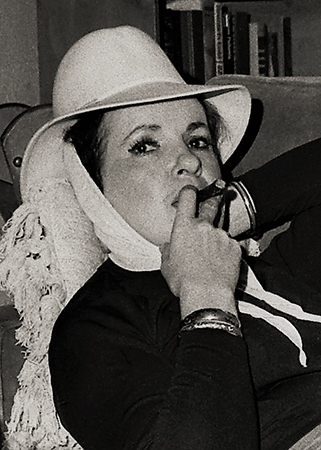
My mom grew up in the Ozarks. She believed that staying there would give her few possibilities in life. So she changed her condition of possibility by moving to San Antonio. Women at the time were raised to believe that their main objective as a woman was to find a husband. And my mom did only it didn’t work out. The brutal separation from my dad changed her attitude towards marriage and the traditional role society gave women. My mom understood that, despite her efforts, she wasn’t a conformist and no longer had any intention of becoming one.
Of course, in the late 1950s, being a divorcée with a small child to raise was a challenge. Even finding a place to live was difficult. My mom said that many many times she would try to rent a place for us to live only to be told “no pets or children allowed”. But my mom had a very strong survivor instinct. Despite all her struggles, I never missed a meal, always a clean bed to sleep in, and wore the loveliest of clothes.
I don’t know how they met but my mom and Gloria became so close that they considered themselves sisters. I used to call Gloria “Aunt Gloria” and Gloria’s kids called my mom “Aunt Toni”.
Aunt Gloria came from a Mexican culture and shared her love of Mexican music with my mom. The two “sisters” would often sit in the living room with the music blaring singing their hearts out as if it could help them exorcize their sadness.
Ray Charles said that he got involved with country music because it had a story to tell. Well, the lyrics to Mexican music are more than a story—they’re a telenovela! And as my mom sang along, she became the star.
I was not with my mom when she died…a sorrow I will carry within for the rest of my life. Mercifully, Dr. Salinas was there in the room with her. Together they were listening to her favorite singer, Chavela Vargas. When I told him that my mom’s theme song was “Echame a mi la culpa”, he put it on immediately and sang along while standing next to her bed. My mom, too weak to talk, attempted to move her mouth as if singing. She died a few hours later.
It had never occurred to me until then as to why my mom was so attached to this song. But really, all I had to do was listen to the lyrics. It was easy to imagine my mom saying these words to the man who’d broken her heart because of all the horrible things he’d done to her. Nevertheless, she wanted him to be happy so, when friends asked why they’d split,she told him he could blame her instead of revealing what a jerk he’d been:
Échame a mí la culpa
De lo que pase
Cúbrete tú la espalda
Con mi dolor
“Cover your back with my pain” is a pretty heavy duty phrase, no?
Below is a post from a few years ago:

If you’re going to suffer, sing about it. This is what Mexican rancheras have taught me. And no one respected this philosophy more than Chavela Vargas.
Ranchera songs are populated by the broken hearted who go to cantinas to drink away their sorrows. This music was traditionally dominated by men until Chavela elbowed her way in to make space for las borracheras, women who could drown in alcohol as easily as men could. And before criticizing these tequila drinking mujeres, it should be noted that Chavela & Co came from pre-feminists times. This Cantina Solution was a reply to conformity and fake respectability. Drinking like men suggested a form of emancipation.

Chavela Vargas was born in Costa Rica but moved to Mexico at the age of 14 where she sang in the streets until she got gigs in cantinas. Here she made no secret of her sexuality and was known as a cigar smoking, heavy drinking womanizer. Chavela sang in cantinas for years until she was discovered by singer and songwriter extraordinaire José Alfredo Jiménez.
Jiménez did not play a musical instrument and knew little about musical technicalities but he wrote over 1,000 songs many of which are still well-know today. Together, Jiménez and Chavela turned pathos into poetry.
Chavela felt at home with Jiménez’ songs. Take, for example, En El Último Trago where the singer asks an ex-lover to drink together until oblivion. Because:
The time hasn’t taught me anything,
I always make the same mistakes,
I drink again and again with strangers
and mourn because of the same sorrows.
Once her career took off, Chavela came in contact with a new milieu. She became friends with Diego Rivera and Frida Kahlo and was often their house guest. It’s also rumored that Chavela and Frida had an affair together. Besides, Frida liked to wear huipiles, Chavela ponchos. If you saw the movie Frida, you can’t help but remember Chavela singing La Llorona.
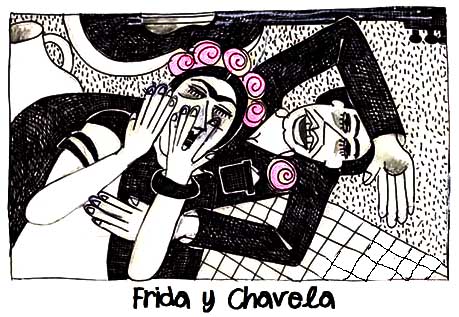
But the Cantina Solution caught up with Chavela. She became a major alcoholic and, during the 1970s, gave up singing. But almost 20 years later, at the age of 81, Chavela returned to the stage. She debuted at a sold-out Carnegie Hall at the age of 83. After each song, she was rewarded with a standing ovation. The audience could not have enough of her. In the words of Pedro Almodóvar, Chavela made of abandonment and desolation a cathedral in which we all found a place.
The Spanish poet, Federico García Lorca, was one of Chavela’s passions. Unfortunately, García Lorca’s life was brief. In 1936, he died at the age of 38, assassinated during the Spanish Civil War.
In 1993, Chavela went to Spain and stayed in a room that once had belonged to García Lorca. Every day, she said, a yellow bird would come peck on the room’s window and she was sure the bird was the spirit of Lorca himself.

(Copyright © 2015 Cynthia Korzekwa. All Rights Reserved)

















 The Narrative Within