A Feminist Madonna

Orant Madonna & Son, Longovarda Monastery, Paros

It came as a surprise to learn that, for some early feminists, the Virgin Mary was a symbol of the feminine ideal. In Our Lady of Victorian Feminism: the Madonna in the work of Anna Jameson, Margaret Fuller, and George Eliot, author Kimberly Van Esveld Adams explains how Victorian feminists made considerable use of the Madonna to help empower women. In part thanks to the representations of Mary in art, the Virgin Mary was often presented as independent, powerful, and wise.

Anna Jameson (1794-1860) was born in Ireland but raised in England. Her father, a miniature portrait painter, taught his daughter basic art principals. At the age of 31, Anna married Robert Jameson but the marriage was an unhappy one. Jameson was emotionally aloof, prone to drink, and a whiner. Luckily, a book Anna had written previous to her marriage, The Diary of an Ennuyée, was published and launched Anna’s literary career creating a means for her to become economically independent. She wrote popular versions of the lives of queens and poets, accounts of her travels, and literary and art criticism.

As women at the time were not permitted to frequent universities, Anna was self-taught. Her scholarship was shaped in large part by her activism of behalf of women. In the late 1830s, Anna began visiting private art collections in the London area and taking notes. To help those without a background in art better understand paintings, Anna wrote a series of art related books.

Madonna of the Hat Rack, La Sussurrata (by Stavros of Plaka)

At a certain point in her studies, Anna began focusing on the Madonna. Although many scholars see the Marian tradition as extremely misogynist, Anna, as well as many early feminists, had another outlook. Christianity was the cult of Jesus who represented the highest form of manhood. However, a Godhead must be whole thus Mary, representing the highest form of womanhood, is Jesus’ counterpart. Like Jesus, Mary is both human and divine and the implication is that Mary and Jesus are equals and their roles are complementary. What can be more feminist than a man and a woman being equals?

Anna’s appreciation of Mary came from carefully studied paintings she saw in art galleries and not from religious indoctrination. For Anna, the worship of Mary and of the other mother-Goddesses who came before her is “an acknowledgement of a higher as well as gentler power than that of the strong hand and the might that makes the right.”
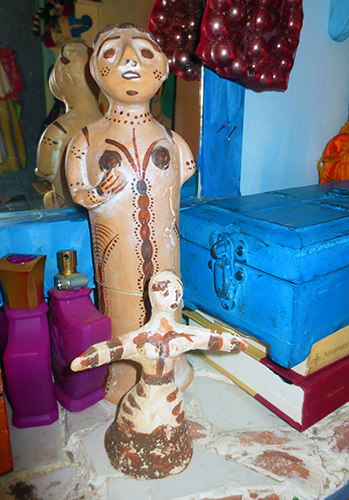
Cretan Goddesses on Paros

Mary was the Queen of Heaven and sat on a throne with a crown on her head. There was thus nothing docile or submissive about her although certain “motherly” traits are seen, by men, as being passive and accommodating. But compassion and care for another are anything but a sign of weakness. And this, for women, is empowering.

According to the Mariology of John Henry Newman, the fall of man was Adam’s and not Eve’s fault as Adam, not Eve, represented the human race. Eve, instead, is the “Mother of All Living” and had no fault other than that of satisfying Adam. Mankind, said Newman, had a second chance with Jesus as the new Adam and Mary as the new Eve. But Newman’s Mary, obedient, pure, and self-abnegating, is nothing at all like Anna’s Mary who is a merciful mother standing between humankind and an offended Father. She is not a shy cloistered virgin but the Queen of Heaven and ready to show it.

-30-

Bibliography:

Adams, Kimberly Van Esveld. Our Lady of Victorian Feminism: the Madonna in the work of Anna Jameson, Margaret Fuller, and George Eliot. Ohio University Press. Athens. 2001. Read on archive.org HERE.

Adams, Kimberly Van Esveld. “Feminine Godhead, Feminist Symbol: The Madonna in George Eliot, Ludwig Feuerbach, Anna Jameson, and Margaret Fuller”. Journal of Feminist Studies in Religion, Vol. 12, No. 1 (Spring, 1996), pp. 41-70 (30 pages). Published by: Indiana University Press on behalf of FSR, Inc. Read on JSTOR HERE.

Feuerbach, Ludwig. The Essence of Christianity. Harper. New York. 1957. Read on archive.org HERE.

Jameson, Anna. Legends of the Madonna. Houghton, Mifflin & Co., Cambridge. 1881. Read on Project Guttenberg HERE.

Thomas, Clara. Love and work enough; the life of Anna Jameson. University of Toronto Press. Toronto. 1967. Read on archive.org HERE.

Posted in Art Narratives, Conditions of Possibility, female consciousness | Tagged , , , , , , , , , , | 2 Comments

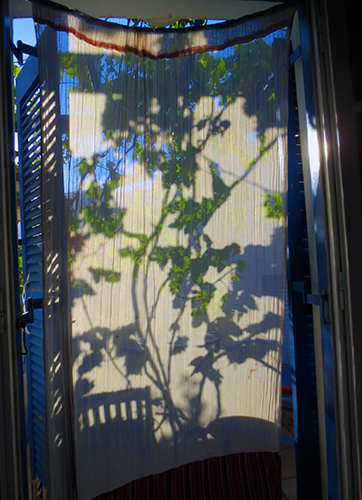
Shadow Decor


grapevine shadows on a breeze blown curtain

“Another good reason that we ought to leave blank, unvexed, and unencumbered with paper patterns the ceiling and the walls of a simple house is that the plain surface may be visited by the unique designs of shadows” writes Alice Meyhell. Of all her essays, “Shadows” is the one I’ve most enjoyed.

Alice suggests playing with shadows. Like putting long sedges and rushes in a vase so that their silhouette will be projected on the wall thanks to the light coming in from the windows providing a much better work of art than some cheap and trivial decoration bought in a shop.

“The shadow has all intricacies of perspective simply translated into line and intersecting curve, and pictorially presented to the eyes, not to the mind. The shadow knows nothing except its flat designs. It is single; it draws a decoration that was never seen before, and will never be seen again, and that, untouched, varies with the journey of the sun….”

And, if the day is grey and the sun doesn’t shine thus robbing your wall of sprinkled shadows, then keep a painting or a plaque in a closet ready to be whipped out to fill up the empty space.

shadow photographing shadows

Mixing and matching her observations on nature, art, literature, and human sentiment, Alice’s essays are like little “sermons of enlightenment” that, in the words of one critic, “discern self-evident things as yet undiscerned.”

Although a suffragist, Alice spares women no indulgence. The women in Goldsmith’s The Vicar of Wakefield are highly criticized. So is the Lady of Lyrics, the troubadour heroine, who, says Alice, has no more individuality than has the rose, her rival.

Alice also criticizes the poetry of George Crabbe (I had to look him up as I’d never heard of him) and says he will never measure up to Milton.

Motherhood subjects women to a life without boundaries and Alice uses the example of the letters French poet Marceline Valmore wrote to her daughter.

Habits can be lethal as shown by Tolstoi, a keen observer, who illustrates how certain habits can make someone hate you. “Anna Karenina, as she drank her coffee, knew that her sometime lover was dreading to hear her swallow it, and was hating the crooking of her little finger as she held her cup.”

Nature also plays a big role in Alice’s essays. She compares the greens of leaves in July and quips that the Romans, with the invention of aqueducts, made water their prisoner.

A precursor of grounding theories, Alice stresses the importance of walking barefoot outdoors. “If our feet are now so severed from the natural ground, they have inevitably lost life and strength by the separation. It is only the entirely unshod that have lively feet.”

And if you meet a mendicant on the streets, “obviously it is not easy to reply to begging except by the intelligible act of giving.”

As for rain, what else can it do if not fall? “The long stroke of the raindrop, which is the drop and its path at once, being our impression of a shower, shows us how certainly our impression is the effect of the lagging, and not the haste, of our senses.”

Personally, I find no flow in Alice’s writing style simply because Alice and I come from different times. Unlike myself, she lived well before TV, internet, and images of mass production when visuals were created with the sound of words.

Reading certain passages, I can imagine Alice sitting somewhere, observing her surroundings, and taking notes. Just looking at the world around her was like watching a movie. It was a DIY entertainment and contemplation was a marvellous pastime.

-30-

Related: In the Shade of a Tamarisk +Two Plants in a Pot + Shadows are Stalkers + Shadow people + When love leaves without you

Bibliography: Meynell, Alice. The Spirit of Place, and Other Essays. John Lane the Bodley Head. London and New York. 1890. Read on archive.org HERE

Posted in Art Narratives, Conditions of Possibility, female consciousness | Tagged , , , , , | Leave a comment

Remnants

Art for Housewives's avatarMuy Marcottage

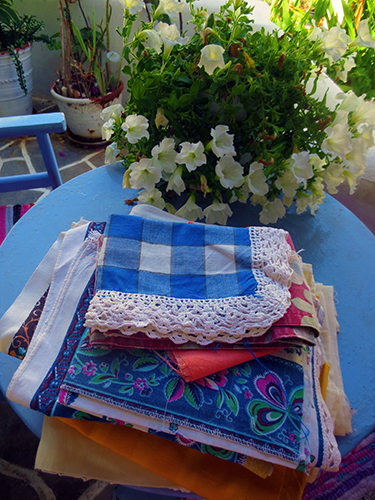
My friend Alexandra gave me a bag of remnants that she, in turn, had gotten from a friend. I was moved by how each piece of fabric had been washed, ironed, and folded. Such reverence for something most people would have simply thrown away. True abundance comes not from quantity but from appreciation.

View original post

Posted in Lifestyle, Living With Less, Mend & Repair, Paros | 2 Comments

Two Plants in a Pot

If you water one, you water the other.

As part of my research regarding women involved in the arts neglected by history, I continue to ready essays by Alice Meynell (1847-1922). However, reading Alice, I realize that the past is a foreign country. Reading 19th cen. English almost seems like reading another language. Save for a few phrases such as “saucy jades”, “humble cumdumble”, “she tells thumpers” and “as tame as a clout”, the language itself is comprehensible. It is how it’s structured that sometimes confuses me.

In her essay “Mrs. Dingley”, Alice expresses her dismay as to how Mrs Dingley has been treated. Who is Mrs. Dingley? And what is this treatment that bothers Alice so much?

Jonathan Swift, author of Gulliver’s Travels (1726), tutored the young Esther Johnson in reading and writing. Impressed by her wit and charm, upon the death of her guardian, Swift encouraged Esther to move to Dublin where he was from. So Esther moved to Ireland along with her friend Rebecca Dingley. Swift spend much time with the two women and would write letters to both of them when away. In his letters he refers to Esther as “Stella” and to Rebecca as “Mrs. Dingley”. This in itself bothers Alice as she feels Mrs. Dingley is not given the respect due of using her Christian name as well.

But what really bothers Alice, still defending Mrs. Dingley, is that “no one else in literary history has been so defrauded of her honors.” Why couldn’t the “sentimentalist” acknowledge that Swift had sentiments for Mrs. Dingley as much as he did for Stella? Because in love, she says quoting Shelley, ”to divide is not to take away.” Love is fluid and flows and can simultaneously be here and there. Like two plants in a pot, you can water one while simultaneously watering the other.

But types of historians (notoriously males) Alice calls “the sentimentalists” cannot comprehend this. And their lack of comprehension has subjected women to perpetual injustice. By assigning importance to events and people according to their own perceptions, historians leave the reader not with a summary of facts so much as with a presentation of their own worldview. Alice, in the spirit of Synergy & Solidarity, thus feels the need to defend another woman whose “empowerment has gotten hijacked by the patriarchal overculture.” *

Mrs Dingley is still alive.

-30-

Related: In the Shade of a Tamarisk

Bibliography:

Meynell, Alice. The Spirit of Place, and Other Essays. John Lane the Bodley Head. London and New York. 1890. Read on archive.org HERE

*Rein, Valerie. Patriarchy Stress Disorder: The Invisible Inner Barrier to Women’s Happiness and Fulfillment.  Lioncrest Publishing. Austin, Texas. 2019. (Thank you Eileen!)

Posted in Art Narratives, Books, Conditions of Possibility, female consciousness | Tagged , , , , , , , , , | 1 Comment

In the Shade of a Tamarisk

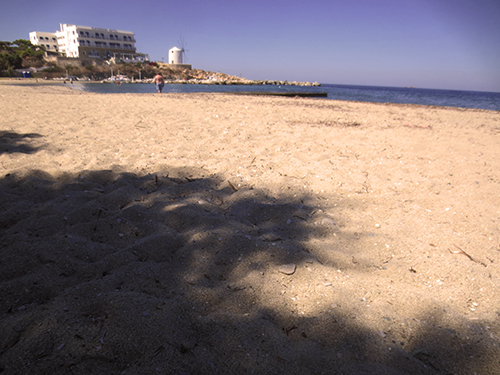
After months of Covid Gloom, we are finally out of Rome and on our special island. Today we went to a beach I know well as it’s less than 100 meters from our front door. Although not the most exotic of Parian beaches, it’s popular with people living in the neighbourhood. The children dominate the area where it’s easy to get in and the water is shallow. And where the water is not quite so shallow, a group of middle aged women meet for their daily swim. Well, more than swim, they tread the water as they animatedly talk to one another. All wear hats for protection so, from a distance, they look like a bunch of heads bobbing in the sea.

Lying in the shade of a tamarisk tree, I look up at the sky and sigh. Finally, after so many months of tension, my body is learning to relax again. The vastness of the cerulean blue above me is hypnotic and leads me to places I’d temporarily left behind.

In 1971, art historian Linda Nochlin published an essay entitled “Why Have There Been No Great Women Artists?” and answers the question herself by saying that there have been few “great” women artists simply because the patriarchal system has left little room for them to evolve as artists and become “great”. Women have been deprived those “conditions of possibility” that would permit them to be on the same level as men in terms of cultural success. In the past, for example, men were permitted to attend art academies whereas women were not. Thus it’s obvious that the condition of possibility, in this context, favors the male and not female artist.

But just because women have not been treated equally doesn’t mean they haven’t tried. Let’s take, for instance, a look at the historical role of women in the visual arts. Women have made significant contributions as interpreters of the visual arts but, despite the quality and quantity of their writings, they’ve been ignored or minimized compared to their male colleagues.

Alice Meynell (1847-1922) was a British poet, essayist, and suffragist. Although born in London, she grew up in Italy where she acquired her aesthetic imprinting.

Alice suffered from bad health and, during one illness, a Jesuit priest offer her solace. He gave her so much comfort that she decided to convert to Catholicism and give her writing a new direction. One common theme was the idea of equality.

 A passionate suffragist, Alice believed that “We dare to say that if the balance of power between men and women had been more equal the world over, we should not still be settling international disputes by swamping a continent in blood and turning Europe into a shambles.”

Essays provide the perfect format for observations on specific themes and it was a format that Alice frequently used. One such essay was “The Spirit of Place.” More than the essay itself, it’s the title that intrigues me. For, sitting under the shade of a tamarisk looking towards the sea, I can feel that just by being here, my spirit is transformed.

“Spirit of place! It is for this we travel, to surprise its subtlety; and where it is a strong and dominant angel, that place, seen once, abides entire in the memory with all its own accidents, its habits, its breath, its name.” Alice Meynell

-30-

Bibliography:

Meynell, Alice. The Spirit of Place, and Other Essays. John Lane the Bodley Head. London and New York. 1890. Read on archive.org HERE

Sherman, Claire Richter, Holcomb, Adele M. Women as Interpreters of the Visual Arts, 1820-1979. Greewood Press. Wesport, Conn. 1981. Read on archive.org HERE

Posted in art, female consciousness, Lifestyle, Paros | Tagged , , , , , , | 6 Comments