Keep Your Fountains Flowing

Trevi Fountain

After the lockdown in Rome, photographs taken mainly by drones began appearing on internet showing a deserted city. One photo that got my attention was that of two vigili (city policemen) taking a selfie alone in front of the Trevi. There was something very tender about the photo as if these two vigili understood the uniqueness of being alone in front of one of Rome’s most important monuments and wanted to immortalize it.

Trevi Fountain is the oldest Roman water source and dates back to 19 B.C. The fountain was built at the end of the Aqua Virgo Aqueduct where there was the junction of three roads, “tre vie” thus “Trevie” then “Trevi”.

In 1730, Pope Clement XII commissioned the fountain’s remodelling. The architect who designed it, Nicola Salvi, died before the fountain was completed as it took 30 years to finish it.

The protagonist of the fountain’s sculptural composition is Oceanus, the god of the earth’s fresh water. The fountain uses tons of water that it reuses to sustain itself.

The film Three Coins in the Fountain made making a wish and throwing a coin into the fountain popular with tourists. The coins are collected regularly by Caritas, a Catholic charity, that uses the money for worldwide food and social programs. It’s estimated that c. E3,000 is collected daily or rather was before the lockdown.

In 1996, the fountain was draped in black after Marcello Mastroianni who, thanks to the film La Dolce Vita, helped make the fountain more famous than ever. (You can read more about Marcello here: Vieni, Marcello, vieni!)

Romans love water (just think of ancient Rome’s aqueducts and public baths).

A “nasone” is a drinking fountain in the shape of a large nose (thus “nasone” which means “big nose”). Introduced in the 1870’s, there are over 2,500 of them in Rome with the purpose of supplying the people with free drinking water. The water that comes out of them is the same water that comes out of household water faucets.

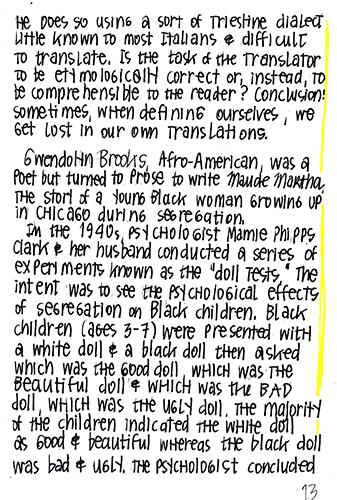
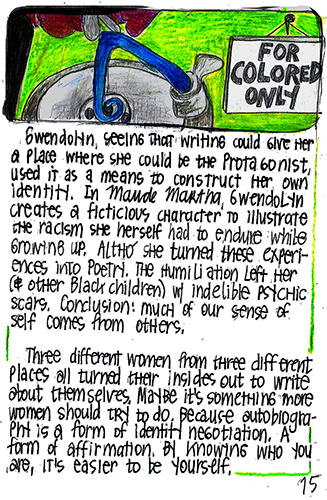
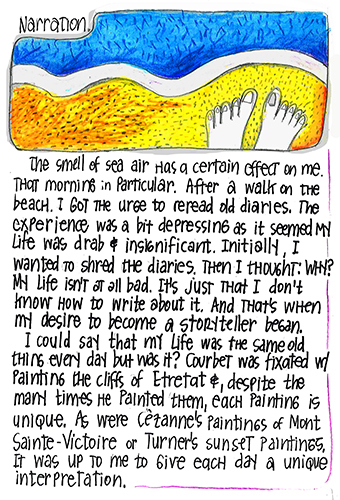
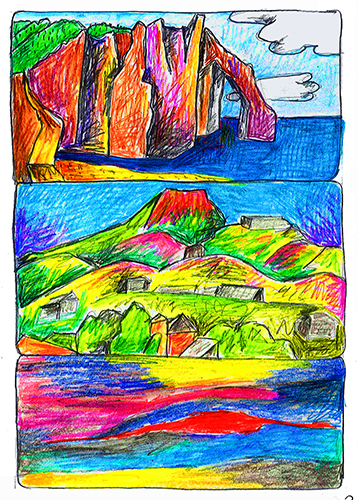
Although it may seem like a waste of water, it’s not. The nasoni are used as ventilation valves for Rome’s water system. Plus the constant flow of water keeps water from stagnating in the pipes as this would produce bacteria. More water is lost from leaky pipes than from the nasoni.

If there’s a lesson to be learned from the nasoni, it’s that flow prevents stagnation.

-30-

Sculptural fountains in Rome + ”Marcello come here”: la scena cult nella fontana di Trevi


Posted in Art Narratives, Rome/Italy | Tagged , , , , , | 3 Comments

The Silence of Angels

Angels on a Bridge

Years ago, while crossing the bridge of Castel Sant’Angelo, my skin felt the angels speak. A mystical experience? No, it was the magic of French conceptual artist, Alain Fleischer, who, via technology, had given life to angels made of stone.  Intrigued, I asked the artist (a very sexy guy with eyes like lasers) to speak to my students at the Academy of Fine Arts. Ooh là là, I wondered, had Fleischer, who has a PhD in Semiotics, ever heard the angels sing?

The other day, after seeing drone photos of a depopulated Ponte Sant’Angelo, I remembered Fleischer’s angels. Although majestically standing on their pedestals, they were silent. Because angels, when alone, don’t talk.

Angels have not always been present at Castel Sant’Angelo. Initially, Sant’Angelo was a mausoleum that the Roman emperor, Hadrian, had built for himself. Although considered a “benevolent dictator” he was, nevertheless, quite conceited and wanted an impressive monument left behind to remind history that he’d existed.

After the fall of the Roman Empire and the rise of papal rule, the mausoleum was renamed Castel Sant’Angelo (the Catholics were masters at recycling pagan constructions). It’s said that, during the Roman Plague of 590, the Archangel Michael stood on top of the mausoleum with a burning sword to chase away death and thus its new name. Much later, in 1669, the esoteric Bernini was commissioned by Pope Clemente IX to design the ten angels now standing on the bridge.

Ahhh, so many angels.

Without wanting to be, Julian Jaynes was a controversial scholar. He speculated that, 3,000 years ago, man had a bi-cameral mind where one half of the brain spoke and the other half listened believing it was a god who was speaking to him. In other words, once upon a time, everyone heard voices. Then an increase in demographics, the collapse of ancient societies, and mass migrations marked a transition in man’s way of thinking. Introspection was now no longer a voice from a god but a voice from just one half of the brain.

But the gods could not be silenced. Anxious to be heard again, they sent winged messengers to reactivate that forgotten voice. So man, afraid of his own thoughts, could say that they’d come from an angel. But why? Why can we not accept our inner voice as our own? Why is it that we need an excuse to believe in ourselves? Why is it that we are so eager to conform to the words of gurus, preachers, and/or narcissistic world leaders that we cannot understand that God is within our own being as much as it is within anyone else’s.

There is an angel within us all just waiting to be heard.

-30-

Related: Les hommes dans les draps d’Alain Fleischer + Alain Fleischer bio (italiano) + Hermes, the winged messenger

Posted in Art Narratives, Rome/Italy | Tagged , , , , , | 1 Comment

Contradictions

After Cleopatra committed suicide, Rome took control of Egypt and appropriated many of its artefacts such as obelisks. Special cargo ships were used to transport these monolithic monuments down the Nile to Alexandria and then across the Mediterranean to Italy.

Like giant needles meant to pierce the sky, obelisks abound in Rome more so than in any other city in the world. One such obelisk is in Vatican Square.

Although today we associate the term “Vatican” with the Catholic Church, the word comes from the location itself once known as Mount Vatican. It’s not certain but it could be that the Vatican Hill got its name from the Latin word “vaticanus” in allusion to the oracles that were once delivered there. In other words, a place of pagan cult.

In 40 A.D. Caligula brought the obelisk to Rome to use as a centrepiece for his Vatican Circus. Here Caligula organized horse and chariot races. Caligula loved horses. It’s said that he loved his horse, Incitatus, so much that he wanted to make it a senator.

Roman emperors were not in favour of the Christian movement seeing it as being seditious. Thus Christians were often persecuted and even tortured. St. Peter, for example, was crucified upside down. Then, in 313 A.D., Emperor Constantine legalized Christianity and built the original St. Peter’s Basilica on the site of Caligula’s circus.

Although there are no hieroglyphics inscribed on the Vatican obelisk itself, on the east and west sides of its base are inscribed exorcism formulas.

Once person who was fascinated by the presence of Egypt in Rome was Ezra Pound’s son-in-law, Boris de Rachewiltz. Boris was a penniless prince fascinated by the esoteric. He’d met Pound’s daughter, Mary, at a party in Rome hosted by Princess Troubetzkoy aka Amélie Rives, a moody but golden haired Southern Beauty who kept herself entertained by writing naughty novels and hanging out with controversial personalities.

In 1946, Mary and Boris decided to get married despite the protest of Mary’s parents. Boris, eager to dazzle and flaunt his noble blood, bought the run-down Brunnenburg Castel that gained fame when father-in-law Pound went to live there. Here Pound wrote many parts of his “Cantos”.

After he married, de Rachewiltz studied Egyptology at the Pontifical Biblical Institute and began focusing on the presence of Egyptian culture in Rome. Obviously, he became an expert in obelisks. Thanks to his ties to the Vatican, de Rachewiltz had access to the Tulli Papyrus, the first know written account of a UFO sighting. Named after Alberto Tulli former director of the Vatican’s Egyptian Museum, de Rachewiltz attempted to make a name for himself by translating the papyrus. The Tulli Papyrus provoked much controversy as did de Rachewiltz himself.

De Rachewiltz, a disciple of Julius Evola, had his residence in Senegal which led to an accusation of being involved in international arms trafficking with the Camorra. Although the Egyptologist, was absolved, de Rachewiltz continues to be a mystery.

St. Peter's Obelisk

It would seem that having a pagan obelisk in the middle of a Christian piazza would be a contradiction. But that depends, in part, on your worldview.

Eastern thinking tends to see contradictions as a yin yang correlation where mutations can create harmony. The western mind, instead, sees contradiction as a conflict, as “me vs. not me” situation.

Some contradictions are not apparent because of their context.

I have edited this post eliminating the many contradictions created by the coronavirus as it’s now spring and I am waiting to turn into a flower.

-30-

Boris de Rachewiltz is buried at the Verano Monumental Cemetery in Rome in a family plot.

Posted in Art Narratives, Rome/Italy | Tagged , , , , | 1 Comment

The Pantheon

The Pantheon

The Pantheon, in the center of Rome, is a huge round building with a rectangular portico. Its granite columns are from Egypt and first had to float down the Nile on a barge then cross the Mediterranean in a ship before they could be erected. Even before it was built, the Pantheon already had a history of its own.

The Pantheon gets its name from the Greek πάνθεον and means, basically, “of all gods”. Its most unusual feature is the huge opening in the middle of its dome. Known as an “oculus” from the Latin word “oculus” meaning “eye”, it was meant to illuminate the interior while at the same time letting the gods look in. And when it rains, the water goes inside but doesn’t flood the slightly sloping floor as there are many carefully hidden drains. Thus nature and of man co-exist in harmony.

On the day of the Pentecost, thousands of rose petals are dropped through the dome’s hole.  This ensures that the Pantheon, once a pagan temple, is now recognized as a Christian dwelling.

Renaissance painter and lady’s man, Raffaello Sanzio, is buried here. Originally from Urbino, Raffaello was orphaned at age 11. His uncle, a priest, became his official guardian. This helped him, at an early age, to become a painter’s apprentice. Naturally gifted, Raffaello eventually made his way to Rome where he immediately was commissioned by the Pope to paint private Vatican rooms. Michelangelo, already in Rome, had to struggle for his commissions. While Raffaello was comfortably standing up to paint walls, Michelangelo was lying down on elevated scaffolding to paint the Sistine ceiling. This earned Raffaello Michelangelo’s eternal wrath. Even after Raffaello’s death, Michelangelo continued to criticize and demean his rival even accusing Raffaello of plagerism.

Raffaello had obviously appropriated from Michelangelo as well as other artists (didn’t Picasso say that “Good artists copy; great artists steal”). But Raffaello got much of his inspiration from women as well.

One morning Raffaello was walking near the Tiber when he saw a young woman bathing her feet in the river. The image hit him like a bolt of lightning and he exclaimed “I’ve found my Psyche!” The young woman’s name was Margherita Luti but she was known as “La Fornarina” as her father was a “fornaio”, a baker. The baker’s daughter became Raffaello’s lover and favorite model. But there was a slight problem. Raffaello was engaged to Maria Bibbiena, the niece of family friend and benefactor, Cardinal Medici Bibbiena. Many marriages are arranged for practical reasons and, for Raffaello, this was no different. In no hurry to marry Maria, he kept postponing and postponing the marriage. Then, in 1520 on his 37th birthday, Raffaello unexpectedly and mysteriously died and was buried in the Pantheon.

Art historian conspiracy theorists suggest that Raffaello had been secretly married to Margherita. And when Maria’s powerful uncle, Cardinal Medici Bibbiena found out about it, he was so enraged that he had the famous artist poisoned. To further cover up the scandal, when Maria, the “widowed” fiancée, died, she was placed in the tomb with Raffaello as a means of legitimizing her position as “promessa sposa”. Margherita, instead, was sent to live in a convent where she died a couple of years later.

There are other theories, too. Such as that suggesting that Margherita had become one of Rome’s most well-known courtesans. Raffaello, so tormented by his lover’s deception, died of a broken heart. But Giorgio Vasari, in his The Lives of the Artists, claims that Raffaello died from having too much sex.

Artists and writers have based many of their works on the story of Raffaello and Margherita. Ingres painted five versions of the lovers together. Dante Gabriel Rossetti drew La Fornarina and “La Fornarina” is the name Byron gave to his Venetian mistress Margherita Cogni. Balzac modelled his Lucien de Rubemprè on Margherita and Nobakov wrote a story about her. Picasso did a series of erotic drawings of Raphaello with Margherita and Goebbels’ mistress played the role of La Fornarina in a film of the same name. The list goes on.

Love, it seems, is the greatest inspiration for both fact and fiction.

-30-

Related: “La Fornarina” at Galleria Barberini + Art sleuth uncovers clue to secret Raphael marriage + Did Rafael Santi Have Children + Raphael death. How did Raphael died? + The Sistine Madonna by Raphael + sinkhole opens in front of Pantheon

Posted in Art Narratives, Rome/Italy | Tagged , , , , | Leave a comment

Beauty is the only truth I want to know

At the beginning of the lockdown, drones were sent out to immortalize a deserted Rome. The photos were stunning because, without people, the city regained its original contours and majestic beauty. How magical it would be, I thought, to walk the empty streets and carefully observe Rome without the distraction of others. Unable to do so, I made drawings instead.

The Spanish Steps

In between the church of Trinità dei Monti and the Barcaccia Fountain designed by Bernini’s father are the Spanish Steps. This monumental staircase of 135 steps has found a place in many films (such as Roman Holiday, The Roman Spring of Mrs. Stone, and The Talented Mr. Ripley). Fitzgerald writes about the steps in Tender is the Night as does Anthony Burgess in ABBA ABBA.

At the foot of the staircase to the right is the “Casina Rossa”. Here a woman named Anna Angeletti rented rooms to tourists. And one of these tourists was the poet John Keats. Suffering from tuberculosis, Keats arrived in Rome in hopes that a change in climate would improve his health. From his room on the second floor, he could hear the water gurgling in the fountain. It was this sound that kept the poet company when he was overwhelmed by that particular kind of solitude felt by those who are dying. Keat’s died in his room next to the Spanish Steps on February 23, 1821. The poet was only 25 years old. Buried in Rome’s Protestant Cemetery, he asked for this epitaph to be placed on his tombstone: “Here lies one whose name was writ in water.”

Two years before his death, Keats wrote his most well-known poem, “Ode to a Grecian Urn.” Like Isadora Duncan, Keats made many visits to the British Museum and, like Isadora, was impressed by the Greek vases. The vase paintings with women dancing around with veils inspired many of Isadora’s dance routines. Keats, on the other hand, was inspired not to dance but to write an ekphrasis, a poetic description of a work of art. So overwhelmed by the beauty of the vases, Keats decided that spontaneous emotions held more truth than did dry reasoning. Thus, he wrote, “Beauty is truth, truth beauty.”

The vase that Keats calls the “still unravished bride of quietness” is, really, nothing more than painted clay. Nevertheless, it speaks to humanity. And for those who cannot hear it speak, Keats writes an ode. But a work of art is like the Tower of Babel and speaks as many languages as it has people looking at it.

“Beauty is in the eye of the beholder,” wrote Margaret Wolfe Hungerford in her 1878 novel Molly Bawn. But to see this beauty, you have to open up your eyes and look around you. And I wonder if, after so many days of being inside, the outside world will look any differently once the lockdown in over.

.-30-

Of note: Tender is the Night gets its title from Keats’ poem “Ode to a Nightingale”..you can read Fitzgerald’s book on Archive.org HERE + Burgess’ Abba Abba is about Keats’ final month and can be found on Archive.org HERE +

Posted in Art Narratives, Beauty, Rome/Italy | Tagged , , , , | Leave a comment