The Hero of Two Worlds

Italy Was Fragmented Like A Broken Vase

After the fall of the Roman Empire, Italy was fragmented and divided up into various kingdoms. Battles routinely moved boundaries but, in the early 1800s, Italy was basically divided into 3 parts: the Bourbons in the south, the Pope in the center, and the Savoys in the north.

In 1848, a series of revolutions broke out in Europe.  The masses were tired of being commanded by the conservative elite–having too much meant depriving others of having enough.

In Italy a move towards the unification of the country began which led to the Risorgimento and, subsequently, the unification of Italy in 1870.

The men given credit for this unification are Giuseppe Mazzini, Victor Emmanuel II, Camillo Benso count of Cavour, and Giuseppe Garibaldi. But, even though they all claimed to want a unified Italy, their motivations were not the same. Victor Emmanuel II and Cavour both wanted to unite Italy but as a monarchy under Piedmont rule.  Mazzini wanted to unite Italy but as a republic.  Garibaldi didn’t care if it was a monarchy or a republic just as long as it was united.

Italy's Four Forefathers

Garibaldi, the romantic rebel, was born in Nice.  He grew up with the presence of the sea and it’s distant horizon  that constantly beckoned him.  He worked as a sailor and became a merchant marine captain.

Garibaldi Was Born In Nice

In 1833, while heading towards Constantinople, the 36 year old Garibaldi met Emile Barrault, a follower of  Henri Saint-Simon.  Saint-Simon believed that man should adopt humanity as his homeland and fight for people struggling against tyranny.  For whoever fought such a battle, more than a soldier, was a hero. Dazzled by these ideals, Garibaldi now had a new horizon—that of becoming a hero.

Followers of Saint-Simonianism believed in the importance of brotherhood.  Some followers even encouraged the wearing of clothing that buttoned down the back. Needing help to unbutton your clothes symbolized your need for others in general indicating that our lives are all interrelated.

Garbaldi 4 b

Now Garibaldi’s goal to be a hero had him participating in revolts and subversive activities not only in Italy but in South America as well. He was always on the run.  And always in trouble.  Nevertheless, Garibaldi was audacious and brave.  The Argentine dictator Manuel Rosas once caught him and had him hung by his feet and whipped. The stoic Garibaldi didn’t complain or cry out in pain. For the oppressed and idealistic, there was no doubt that Garibaldi was indeed a hero.

they hung him upside down

In Brazil where the air smelled of revolution and intrigue, he continued to fight for just causes. But the life of a revolutionary, despite the people around you, is often lonely.  Then he met Anita.  Overwhelmed maybe more by his need to be loved than by Anita herself, he immediately whispered in her ear “You will be mine!”   Convinced, she left her abusive husband and ran off with Garibaldi.

Together, in the name of liberty and equality,  they fought many battles in Brazil.

But, in 1848, revolutions were exploding all over Europe and Garibaldi decided it was time to go back to Italy. As in Brazil, Anita was at his side and together they fought to defend the Roman Republic. But Anita, already pregnant and sick with malaria, didn’t have the strength to continue the struggle and died in her husband’s arms  not far from Ravenna.

he held her in his arms for the last time

After 1848, Garibaldi modified his heroic image: Less hippy and more savoir faire. Less of a bandit and more of a gentleman.

He Waited For The On The Beach

Garibaldi is best known for the Spedizione dei Mille (Expedition of the Thousand) a crucial battle for the Risorgimento.  In 1860, Garibaldi, along with 1000 volunteers, arrived in the Kingdom of the Two Sicilies to overthrow Bourbon rule. Despite the advantage the Bourbons had in numbers and arms, Garibaldi and his troops were victorious and the Bourbon ruler and consort, King Francis II and Queen Maria Sophie, forced to leave.

they'd reached the shores of Marsilia

King Francis II and Queen Maria Sophie were destined for sadness. Sophia Maria, Empress Sissy’s younger sister, married Francis by proxy.  When they finally meet in the bedroom, Francis ignore his bride and spent the night praying.  In 1859 they become rulers of the Two Sicilies.

King Francis II is known mainly for being insignificant whereas Maria Sophie was considered a kind of heroine because of her efforts to care for and encourage royal troops during Garibaldi’s attack. Only 18 years old at the time, she had no problems picking up a gun and shooting at the enemy. Marcel Proust made reference to her in La prisonnière calling her  a “soldier queen”.  Gabriele D’Annunzio, instead, saw her as the “stern little Bavarian eagle.”

the queen acted like a soldier

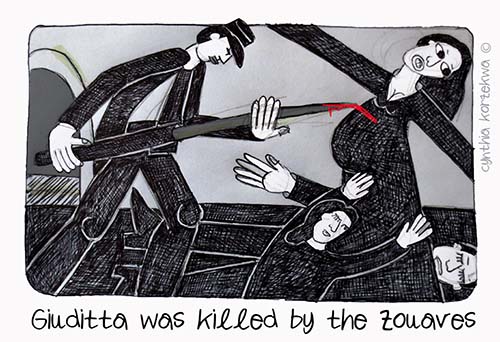
Maybe Maria Sophie  just had a lot of pent up frustration to release. Francis II had a malformation that kept him from consummating the marriage with her. Frustrated, Maria Sophia spent much time bathing in the sea of Naples, smoking cigars, and riding her horse around town. After the couple was forced to flee to Rome, she had an affair with a Papal Guard (Zuavo), got pregnant, and was sent off to Bavaria to avoid scandal.

Marie Sophia loved a zuavo

The situation was a mess especially considering that royalty made alliances via their off-spring and Francis was not doing his part.  The family forced him to have an operation and viola, Marie Sophie got pregnant again but this time by her husband. Unfortunately, the baby did not live long (some say because of nanny’s incompetence). The couple was destroyed psychologically. Francis turned to God and Marie Sophie turned to lovers.

When the unification of Italy becoming more and more a reality, Francis and Maria Sophia were forced to leave Rome and wander from one royal home to another. Francis eventually gave up and died but Marie Sophie kept on trucking. Her Italian experience had provoked a need for revenge. Her desire to cause conflict in Italy as to break up the unification led to speculation that she was involved with Humbert’s assassination.

Admirers.

The Three Muskateers man, Alexandre Dumas, adored Giuseppe Garibaldi.  Not even he could have invented such a character! Dumas wrote two Garibaldi related books: Mémoires de Garibaldi and I garibaldini. The French author was with the hero during the Expedition of the Thousand.

The Three Muskateers

Garibaldi had another admirer—Abraham Lincoln.  Lincoln asked Garibaldi to come help him with the American Civil War but, not feeling that the main purpose of the war was the liberation of the slaves, Garibaldi declined.


They Liked Hats

Il Gattopardo.

Giuseppe Tomasi di Lampedusa (1896-1957) was the 11th prince of Lampedusa, an aristocratic Sicilain family that was slowly dissipating into nothingness. He grew up with an excessively unattached father and an overly attached mother.  The company he most enjoyed was that of his books.  Shy and introspective, at the age of 36 he married an aristocrat and psychiatrist from Latvia, Alexandra Wolff Stomersee, aka Licy. The couple begin their married life in Palermo living with Tomasi di Lampedusa’s mother.  But the situation didn’t last long as Licy was too independent minded to be dominated by a mother-in-law and moved back to the family castle in Latvia. For years Licy and Giuseppe Tomasi di Lampedusa had a Marriage By Correspondence.  After the mother-in-law’s death, Licy moved back to Palermo.

Tomasi di Lampedusa was an avid reader and most every day for 10 years would start his day off at a pasticceria followed by a visit to Flaccovio’s, his favorite bookshop. More bookshops and more cafes then he’d return home by bus.  Licy, instead, slept all morning because her psychiatry practice kept her working until late at night.

Tomasi di Lampedusa always carried books with him with at least one Shakespeare because, if affronted by a disagreeable situation, reading Shakespeare for him was like taking a Valium.

The Lampdusa's & their Leopard

Nearing the age of 60, Tomasi di Lampedusa felt the need to write the history of Sicily from his family’s point of view. The Leopard (Il Gattopardo) is the story of how the unification of Italy provoked the decline of the Sicilian aristocracy. The title comes from the family coat of arms that bears a leopard.

Protagonist of this tale is Prince Fabrizio de Salinas, a middle-aged aristocrat living in Sicily. Garibaldi has arrived on the island with his Redshirts and Don Fabrizio sees his world of privilege quickly crumbling away.  He knows the change is necessary but, as for most all of us, change is not always easy to absorb.  So, no longer able to identify with the events, he begins a process of alienation.

Garibaldi is not the only one who challenges the status quo.  So do the nouveau riche. Don Fabrizio’s nephew, Tancredi, is engaged to the beautiful but crass Angelica whose father is a rich merchant.  Tancredi is attracted to Angelica’s money and Angelica to Tancredi’s aristocratic status.  They pretend to themselves that they are in love with one another when they are actually in love with their ambitions.

It is Tancredi who truly personifies what is happening.  He says: if we want everything to stay as it is, we must change everything.  The young aristocrat who has a title but no money knows he must adapt and adapt he does.  So he becomes one of Garibaldi’s Red Shirts then part of the Royal Army then a member of the Parliament. He also marries for money and describes his fiancé  as a beautiful amphora full of coins. For survival,  Tancredi transforms himself when necessary.

Tancredi & Angelica

The Leopard was published after Tomasi di Lampedusa’s death in 1958 and later made into a film by Luchino Visconti most notable for its 45 minute ballroom seen .

Garibaldi’s overthrow of the Kingdom of the Two Sicilies has sometimes been called “the solution that didn’t resolve anything”.  Don Fabrizio said that Sicilians didn’t want to improve because they saw themselves as perfect and their vanity was stronger than their misery.

The novel ends with Don Fabrizio daughters, all old maids, who desperately try to hold on to a reality that no longer exists. Resisting the inevitable, their life has become sterile, sad, and self destructive.


Boundaries are made to be moved.


The Garibaldi Family Tomb is at Verano Monumental Cemetery whereas Garibaldi himself is buried on his island, Caprera.

Posted in Uncategorized, Verano Monumental Cemetery | Tagged , , , , , | 1 Comment

Futurists without a future

At the beginning of the 1900s, the United States  and much of Europe was being swept away by the Industrial Revolution.  But Italy, burdened with grandeurs of the past (Ancient Rome, Renaissance, Baroque) had difficulties updating itself.  So a group of young, animated and slightly rebellious Italian writers and artists got together to promote not the present but the future.  Led by the Milanese Filippo Tommaso Marinetti, they created Futurism.  In 1909 Marinetti wrote the group’s manifesto which promoted modernism and the aesthetics of speed.  They praised machines but scorned women. The Futurists wanted to make things happen and this was possible only via motion and motion was a manifestation of force.

Chronophotography and Cubism

The Futurists were mesmerized by the time lapse photography of Étienne-Jules Marey and contaminated by Cubism.  Their movement soon became international.  But, unfortunately, the Futurist art movement became highly politicized.  Extremely nationalists, they strongly identified with Mussolini.  And, because they glorified war calling it the world’s only hygiene, many Futurists enrolled in the army during World War I.  This proved a bad decision for Futurist sculptor Umberto Boccioni. During military training, he fell from his horse and was trampled to death.  The speed and motion he promoted was the same thing that killed him. Boccioni’s  presence can still be felt today as his most famous work, the Hermes related statue, Forme uniche della continuità nello spazio, is commemorated on the Italian 20 cent coin.

Boccioni‘s speed and motion

By 1914 the artists started bickering among themselves and, after WW I, the movement began dissipating. But Marinetti tried resuscitating his dying movement by calling it “il secondo Futurismo”. Marinetti tried to make his Born Again Futurism the official art of the Fascist government. But Mussolini’s aesthetics were that of the Roman Empire. Plus Mussolini’s mistress at the time, Margherita Sarfatti, was a cultural tzar and preferred the Novecento movement to that of the Futurists. So Marinetti, a conformist at heart who only wanted to be part of the status quo, began making one compromise after the other.  A proclaimed atheist, he resigned himself to Catholicism  justifying himself by saying that Jesus was a Futurist.

Buried at the Verano Monumental Cemetery are three active members of the Futurist movement:  Giacomo Balla, Enrico Prampolini and Anton Giulio Bragaglia.

Giacomo Balla  (1871 – 1958)

Balla was part of the group right from the start. When he was just nine years old, Balla’s father died. He was forced to work at an early age and later attended night school to learn how to draw.  For awhile he worked as an illustrator but also painted portraits and landscapes.  Living now in Rome and far away geographically and psychologically from his hometown, Turin, Balla lived difficult days and became sensitive towards people who struggled to survive.

So possessed by the idea of movement, Balla named one of his daughters Elica (“propeller”).  The other daughter’s name was Luce (“light”), another one of his fixations.

Balla remained faithful to the Futurist style until he, too, got bored with it and went back to traditional painting with a fondness for portraits. He also enjoy painting the walls and furniture of his home in Rome.

Giacomo Balla

Enrico Pampolini (1894-1956)

Aeropittura became very popular with the second generation Futurists.  It was inspired by the way being in an airplane changes your perspective as compared to being on the ground.  One of the main aeropainters was Enrico Pampolini. Prampolini studied Applied Arts at the Academy of Fine Arts with Duilio Cambellotti (who adorned various tombs at Verano with his stained glass windows).  Painter, scenographer and architect, Prampolini was interested in all of the new European art trends.

In 1917, Prampolini designed the sets for Thaïs, a Futuristic film directed by Anton Giulio Bragaglio. Prampolini’s backdrops were full of geometric shapes and symbolic figures such as cats and masks. Painted optical illusions interacted with the real indicating that fact and fiction often live in symbiosis.

Enrico Pampolini

Anton Giulio Bragaglia (1890-1960)

Brothers Carlo and Anton were the sons of Francesco, director of the Cines movie studio and that’s how they got started in filmmaking. Together they created the gallery Casa d’Arte Bragaglia in Rome (1918) to help promote avant garde art.  However, Carlo’s filmmaking took him in a very commercial direction (he directed many films starring the Italian legend Totò) whereas Anton preferred experimental art and its theory.

Anton became a part of cinematography history with his film Thaïs based on a novel by Anatole France. It’s  the story of Countess Vera Preobrajenska and the married men she seduces—a plot typical of the femme fatal movies of the time.

Anton Giulio Bragaglia

But Anton also loved “the moveable mask” and  theater.  He created Il Teatro Sperimentale degli Indipendenti (1922-1936) attracting a number of performers including Alberto Spadolini.  Anton refered to Spadolini’s dancing as “aereodance”.  The speed the Futurists tried to represent in their art, Spadolini represented in his way of dancing.  And when Mussolini forced the theater to close, Spadolini moved to Paris.  Here, known as Spadò, he painted, acted and danced.  He was partners on and off stage with Josephine Baker for awhile as they both exalted their bodies and enjoyed dancing naked.  Spadò was also a secret agent for the Resistenza.

Josephine and Spadò

Angiolo Mazzoni  (1894-1979)

Leaving the Verano Cemetery via the main gates, in the distance you can see the water tower, adjacent to the Termini train station, designed by Angiolo Mazzoni.  Mazzoni (who worked for awhile with mega Fascist architect Marcello Piacentini) was a well-respected architect during the Fascist government and designed the Roma Termini train station once known as being the biggest and most trafficked train station in Europe.  Even today it’s been defined as “a universe in continual expansion” because of the changes it continues to make.  Mazzoni  had even greater plans for the train station but, because of WW II, the worked was stopped.  After the war, Fascists were no longer well received in Italy so, in 1948, Mazzoni moved to Bogata and stayed there until 1963.

Angiolo Mazzoni Water Tower

Related: CASA BALLA, A COLOR EXPOLSION + Lo scandalo di casa Balla +  Unfortunately, Balla’s home (1929-1958), the CASA MUSEO DI GIACOMO BALLA, Via Oslavia 34  Roma, is closed to the public + Fotodinamismo Futurista, Anton Giulio Bragaglia video + Politics as Art: Italian Futurism and Fascism by  Anne Bowler pdf + Angiolo Mazzoni in Toscana + Video Anton Giulio Bragaglia: Thaïs (1917)  + Josephine Baker Vintage Naked on Stage + TESINA SULL’ARCHITETTO : ANGIOLO MAZZONI (1894 – 1979) ARCHITETTO INGEGNERE DEL MINISTERO DELLE TELECOMUNICAZIONI

Giacomo Balla's Grave at Verano

Giacomo Balla, Verano, Basso Pincetto, riquadro 139

Enrico Prampolini's grave at Verano

Enrico Prampolini, Verano,  Rampa Caracciolo, tra i riquadri 160 e 161, fila IV, loculo 22

Anton Giulio Bragaglia

Anton Giulio Bragaglia, Verano, Alto Pincetto, Viale della Marina

.

.

Posted in Drawings & Paintings, Rome/Italy | Tagged , , , , , | 4 Comments

Roses & Freemasons

Between 1880 and 1910, an arts & crafts movement exploded in Europe. It was a reaction against the decline in standards resulting from factory produced as opposed to handmade objects. Quality as opposed to quantity was now the objective.  But World War I emphasized the need for technology transforming, once again, artistic standards.  Nevertheless, there was an appreciation for the applied arts that today is non-existent. Stained glass, wrought iron, ceramic, mosaics and bas reliefs abounded. Two exponents of Italian applied arts were Cesare Picchiarini  (1871-1943) and Paolo Paschetto (1885-1963).

One of the reasons why I love Verano Monumental Cemetery is because it offers so many examples of Italian applied arts. The Cappella Calderai  (commissioned by engineer and builder Ugo Calderai) is a great example. The cappella’s stained glassed window was made by Picchiarini.  No religious figures as often found at the cemetery but, instead, roses.

Cesare Picchiarini stained glass window

Symbolically, the rose has been given many meanings. For example, in ancient Rome, the Rosalia was a yearly festival of roses and the flowers were place on tombs as they were symbols of resurrection. Another symbol is that of the pentalpha star as the five petals of the wild rose have been identified with the five points of a star.

Paolo Paschetto is an intriguing and, in some ways, ambiguous figure. Son of a Waldensian pastor, he considered his artistic activity as the making of sacred art. In 1914, he designed  the stained glass windows for the Waldensian Church on Via Cavour in Rome and, in 1924, he designed the windows for the Methodist Church in via XX Settembre although it was Picchiarini who actualized the work.  Paschetto also created the logo for the Italian Assembly of God church (“Tutto l’Evangelo”).

The stained glass windows designed by Paschetto are, obviously, full of symbolism.

Paolo Paschetto stained glass windows

Some examples:  The grape vine in Christian symbolism comes from Jesus having said “I am the vine”.  A lamb standing with a banner, the Agnus Dei, represents Jesus who has risen and victorious over death. With the flaming tower, the tower represents a refuge whereas  the flames represent the Holy Spirit.

Because he was a freemason, Paschetto’s role in designing not only postage stamps for the Republic of Italy but the country’s emblem as well, raises a few questions.  For one, the pentalpha star that dominates Italy’s emblem is the same as that used by freemasons.

Hermes Was Made for Motion

Paschetto used the wings of Hermes for the Italian express mail stamps he designed.  One shows the King, Vittorio Emanuele III, with wings whereas another stamp depicts the winged foot of Hermes.

Hermes appears frequently in freemasonry art.  Hermes, with his wings, can transcend boundaries and move from the world of mortals to the world of the gods.

The Flaming Torch

The flaming torch is another masonic symbol used by Paschetto for another stamp design. It was also used by  freemason sculptor, Frederic A. Bartholdi ,(1834-1904) for the Statue of Liberty.

Paschetto was one of the main protagonists of the Liberty Style (Italian art nouveau) thus much influenced by the Belgian, Victor Horta (1861-1947). Horta, a freemason, thus another controversial figure, had much to do with the creation of art nouveau.  The new style, that quickly captivated the bourgeoisie with its meandering lines, was often associated with freemasonry and its liberal politics.

Cappella Calerai, Verano Cemetery

Capella Calderai, Verano Cemetery, Rome

Related:   CHIESA EVANGELICA VALDESEwindowsPaolo Paschetto + Chiesa Metodista di Roma, via XX Settembre + Freemason Information + STATUE OF LIBERTY

.

.


Posted in Drawings & Paintings, Rome/Italy | Tagged , , , , , , | 2 Comments

The Unfolding of Mariano Fortuny

What is a pleat other than a fold.  And what is a fold other than the combination of order and flexibility.

Pleats have been around for a long time. They were around in ancient Egypt and continued to be used throughout history. Just think of Mary Stuart’s famous pleated collar, the Scottish kilt, and the Greek fustanella .

Textiles of the past were coarse and thus more difficult to fold.  Now synthetic fabrics make pleating much easier for contemporary fashion designers.  One such designer is Issey Miyake who loves pleats so much he’s even named a perfume  in their honor.

Miyake Like Pleats

But the most successful pleated dress of all times is that of Mariano Fortuny, the “Delphos” dress.

The son of a well-known Spanish artist, Fortuny was born in Granada in 1871. His family was wealthy enough to permit him to study and travel. At the age of 18, he moved permanently to Venice.

Fortuny and His Palazzo

A painter, a stage designer, a stylist and more, Fortuny was very much a Renaissance man. “Art is my life’s aim” he said. Fortuny, greatly influenced by the Aesthetic movement and by Wagnerism, was not interested in haute couture.  He considered his dresses a form of conceptual art.

In 1906 he opened his atelier (now the Fortuny Museum) that emphasized fashion. Fortuny liked appropriating ideas especially from the Greeks such as that of the chiton. A chiton is made by piecing together many woven rectangles to form a cylinder with openings for the head and arms. The cylinder was held in place by a girdle (belt) that created a pleated effect.

Chiton & Chiton With Girdle

Fortuny’s famous dress, the Delphos, was based on the chiton worn by the “Charioteer of Delphi”,  a 5th cen. BC Greek bronze found in 1896. Created with the help of his partner and wife, Henriette Nigrin, the Delphos dress, thanks to a machine he invented (and patented), is full of skinny little pleats.

Charioteer of Delphi's Dress

The Delphos dress clung to the body and was well loved by men and women alike.  Actresses such as Isadora Duncan and Sara Bernhardt adored it. Writers, like Marcel Proust, even wrote about it in their novels.

Marcel Proust  saw the dress as magical and included refrences to it in In Search of Lost Time.  The many Fortuny gowns owed by Madame de Guermantes are a source of envy for Albertine, Marcel’s lover, who would like to have one for herself.

Proust & the Delphos Dress

Fortuny’s Knossos scarf was also well received. It  was a large silk veil specially dyed  with dyes of his own invention and often printed with Cycladic geometric motifs.

She Wore A Knossos Scarf

Actress Isadora Duncan not only loved the Delphos dress.  She was also fond of his Knossos scarf.  Who knows if she was wearing one when she had her car accident.

Isadora Duncan & the Knossos Scarf

Fortuny’s dresses often made use of colored glass beads from Murano.    Especially fond of the Medieval style, he liked  velvet  capes and often used stencils to decorate them.

Fortuny Prints for Textiles

Henriette wore Fortuny

The list of women who wore Fortuny’s dresses is long and impressive.  The first who really helped launch the dress was the Marchessa Luisa Casati. Peggy Guggenheim was  another big  fan of the Delphos dress.

Peggy Guggenheim Wore Fortuny

For about 15 years, Susan Sontag and Annie Leibovitz had an important relationship and ended with Sontag’s death in 2004. Leibovitz photographed the corpse of Sontag wearing a Delphos dress before Sontag was buried at Montparnasse (Paris).

Susan Sontag Wore Fortuny


La Marchessa Luisa Casati.

Luisa Casati was 22 and tired of being a good girl wife to Marchese Camillo Casati.  Then, at a fox hunt, she met naughty boy Gabriele D’Annunzio and gave her life a new direction.  At the time D’Annunzio, almost twice Luisa’s age, was Italy’s most notorious poet and novelist.  The two began a relationship that was to last for several decades.

D’Annunzio was short, bald and borderline ugly.  He was attracted to bored and wealthy women because they were easy prey and possible sources of income. A forger of words and of sentiments, D’Annunzio was an expert in giving women wanted they wanted—words of adoration and good sex.  Luisa dazzled D’Annunzio not only because she was rich and wanting, but because she was audacious and wanted to imprint her image on the world around her.

She WantedTo Be A Work of Art

As her relationship with D’Annunzio progressed, so did her physical metamorphosis.  Luisa began tinting her hair and wearing extravagant clothing—she had discovered that an unconventional and eccentric presence turned her into a magnet attracting everyone’s attention and, becoming increasing more narcissistic, that’s exactly what she wanted.

Luisa was now D’Annunzio’s main muse.  She inspired, for example, the character of Isabella Inghirami in Forse che sì, forse che no (maybe yes, maybe no).  The title was taken from  Francesco II Gonzaga’s motto painted on a ceiling at the ducal palace in Mantua. The story is that of violent passion and its consequences.

Exaggeration for Luisa now became a norm.  Hers was the aesthetics of excess—too much was not enough.  At the time there was a fascination with death and the occult so it was trendy to look more dead than alive.  Luisa dyed her hair red, blackened her eyes with kohl, dilated her pupils with belladonna, powdered her face white, and was thin to the bone.

Luisa, bored with Milan, moved to Venice and bought a house on the Grand Canal (Palazzo Venier dei Leoni  now the Peggy Guggenheim Museum).  She animated her life redecorating her house and herself. Fortuny, known for his exotic style, attracted Luisa’s attention.  She especially liked his scarves and cloaks. In Forse che sì, forse che no, D’Annunnzio describes Isabella aka Luisa as being “enveloped in one of those very long scarves of Oriental gauze the alchemist Mariano Fortuny plunges in the mysterious dyes of his vats and withdraws tinted with strange dreams.”  Luisa and Fortuny became friends and often went for gondola rides together.

Luisa & Mariano Enjoyed the Gondola

Luisa said: I want to be a living work of art. And this meant, for her, to live to extremes. More than supporting the arts, she supported artists who made portraits of her—Giovanni Boldini, Kees Van Dongen, Romaine Brooks, Man Ray, Giacomo Balla, etc. She was a muse to the Futurists and inspired fashion designers. Luisa’s parties and appearances were legendary. But exaggeration caught up with her.  Her money squandered on excess, she spent the last years of her life penniless and making collages. La Marchesa Casati is buried in London’s Brompton Cemetery along with her embalmed dog.

She Wanted To Be A Work of Art

.

Mariano Fortuny, Verano Cemetery

Mariano Fortuny’s tomb at Verano Cemetery in Rome (located at Pincetto Nuovo, Riquadro 49).

.

.


Posted in Drawings & Paintings, People, Rome/Italy, Uncategorized | Tagged , , , , , | 2 Comments

Nazim Hikmet, poet with a cause

I bought a book of his poetry at the train station in Milano just because of a phrase on the dust jacket: You are my enslavement and my freedom.

Loving You Is A Prison

Nazim Hikmet was the first modern poet from Turkey. Born in the Ottoman Empire,  thanks to his mom, he was exposed to poetry at an early age. Raised in Istanbul, he then  attended university in Moscow, an experience that greatly shaped his political thinking. In 1924 Hikmet returned to Turkey but got arrested for his leftist thinking so he escaped  and went back to Russia. Homesick, he went back to Turkey once again in 1928 only to be arrested again and sentenced to 28 years in prison. Once out of jail, in 1951, he returned to Russia and stayed there until his death in 1963.

Russia not only changed Hikmet politically but artistically as well. He was greatly influenced by the Russian Futurists who promoted linguistic experimentation.

Below is a little Hikmet Sampler:

There WasA Kilim On Her Wall

Because of you, each day is a melon slice smelling sweetly of earth…

 Because of you, even my loneliest nights smile like an Anatolian kilim on your wall.

She Drank From The Tap

I love you like waking up at night with high fever 

 and drinking water, with the tap in my mouth.

The Sea Was Waiting To Be Crossed

The most beautiful sea hasn’t been crossed yet

 …And the most beautiful words I wanted to tell you I haven’t said yet.

Their Knees Touched On the Train

I didn’t know I loved so many things and I had to wait until sixty

 to find it out sitting by the window on the Prague-Berlin train

 watching the world disappear as if on a journey of no return.

Hikmet’s words have been used as song lyrics. Pete Seeger (of “Where Have All The Flowers Gone”) mated the words of Hikmet’s “I Come And Stand At Every Door” with the Scottish ballad “The Great Silkie” later recorded by The Byrds as well. Hikmet’s poem speaks of a little girl who was killed at Hiroshima thus often used in terms of anti-war protests.

So why don’t we  arm ourselves with poetry instead of guns?

.

.

Posted in Books, Drawings & Paintings, People, politics | Tagged , , , , , | 3 Comments