Roses & Freemasons

Between 1880 and 1910, an arts & crafts movement exploded in Europe. It was a reaction against the decline in standards resulting from factory produced as opposed to handmade objects. Quality as opposed to quantity was now the objective.  But World War I emphasized the need for technology transforming, once again, artistic standards.  Nevertheless, there was an appreciation for the applied arts that today is non-existent. Stained glass, wrought iron, ceramic, mosaics and bas reliefs abounded. Two exponents of Italian applied arts were Cesare Picchiarini  (1871-1943) and Paolo Paschetto (1885-1963).

One of the reasons why I love Verano Monumental Cemetery is because it offers so many examples of Italian applied arts. The Cappella Calderai  (commissioned by engineer and builder Ugo Calderai) is a great example. The cappella’s stained glassed window was made by Picchiarini.  No religious figures as often found at the cemetery but, instead, roses.

Cesare Picchiarini stained glass window

Symbolically, the rose has been given many meanings. For example, in ancient Rome, the Rosalia was a yearly festival of roses and the flowers were place on tombs as they were symbols of resurrection. Another symbol is that of the pentalpha star as the five petals of the wild rose have been identified with the five points of a star.

Paolo Paschetto is an intriguing and, in some ways, ambiguous figure. Son of a Waldensian pastor, he considered his artistic activity as the making of sacred art. In 1914, he designed  the stained glass windows for the Waldensian Church on Via Cavour in Rome and, in 1924, he designed the windows for the Methodist Church in via XX Settembre although it was Picchiarini who actualized the work.  Paschetto also created the logo for the Italian Assembly of God church (“Tutto l’Evangelo”).

The stained glass windows designed by Paschetto are, obviously, full of symbolism.

Paolo Paschetto stained glass windows

Some examples:  The grape vine in Christian symbolism comes from Jesus having said “I am the vine”.  A lamb standing with a banner, the Agnus Dei, represents Jesus who has risen and victorious over death. With the flaming tower, the tower represents a refuge whereas  the flames represent the Holy Spirit.

Because he was a freemason, Paschetto’s role in designing not only postage stamps for the Republic of Italy but the country’s emblem as well, raises a few questions.  For one, the pentalpha star that dominates Italy’s emblem is the same as that used by freemasons.
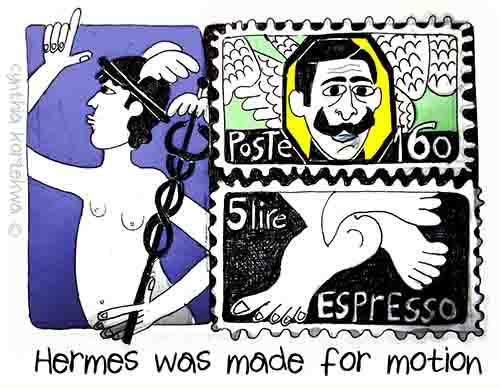
Hermes Was Made for Motion

Paschetto used the wings of Hermes for the Italian express mail stamps he designed.  One shows the King, Vittorio Emanuele III, with wings whereas another stamp depicts the winged foot of Hermes.

Hermes appears frequently in freemasonry art.  Hermes, with his wings, can transcend boundaries and move from the world of mortals to the world of the gods.
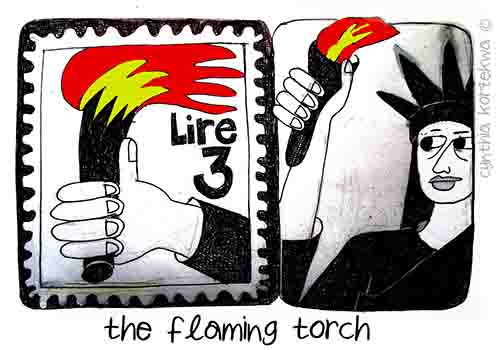
The Flaming Torch

The flaming torch is another masonic symbol used by Paschetto for another stamp design. It was also used by  freemason sculptor, Frederic A. Bartholdi ,(1834-1904) for the Statue of Liberty.

Paschetto was one of the main protagonists of the Liberty Style (Italian art nouveau) thus much influenced by the Belgian, Victor Horta (1861-1947). Horta, a freemason, thus another controversial figure, had much to do with the creation of art nouveau.  The new style, that quickly captivated the bourgeoisie with its meandering lines, was often associated with freemasonry and its liberal politics.

Cappella Calerai, Verano Cemetery

Capella Calderai, Verano Cemetery, Rome

Related:   CHIESA EVANGELICA VALDESEwindowsPaolo Paschetto + Chiesa Metodista di Roma, via XX Settembre + Freemason Information + STATUE OF LIBERTY

.

.
 

Posted in Drawings & Paintings, Rome/Italy | Tagged , , , , , , | 2 Comments

The Unfolding of Mariano Fortuny

What is a pleat other than a fold.  And what is a fold other than the combination of order and flexibility.

Pleats have been around for a long time. They were around in ancient Egypt and continued to be used throughout history. Just think of Mary Stuart’s famous pleated collar, the Scottish kilt, and the Greek fustanella .

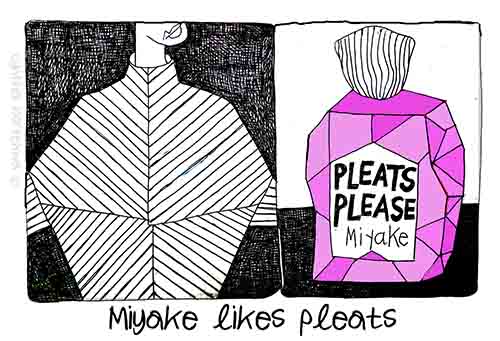
Textiles of the past were coarse and thus more difficult to fold.  Now synthetic fabrics make pleating much easier for contemporary fashion designers.  One such designer is Issey Miyake who loves pleats so much he’s even named a perfume  in their honor.

Miyake Like Pleats

But the most successful pleated dress of all times is that of Mariano Fortuny, the “Delphos” dress.

The son of a well-known Spanish artist, Fortuny was born in Granada in 1871. His family was wealthy enough to permit him to study and travel. At the age of 18, he moved permanently to Venice.

Fortuny and His Palazzo

A painter, a stage designer, a stylist and more, Fortuny was very much a Renaissance man. “Art is my life’s aim” he said. Fortuny, greatly influenced by the Aesthetic movement and by Wagnerism, was not interested in haute couture.  He considered his dresses a form of conceptual art.

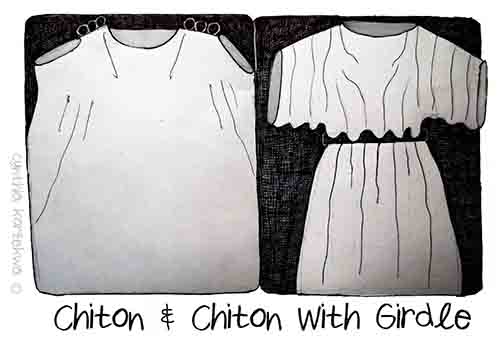
In 1906 he opened his atelier (now the Fortuny Museum) that emphasized fashion. Fortuny liked appropriating ideas especially from the Greeks such as that of the chiton. A chiton is made by piecing together many woven rectangles to form a cylinder with openings for the head and arms. The cylinder was held in place by a girdle (belt) that created a pleated effect.

Chiton & Chiton With Girdle

Fortuny’s famous dress, the Delphos, was based on the chiton worn by the “Charioteer of Delphi”,  a 5th cen. BC Greek bronze found in 1896. Created with the help of his partner and wife, Henriette Nigrin, the Delphos dress, thanks to a machine he invented (and patented), is full of skinny little pleats.

Charioteer of Delphi's Dress

The Delphos dress clung to the body and was well loved by men and women alike.  Actresses such as Isadora Duncan and Sara Bernhardt adored it. Writers, like Marcel Proust, even wrote about it in their novels.

Marcel Proust  saw the dress as magical and included refrences to it in In Search of Lost Time.  The many Fortuny gowns owed by Madame de Guermantes are a source of envy for Albertine, Marcel’s lover, who would like to have one for herself.

Proust & the Delphos Dress

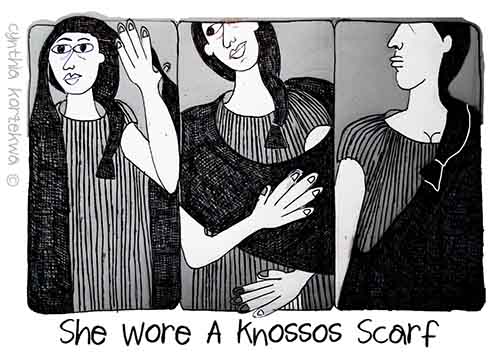
Fortuny’s Knossos scarf was also well received. It  was a large silk veil specially dyed  with dyes of his own invention and often printed with Cycladic geometric motifs.

She Wore A Knossos Scarf

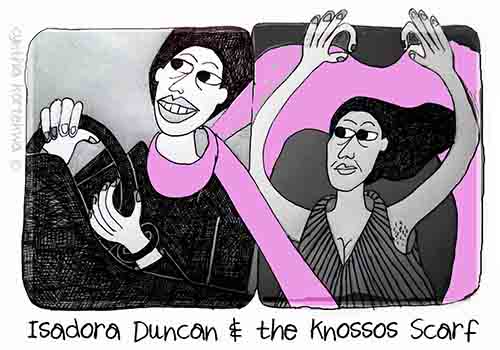
Actress Isadora Duncan not only loved the Delphos dress.  She was also fond of his Knossos scarf.  Who knows if she was wearing one when she had her car accident.

Isadora Duncan & the Knossos Scarf

Fortuny’s dresses often made use of colored glass beads from Murano.    Especially fond of the Medieval style, he liked  velvet  capes and often used stencils to decorate them.

Fortuny Prints for Textiles

Henriette wore Fortuny

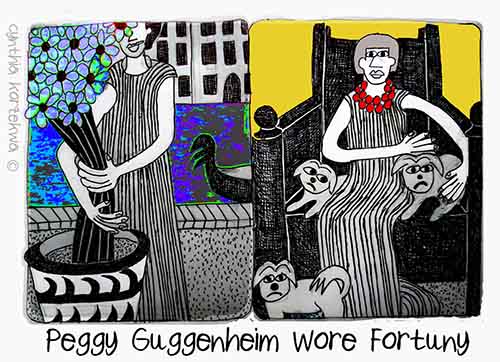
The list of women who wore Fortuny’s dresses is long and impressive.  The first who really helped launch the dress was the Marchessa Luisa Casati. Peggy Guggenheim was  another big  fan of the Delphos dress.

Peggy Guggenheim Wore Fortuny

For about 15 years, Susan Sontag and Annie Leibovitz had an important relationship and ended with Sontag’s death in 2004. Leibovitz photographed the corpse of Sontag wearing a Delphos dress before Sontag was buried at Montparnasse (Paris).

Susan Sontag Wore Fortuny


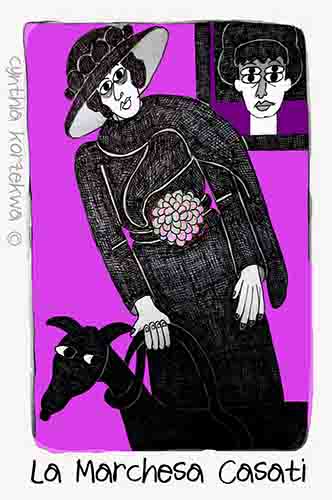
La Marchessa Luisa Casati.

Luisa Casati was 22 and tired of being a good girl wife to Marchese Camillo Casati.  Then, at a fox hunt, she met naughty boy Gabriele D’Annunzio and gave her life a new direction.  At the time D’Annunzio, almost twice Luisa’s age, was Italy’s most notorious poet and novelist.  The two began a relationship that was to last for several decades.

D’Annunzio was short, bald and borderline ugly.  He was attracted to bored and wealthy women because they were easy prey and possible sources of income. A forger of words and of sentiments, D’Annunzio was an expert in giving women wanted they wanted—words of adoration and good sex.  Luisa dazzled D’Annunzio not only because she was rich and wanting, but because she was audacious and wanted to imprint her image on the world around her.

She WantedTo Be A Work of Art

As her relationship with D’Annunzio progressed, so did her physical metamorphosis.  Luisa began tinting her hair and wearing extravagant clothing—she had discovered that an unconventional and eccentric presence turned her into a magnet attracting everyone’s attention and, becoming increasing more narcissistic, that’s exactly what she wanted.

Luisa was now D’Annunzio’s main muse.  She inspired, for example, the character of Isabella Inghirami in Forse che sì, forse che no (maybe yes, maybe no).  The title was taken from  Francesco II Gonzaga’s motto painted on a ceiling at the ducal palace in Mantua. The story is that of violent passion and its consequences.

Exaggeration for Luisa now became a norm.  Hers was the aesthetics of excess—too much was not enough.  At the time there was a fascination with death and the occult so it was trendy to look more dead than alive.  Luisa dyed her hair red, blackened her eyes with kohl, dilated her pupils with belladonna, powdered her face white, and was thin to the bone.

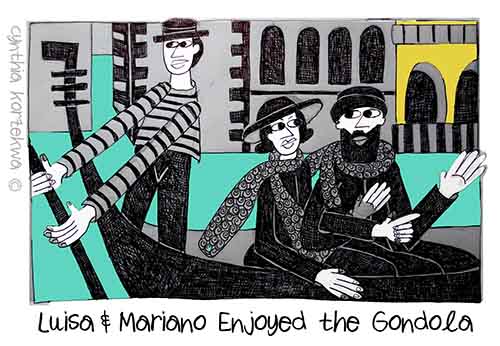
Luisa, bored with Milan, moved to Venice and bought a house on the Grand Canal (Palazzo Venier dei Leoni  now the Peggy Guggenheim Museum).  She animated her life redecorating her house and herself. Fortuny, known for his exotic style, attracted Luisa’s attention.  She especially liked his scarves and cloaks. In Forse che sì, forse che no, D’Annunnzio describes Isabella aka Luisa as being “enveloped in one of those very long scarves of Oriental gauze the alchemist Mariano Fortuny plunges in the mysterious dyes of his vats and withdraws tinted with strange dreams.”  Luisa and Fortuny became friends and often went for gondola rides together.

Luisa & Mariano Enjoyed the Gondola

Luisa said: I want to be a living work of art. And this meant, for her, to live to extremes. More than supporting the arts, she supported artists who made portraits of her—Giovanni Boldini, Kees Van Dongen, Romaine Brooks, Man Ray, Giacomo Balla, etc. She was a muse to the Futurists and inspired fashion designers. Luisa’s parties and appearances were legendary. But exaggeration caught up with her.  Her money squandered on excess, she spent the last years of her life penniless and making collages. La Marchesa Casati is buried in London’s Brompton Cemetery along with her embalmed dog.

She Wanted To Be A Work of Art

.

Mariano Fortuny, Verano Cemetery

Mariano Fortuny’s tomb at Verano Cemetery in Rome (located at Pincetto Nuovo, Riquadro 49).

.

.


Posted in Drawings & Paintings, People, Rome/Italy, Uncategorized | Tagged , , , , , | 2 Comments

Nazim Hikmet, poet with a cause

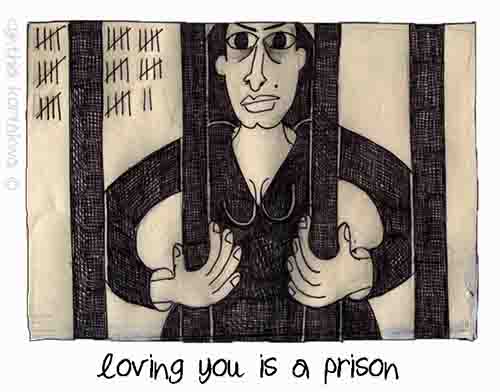
I bought a book of his poetry at the train station in Milano just because of a phrase on the dust jacket: You are my enslavement and my freedom.

Loving You Is A Prison

Nazim Hikmet was the first modern poet from Turkey. Born in the Ottoman Empire,  thanks to his mom, he was exposed to poetry at an early age. Raised in Istanbul, he then  attended university in Moscow, an experience that greatly shaped his political thinking. In 1924 Hikmet returned to Turkey but got arrested for his leftist thinking so he escaped  and went back to Russia. Homesick, he went back to Turkey once again in 1928 only to be arrested again and sentenced to 28 years in prison. Once out of jail, in 1951, he returned to Russia and stayed there until his death in 1963.

Russia not only changed Hikmet politically but artistically as well. He was greatly influenced by the Russian Futurists who promoted linguistic experimentation.

Below is a little Hikmet Sampler:

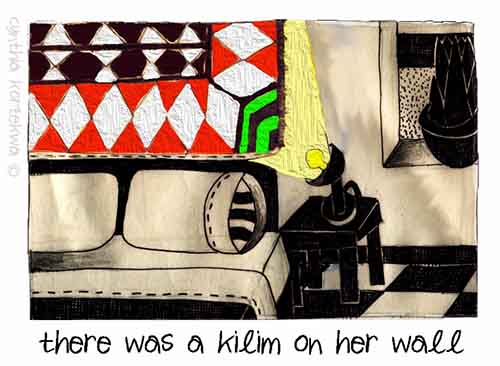
There WasA Kilim On Her Wall

Because of you, each day is a melon slice smelling sweetly of earth…

 Because of you, even my loneliest nights smile like an Anatolian kilim on your wall.

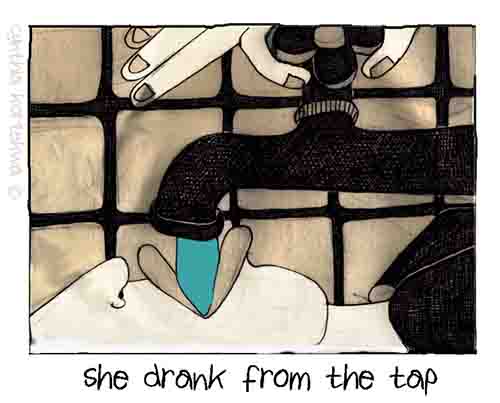
She Drank From The Tap

I love you like waking up at night with high fever 

 and drinking water, with the tap in my mouth.

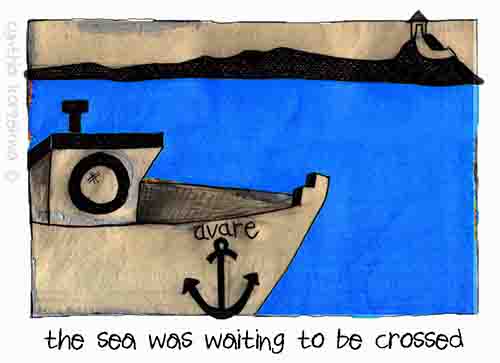
The Sea Was Waiting To Be Crossed

The most beautiful sea hasn’t been crossed yet

 …And the most beautiful words I wanted to tell you I haven’t said yet.

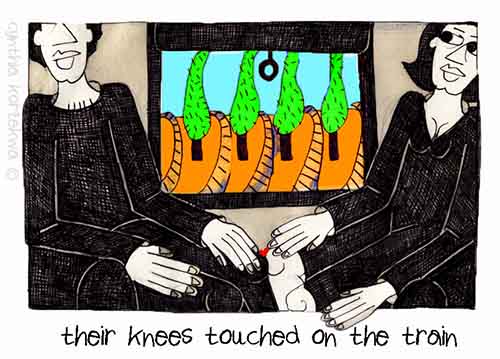
Their Knees Touched On the Train

I didn’t know I loved so many things and I had to wait until sixty

 to find it out sitting by the window on the Prague-Berlin train

 watching the world disappear as if on a journey of no return.

Hikmet’s words have been used as song lyrics. Pete Seeger (of “Where Have All The Flowers Gone”) mated the words of Hikmet’s “I Come And Stand At Every Door” with the Scottish ballad “The Great Silkie” later recorded by The Byrds as well. Hikmet’s poem speaks of a little girl who was killed at Hiroshima thus often used in terms of anti-war protests.

So why don’t we  arm ourselves with poetry instead of guns?

.

.

Posted in Books, Drawings & Paintings, People, politics | Tagged , , , , , | 3 Comments

Vieni, Marcello, vieni!

Federico Fellini was from Rimini but moved to Rome in 1939.  He wanted to be a writer but enrolled in law school to appease his parents.  Of course the war changed everything. Fellini was into making films evolving around politics more than in taking a political stance.  So, for a part of WWII, he and Giulietta Masina (who was to become his wife) hid out in the apartment of Giulietta’s aunt.

After the Allied liberation of Rome, Fellini met Roberto Rossellini (buried at Verano) and got involved with Neo-realism.  Fellini, along with Sergio Amidei (also at Verano), helped write the screenplay for Rossellini’s Rome, Open City.

In 1948, Fellini met Marcello Mastroianni who was acting in a play with Giulietta. And thus began a relationship that would last for the rest of his life.

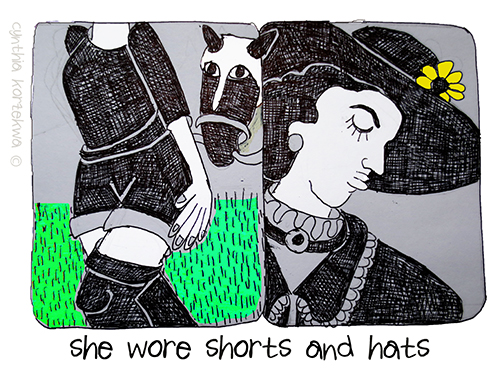
Marcello loved beautiful women.  One of his first loves was Silvana Mangano.  They were from the same neighborhood in Rome.  She was 16 and he was 22. Marcello was already involved in film and introduced Silvana to the movie industry where she had great success and became a sex symbol after the film Riso amaro (Bitter Rice, 1949) because of the shorts and ripped stocking she wore. But Marcello was already somewhat of a playboy and the two broke-up only to make a film together years later, Oci Ciornie (Dark Eyes, 1987), Silvana’s last film. In the film Marcello plays her husband who flirts around with a much younger woman. Typecasting?

She Wore Shorts & Hats

Fellini was greatly inspired by the Wilma Montesi case for the making of La Dolce Vita. Life in Italy went through major changes after WW II. After years of poverty and la miseria, the economy began to prosper.  Fellini was aware of the change and departed from neo-realism. After years of being overdosed on the need to survive, Italians wanted to dream. And, for the cost of a ticket, the movie industry gave them more dreams than they could consume.

Mastroianni was a true lady’s man which made him perfect for the role of Marcello Rubini, the restless reporter in Fellini’s La Dolce Vita.

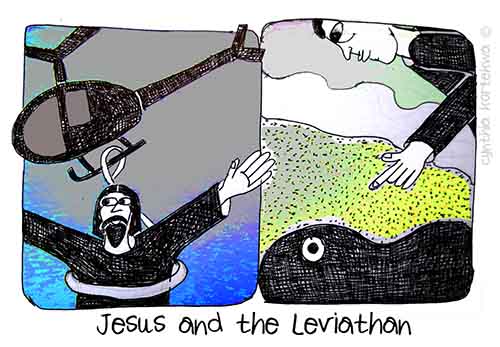
The film opens with the weak-willed but handsome Marcello in a helicopter that’s transporting a statue of Jesus and ends with the discovery of a Leviathan on the beach. Sandwiched in between these two scenes are vignettes representing Rome’s Babylonian lifestyle. The statue of Jesus is a fake whereas the fish monster is real.  But hedonists love the fake and hate the real. And this, basically, is what the film is all about.

Jesus and the Leviathan

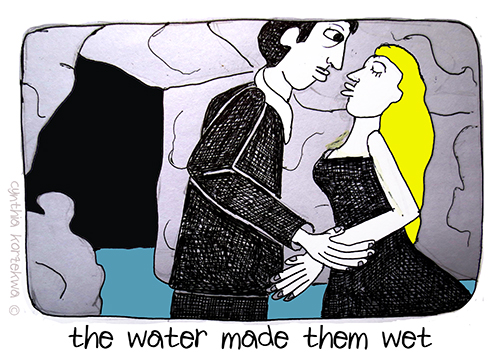
One of the film’s most famous scenes is that of the Trevi fountain where Sylvia (Anita Ekberg) walks into the fountain and, after splashing around for awhile, calls out “vieni Marcello vieni”. Marcello, mesmerized by her beauty, immerses himself in the water, too. Not having formed his own ideals, Marcello feels a romanticism towards those things that are not romantic at all. He is far away from “the sweet life” (dolce vita) he thinks he is living.

Triva: the scene was shot in January.  Ekberg was Swedish and not afraid of the cold.  But Mastroianni was and, to get himself into the water, he insisted on drinking a lot of vodka first and then on wearing a wetsuit under his clothes.

Water Made Them Wet

La Dolce Vita is the story about those who want a glamorous lifestyle without understanding the consequences. Seeing self-gratification as an ideal, they cannot see that glamour is often synonymous with the grotesque and, most of all, that  emptiness produces desperation.

Two curiosites about the film:  (1) much of the film was not shot on location but in the studios of Cinecitta (studio 5) where Via Veneto had been reconstructed.  (2) Nico of the Velvet Underground was invited to La Dolce Vita set where she awed Fellini so he gave her a small part in the film.  Nico, a heroin addict and bohemian searching for her purpose in life, was very much a Dolce Vita person.

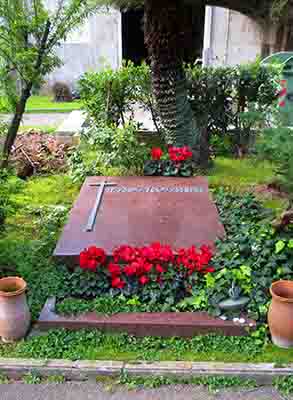
Marcello Mastroianni at Verano

Marcello Mastroianni’s grave

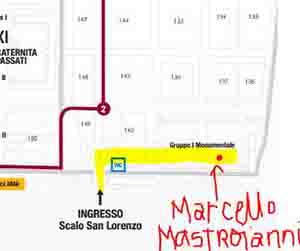
Collocazione: Zona Ampliamento, Gruppo 1, tomba 71

Marcello Mastroianni

map of Verano

Verano Monumental Cemetery series

.

.

Related: Marcello Mastroianni interview on David Letterman  1987 +   My Funny Valentine By Nico + Marianne Faithfull’s Song for Nico +  La Dolce Vita “Fontana di Trevi” clip

Posted in Drawings & Paintings | Tagged , , , , , , , , , | 3 Comments

The Cold Case of Wilma Montesi

It was the day before Easter of 1953 when fishermen found a young woman’s body on the beach of Torvaianica  not far from Rome.  Her face was in the sand and her shoes, stockings, garter belt, and skirt were missing. A day later the woman was identified as 21 year old Wilma Montesi.

There Was A Body on The Beach

Wilma’s story is not only that of a young woman’s tragic death but of the expectations a woman living in Rome in 1953 could have had for herself.

When Wilma was born,  Benito Mussolini was in his 10th year as dictator.  The Fascist regime, like the Catholic Church, saw women as inferior beings who were not entitled to the same rights as men.  Although Mussolini wanted to modernize Italian society, he wanted to keep women at home in the role of mothers and wives.  World War II changed all that and, in 1946, Italian women voted for the first time. But political liberation is one thing and economic liberation another.

Palazzo Braschi, Mussolini's Headquarters

Mussolini, like Hitler, practiced personality cultism to maintain his power. And this meant using mass media as a form of propaganda. Propaganda addresses the masses focusing on those of low intellect and aims to awaken a certain kind of imagination, a dream for something that doesn’t exist. And Mussolini sought to awaken that imagination.  He kept a copy of Gustave Le Bon’s The Crowd: A Study of the Popular Mind on his nightstand.  Le Bon claimed “that an individual immersed for some length of time in a crowd soon finds himself – either in consequence of magnetic influence given out by the crowd or from some other cause of which we are ignorant – in a special state, which much resembles the state of fascination in which the hypnotized individual finds himself in the hands of the hypnotizer.”

Mussolini's Nightstand

“The great majority of a nation is so feminine in its character and outlook that its thought and conduct are ruled by sentiment rather than by sober reasoning. This sentiment, however, is not complex, but simple and consistent. It is not highly differentiated, but has only the negative and positive notions of love and hatred, right and wrong, truth and falsehood.” from Hitler’s Mein Kampf

Despite Mussolini’s WW II defeat, the media still continued to use his techniques.  However, new personalities were needed to idolized and so the focus was now on movie stars and the elite.  News kiosks were covered with photo mags with beautiful young starlets on their covers. Now imagine Wilma who, like most women of the time, was not permitted to aspire for anything other than marriage which meant staying at home cooking, cleaning and caring for others.  But seeing these magazines made her think Why can’t I become a star, too?”  So Wilma, like so many young women of the time, had dreams of becoming part of il mondo dello spettacolo—the world of entertainment.

She Wanted To Be Like Them

So we have Wilma, living at home with her family, engaged to someone who not only lived in another town but someone she doesn’t even like.  Dissatisfied with her prospectives, she looked for a change.  But it was this change that led to her death.

On the afternoon of April 9, 1953, Wilma left her home on via Tagliamento 74 (Rome) and never came back. When she didn’t show up for dinner, her parents got worried. They went to the police and discovered a day later that her body had been found. Immediately, the police said that it was a suicide but her family, worried about their reputation and knowing a suicide meant Wilma couldn’t be buried on church grounds, insisted that further inquiries be made.  So the police then said that her death was accidental—that she’d gone to Ostia to wade in the water but fainted and drowned. Obviously there was much curiosity and speculation about this case but it eventually died down.

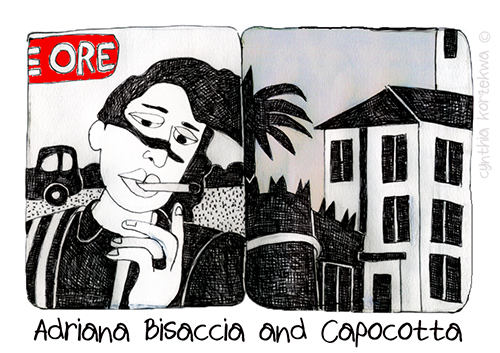
Then several months later, Silvano Muto’s  gossip magazine, L’Attualità, came out with a story entitled La verità sul caso Montesi (The Truth About the Montesi Case). Investigation led him to a young actress name Adriana Concetta Bisaccia who frequented Rome’s “bel mondo”  who said she had, along with Wilma, participated in an orgy at marchese Ugo Montanga’s Capocotta estate located in the area Wilma’s body had been found.  Wild parties were often held there attended mainly by young women hoping to become actresses and men who were rich and powerful experts in making unfulfilled promises.

Adriana Bisaccia & Capocotta

Adriana, nicknamed The Existentialist, is a troubled soul. At a very young age, she got pregnant and went to Rome in search of a solution. Here a blotched abortion lead to an inflammatory disease causing her so much pain that she often thought of killing herself.  To distract herself from the pain, she began hanging out at Il Baretto on via del Babuino where she met many drug users.  She also met people like Piero Piccioni (son of Attilio Piccioni, politician and important member of the dominating Christian Democrat party) who introduced her to the Capocotta group.

At one of these feasts of dissolute notables, Wilma took an excess of drugs and passed out.  Wanting to avoid a scandal, Wilma’s body was taken away and dumped on the Torvaianica beach. The story was further confirmed by another would-be actress, Anna Maria Moneta Caglio know as The Black Swan because of her dark hair and long neck. Anna Maria came from a prominent Milanese family and was the ex-girlfriend of Ugo  Montagna. She later testified that Wilma had died while she was with Piero Piccioni. After Wilma’s death and the related trial, Anna Maria got a role in the film Ragazza di Via Veneto.

Ragazza di Via Veneto

And now Italian politics officially entered into the investigation of Wilma Montesi’s  death. Italy was going through a major transition—from a dictatorship to a democratic republic.   During this time there was much political confusion.  The first elections as a republic had taken place only seven years before. The Americans and Catholic Church had imposed themselves politically resulting in the victory of the Christian Democratic Party full of recycled Fascists. Their main competition had come from the Communists Party full of members of the Italian resistance movement.  So there was the idea that the civil war that existed during the war was in some way continuing.  And the Montesi case provided the anti-Christian Democrats with much ammunition (somewhat like the Clinton-Lewinsky case).

He Was Followed by Paparazzi

The corrupted elite, show biz hungry women, orgies—it was all very exciting. Scandal sells and the tabloids enjoyed an economic boom. Paparazzi multiplied like rabbits and stalked anyone capable of providing them with saleable photographs.

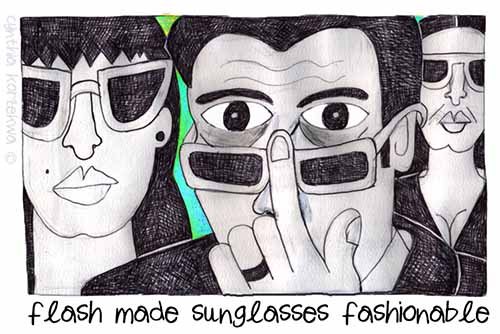
FlashMade Sundglasses Fashionable

Cameras were flashing everywhere.  So to hide themselves or to  protect their eyes, celebrities  began wearing sunglasses.

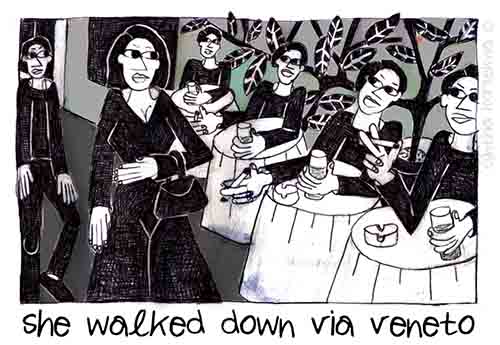
She Walked Down Via Veneto

Via Veneto is pretty yawn provoking today.  But once it was where the elite hung out to let everyone know they were elite and for starlets looking for a means of meeting people in the movie industry or a potential husband. The main activity was that of men sitting and drinking (thus giving birth to the cocktail generation)  as they watched women sashay down the street.

Walking Down Via Veneto

Fellini’s Dolce Vita was, in many ways, inspired by the Montesi Case. The term “paparazzo” was  based on Coriolano Paparazzo, a character in George Gissing’s southern Italy travel narrative entitled By The Ionia Sea. However, the person who inspired the paparazzo prototype was Tazio Secchiaroli, a professional photographer who’d told Fellini about his fights with various celebrities and running around on his scooter looking for a scoop.

Four years after the discovery of Wilma’s body on the beach, Piccioni and Montagna are cleared of having anything to do with her death (Piccioni even become an award winning music composer for movies).  Muti and Anna Maria, instead, are convicted of slander.  And, as for the poor Wilma, her case still remains unresolved.

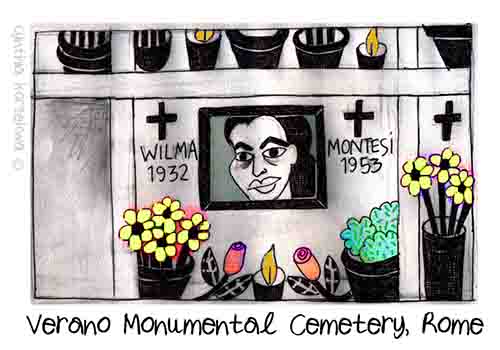
Wilma Montesi at Verano

Wilma Montesi (1932 – 1953) is buried at the Verano Monumental Cemetery (Collocazione:  Scaglione Tiburtina).

Wilma Montesi at Verano

with the new tombstone

wilma montesi

map of Verano

Verano Monumental Cemetery series

.

.

Bibliography: Gundle, Stephen. Death and the Dolce Vita: The Dark Side of Rome in the 1950s. Canongate Books. Edinburgh. 2011.

Related:  In Italia Garcia Marquez fu cronista per il caso Montesi + The scandal that inspired La Dolce Vita + even Georges Simenon interested in Montesi case

Posted in Drawings & Paintings, Rome/Italy | Tagged , , , , , , , , , | 3 Comments