Thinking about India and drapage…

Drapage/draping is one of the most basic techniques in clothing design. Before zippers and sewing machines, draping a piece of cloth around the body was an obvious solution to covering oneself. Think of the toga. And the sari.

Drapage at Epidavros Museum + Draping. Art and Craftsmanship in Fashion Design, the book.

A sari is a long piece of unstitched fabric that Indian women drape over their bodies.  The way these sarees are draped often depends upon the region where they’re worn but the most common way is that of wrapping the sari around the waist with one end and using the other end to drape the shoulder.

There are over 80 ways to drape a sari. Mumbai-based fashion designer, Shaina NC, holds a record in Guinness Book of World Records for draping fastest saree. Her 55 innovative ways of draping saree has brought glory to her fashion designing career, thus earning her the title of “Queen of Drapes”.

Designer Shaina Nc wearing pantsuit version with sari

History of the sari + History of Saree and Types of Saris From Different Regions in India + Indian Clothing.

Mumtaz style drap: This is very innovative drap. here saree is rounded twice around to give a slim effect. It’s hard to walk in this drap. This drap is good for saree with heavy or embroidered borders.

Draping a saree + More.

EastWestLifestyle BLOG.

Revolutionary Rugs at ABC Carpet & Home: Indian women spinning recycled sari silk yarn to make rugs.

Saree blouse designs

Recycled Sari eco handbag + 20 WAYS TO RECYCLE SARIS + 7 Ways to Upcycle Sari Fabric + Recycled sari sundress + Sarees + My Indian Sarees Design Collection.

Posted in Fashion | Tagged , , , | 1 Comment

Not all buttons need holes

My blog has permitted to come in contact with a lot of interesting women dedicated to making things. One such woman is Chiara Trentin of Chimajarno.


Chiara is a young woman who lives near Venice.  Years ago she was given a tin can full of her grandmother’s buttons. Initially she enjoyed playing with them, grouping them together according to size and color. This interest for her grandmother’s buttons led her to various experimentations.  And that’s how she began making button necklaces.

Necklaces have been around for a long time. In South Africa, archeologists discovered a cave with necklaces made from shells that were strung nearly 75,000 years ago!

Chiara’s passion for making button necklaces became so great that she abandoned her office job to dedicate herself full time to her craft.  She successfully participates in many exhibitions and markets.

Here’s a sampling of Chiara’s delightful necklaces:

Power is pink by Chimajarno

button necklacePigmenti d’angelo” per il concorso “Bijoux d’Autore 2012”.

Aggregazione di bottoni” esposta a Riearteco 2010 Biblioteca delle Oblate Firenze

Necklace made from CDs (Chiara uses the same technique to make necklace from bottle caps!)

Check out Chiara’s Facebook page, Chimajarno to see more!

Directly from Chiara (in Italian!):  «Ciao sono Chiara (Chimajarno) e da un po’ di anni i bottoni sono entrati davvero con gioia nella mia vita, un po’ per scherzo, un po’ per necessità di sfogo ho iniziato a unire con dei fili i bottoni che stavano dentro una scatola di latta ereditata da mia nonna. Ora un po’ di tempo è passato da quei primi esperimenti e posso dire che la mia vita è cambiata moltissimo, dalle 8 ore chiusa in ufficio mi ritrovo adesso dentro in esperienze che mai avrei potuto nemmeno sognare, e oggi mi sembra in effetti di vivere ancora in un sogno. La mia passione si è trasformata in un’attività con soddisfazioni enormi ed inimmaginabili. Da qualche anno partecipo a tanti eventi, i quali mi regalano molto spesso grandi emozioni. Gli incontri con le persone, sia il pubblico sia gli altri artisti che gli organizzatori, sono uno degli aspetti più piacevoli, ho provato sensazioni che mai avevo incontrato nella mia vita “normale” di prima e sinceramente tutte queste belle positività mi danno una bella forza in questo mio percorso. Quando ad un certo punto della mia vita mi sono ritrovata praticamente ad un bivio a dover affrontare scelte non proprio facili e sicuramente decisive per me (ritornare o non ritornare in ufficio? il mio era solo un hobby o no?) molto ha influito in me la voglia di crederci a pieno in ciò che avevo intrapreso, testardaggine e gran impegno hanno poi fatto il resto. Quando ho iniziato ad aggregare i miei bottoni ho scoperto qualcosa che può capire solo chi usa le mani, testa e cuore. Consiglio sempre di crederci veramente in ciò che si sta facendo e si vuole fare, il vedere le cose in positivo (ed essere positivi) aiuta davvero tantissimo …e i risultati un po’ alla volta arriveranno».

Related links:  Prehistoric Jewelry Dates Back 82,000 Years + Vintage button jewelry on pINTEREST + MORE BUTTON JEWELRY HERE + Button Necklaces + Retro Button Necklace Tutorial + Vintage Jewel Full Collar Button necklace + Bread Dough Rose and Vintage Look ButtonNecklace + Bird cage and button necklaces.

Lori Anderson’s button necklace

Posted in People | Tagged , , , , | 3 Comments

Feminists and Huipiles

HAPPY BIRTHDAY MOMMA!

hupil "feminist"

This is a hupil I made from an old pair of sweat pants and lace remnants given to me, in part, by my mom. The red stitching running across the front diagonally reads “feminist“.

Not long ago, while discussing animatedly,  a male friend of mine  called me a feminist as if being a feminist was something bad. Initially, I reacted defensively but then thought “Who is this dude to talk to me about feminists”? A feminist is simply a woman who tries to protect her rights and the rights of other women. So why do so many men have a problem with this?

We live in a world excessively masculinized and, for the past 5,000 years, women have been treated as inferiors. It was not always this way. Once, when life was considered sacred, women were revered for their major contribution to the life cycle.

Once upon a time, the many cultures of this world were all part of the gynocratic age. Paternity had not yet been discovered, and it was thought … that women bore fruit like trees—when they were ripe. Childbirth was mysterious. It was vital. And it was envied. Women were worshipped because of it, were considered superior because of it…. Men were on the periphery—an interchangeable body of workers for, and worshippers of, the female center, the principle of life.

The discovery of paternity, of sexual cause and childbirth effect, was as cataclysmic for society as, say, the discovery of fire or the shattering of the atom. Gradually, the idea of male ownership of children took hold….

Gynocracy also suffered from the periodic invasions of nomadic tribes…. The conflict between the hunters and the growers was really the conflict between male-dominated and female-dominated cultures.

… women gradually lost their freedom, mystery, and superior position. For five thousand years or more, the gynocratic age had flowered in peace and productivity. Slowly, in varying stages and in different parts of the world, the social order was painfully reversed. Women became the underclass, marked by their visible differences.

from Gloria Steinem’s “Wonder Woman

The concept of democracy has been around for c 2,500 years but women have been voting only for the past 100. This means that for 2,400 years society has evolved dominated by male and not female values.  And we see where that has taken us!

HUIPILES:

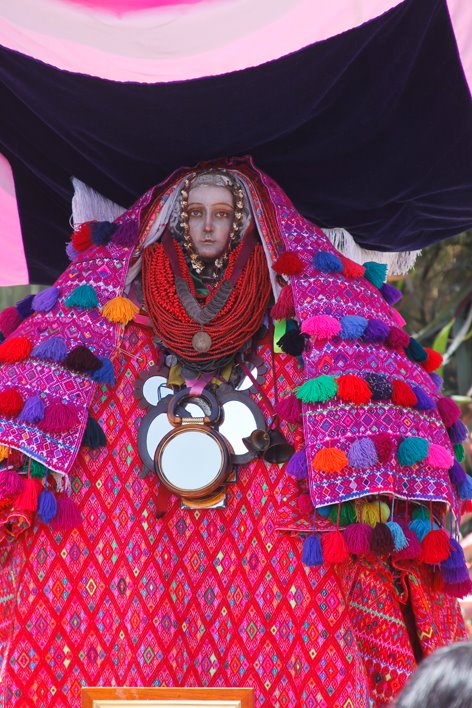
Huipiles and Mayans

Huipil and Snakes Chalk Drawing + Huipil from Patzun, Guatemala + Huipil skEtch + Details of “huipil” + Interesting huipiles + And more huipiles.

Sig Wynne-Evans‘ huipil design

huipilMaya Heritage: The Textiles Around Lake Atitlan

Tejuana huipil via maison celeste

The Dancing Chicken, huipil collar

Huipil style shoesColours to boot + Chinantec Huipil Oaxaca + Huipil inspiredrug + Mexican huipil, paper huipiles made by children + Take me with you: Huipil Weekenders.

Inside out hupil coin purse by Grain Design found here

If you are in Rome, please check out by Muy Marcottage dresses, ponchos and huipiles at Mercatino Monti next Sunday, November 18.

Posted in Ecofeminism | Tagged , , , , , , , | 1 Comment

Orange wrappers and cardboard purses

Sometimes going to the market is like going to an art supply store. There’s a produce market near our house where I usually do my grocery shopping. I buy fruit and vegetables from Clara. She often gives me seeds from pumpkins, roots from chickory, sprouts from ginger, etc.  She also saves orange wrappers for me when  I need them.

  This is a purse I made using only refuse materials found at the Trieste Market – cardboard, netting, plastic bags, bottle cap and orange wrappers.


The Muy Marcottage “Produce Purse” will be available at another Roman market, that of Mercato Monti, Sunday November 18. So, if you’re in town, why not stop by: «MERCATO MONTI Best Market In Town offers the latest collections by young designers, independent productions and creative handcraft, with an incredible selection of vintage clothing, accessories, modern art, collectibles, books and illustrations».

Orange wrapper related links: orange wrappers {sicily} + Art for Art’s Sake: Orange Wrapper Collector + I bought a scrapbook filled with orange wrappers from the 50’s and spent all morning soaking them off the pages + Reading that in the catalogue to the Francesco Clemente exhibition at the Royal Academy in 1992 got me looking at orange wrappers + ORANGE WRAPPERS + File di Maryse Papiers d’orange.


wrapper’s delight

«The first shipment of oranges arrived in the UK in the late 13th Century. Wrappers were initially just functional and protected the oranges in transit. Later, in Victorian times, when oranges were popular Christmas presents, the artwork on the wrapper became more decorative. I started my collection of these ephemeral objects 8 years ago. In 2010 Hyperkit held an exhibition displaying the wrappers at the Taschen gallery in London. I have displayed a small selection of my collection on this site for everyone else to enjoy».

Papier d’orange II + Papier d’orange Tintin + Lampe Papiers d’orange + Papiers d’orange, Luc Thiébaut + La carta agrumi.

Posted in Muy Marcottage | Tagged , , , , | Leave a comment

Tea Towels

My mom gave me some of her old “vintage” tea towel calendars. I used some of them to make huipiles. Here’s Chiara modeling a tea towel huipil (unfortunately  she put it on backwards! Oh well).

Soft Toy Dog called Shane made from a vintage tea towel

monkey and mum tea towel bracelets

more recycled tea towels, Upcycle: Tea Towels—inspired tea towel tote—another tea towel tote——west and plum—–

tea towel pouch

above site is a MUST SEE!  Using vintage linen tea towels, with prints depicting scenes from places visited, from native animals to flowers, I bring together vibrant memories of travels in an upholstery collage. The decorative nature of the upholstered fabric covers yet accentuate the practical form of the chair, and the vibrant 50’s and 60’s colour pallet and 100% Irish Linen base make them uniquely appealing.

tea towel stools….unfortunatley I can’t find the original post to see whose idea belongs to…..see too How-To Make No-Sew Kitchen Stool Covers—

Dolphin tea towel landscape by Jo Grant

  Vintage Tea towel cushions

tea towel skirt, Made from vintage and souvenier linen tea towels patchwoked together to create a unique and one off piece of waerable art. (Size 12)

Lori Marsha’s tea towel apron skirts—-another vintage apron skirt—-

Tea Towel Toy Bag—tea towel dresses for kids—–“Dozens of Ways to Repurpose a Tea Towel” book—-How-To Make No-Sew Kitchen Stool Covers—-

Posted in Crafts | Tagged , , , | 5 Comments